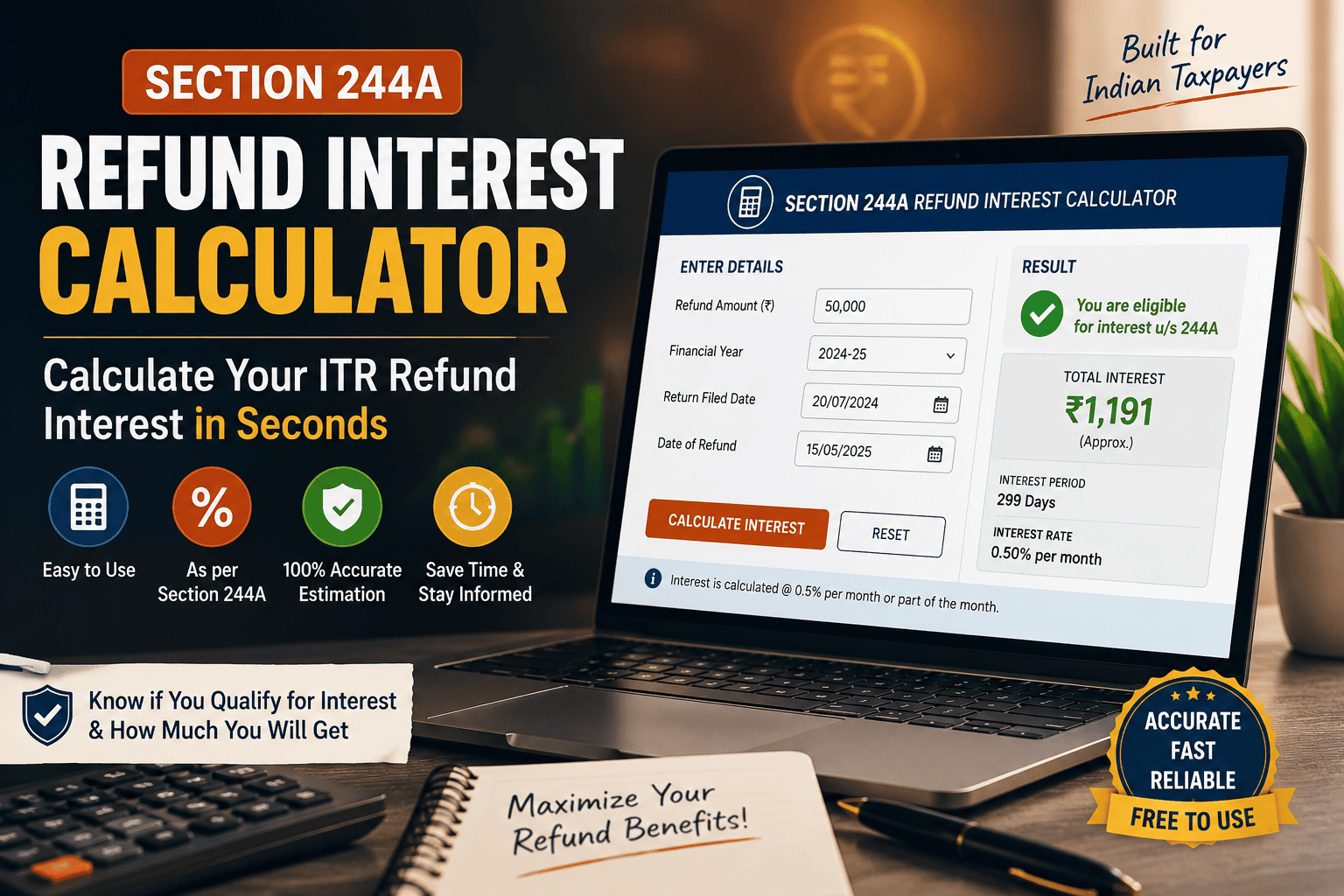
How to Use This Calculator
1
Pick your filing typeSelect "on-time" if you filed on or before 31 July 2026, or "belated" if you filed after.
2
Enter the filing date (belated returns only)This field appears automatically only when "belated" is selected.
3
Enter your refund amountUse the exact figure from your ITR's computation sheet or the portal's "Refund Determined" line.
4
Enter your total tax payableFound in your Form 16 / computation sheet — this triggers the 10% eligibility check.
5
Enter the refund credit dateIf it hasn't arrived yet, leave today's date to see interest accrued so far.
6
Click CalculateThe full breakdown appears instantly below the button.
If your income tax refund took longer than expected, you may be owed more than just the principal amount. The department is legally required to compensate you for its own delay — yet few taxpayers ever check whether that compensation was paid correctly. This calculator and guide help you verify both: whether your refund qualifies for interest, and roughly how much it should be.
Complete Guide: What Is Section 244A
Section 244A of the Income Tax Act, 1961 entitles a taxpayer to simple interest on a delayed refund, at 0.5% per month (6% per annum), whenever the delay is caused by the department rather than the taxpayer. This applies regardless of whether the excess tax was paid through TDS, TCS, advance tax, or self-assessment tax.
For returns filed on or before the due date, the interest clock starts on 1 April of the relevant assessment year and runs until the date the refund is actually credited. For belated returns, the clock starts only from the date of filing. If any part of the delay is genuinely attributable to the taxpayer — an incorrect bank account, an unanswered notice, or incomplete disclosures — that portion of the period is excluded from the calculation, and only the department-caused period earns interest.
The calculation itself is simple once eligibility is confirmed, but eligibility is where most people go wrong. Two conditions must both be met before any interest is payable:
Refund ≥ 10% of Total Tax Payable AND Interest ≥ ₹100
If either condition fails, interest is treated as zero — regardless of how many months the refund was delayed.
If both conditions pass, the interest itself is calculated as:
Interest = Refund Amount × 0.5% × Number of Delay Months
Worked Examples
Example 1 — Interest Applies. Refund of ₹24,000, total tax payable ₹1,80,000, filed on time, credited five months after 1 April 2026. Since ₹24,000 is above 10% of ₹1,80,000 (₹18,000), the refund is eligible. Interest = ₹24,000 × 0.5% × 5 = ₹600. Total credited: ₹24,600.
Example 2 — No Interest. Refund of ₹8,000, total tax payable ₹1,50,000, delayed by four months. Since ₹8,000 falls below 10% of ₹1,50,000 (₹15,000), the eligibility check fails and no interest is payable — regardless of the delay length.
Benefits of Checking Your Refund Interest
- Catches under-paid interest. CPC's automated figure can carry the same TDS-mismatch errors that caused the delay.
- Sets realistic expectations. Avoids confusion when an intimation shows ₹0 interest on a genuinely delayed refund.
- Supports a grievance. A documented expected amount strengthens any complaint over a missing credit.
- Helps next year's return. Interest received is taxable — knowing the figure early makes filing smoother.
Common Mistakes to Avoid
- Assuming every delay earns interest. The 10% threshold rule disqualifies many smaller refunds.
- Using the wrong start date. On-time filers count from 1 April of the assessment year, not the filing date.
- Forgetting the ₹100 minimum. Short delays on small refunds often round down to zero interest.
- Not declaring interest received. It's taxable and must be reported the following year.
Conclusion
Section 244A ensures a delayed refund doesn't cost you extra — but the eligibility rules mean interest isn't automatic for every case. Running your numbers through this calculator takes under a minute and gives you a figure to compare against whatever CPC actually credits.
FAQs
Is interest paid on every delayed refund?
No. Interest applies only if the refund is at least 10% of your total tax payable for the year, and the calculated interest works out to at least ₹100.
Is the refund interest taxable?
Yes. The interest component is taxable as "Income from Other Sources" at your applicable slab rate in the year it's received, while the refund principal itself is not taxable.
Do I need to apply separately to receive this interest?
No. CPC calculates and credits Section 244A interest automatically along with the refund, shown as a separate line item in your Section 143(1) intimation.
What if the delay was my own fault?
Any period of delay attributable to the taxpayer — such as an incorrect bank account or an unanswered notice — is excluded from the interest calculation for that portion of time.
Good to Know
No interest is paid if the refund is below 10% of your total tax payable, or if the calculated interest works out to under ₹100 — CPC rounds these down to zero.
Disclaimer: This calculator gives an educational estimate only and is not a substitute for the official Section 143(1) intimation issued by CPC. For the full explanation of Section 244A and how ITR refund status works, see our
complete ITR Refund Status guide.



 ITR Refund Status Kaise Check Kare 2026: The Complete Step-by-Step Guide
 ITR-4 Investment Disclosure Calculator: New 2026 Rule for Presumptive Taxpayers
 8th Pay Commission Salary Calculator: Complete 2026 Guide
 Share Buyback Tender vs Sell Calculator: 2026 Tax Guide
 F&O STT Hike Breakeven Calculator: 2026 New Rates
 SGB Premature Redemption Calculator 2026: Tax Rules, RBI Dates & Exit Guide
 Mutual Fund BER vs TER Calculator (2026): Compare BER vs TER Online
 The Ultimate Budgeting Guide That Works in 2026