
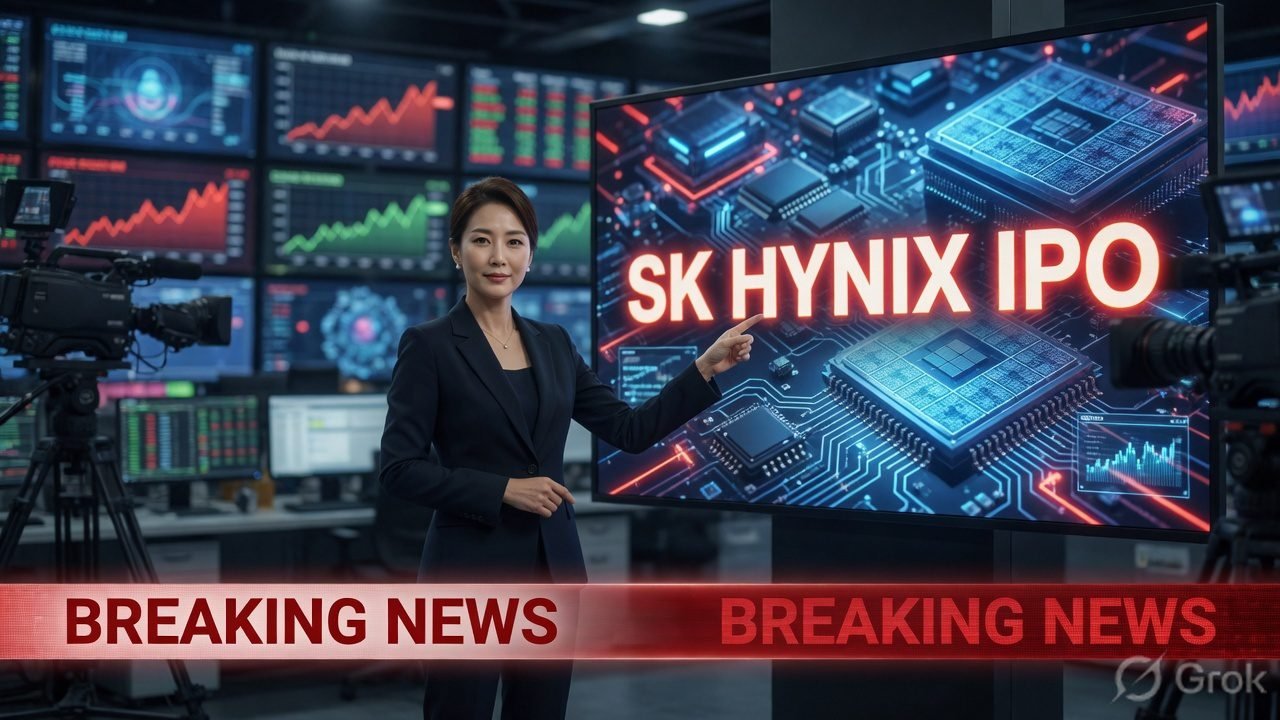

SK Hynix IPO: Inside the Biggest Foreign Listing in Wall Street History
A South Korean memory chipmaker just pulled off the second-largest ADR offering ever recorded — trailing only SpaceX — and became the most direct way for US investors to bet on the chip feeding every major AI accelerator on Earth.
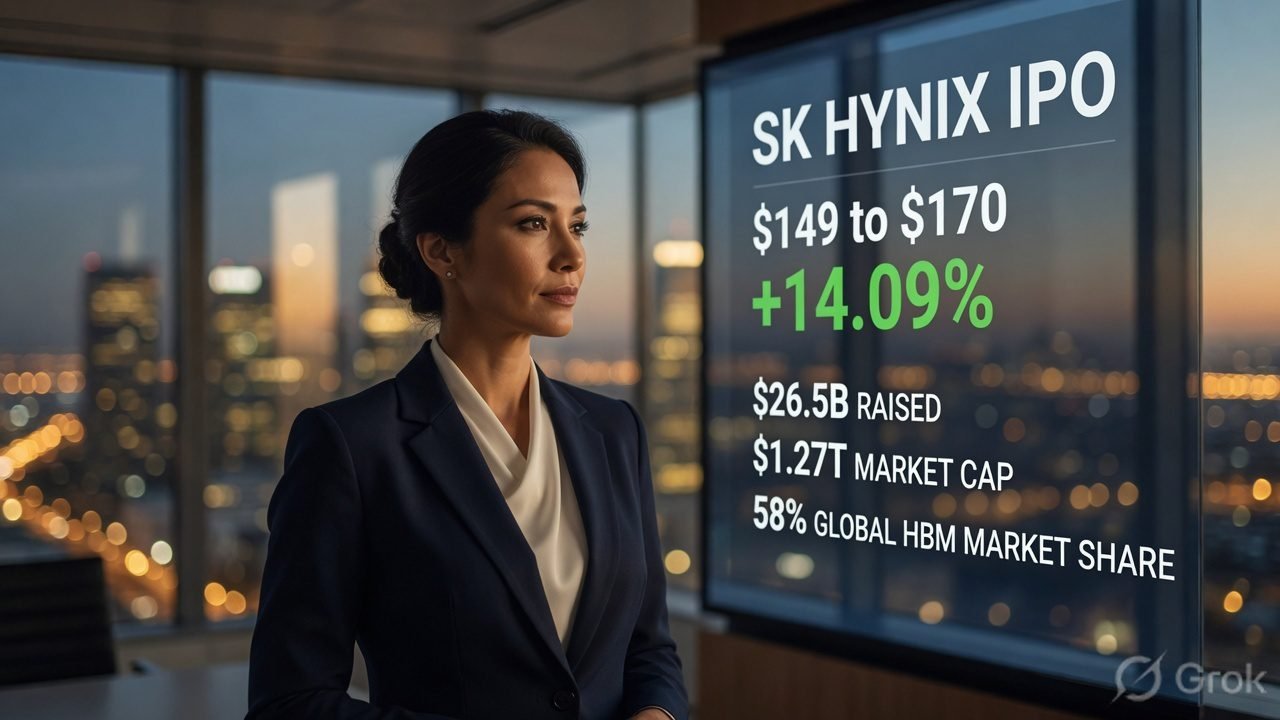
On Friday, July 10, 2026, a company most American retail investors had never been able to buy directly opened for trading on the Nasdaq at $170 a share — a 14% jump over its $149 offer price. By the closing bell, SK Hynix carried a market capitalization of $1.27 trillion, and Wall Street had a new, direct way to own the single most important supplier in the entire AI hardware stack.
The Debut, In Five Charts
Swipe / scroll →The 14% Pop
IPO priced at $149; opened at $170 — one of the strongest large-cap debuts of the year.
Who Makes AI's Memory
■ SK Hynix 58% ■ Samsung 21% ■ Micron 21%
Extraordinary Margins
$34.9B quarterly revenue at margins most software companies would envy.
First, Every Time
SK Hynix reached mass production on every HBM generation before rivals Samsung and Micron.
The "Korea Discount"
More HBM share, more revenue, more profit than Micron — yet a cheaper forward multiple.
1. The SK Hynix IPO: What Happened and Why Wall Street Cares
The SK Hynix IPO marks South Korea's second most valuable company finally becoming directly accessible to US investors. SK Hynix is the world's dominant maker of high-bandwidth memory, the specialized chip that sits directly beside every Nvidia GPU powering the current AI buildout. Until Friday, owning it meant navigating a Seoul-listed stock most US brokerages made difficult to access.
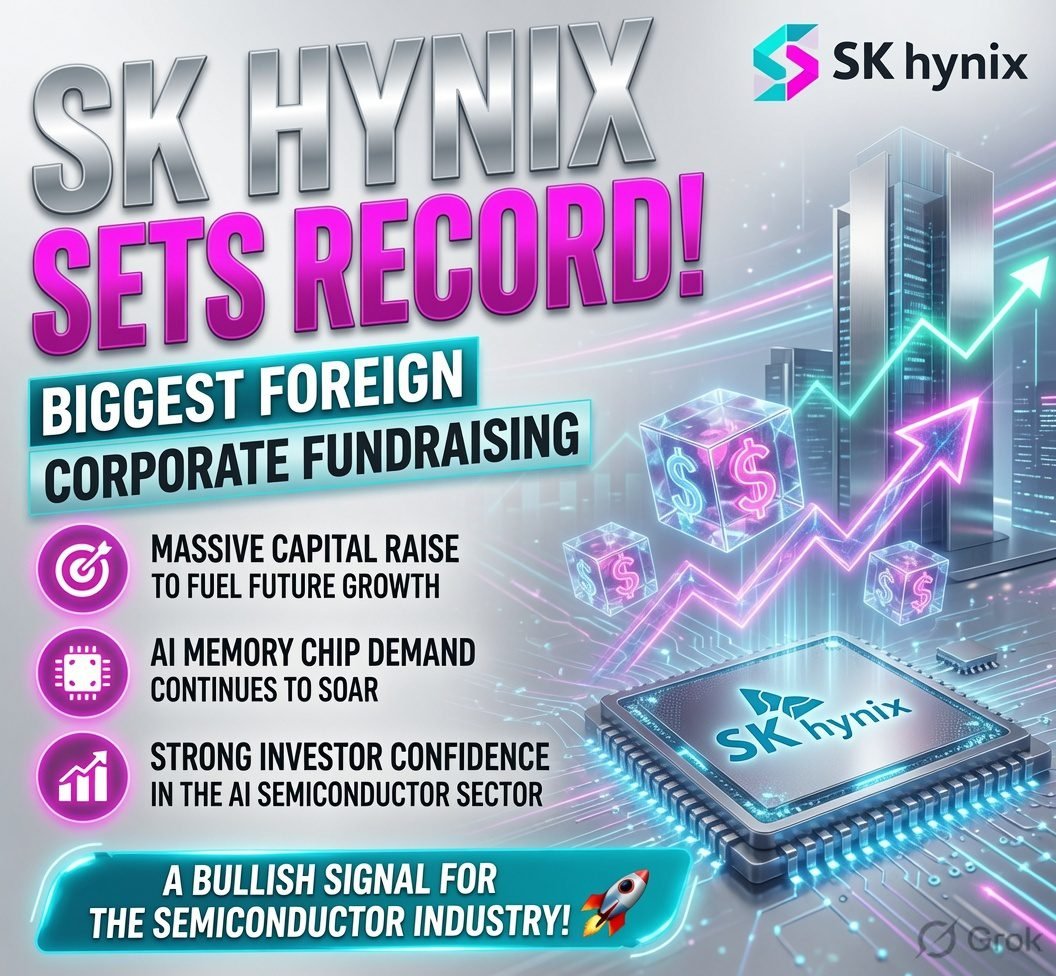
That access gap is now closed. SK Hynix's American Depositary Receipts opened trading Friday under the ticker SKHYV, before converting to the permanent ticker SKHY the following week, according to Yahoo Finance's coverage of the offering. Chairman Chey Tae-won rang in the listing alongside CEO Kwak Noh-jung, marking what Bloomberg data confirms as a raise that tops even Alibaba's US IPO. The SK Hynix IPO's $26.5 billion size ranks it second only to SpaceX among all-time ADR offerings.
2. The HBM Story: Why Memory Chips Became AI's Bottleneck
Every Nvidia GPU running today's AI data centers depends on high-bandwidth memory, and there is no viable substitute at scale. Only three companies on the planet manufacture it: SK Hynix, Samsung, and Micron.
What makes HBM different
Standard memory sits at a distance from a processor, connected by a signal path that limits speed. HBM instead sits directly beside the GPU on a shared silicon interposer, eliminating that bottleneck entirely. The current generation, HBM4, uses a 2,048-bit interface — 32 times wider than a standard DDR5 module — delivering roughly 2 terabytes per second per stack. Nvidia's next-generation Rubin GPU carries eight of these stacks, for close to 22 terabytes per second of aggregate memory bandwidth, nearly triple the prior Blackwell generation.
SK Hynix reached HBM4 mass production in February 2026, ahead of both rivals, extending a pattern: it was first to mass-produce HBM3 and first with HBM3E as well, according to TechTimes' technical breakdown of the HBM roadmap. For Nvidia's Rubin platform specifically, analysts project SK Hynix will supply roughly 60–70% of HBM4 volume, a share even higher than its overall market position, per 24/7 Wall St.'s analysis of the SK Hynix IPO's competitive positioning.
4. Why List in the US At All
The proceeds answer this cleanly: all $26.5 billion raised is committed entirely to manufacturing capacity, specifically construction of SK Hynix's Yongin fab in South Korea and a new US packaging facility. This isn't a liquidity event for existing shareholders; it's a direct capital raise to build more of the chips the market is desperate for.
There's also a valuation argument. Despite generating more revenue and net income annually than Micron, and holding nearly 2.5 times Micron's HBM market share, SK Hynix traded at a lower forward earnings multiple on its Korean listing, a gap analysts have dubbed the "Korea Discount," detailed further in Investing.com's IPO valuation guide. That discount existed largely because most US investors simply couldn't access the Seoul-listed shares without friction. The SK Hynix IPO on the Nasdaq removes that friction directly.
3. Inside the Numbers
The scale here is genuinely difficult to overstate. SK Hynix's first-quarter 2026 revenue came in at $34.9 billion, with a 72% operating margin and a 77% net margin — figures more commonly associated with software companies than semiconductor manufacturers.
Annualized, 2026 net income is tracking toward Fortune's estimate of roughly $144 billion. Against a $1.3 trillion total market cap at debut, that implies a valuation multiple that looks inexpensive relative to the company's own growth trajectory, even before considering its dominant market position. A full breakdown of these figures is available in IndMoney's SK Hynix IPO analysis.
| Metric | SK Hynix | Context |
|---|---|---|
| IPO Price | $149 | Second-largest ADR offering ever, behind SpaceX |
| Day-One Open | $170 | +14.09% pop |
| Market Cap at Debut | $1.27 trillion | South Korea's #2 most valuable company |
| Q1 2026 Revenue | $34.9 billion | 72% operating margin |
| Global HBM Share | ~58% | Samsung and Micron split the rest, ~21% each |
5. The Risk Nobody's Pricing In
Memory is a famously cyclical business, and SK Hynix's own history includes periods of oversupply and collapsing prices. The current shortage, and the record pricing power it gives suppliers, isn't guaranteed to last indefinitely.
Morningstar analyst Jing Jie Yu has flagged, in commentary reported by TradingKey, that large-scale supply is expected to recover gradually through 2027 and 2028, which "should improve significantly" the supply-demand balance in the memory market, potentially weakening pricing power and triggering a cyclical downturn for the sector.
For a company whose entire investment case currently rests on a supply shortage that "won't clear before late 2027" according to memory market analysts, that's a meaningful multi-year risk window worth watching rather than a footnote.
6. SK Hynix vs Micron vs Samsung
SK Hynix's roughly 6.2x forward price-to-earnings multiple compares to Micron's approximately 7x, despite SK Hynix generating more total revenue and net income annually with nearly 2.5 times the HBM market share. If that multiple simply closes toward parity with Micron's, that alone implies roughly 13% upside from the IPO price before accounting for any further fundamental improvement, independent of where memory prices go next.
Micron, for its part, isn't standing still. The company has committed to investing more than $250 billion in US manufacturing capacity through 2035, according to Reuters reporting, a direct response to the same AI-driven memory demand SK Hynix is capitalizing on.
7. What This Means for US Investors
For years, gaining direct exposure to the company supplying the memory inside virtually every advanced Nvidia GPU meant either navigating Seoul-listed shares directly or accepting indirect exposure through Nvidia or Micron alone. That access gap has now closed entirely through a standard Nasdaq-listed ADR.
The AI infrastructure trade itself is visibly broadening beyond chips into memory, storage, servers, and racks. Meta's stock climbed 22% in ten trading days around its own custom AI chip announcement and a computing capacity target of 14 gigawatts by 2027, a reminder that this capital cycle is running across multiple layers of the AI stack simultaneously, not just the GPU itself.
Not a US-only story
Global capital flows tend to move together during moments like this. Readers following broader macro and commodity trends this year can also see our coverage of Bitcoin's 2026 drawdown and gold's record run for how capital has rotated across asset classes in parallel with this AI infrastructure buildout.
8. FAQs
What is SK Hynix's ticker symbol on the Nasdaq?
SK Hynix trades under SKHYV on its first trading day, converting to the permanent ticker SKHY the following week.
How much did SK Hynix raise in its US IPO?
SK Hynix raised approximately $26.5 billion, making it the second-largest ADR offering in history, trailing only SpaceX's recent Nasdaq debut, and topping Alibaba's US IPO.
What is HBM and why does it matter for AI?
High-bandwidth memory (HBM) is specialized memory that sits directly beside a GPU, dramatically increasing data transfer speed compared to standard memory. Every major AI accelerator, including Nvidia's chips, depends on it, and only three companies manufacture it at scale: SK Hynix, Samsung, and Micron.
Is SK Hynix stock a good investment?
This depends on individual risk tolerance and outlook on the memory cycle. SK Hynix trades at a valuation discount to Micron despite stronger market share and margins, but the sector carries genuine cyclical risk as new supply is expected by 2027–2028. This is not investment advice; consult a licensed financial advisor before making investment decisions.
- CNBC — Live market coverage and SK Hynix debut analysis, July 10, 2026
- Yahoo Finance — SK Hynix ADR pricing and offering details
- TradingKey — SK Hynix market capitalization and debut pricing data
- 24/7 Wall St. — HBM market share and competitive analysis
- IndMoney — SK Hynix vs Micron valuation and "Korea Discount" analysis
- Investing.com — SK Hynix IPO valuation overview

Pranab Barman is a Financial Educator and Personal Finance Researcher with over 10 years of hands-on experience in stock markets, trading, and investing. Currently enrolled in the CFA Program, he is committed to continuous learning and professional excellence in finance.
As the Founder of PlayWithStock, Pranab covers a wide range of topics including Mutual Funds, SIP, Taxation, Stock Market Basics, and Financial Calculators — with a focus on simplifying complex financial concepts for everyday all investors.
Email: support@playwithstock.com
Website: playwithstock.com
Related posts:
 Jio IPO 2026: 10 Crucial Facts Every Investor Must Know
 SBI Mutual Fund IPO 2026: Dates, Price Band, GMP & Should You Apply
 SBI Mutual Fund IPO Opens Tomorrow: Everything Before You Apply
 Beginner Investing: 7 Proven Steps to Start the Right Way
 What is a Demat Account? A Complete Beginner’s Guide
 What is a Stock Split and Why Do Companies Do It
 Jio Financial Services Q1 FY27 Results Preview: Date, Estimates & Stock Analysis
 Micro-Investing Apps for Beginners: A Complete Comparison