
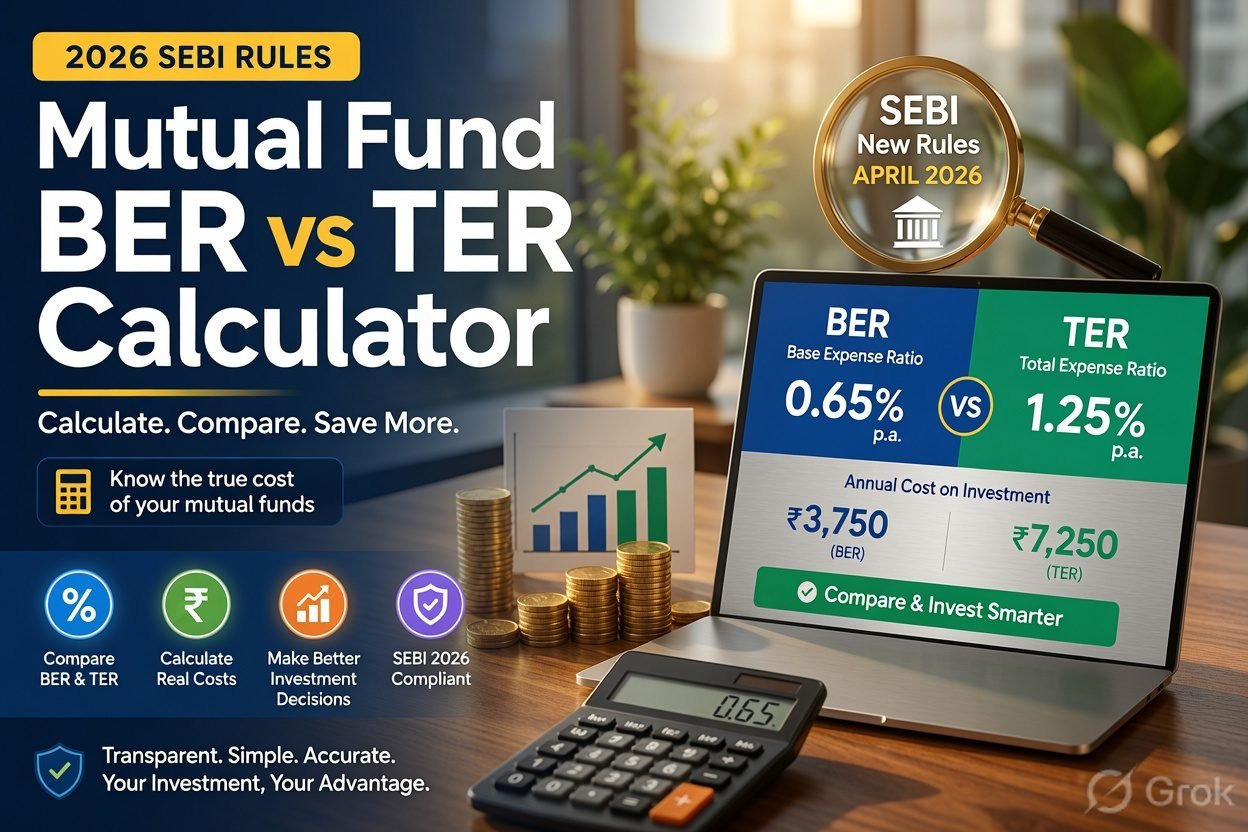

Mutual Fund BER vs TER Calculator: 2026's True Cost Rule
SEBI just split your fund's one expense number into three. Here's what you're actually paying — and a calculator to work out the rupee difference.
Ask most mutual fund investors what they pay in charges and you'll get one number: the Total Expense Ratio, usually somewhere between 0.3% and 2%. From 1 April 2026, that single figure stopped telling the whole story on its own. A mutual fund BER vs TER calculator is suddenly a genuinely useful thing to have, because SEBI has taken that one bundled number and split it into three separately disclosed pieces — and understanding which piece is which is now the difference between comparing funds properly and comparing them by accident.
This isn't a cosmetic relabeling exercise, even though several early explainers treated it that way. SEBI also cut the actual caps on what funds can charge, tightened brokerage limits meaningfully, and closed a specific loophole where taxes quietly inflated the number investors thought was pure management fee. This guide walks through exactly what changed, what the new category-wise limits are, and gives you a calculator to see the real rupee impact on your own SIP or lump sum.
Table of Contents
- 1. What Actually Changed: TER Unbundled
- 2. Why SEBI Did This
- 3. The New Caps, Category by Category
- 4. Mutual Fund True Cost Calculator
- 5. What This Means for SIP Investors
- 6. The Other Changes Bundled Into the Same Rulebook
- 7. What You Should Actually Do
- 8. Three Misconceptions Worth Clearing Up
- FAQs
1. What Actually Changed: TER Unbundled
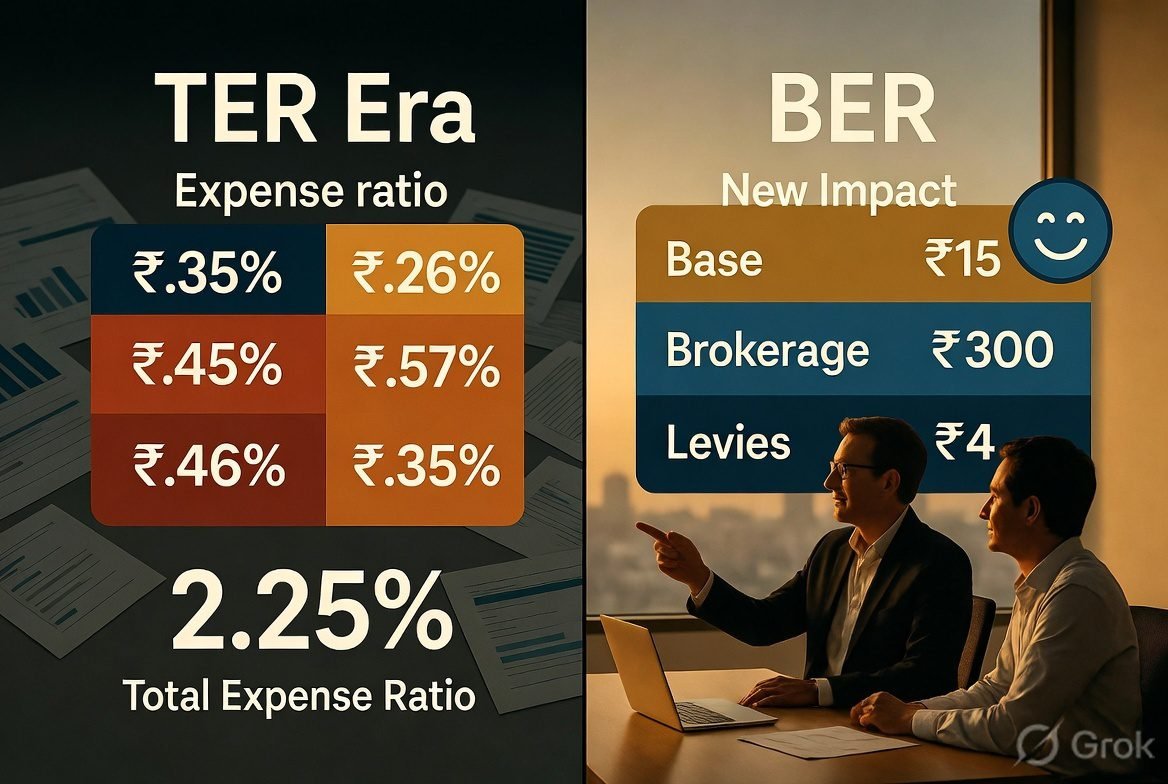
Under the old framework — the SEBI (Mutual Funds) Regulations, 1996 — the Total Expense Ratio was one all-inclusive cap. It bundled the AMC's management fee, brokerage paid on buying and selling stocks, and statutory charges like GST, Securities Transaction Tax (STT), and stamp duty into a single capped percentage. If a fund traded more, or if GST rates changed, that cost simply ate into the same number investors were told represented "fund management."
The SEBI (Mutual Funds) Regulations, 2026 — approved by the SEBI Board on 17 December 2025, notified on 14 January 2026, and effective 1 April 2026 — replace that entire 1996 framework and introduce a new formula:
The Base Expense Ratio is now defined narrowly: it's only the investment and advisory fee the AMC charges, plus the scheme's recurring operational expenses — and it explicitly excludes GST, other statutory levies, and transaction/execution costs. Brokerage and transaction costs are shown as a separate line, capped independently. Statutory and regulatory levies — GST, STT, CTT, stamp duty, SEBI and exchange fees — are now charged "on actuals," meaning the exact amount incurred, disclosed on top of the BER rather than absorbed inside one bundled cap.
In practical terms: your fund's headline cost number didn't necessarily get smaller overnight, but it did get more honest. You can now see, for the first time, exactly how much of what you pay is the fund manager's fee versus how much is trading cost versus how much is simply tax the government collects regardless of the AMC's skill.
2. Why SEBI Did This
The regulator's own framing, repeated across its release, is that this is "primarily about transparency" rather than a guaranteed cost cut. But the mechanics reveal a real problem it's fixing: under the old bundled TER, a rise in GST or STT rates — decisions made entirely outside a fund manager's control — could silently eat into the same capped number investors read as "how good is this fund manager at controlling costs." Separating the two means a fund's BER now genuinely reflects the AMC's own pricing discipline, and a change in tax policy shows up honestly as a tax line, not a stealth increase in the fee you'd blame the fund house for.
There's a second, smaller story here too: SEBI used this overhaul to cut the actual rulebook down by 44% in page count (from 162 to 88 pages) and 54% in word count (from roughly 67,000 words to 31,000), removing obsolete chapters like the ones covering Real Estate Mutual Funds and Infrastructure Debt Funds that now have their own separate regulatory frameworks. That's a compliance-simplification story more than an investor-facing one, but it's part of the same release and explains why this feels like a bigger overhaul than a single expense-ratio tweak.
Here's a concrete illustration of the problem SEBI was fixing, using a distributor commission example that came up repeatedly in early industry commentary. Say a flexicap fund pays its distributor a trail commission of 0.7% on your investment. Under the old bundled TER, the GST charged on that 0.7% commission was typically absorbed inside the same overall expense cap — so if GST rates moved, or if the fund simply had a GST-heavy cost structure, that showed up as a slightly higher TER with no clear explanation of why. Under the new framework, GST on brokerage and commission is a separate, explicit line item charged on actuals, sitting outside the BER cap entirely. You can now see, specifically, "this much is commission, this much is the tax on that commission" — rather than one number that quietly absorbed both.
3. The New Caps, Category by Category
Beyond the unbundling, SEBI genuinely lowered several of the maximum limits funds can charge. Here's the before-and-after for the categories that matter to most retail investors:
| Category | Old TER Cap | New BER Cap |
|---|---|---|
| Equity schemes, AUM < ₹500 Cr | 2.25% | 2.10% |
| Debt schemes, AUM < ₹500 Cr | 2.00% | 1.85% |
| Index Funds / ETFs | 1.00% | 0.90% |
| Close-Ended Equity Schemes | 1.25% | 1.00% |
| Fund-of-Funds (liquid/index/ETF) | 1.00% | 0.90% |
Brokerage caps were cut too, and by a wider margin: cash-market brokerage drops from 12 basis points to roughly 6 basis points, and derivatives brokerage from 5 basis points to roughly 2 basis points, with an additional 5 bps allowance that some funds previously claimed on exit-load schemes removed entirely. (A handful of early reports cited slightly different final numbers — 5 bps and 1 bps — so always check your own fund's latest Scheme Information Document for the exact figure that applies to it; the direction and scale of the cut is consistent across every source.)
Old TER caps (all-inclusive) vs new BER caps (management fee only — brokerage and levies now sit on top separately). Category examples shown for the smallest AUM slab.
4. Mutual Fund True Cost Calculator
Percentages are hard to feel. Rupees aren't. This mutual fund BER vs TER calculator breaks your fund's cost into its three new components and shows you the actual annual rupee cost, plus what that cost compounds into as a drag on your corpus over time. Pick your fund category to load realistic default figures, then adjust anything to match your own fund's actual disclosed numbers.
See Your Real Cost Breakdown
Default BER, brokerage, and levy figures per category are illustrative estimates based on post-April-2026 caps and typical industry levels — not a specific fund's actual disclosure. "Corpus Drag" is a simplified estimate assuming the expense ratio is deducted annually from a static investment for comparison purposes; it does not model compounding growth or SIP cash flows. Always check your fund's Scheme Information Document and factsheet for its exact, current BER, brokerage, and levy figures.
5. What This Means for SIP Investors
If you're running a monthly SIP rather than holding a lump sum, the unbundling doesn't change your mechanics — the expense ratio is still deducted proportionally from the NAV every trading day, and you never see a separate bill. What changes is your ability to actually compare funds properly. Two funds that used to show an identical 1.8% TER might now reveal very different BERs once brokerage and levies are stripped out — one might be a genuinely cheaper, lower-turnover fund with a slightly higher statutory levy simply because of where it's domiciled or how it trades, while the other might have a higher core management fee hiding behind a similar all-in number. Comparing BER to BER, category to category, is now the more meaningful exercise than comparing old-style TER to TER.
The reduced brokerage caps specifically benefit high-turnover active funds the most — a fund that trades frequently now has a firm, lower ceiling on how much of that trading cost it can pass on to you, which curbs an incentive that previously existed to over-trade for reasons unrelated to actual performance.
There's also a category-level pattern worth knowing if you're deciding between active and passive funds for a fresh SIP. Index funds and ETFs were already the lower-cost option before this change, and the gap doesn't close under the new rules — if anything it's reinforced, since passive funds have less brokerage and lower BER caps to begin with, and their trading is mechanical and low-turnover by design, so the statutory levy component tends to be smaller too. Running an index fund and an active fund through the same mutual fund BER vs TER calculator side by side, using each fund's own disclosed numbers, is a genuinely useful exercise before committing a new SIP — not because active funds are automatically the wrong choice, but because you should be able to articulate specifically what extra you're paying for versus a passive alternative, and whether the fund's track record justifies that gap.
One more practical point for SIP investors specifically: because BER, brokerage, and levies are all now disclosed as separate line items in monthly factsheets, you can track whether a fund's cost structure is drifting over time — a rising brokerage line, for instance, might signal a fund manager trading more actively than before, which is worth understanding even if the headline BER hasn't moved.
6. The Other Changes Bundled Into the Same Rulebook
The expense ratio overhaul is the headline, but the same 2026 Regulations bundle in several other changes worth knowing about if you're an active mutual fund investor:
- No new investments in retirement and children's funds from 1 April 2026 — existing investors are unaffected, but these categories are effectively frozen for new money.
- Gold and silver allocation: actively managed equity funds can now invest up to 35% of their residual (non-core) portion in gold, silver instruments, and InvIT units; hybrid funds can invest in gold and silver ETFs.
- Fund naming and mandate alignment (by ~August 2026): funds must ensure their names accurately reflect what they actually invest in, some equity categories must raise minimum equity exposure to 80%, and AMCs must start publishing monthly portfolio overlap reports.
- Sectoral/thematic fund overlap rule (by April 2029): funds exceeding a 50% portfolio overlap with a benchmark or peer scheme may eventually need to merge with another scheme if they can't bring overlap down.
That overlap-report requirement is worth bookmarking for later in 2026 — if you're holding two or three "different" thematic or sectoral funds that turn out to be 70-80% the same underlying stocks once overlap data is published, that's a real, actionable finding about your portfolio, not just a compliance footnote.
7. What You Should Actually Do
For the overwhelming majority of retail SIP investors, this isn't a call to sell anything. It's a call to look more carefully the next time you compare funds. A few concrete habits worth building from here:
Use BER, not TER, as your primary cost comparator
When you're deciding between two similar funds, compare their Base Expense Ratios first — that's the number that actually reflects the AMC's pricing, stripped of tax and trading noise that has nothing to do with fund manager skill.
Don't panic-compare an old TER figure to a new BER figure
A fund's pre-April-2026 TER and its post-April-2026 BER are not measuring the same thing, so a headline "the expense ratio dropped from 1.8% to 1.5%" comparison can be misleading unless you check whether that's an apples-to-apples BER-to-BER comparison or an apples-to-oranges TER-to-BER one.
Revisit your Consolidated Account Statement
Your CAMS or KFintech Consolidated Account Statement is the single place to see every fund you hold in one view — a good prompt to check, while you're there, whether your overall allocation still matches your goals. If you haven't reviewed your broader money plan recently, our 50/30/20 budgeting framework and beginner investing guide are useful companions for deciding where fresh SIP money should go.
And if any of this triggers a fund switch or a scheme merger later in the year — mergers under the new sectoral overlap rule can be a genuine capital gains event — it's worth keeping your ITR filing deadline for 2026 in mind so any resulting gains get reported correctly. For more on how 2026's other new-rule-driven investing decisions stack up, our pieces on the SGB premature redemption tax change and the share buyback tax rules cover similar "the rule just changed, here's the math" territory from this same Budget cycle.
8. Three Misconceptions Worth Clearing Up
Social media commentary around this change has been noisy, and a few misreadings keep circulating. Worth addressing them directly before you run your own numbers through the mutual fund BER vs TER calculator above.
"Expense ratios got dramatically cheaper"
Not really, and treating this as a blanket cost cut misses the point. Analysts estimate the realistic TER reduction for active equity funds at around 10-20 basis points once you account for both the lower BER caps and the tighter brokerage limits — meaningful over a decade of compounding, but nowhere near the dramatic headline some early social posts implied. The bigger, more durable change is that you can now actually see what you're comparing.
"BER and TER are basically the same number with a new name"
This is the mistake that actually costs people money if they act on it. A fund's old TER and its new BER measure genuinely different things — TER was always the bigger, all-in figure; BER is deliberately the narrower, management-fee-only figure. Comparing a 2024 TER of 1.8% to a 2026 BER of 1.5% and concluding "costs fell by 30 bps" is comparing two different measurements, not two points on the same scale.
"This means trading becomes free for fund managers"
The lower brokerage caps reduce the ceiling on what can be charged to you for trading, not the actual cost of trading itself. If a fund trades heavily, that activity still costs money — the new rule simply limits how much of that cost can be passed through to investors versus absorbed by the AMC, which is a genuine investor protection, but it doesn't make trading itself free.
Getting these three distinctions right is really the whole point of building a habit around a proper BER vs TER calculator rather than eyeballing headline percentages — the framework changed enough that old comparison instincts can now actively mislead you if you're not careful about which number means what.
FAQs
What is BER in mutual funds?
Base Expense Ratio (BER) is the core fee the AMC charges for managing your money — investment and advisory fees plus recurring scheme expenses — explicitly excluding GST, other statutory levies, and transaction costs, which are now shown as separate line items under the SEBI (Mutual Funds) Regulations, 2026.
What's the difference between BER and TER?
TER (Total Expense Ratio) is the full, all-in cost: BER plus brokerage and transaction costs plus statutory/regulatory levies. BER is only the fund management fee component. TER is always the higher, complete figure; BER is the narrower, more comparable one.
Did mutual fund costs actually go down in 2026?
Partially. SEBI did lower several BER caps by roughly 10-15 basis points across categories and cut brokerage limits more significantly. But the bigger change is transparency — the same total cost is now shown in clearly separated parts rather than one bundled number, so "did my cost go down" depends on your specific fund's old TER versus its new all-in BER-plus-levies total.
Do I need to do anything with my existing SIPs because of this change?
No immediate action is required for most investors. Your SIP mechanics are unchanged; only the cost disclosure format has changed. It's a good prompt to review your funds' new BER figures next time you're comparing options, not a reason to redeem or switch reflexively.
Why did SEBI separate taxes from the expense ratio?
Under the old bundled TER, changes in GST, STT, or other government-set rates could silently eat into the same number investors read as a measure of fund management cost, even though the AMC has no control over tax rates. Separating them means the BER now purely reflects the AMC's own pricing choices.
- SEBI — SEBI (Mutual Funds) Regulations, 2026 official release
- AMFI — mutual fund industry body, scheme and expense ratio disclosures
- Cafemutual — new expense ratio framework breakdown
- Upstox — SEBI 2026 regulations highlights
- Legallands — detailed BER cap comparison by category
- Mondaq — regulatory overhaul analysis for AMCs

Pranab Barman is a Financial Educator and Personal Finance Researcher with over 10 years of hands-on experience in stock markets, trading, and investing. Currently enrolled in the CFA Program, he is committed to continuous learning and professional excellence in finance.
As the Founder of PlayWithStock, Pranab covers a wide range of topics including Mutual Funds, SIP, Taxation, Stock Market Basics, and Financial Calculators — with a focus on simplifying complex financial concepts for everyday all investors.
Email: support@playwithstock.com
Website: playwithstock.com
Related posts:
 SBI Mutual Fund IPO Opens Tomorrow: Everything Before You Apply
 SBI Mutual Fund IPO 2026: Dates, Price Band, GMP & Should You Apply
 What Are Life Cycle Funds? SEBI’s Quiet New Mutual Fund Category
 8th Pay Commission Salary Calculator: Complete 2026 Guide
 Share Buyback Tender vs Sell Calculator: 2026 Tax Guide
 F&O STT Hike Breakeven Calculator: 2026 New Rates
 SGB Premature Redemption Calculator 2026: Tax Rules, RBI Dates & Exit Guide
 ITR-4 Investment Disclosure Calculator: New 2026 Rule for Presumptive Taxpayers