
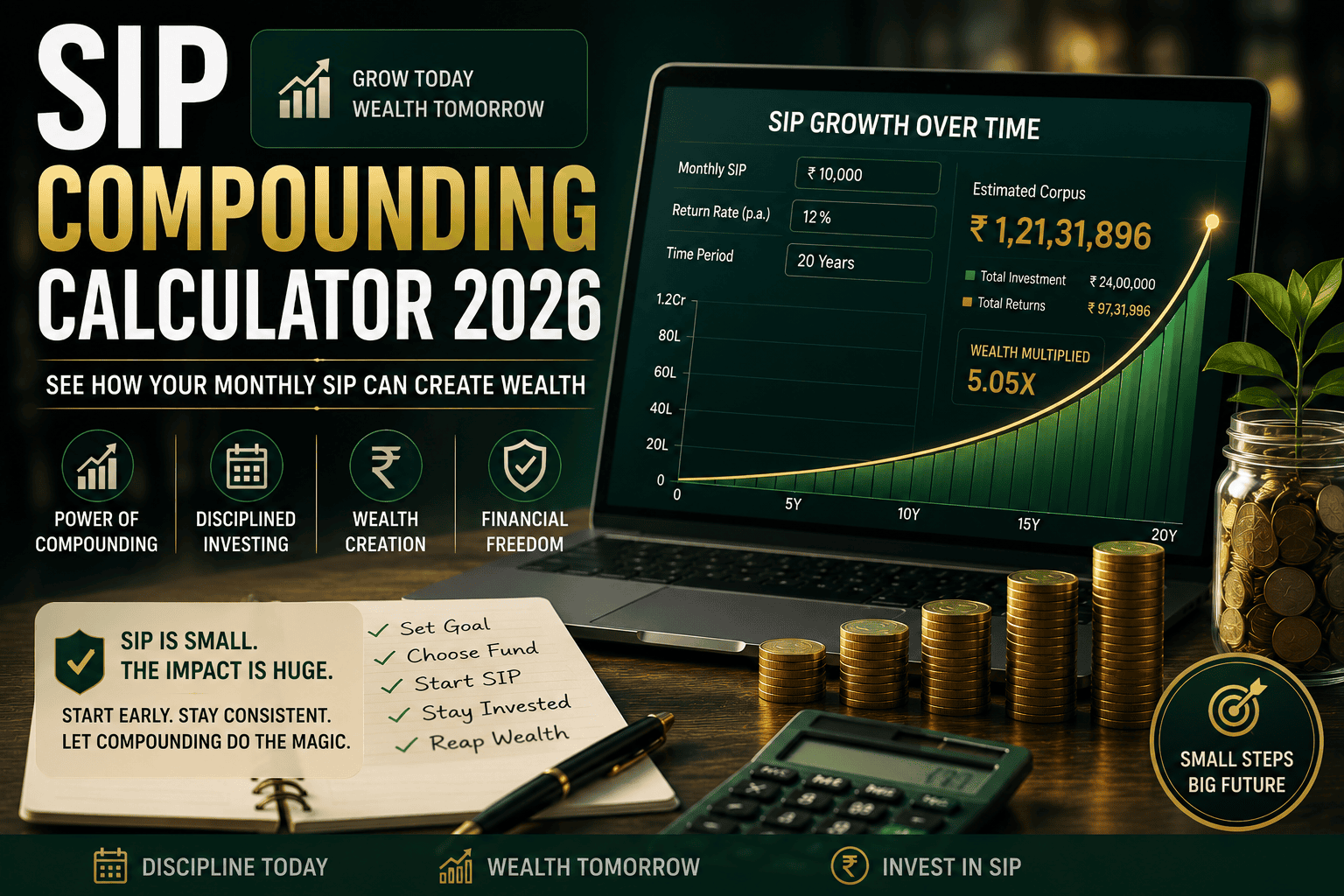

SIP Compounding Calculator 2026: The Complete Guide
See exactly how your monthly SIP grows over time — and how much of the final amount is actually compounding, not your own money.
SIP Compounding Calculator
Enter your details below for an instant projection. This is an educational estimate only — actual mutual fund returns are never guaranteed.
Introduction
A SIP looks simple from the outside — the same amount, deducted the same day, every month. What's not obvious is how much of the final maturity value actually comes from your own contributions versus how much comes purely from compounding working on money that's already invested. This calculator breaks that split apart explicitly, so you can see compounding's real contribution rather than just a single final number.
Complete Guide: How SIP Compounding Works
A Systematic Investment Plan (SIP) invests a fixed amount into a mutual fund at regular intervals, typically monthly, rather than as a single lump sum. Each instalment buys units at that month's prevailing price, and every unit purchased then continues to grow — or shrink — with the fund's performance for the remaining duration of your SIP.
Compounding is what makes early instalments disproportionately powerful. A SIP payment made in year one has decades to compound if the SIP runs for 20-25 years, while a payment made in the final year barely has time to grow at all. This is why extending a SIP's duration tends to matter more for the final corpus than increasing the monthly amount by a similar percentage — time in the market compounds; a larger cheque written for a shorter period simply doesn't get the same runway.
India's SIP industry has scaled dramatically in recent years — monthly SIP contributions across the industry grew from roughly ₹10,000 crore in 2022 to over ₹23,000 crore by 2025, reflecting how many more retail investors have adopted this route into equity and debt markets rather than trying to time lump-sum entries.
How to Use This Calculator
The SIP Formula
The standard SIP future value formula used across the mutual fund industry is:
| Variable | What It Means |
|---|---|
| P | Your fixed monthly investment amount |
| i | Expected annual return, converted to a monthly rate |
| n | Total months (years × 12) |
| M | Final maturity value at the end of the SIP tenure |
Common Mistakes to Avoid
- Assuming a fixed annual return actually happens every year. Real mutual fund returns fluctuate year to year; the assumed rate is a long-term average, not a guarantee for any single year.
- Underestimating how much a shorter duration costs you. Cutting a SIP short by even 3-5 years near the end removes some of the highest-compounding years, not just a proportional slice of the total.
- Stopping SIPs during a market downturn. Pausing contributions when prices fall means missing the exact period when your fixed amount buys the most units.
- Ignoring inflation when picking a target corpus. A maturity value that looks large today may buy meaningfully less in real terms 15-20 years from now.
Worked Example
Example — ₹10,000/Month for 15 Years. At an assumed 12% annual return, a ₹10,000 monthly SIP for 15 years results in total investment of ₹18 lakh, growing to a maturity value of approximately ₹50.3 lakh — meaning roughly ₹32.3 lakh, or about 64% of the final corpus, came purely from compounding rather than your own contributions.
Example — Same SIP, 25 Years Instead of 15. Extending the same ₹10,000/month SIP to 25 years, still at 12%, takes total investment to ₹30 lakh but grows the maturity value to roughly ₹1.9 crore — illustrating how disproportionately the final decade of a long SIP contributes to the total corpus.
Conclusion
The single biggest lever in SIP investing isn't the monthly amount — it's time. A modest SIP started early and left untouched for two decades will typically outgrow a much larger SIP started with a shorter runway, purely because compounding needs years to do its real work. Run your own numbers through the calculator above, and treat the "compounding share" figure as the clearest signal of whether your current duration is actually long enough to make the SIP worth doing.
FAQs
No. Mutual fund SIP returns are market-linked and never guaranteed. The rate used in this calculator is an assumption for projection purposes, not a promised return.
Long-term equity mutual fund assumptions commonly range from 10-12% per annum, though actual results depend on market conditions, fund selection, and the specific period held.
Extending duration generally has a larger compounding effect than a similar percentage increase in monthly amount, because additional years let earlier contributions compound for longer.
Most financial planners suggest continuing SIPs through downturns, since falling prices mean your fixed monthly amount buys more units — pausing removes this benefit precisely when it matters most.
Related Reading on Play With Stock

Pranab Barman is a Financial Educator and Personal Finance Researcher with over 10 years of hands-on experience in stock markets, trading, and investing. Currently enrolled in the CFA Program, he is committed to continuous learning and professional excellence in finance.
As the Founder of PlayWithStock, Pranab covers a wide range of topics including Mutual Funds, SIP, Taxation, Stock Market Basics, and Financial Calculators — with a focus on simplifying complex financial concepts for everyday all investors.
Email: support@playwithstock.com
Website: playwithstock.com
Related posts:
 UPS Pension Calculator 2026: The Complete Guide
 SSY Maturity Calculator 2026: The Complete Guide
 Amrit Vrishti FD Calculator 2026: The Complete Guide
 Record SIP Inflows June 2026: Indians Just Invested ₹31,781 Crore
 8th Pay Commission Salary Calculator: Complete 2026 Guide
 Share Buyback Tender vs Sell Calculator: 2026 Tax Guide
 SGB Premature Redemption Calculator 2026: Tax Rules, RBI Dates & Exit Guide
 ITR Refund Status Kaise Check Kare 2026: The Complete Step-by-Step Guide