


Reliance Jio IPO 2026: India's Biggest-Ever Listing, Explained
DRHP filed. ₹37,700 crore fresh issue. A valuation debate that spans $50 billion depending on who you ask. Here's what's actually confirmed, and what's still just an estimate.
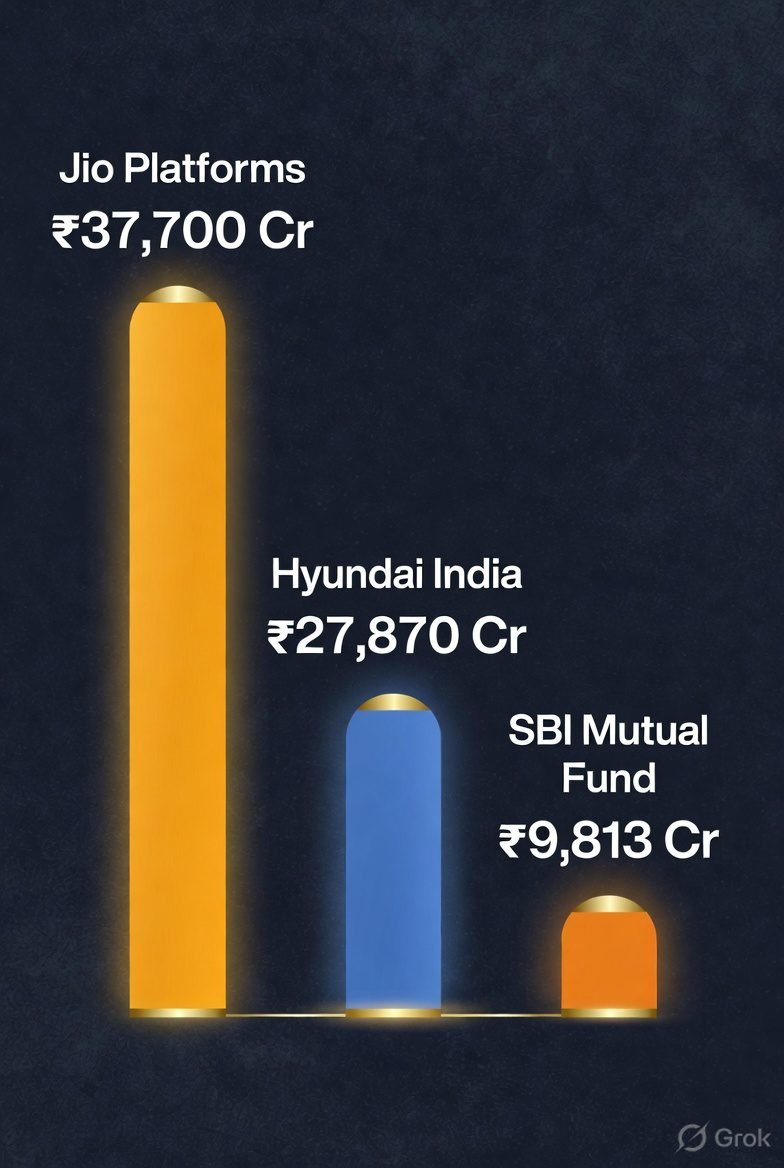
Issue size vs India's previous largest IPOs
Reliance Jio IPO is no longer speculation — Jio Platforms Limited filed its Draft Red Herring Prospectus with SEBI on June 19, 2026, and the numbers attached to it are genuinely hard to overstate. A fresh issue of up to 27 crore shares, a valuation somewhere between $130-180 billion, and a listing that will almost certainly become the largest in Indian stock market history. If you've held Reliance Industries shares for years hoping to see Jio listed separately, or you're simply trying to understand what this means for the market, this is where things actually stand right now.
We've gone through the DRHP disclosures and the analyst commentary that followed, and this guide walks through what's confirmed, what's still estimated, and what to actually watch for before this IPO opens.
The DRHP Filing: What Actually Happened
On June 19, 2026, the Jio Platforms board approved its Draft Red Herring Prospectus and filed it with SEBI, BSE, and NSE the same day. Mukesh Ambani announced the filing in person at Reliance Industries' 49th Annual General Meeting, reportedly calling it "a deeply emotional moment" — which, for a company built almost entirely on his own bet on Indian telecom a decade ago, tracks.
The filing itself is a 100% fresh issue of up to 27 crore equity shares, each with a face value of ₹10. There's no Offer for Sale component, meaning no existing shareholder — including Reliance Industries, which owns 66.43% of Jio Platforms pre-IPO — is selling shares as part of this listing. Every rupee raised goes directly to the company.
That detail matters more than it might first appear. A pure fresh issue with no OFS tells you management is raising this money specifically because the business needs it — mainly to repay debt — rather than existing investors cashing out. It's a meaningfully different signal than IPOs where founders or early investors are using the listing as an exit.
How Big Is This IPO, Really
The numbers here are worth sitting with. Estimates for the issue size range from ₹30,000 crore to ₹38,000 crore, with ₹37,700 crore being the figure most consistently cited across analyst notes. For comparison, the previous record holder for India's largest IPO was Hyundai Motor India at ₹27,870 crore in 2024. Jio is expected to comfortably clear that.
On valuation, the picture is a bit wider. DRHP-implied numbers suggest something in the $130-137 billion range (roughly ₹11-11.5 lakh crore), while some analyst estimates stretch as high as $180 billion depending on which EBITDA multiple gets applied. At the upper end of that range, Jio Platforms would list bigger than Bharti Airtel — whose market cap sat around ₹11.6 lakh crore as of June 2026 — and just below its own parent, Reliance Industries.
| Metric | Figure |
|---|---|
| Fresh issue size | 27 crore shares, ~₹37,700 crore |
| Offer for Sale (OFS) | None — 100% fresh issue |
| Estimated valuation | $130-180 billion (~₹11-15 lakh crore) |
| Face value per share | ₹10 |
| Book Running Lead Managers | 20 (an unusually large syndicate) |
| Listing exchanges | BSE and NSE mainboard |
| Previous IPO record | Hyundai Motor India, ₹27,870 Cr (2024) |
The sheer size of the lead manager syndicate — 20 banks — is itself a signal of how large and complex this offering is expected to be. Most large-cap IPOs run with a handful of lead managers; Jio's filing needed four times that.
Jio's Financial Snapshot
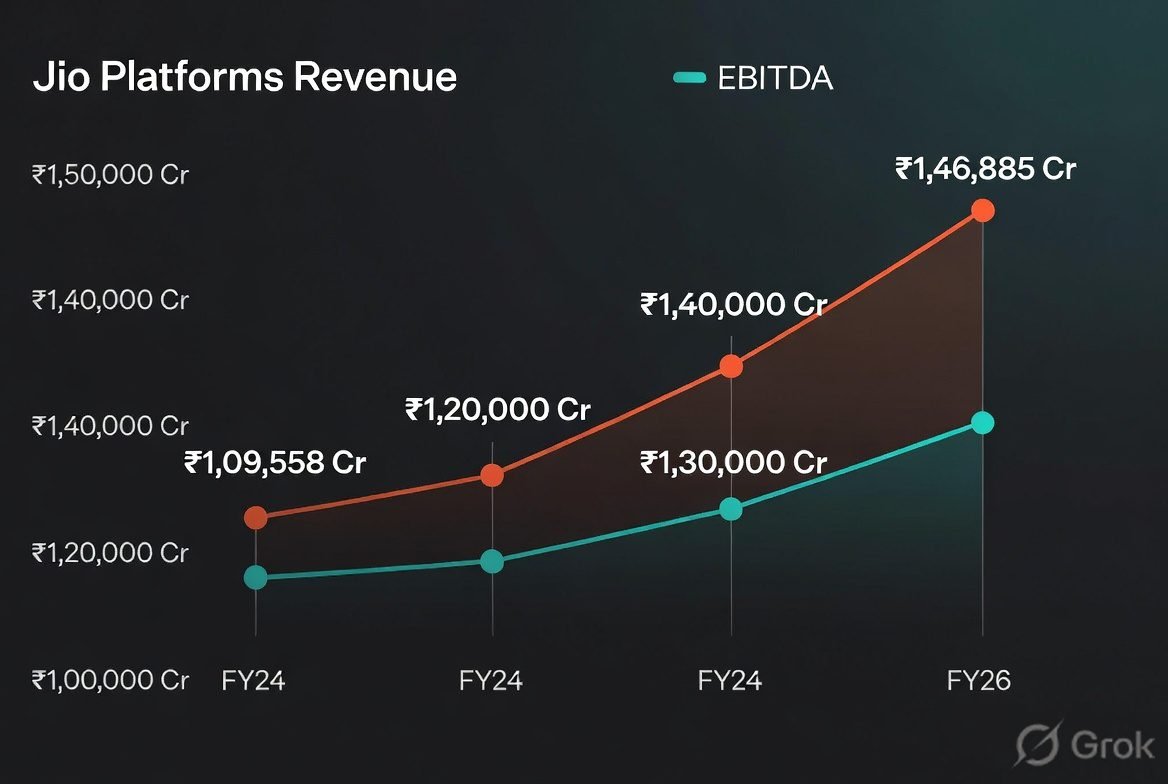
This is where the IPO stops being just a headline number and starts being an actual business you can evaluate. The DRHP discloses restated consolidated financials across FY24, FY25, and FY26, and the trend is a genuinely strong one.
| Fiscal Year | Revenue | EBITDA | EBITDA Margin | Net Profit |
|---|---|---|---|---|
| FY24 | ₹1,09,558 Cr | ₹54,959 Cr | 50.16% | ₹21,423 Cr |
| FY25 | ₹1,28,218 Cr | ₹64,170 Cr | 50.05% | ₹26,109 Cr |
| FY26 | ₹1,46,885 Cr | ₹76,255 Cr | 51.91% | ₹30,049 Cr |
Revenue grew at a two-year CAGR of roughly 15.8%, and EBITDA actually grew faster than revenue in the most recent year — up 18.8% year-on-year — which points to genuine operating leverage kicking in. Once the core fibre and tower infrastructure is built, adding subscribers costs relatively little extra, so margins widen as the base grows. That's a healthy pattern to see in a capital-intensive business, and it's not something every telecom operator manages to show.
Subscriber numbers back this up. As of March 31, 2026, Jio served 524.4 million customers, having added 36.2 million net subscribers through FY26 alone. Of that base, 268 million are 5G users — Jio added 77 million 5G subscribers in a single year, making it the largest single-country 5G operator outside China by subscriber count. ARPU (average revenue per user) has climbed too, reaching ₹214 in Q4 FY26, up from ₹182 two years earlier, driven by tariff hikes and growing 5G adoption.
Why Jio Is Filing Now
The stated purpose in the DRHP is fairly direct: ₹27,500 crore of the fresh issue proceeds — the bulk of the raise — is earmarked to prepay borrowings at Reliance Jio Infocomm Limited (RJIL), Jio's core operating subsidiary. As of March 31, 2026, RJIL's total fund-based borrowings stood at ₹71,529 crore, so this prepayment would knock out roughly 38.45% of that debt in one move.
The company frames this straightforwardly: reducing net debt improves the net asset value backing each equity share and lowers ongoing debt-servicing costs. In an industry as capital-intensive as telecom — Jio's cash capex alone was ₹34,184 crore in FY26, representing 23.27% of revenue — carrying less debt gives meaningfully more room to keep investing in network and infrastructure without leaning as hard on borrowed money.
The remainder of the raise is pointed toward general corporate purposes, with a portion specifically earmarked for continued build-out of AI and digital infrastructure — Jio has been investing heavily in AI data centres, and Ambani has publicly framed the company's next chapter around AI as much as connectivity.
Valuation: The Real Debate
Here's where I'd urge some caution before getting swept up in the "$180 billion" headlines. Using a fairly standard 11-13x EV/EBITDA multiple on Jio's FY26 EBITDA of ₹76,255 crore gives an implied enterprise value of roughly ₹8.4-9.9 lakh crore — before any premium for AI ambitions or digital ecosystem value. The gap between that base calculation and the more aggressive $180 billion figures circulating in early 2026 is essentially a bet on how much extra the market will pay for Jio's platform breadth beyond core telecom: JioCinema, JioMart, JioFinance, JioAirFiber, and the AI infrastructure push.
The comparison that matters most here is Bharti Airtel, whose network still runs on Non-Standalone 5G (built on a 4G core), while Jio's is Standalone 5G — a technical difference that gives Jio an edge in enterprise and low-latency use cases. Whether that technical advantage justifies Jio pricing meaningfully above Airtel on a pure telecom basis, or whether the premium only makes sense once you price in the broader digital ecosystem, is genuinely the crux of how this IPO gets valued once a price band is finally announced.
What Existing Reliance Shareholders Get
If you already hold Reliance Industries shares, the DRHP includes a reserved category specifically for existing RIL shareholders — a priority allotment quota that most large IPOs don't offer to a parent company's retail investor base. Reliance has also signalled a retail discount in the 15-20% range, broadly in line with what previous large public-sector IPOs have offered their own shareholder bases.
This matters practically: if you've held RIL through the multi-year wait for a Jio listing, this quota is effectively the mechanism through which that patience gets rewarded with preferential access, rather than having to compete purely in the open retail category against every other applicant.

Expected Timeline
No exact dates have been announced yet, and that's normal at this stage. SEBI typically takes 30 to 75 days to review a DRHP and issue its observations before a company can announce a price band and formal subscription dates. Based on that standard review window, the market broadly expects Jio's listing to land somewhere in the August to October 2026 period, though this remains an estimate rather than a confirmed date.
An indicative price band of ₹1,100-1,300 per share has circulated in analyst notes, and some estimates suggest a retail range as wide as ₹1,048-1,457 depending on where the final valuation lands — but none of this is official. The actual price band only gets set after SEBI's observations come through and the company files its Red Herring Prospectus.
Jio vs Airtel vs Vodafone Idea
For context on where Jio sits competitively as of its IPO filing: as of March 2026, Jio held the largest wireless broadband market share in India at 49.95%, with Bharti Airtel at 35.13% and Vodafone Idea trailing at 12.65%.
Bharti Airtel's market capitalisation stood around ₹11.62 lakh crore in June 2026, making it the closest listed comparison for how the market might eventually price Jio. Vodafone Idea, at roughly ₹1.61 lakh crore, isn't a meaningful valuation benchmark for Jio specifically — Vi's recent profitability has been driven largely by one-off AGR relief measures rather than genuine operational turnaround, and the company continues to operate under significant financial stress with a delayed 5G rollout.
Jio has, by most accounts, been the primary beneficiary of subscriber churn away from Vodafone Idea over recent years, which is part of why its subscriber base has continued to grow even in an already-mature Indian telecom market.
Risks Worth Knowing
The DRHP itself discloses several risk factors worth being aware of before treating this as a guaranteed strong listing:
- Licence renewal dependency. Jio's unified telecom licence and spectrum holdings are due for renewal in October 2033. Regulatory dependency of this kind is standard for the industry, but it's a real structural risk rather than a formality.
- Capital intensity. At 23.27% of revenue, Jio's cash capex requirement is substantial and ongoing — this isn't a business that can meaningfully cut investment without risking its competitive position on network quality.
- Distribution dependency on the promoter group. Reliance Retail acts as the sole distributor for Jio's prepaid connectivity services, which made up a significant share of core revenue. That's a related-party dependency worth understanding, even though it reflects the broader Reliance ecosystem's integrated structure rather than a standalone weakness.
- Technological obsolescence risk. As with any telecom operator, continued heavy investment is required simply to avoid falling behind on network technology — standing still isn't really an option in this industry.
None of these risks are unusual for a telecom operator of Jio's scale, but a company this large going public deserves the same scrutiny any other listing would get, not a pass simply because of the Ambani name attached to it.

Should You Apply — What to Actually Check
I'd resist the urge to decide on this IPO based purely on brand recognition, however tempting that is given how central Jio has become to daily life for hundreds of millions of Indians. A few concrete things are worth checking once the Red Herring Prospectus and final price band are announced:
- Compare the final price band against the EV/EBITDA-based valuation range, not just the headline dollar figure being reported in the news.
- Read the risk factors section in full, particularly around debt levels post-IPO and the licence renewal timeline.
- Understand what portion of your application, if any, falls under the RIL shareholder reserved quota versus the general retail category, since allotment odds can differ meaningfully between the two.
- Watch for index-inclusion timing. A listing this large is expected to trigger significant passive inflows once Jio enters the Nifty and Sensex, which can affect near-term price action independent of the underlying business fundamentals.
- Treat the "biggest IPO in Indian history" framing as a size statement, not a quality guarantee. Large doesn't automatically mean attractively priced — that depends entirely on where the final band lands relative to the business's actual earnings power.
Frequently Asked Questions
When did Jio Platforms file its DRHP?
Jio Platforms filed its Draft Red Herring Prospectus with SEBI, BSE, and NSE on June 19, 2026, the same day Mukesh Ambani announced the filing at Reliance Industries' 49th Annual General Meeting.
How big is the Reliance Jio IPO expected to be?
Estimates place the issue size between ₹30,000 crore and ₹38,000 crore, with ₹37,700 crore being the most commonly cited figure, making it the largest IPO in Indian stock market history by a wide margin.
What is Jio Platforms' expected valuation?
DRHP-implied valuation sits around $130-137 billion (roughly ₹11-11.5 lakh crore), while some analyst estimates range as high as $180 billion depending on the EBITDA multiple applied and how much premium the market assigns to Jio's broader digital ecosystem.
When will the Reliance Jio IPO open for subscription?
No confirmed dates have been announced. Based on SEBI's typical 30-75 day DRHP review window, the market broadly expects listing sometime between August and October 2026.
Will existing Reliance Industries shareholders get any benefit?
Yes. The DRHP includes a reserved allotment category for existing RIL shareholders, and Reliance has signalled a retail discount in the 15-20% range for this group.
What is Jio Platforms' profit and revenue?
For FY26, Jio Platforms reported revenue of ₹1,46,885 crore, EBITDA of ₹76,255 crore (a 51.91% margin), and net profit of ₹30,049 crore, up from ₹21,423 crore in FY24.
Is this an Offer for Sale or a fresh issue?
The entire Jio Platforms IPO is a 100% fresh issue of up to 27 crore equity shares, with no Offer for Sale component — meaning no existing shareholder is selling shares, and all proceeds go directly to the company.
What will the IPO proceeds be used for?
The primary use, accounting for ₹27,500 crore of the raise, is prepaying debt held by Reliance Jio Infocomm Limited (RJIL) to reduce leverage, with the remainder going toward general corporate purposes including continued AI and digital infrastructure investment.
Sources
- 5paisa — Jio Platforms IPO DRHP: Key Investor Takeaways
- IPO Market — Jio IPO 2026 DRHP Filed
- Groww — Jio Platforms Ltd. Files DRHP with SEBI
- Unlisted Zone — Jio Platforms DRHP Analysis
- CMA Knowledge — Jio Platforms IPO Complete Analysis 2026
- ScanX — Jio Platforms Files DRHP
- ScanX — Jio Platforms ₹27,500 Crore Fresh Issue
- Equity Research India — Jio Platforms IPO DRHP Analysis
- Ventura Securities — Reliance Jio IPO Review 2026
- ClearTax — Reliance Jio IPO: Expected Date and Price

Pranab Barman is a Financial Educator and Personal Finance Researcher with over 10 years of hands-on experience in stock markets, trading, and investing. Currently enrolled in the CFA Program, he is committed to continuous learning and professional excellence in finance.
As the Founder of PlayWithStock, Pranab covers a wide range of topics including Mutual Funds, SIP, Taxation, Stock Market Basics, and Financial Calculators — with a focus on simplifying complex financial concepts for everyday all investors.
Email: support@playwithstock.com
Website: playwithstock.com
Related posts:
 Jio IPO 2026: 10 Crucial Facts Every Investor Must Know
 Reliance Industries Q1 FY27 Results Preview: What to Expect on July 17
 SBI Mutual Fund IPO Opens Tomorrow: Everything Before You Apply
 Jio Financial Services Q1 FY27 Results Preview: Date, Estimates & Stock Analysis
 Why Is the Stock Market Falling Today? US-Iran Tensions, Crude Oil Spike & FII Selling Explained
 Trump Accounts Explained: The $1,000 Baby Bonus Already Reaching 6 Million Kids
 SBI Mutual Fund IPO 2026: Dates, Price Band, GMP & Should You Apply
 SK Hynix IPO: Massive $26.5B Debut Shocks Wall Street