
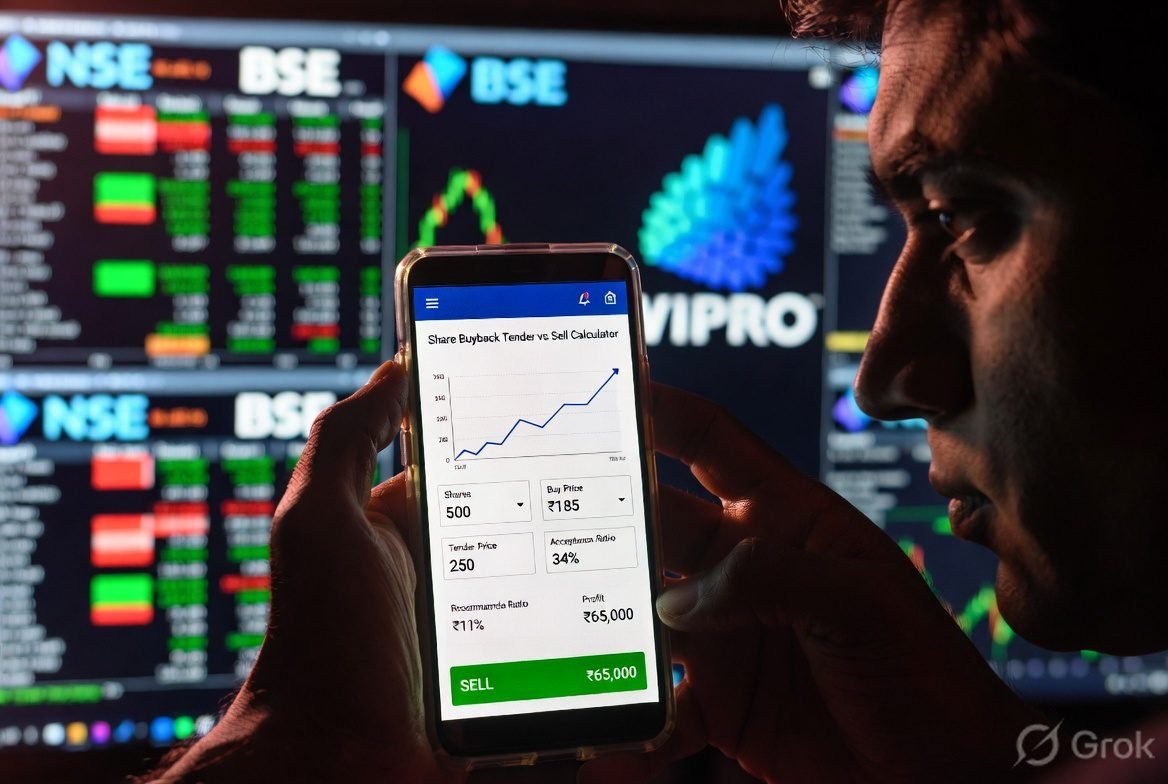

Share Buyback Tender vs Sell Calculator: 2026 Tax Guide
Wipro's ₹15,000 crore buyback just closed under India's brand-new capital gains rule. Here's the actual math — with real acceptance-ratio numbers from investors who lived through it.
I'll be honest — I almost didn't write this one. Buyback articles usually follow the same template: "here's a 23% premium, isn't that great." Then I actually sat down with the numbers from Wipro's June 2026 buyback and realised most of what I'd read online was quietly skipping the two things that decide whether you actually make money: how many of your shares get accepted, and how much tax you now pay on the ones that do. A share buyback tender vs sell calculator that ignores either of those isn't really a calculator — it's a headline with a rupee sign in front of it.
So this article does three things differently. First, it walks through the actual tax mechanics that changed on 1 April 2026 — not the version from two Budgets ago. Second, it uses real numbers from the Wipro buyback that closed on 17 June 2026, including what retail investors on trading forums were reporting about their own acceptance ratios, not just the brokerage estimates published before the window opened. And third, it gives you a working calculator to run your own tender-vs-sell math for any buyback, plus a running tracker of every major 2026 buyback so you're not starting from zero the next time one comes around.
Table of Contents
- 1. What a Share Buyback Actually Is
- 2. The Tax Rules That Changed on 1 April 2026
- 3. Case Study: What Really Happened in Wipro's Buyback
- 4. Tender vs Sell Calculator
- 5. Entitlement Ratio vs Acceptance Ratio — Stop Confusing Them
- 6. 2026 Buyback Tracker
- 7. The Catch: Your Unaccepted Shares
- 8. Should You Tender? A Simple Framework
- FAQs
1. What a Share Buyback Actually Is
A buyback is a company using its own reserves to repurchase shares from existing shareholders, usually at a price above the current market rate, under Section 68 of the Companies Act, 2013. Once bought, Indian law doesn't allow the company to hold those shares as treasury stock — they have to be cancelled (extinguished) within seven days. For the company, this shrinks the equity base, which typically nudges up earnings-per-share and return-on-equity even without any change in actual profit. For shareholders, it's one of the few genuinely retail-friendly mechanisms in Indian markets, because SEBI reserves 15% of every buyback specifically for small shareholders — a protection that doesn't exist in most other corporate actions.
Most large Indian buybacks use the tender offer route, meaning the company fixes a price and shareholders have to actively submit ("tender") their shares during a defined window — nothing happens automatically. That single detail catches out more people than anything else in this process: you have to log into your broker's app and manually tender. Owning the stock on the record date gets you eligibility, not participation.
2. The Tax Rules That Changed on 1 April 2026
This is genuinely the part most 2025-era content gets wrong, because the rule has now changed twice in under two years. Here's the honest timeline:
| Period | How Buyback Proceeds Were Taxed |
|---|---|
| Up to 30 Sept 2024 | Capital gains in the shareholder's hands; company paid a separate buyback distribution tax under old Section 115QA. |
| 1 Oct 2024 – 31 Mar 2026 | Entire proceeds treated as deemed dividend, taxed at your slab rate, with no deduction for what you originally paid — your cost of acquisition became a separate capital loss instead. TDS of 10% applied. |
| From 1 Apr 2026 onward | Reverted to capital gains taxation. You're taxed only on the actual profit (buyback price minus cost of acquisition), not the full proceeds. |
Under the current, post-April-2026 rule: for listed shares, gains on holdings over 12 months are taxed as long-term capital gains at 12.5% (with the standard ₹1.25 lakh annual exemption under Section 112A), while anything held 12 months or less is short-term and taxed at a flat 20%. This is a straightforward win for ordinary shareholders compared to the 2024–26 dividend regime, where the entire buyback amount got added to your taxable income regardless of profit.
If you're an ordinary retail shareholder — not a promoter — none of that surcharge complexity applies to you. You simply pay 12.5% LTCG or 20% STCG on your actual gain, which is a meaningfully better position than the deemed-dividend years, especially if you're in the 30% tax slab.
3. Case Study: What Really Happened in Wipro's Buyback
Numbers on paper are one thing. What actually happens when lakhs of retail investors try to tender at the same time is another, so let's walk through Wipro's ₹15,000 crore buyback — the largest in the company's history, and one of the first big-ticket buybacks to run entirely under the new capital gains regime.
The board approved the buyback on 16 April 2026: up to 60 crore shares (5.72% of paid-up equity) at ₹250 per share. The record date was fixed for 5 June 2026, with the stock closing around ₹198–203 just before it — a premium of roughly 23–24%. Because the stock kept sliding through May and early June (Wipro was down about 24% for the year, reflecting a genuinely tough patch for Indian IT), by the time the tender window actually opened on 11 June the market price had dropped closer to ₹177–185, which pushed the effective headline premium up past 35–40% depending on which day you compare it to.
Wipro set two entitlement ratios: small shareholders (holding shares worth up to about ₹2 lakh on the record date, which worked out to roughly 800–1,008 shares depending on the exact closing price used) could tender 11 shares for every 56 held — about 19.6%. The general category's ratio was far thinner: 10 shares for every 197 held, about 5.1%. Before the window even opened, brokerages were publishing their own estimates: HDFC Securities pegged the likely retail acceptance ratio anywhere from 45% to 80%; Motilal Oswal's separate math, based on the FY25 shareholding pattern, suggested a minimum retail acceptance closer to 30.8%.
What investors were actually reporting once the window closed
Here's where it gets interesting, and where most articles stop but this one doesn't. Once the tender window closed on 17 June, retail investors started comparing notes on trading forums — and the real numbers landed well below the brokerage estimates:
"BB closed on 17 june, contract note on 23 june... 53/155 AR is 34%"
"last time total subscription 15.61, retail acceptance ratio 77.40% — naw total subscription 13.74, retail AR 60% hona chahiye"
Translate that out of trader-shorthand: total demand across all categories was roughly 13.7 times the shares on offer. In the retail bucket specifically, actual reported acceptance ratios clustered closer to the 28–34% mark once real tender numbers came in — meaningfully below the optimistic end of HDFC's 45–80% range, and close to the Motilal Oswal floor. One investor's real contract note, from an entitlement of 155 shares, showed just 53 accepted — a personal acceptance ratio of 34%, almost exactly the pattern most retail participants seem to have experienced.
What does that mean in rupees? Take a small shareholder who tendered 500 shares at an average buy price of ₹185. At a 34% acceptance ratio, roughly 170 shares get bought back at ₹250, generating a gross profit near ₹11,050 on the accepted portion. After 20% STCG (assuming these were bought recently, specifically for the buyback), the after-tax profit on those 170 shares comes to about ₹8,840. The remaining 330 shares stay in the demat account, still moving with Wipro's regular market price — which was trading around ₹184–185 through the settlement window, essentially flat versus the entry price. That's the real headline: not a 35% return on your full holding, but roughly 8–9% of your total capital converted into a realised, tax-paid gain, with the rest still fully exposed to the stock's ordinary ups and downs.
Wipro 2026 buyback: pre-window brokerage estimates vs what retail investors actually reported on trading forums after the 17 June close. Illustrative from publicly shared figures — not an official Wipro disclosure.
The lesson isn't that HDFC Securities got it wrong — a 45-80% range genuinely covers 30-34% at its edge. The lesson is that going into any buyback with a single confident number in your head, whether it's a brokerage estimate or a forum post, is the mistake. That's exactly why the calculator below asks you to test a range rather than trust one figure.
There's a broader pattern worth noticing here too. Within days of Wipro's announcement, market commentary was already framing it as buybacks being "back in vogue" for India Inc., and Cyient's board scheduled its own buyback discussion for the very next earnings call. That's not a coincidence — once a large, well-covered name runs a buyback successfully under a new tax regime, other boards with surplus cash tend to follow quickly, partly because it's now a genuinely cheaper way to reward shareholders than a dividend, and partly because nobody wants to be the company still explaining the old deemed-dividend math to confused shareholders. If you hold IT or pharma stocks with healthy cash reserves, it's worth keeping an eye on quarterly earnings calls through the rest of 2026 — this is unlikely to be the last big buyback of the year.
4. Tender vs Sell Calculator
Use this share buyback tender vs sell calculator to compare two choices for any live or upcoming buyback: tendering into the offer at the fixed buyback price, versus simply selling your entire holding on the open market today. Enter your numbers, test a realistic acceptance ratio range (the Wipro case study above is a good real-world anchor), and see which path actually nets you more after tax.
Compare Your Outcome
"Sell Everything Today" assumes you sell your full holding at the current market price, taxed the same way as the tender path. The tender path assumes the accepted shares are bought back at the buyback price and taxed as capital gains; unaccepted shares are treated as retained at the current market price with no further gain/loss counted (their eventual outcome depends entirely on where the stock trades afterward — see Section 7). This tool does not include brokerage, STT, or other transaction charges, and does not apply promoter-level additional tax. It is for illustration only — confirm your own numbers with your broker or CA before tendering.
If there's one habit worth building from this case study, it's running every future buyback through a proper share buyback tender vs sell calculator before you decide anything — not after you've already tendered and are watching the settlement date arrive. Headline premiums are marketing; a blended, tax-adjusted, realistic-acceptance-ratio number is the only figure worth acting on. That instinct — checking the math instead of chasing the headline — is the same discipline we cover in our piece on why most investors lose money in the stock market, and it applies just as much to a "guaranteed" buyback premium as it does to a hot stock tip.
5. Entitlement Ratio vs Acceptance Ratio — Stop Confusing Them
Almost every buyback-related doubt on investor forums traces back to mixing up these two numbers, so it's worth being precise:
- Entitlement ratio is fixed and announced by the company before the window opens — it's the guaranteed minimum proportion of your tendered shares that will be accepted, based on your category (small shareholder vs general) and total shares outstanding in that category. In Wipro's case, small shareholders had an entitlement of 11 shares for every 56 held (19.64%).
- Acceptance ratio is the actual final outcome once the window closes, and it can run higher than your entitlement if fewer people than expected tender, or it can sit right at the entitlement floor if participation is heavy — which, as the Wipro numbers above show, is usually what happens in a well-publicised, high-premium buyback.
The practical takeaway: treat the entitlement ratio as your realistic floor, not your expected outcome, and don't be surprised if the final acceptance ratio lands close to it rather than near the higher, more optimistic brokerage estimates published before the window opens.
6. 2026 Buyback Tracker
Buybacks tend to cluster once one large company sets a precedent — Wipro's announcement was quickly followed by other names testing the same route. Here's a running list of the major 2026 tender-offer buybacks, all governed by the post-1-April-2026 capital gains rules covered above:
| Company | Price | Size | Record Date | Tender Window | Status |
|---|---|---|---|---|---|
| Wipro Ltd | ₹250 | ₹15,000 Cr (60 Cr shares, 5.72%) | 5 Jun 2026 | 11–17 Jun 2026 | Closed — settled 24 Jun |
| Aurobindo Pharma Ltd | ₹1,475 | ₹800 Cr (54.2 lakh shares, 0.93%) | 17 Apr 2026 | 23–29 Apr 2026 | Closed — settled 7 May |
| Cyient Ltd | Board meeting held 23 Apr 2026 alongside Q4 results | — | Pending confirmation | — | Announced, follow for updates |
If you're tracking a buyback that isn't listed here yet, the two places to check directly are the NSE's tender offer page and the BSE's buyback tender listings — both are updated as new record dates get fixed. We'll keep updating this table as new 2026 buybacks are announced.
7. The Catch: Your Unaccepted Shares
This is the part the Wipro case study above makes concrete: whatever portion of your tendered shares doesn't get accepted comes straight back into your demat account, and from that point it behaves exactly like any other holding — fully exposed to the stock's regular price movement. Wipro traded essentially flat, around ₹184–185, through the settlement window, so investors who tendered didn't see a dramatic loss on their unaccepted shares this time. That won't always be true. A common pattern across Indian buybacks is a soft drift lower once the record date passes and the arbitrage-driven buying support disappears, so it's worth deciding in advance — not after the fact — what you'll do with shares that come back: hold them as a regular long-term position, or exit at market price and accept whatever gain or loss that brings.
8. Should You Tender? A Simple Framework
Strip away the noise and a buyback decision really comes down to four questions, in this order:
1. What's the realistic acceptance ratio, not the optimistic one?
Start from the company's published entitlement ratio as your floor, and treat brokerage estimates as an upper bound rather than a expectation — the Wipro case study shows actual outcomes tend to land closer to the floor than the ceiling.
2. What's your actual post-tax number on the accepted portion?
Run it through the calculator above using your real holding period, since a 20% STCG hit versus 12.5% LTCG genuinely changes whether tendering is worth the effort.
3. Are you comfortable holding the unaccepted balance?
If the company remains one you'd want to own anyway, the unaccepted shares are a non-issue. If you were only ever in it for this specific buyback, plan your exit for those shares in advance rather than reacting emotionally to a post-buyback dip.
4. Does the blended, realistic return still beat simply selling today?
If the calculator above shows tendering wins even at a conservative acceptance ratio, it's almost always worth the five minutes it takes to submit through your broker's Corporate Actions section. If the gap is thin once you use a realistic acceptance ratio, factor in that this is also more effort — and more paperwork at tax-filing time — for a marginal gain.
Speaking of tax-filing time: a buyback gain is a capital gains event that has to be reported correctly in your ITR, and if you tendered shares in more than one buyback this year, the sale dates need to be tracked separately for each. If you haven't already mapped out this year's compliance calendar, our guide to the ITR filing deadline for 2026 is a useful companion to this one — especially since, like a buyback payout, arrears or one-time payouts (our 8th Pay Commission salary calculator covers a similar lump-sum tax-planning scenario from the government-employee side) can push a single year's taxable income higher than you'd expect if you don't plan for it. For more on how corporate actions like this fit into a broader stock-picking approach, our Company Analysis section and Stock Market section cover related ground.
Before you go, bookmark this page — the same share buyback tender vs sell calculator above works for any company's buyback, not just Wipro's, so you can reuse it the next time a tender offer lands in your demat account. For more on how corporate actions and tax rules interact, our Tax section covers related changes from the 2026 Budget.FAQs
Is share buyback income tax-free in India?
No — this changed on 1 April 2026. Buyback proceeds are now taxed as capital gains: 12.5% LTCG (over 12 months, listed shares, with a ₹1.25 lakh annual exemption) or 20% STCG (12 months or less). Between October 2024 and March 2026, buyback proceeds were taxed as deemed dividend at your full slab rate — a much heavier burden that this new rule reverses.
What's the difference between entitlement ratio and acceptance ratio?
Entitlement ratio is the guaranteed minimum proportion of your tendered shares the company will accept, announced before the window opens. Acceptance ratio is the actual final outcome once tendering closes — it can exceed the entitlement ratio if participation is light, but in heavily subscribed buybacks like Wipro's 2026 offer, it tends to land close to the entitlement floor.
What happens to shares that don't get accepted in a buyback?
They're returned to your demat account and continue trading at the regular market price — there's no guarantee or protection on their value going forward. It's worth deciding your plan for these shares (hold or exit) before you tender, not after the buyback closes.
Can I buy shares just before the record date to participate in a buyback?
Yes, technically — but Indian markets settle on T+1, so you generally need to buy at least one trading day before the record date for the shares to actually reflect in your demat account in time. Buying on the record date itself is usually too late.
Do promoters pay more tax on buyback gains than regular shareholders?
Yes. Under the Finance Act 2026, promoters face an additional tax on top of the standard capital gains rate, taking their effective rate to roughly 22% for corporate promoters and 30% for individual/non-corporate promoters, plus a 12% surcharge on that additional tax. Regular retail shareholders are not affected by this promoter-specific levy.
Is a 23% buyback premium a good return?
Only on the shares that actually get accepted. As the Wipro case study shows, retail acceptance ratios in a popular buyback often land in the 25–35% range rather than 80%+, so a headline 23–40% premium frequently converts into something closer to a high-single-digit blended return once you factor in the acceptance ratio and tax — still worthwhile, but not the number in the headline.
- SEBI — buyback of securities regulations
- NSE India — live tender offer and buyback listings
- KPMG India — analysis of the Budget 2026 buyback tax proposal
- TaxGuru — Section 69 promoter additional tax breakdown
- CAclubindia — 12% surcharge clarification on promoter tax
- ClearTax — buyback capital gains computation guide
- Chittorgarh — Wipro buyback 2026 official schedule and entitlement data
- Business Standard — Wipro buyback window coverage


Pranab Barman is a Financial Educator and Personal Finance Researcher with over 10 years of hands-on experience in stock markets, trading, and investing. Currently enrolled in the CFA Program, he is committed to continuous learning and professional excellence in finance.
As the Founder of PlayWithStock, Pranab covers a wide range of topics including Mutual Funds, SIP, Taxation, Stock Market Basics, and Financial Calculators — with a focus on simplifying complex financial concepts for everyday all investors.
Email: support@playwithstock.com
Website: playwithstock.com
Related posts:
 SGB Premature Redemption Calculator 2026: Tax Rules, RBI Dates & Exit Guide
 8th Pay Commission Salary Calculator: Complete 2026 Guide
 Crypto Bookkeeping for Tax in India: The Complete 2026 Guide
 Mutual Fund BER vs TER Calculator (2026): Compare BER vs TER Online
 F&O STT Hike Breakeven Calculator: 2026 New Rates
 ITR-4 Investment Disclosure Calculator: New 2026 Rule for Presumptive Taxpayers
 ITR Filing Last Date 2026: July 31 Deadline, New Tax Act & Penalties
 GST 2.0 for E-commerce Sellers (2026): Complete Guide