
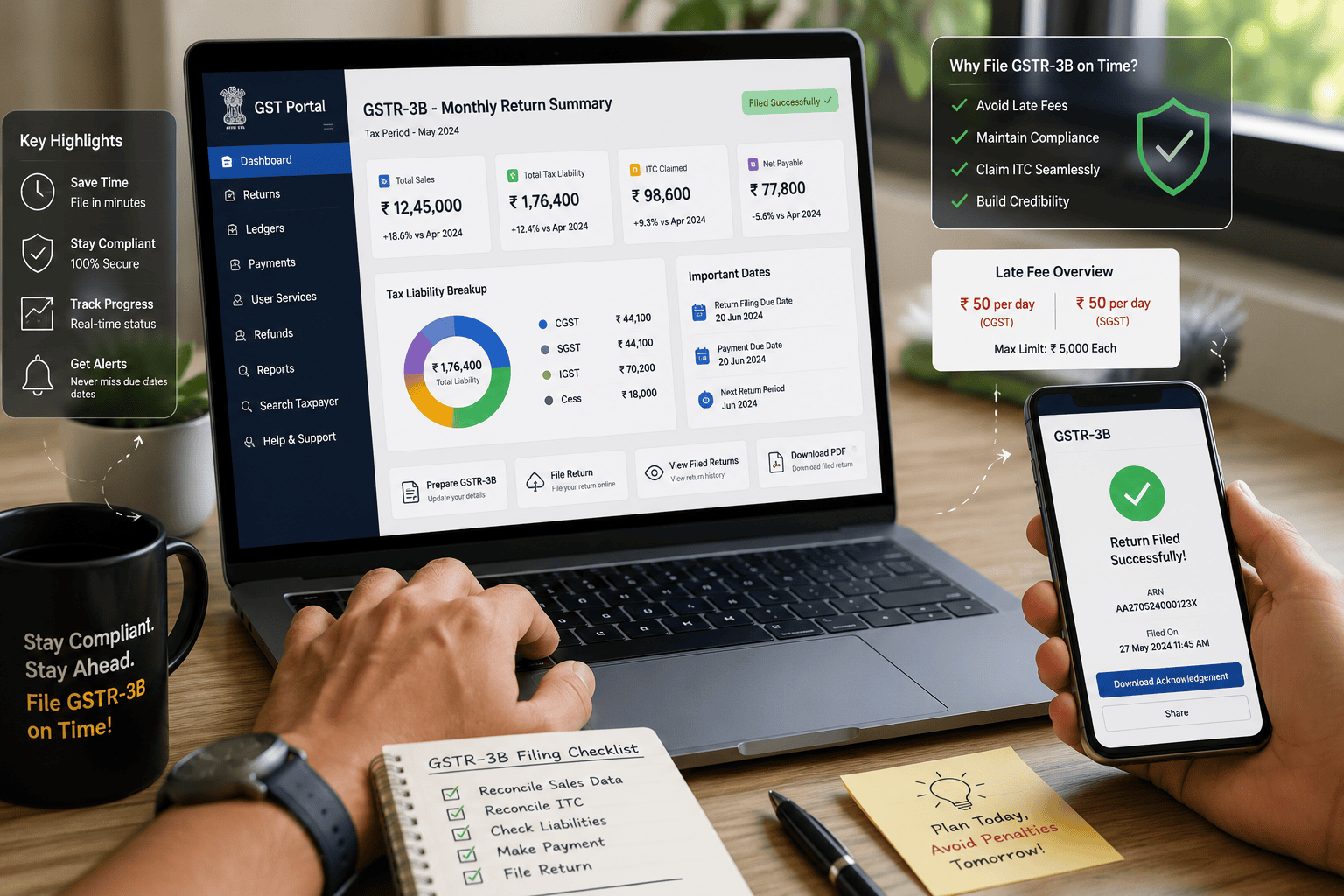



GST 2.0 for E-commerce Sellers: 2026 Rate & Rule Guide
If you sell on Amazon or Flipkart, there's a good chance you're still pricing at least one product wrong. Here's everything that changed — and what to check this week.
If you sell on Amazon, Flipkart, Meesho, or your own website, GST 2.0 for e-commerce sellers isn't just a tax headline from last September anymore — it's a living set of rules that has changed three separate times since then, most recently in April 2026, and a lot of small sellers are still running billing software that hasn't caught up. This guide walks through exactly what changed, what it means for the specific categories most sellers deal with — kitchenware, personal care, clothing, baby and pet products — and what you need to check in your own account this week, not eventually.
Quick Answer
- What changed: GST simplified from 4 slabs (5/12/18/28%) to mainly 3 (5/18/40%), effective 22 Sept 2025 — with two more compliance waves in Jan and Apr 2026.
- Kitchenware, personal care, baby products: mostly moved down to 5% — good news if you sell these.
- Clothing above ₹2,500/piece: moved up to 18% from 12% — check this carefully.
- E-commerce specific: GST registration is mandatory regardless of turnover, and 1% TCS needs active monthly claiming — it isn't lost money, but it isn't automatic either.
Table of Contents
- 1. What GST 2.0 Actually Is
- 2. The Full Timeline: Sept 2025 to Apr 2026
- 3. Old Slabs vs New Slabs
- 4. What Changed for Products You Actually Sell
- 5. E-commerce-Specific Rules
- 6. GST 2.0 Rate & TCS Calculator
- 7. The April 2026 Changes Sellers Are Missing
- 8. Common Mistakes Sellers Are Still Making
- 9. Related Reading
- FAQs
1. What GST 2.0 Actually Is
For eight years, GST ran on a confusing four-slab system — 5%, 12%, 18%, and 28% — and figuring out which slab your product fell into was genuinely one of the more annoying parts of running a small business in India. At the 56th GST Council meeting on 3 September 2025, Finance Minister Nirmala Sitharaman announced GST 2.0: the 12% and 28% slabs were essentially scrapped, and most goods moved into a clean structure of 5% and 18%, with a new 40% slab created specifically for luxury and sin goods. The change took effect on 22 September 2025, timed deliberately to land just before the festive season — the government even branded it the "GST Bachat Utsav."
For consumers, the headline story was good news: everyday items got cheaper almost overnight. But if you're a seller rather than just a shopper, the same change meant something more complicated — every product in your catalogue needed its GST rate re-checked, and two further waves of compliance changes followed in January and April 2026 that have nothing to do with rates and everything to do with how carefully the system now checks your filings.
2. The Full Timeline: Sept 2025 to Apr 2026
It helps to see this as three separate waves, because each asked something different of sellers.
If your accountant only walked you through the September 2025 changes and hasn't mentioned anything from 2026, that's worth a follow-up call.
3. Old Slabs vs New Slabs
| Old Structure (pre-Sept 2025) | New Structure (GST 2.0) |
|---|---|
| 0% — exempt goods | 0% — exempt, expanded (individual health/life insurance now nil-rated) |
| 5% — essentials | 5% — essentials, plus almost everything that used to be at 12% |
| 12% — mid-tier goods | Eliminated — merged into 5% or 18% |
| 18% — standard rate | 18% — standard, plus most of what used to be at 28% |
| 28% — luxury/sin goods | Eliminated — split into 18% or new 40% |
| — | 40% — new slab, luxury/sin goods only |
| 3% / 0.25% — gold, diamonds | Unchanged |
The practical effect: about 99% of what used to sit at 12% dropped to 5%, and the rest moved up to 18%. The 28% slab was restructured too — roughly 90% came down to 18%, while a genuinely small list of luxury and sin goods jumped to the new 40% rate.
4. What Changed for Products You Actually Sell

One more small but relevant category: sewing machines and small manufacturing inputs came down from 12% to 5% — worth knowing if you or your suppliers do any tailoring or small-scale production.
5. E-commerce-Specific Rules
Rate changes are the visible part of GST 2.0 for e-commerce sellers. The less visible part — and the one that actually costs sellers money through friction and blocked cash flow — is how e-commerce transactions get taxed and tracked differently from an ordinary shop.
You must register regardless of turnover
Under Section 24 of the CGST Act, anyone selling through an e-commerce operator — Amazon, Flipkart, Meesho, even a Shopify store routed through certain payment gateways — must register for GST the moment they start selling online, even if turnover is well under the usual ₹20 lakh/₹40 lakh exemption threshold. That threshold simply doesn't apply to online sellers.
The 1% TCS isn't lost money — but you have to claim it
Every e-commerce operator collects Tax Collected at Source at 1% on the net value of your taxable sales, deposited against your GSTIN. It sits in your Electronic Cash Ledger under a separate TCS tab — it isn't automatically applied to your liability. You need to file a "TCS and TDS Credit Received" return each month to move it into your main cash ledger. Skip this regularly, and you're leaving your own working capital stuck in a government ledger instead of using it to pay your GST bill.
The reconciliation chain is longer than it looks
Your GSTR-1 needs to match what the platform reports in its GSTR-8, and that GSTR-8 needs to show "Filed" — not just "Submitted" — before your TCS credit reliably auto-populates in GSTR-3B. In practice this often lags 2-5 days behind the platform's actual filing; waiting a few days after the deadline before filing your own return usually resolves it without manual intervention.
6. GST 2.0 Rate & TCS Calculator
Check your product's old vs new rate, and how much of your monthly sales sits in TCS credit right now.
Rate Impact
TCS Cash-Flow Check
Illustrative estimates only, based on category rate patterns described in this guide — always confirm your product's exact HSN code and current rate on the official GST portal. TCS figures assume the full sales amount is taxable; actual credit depends on your GSTR-8/GSTR-3B reconciliation.
7. The April 2026 Changes Sellers Are Missing
This is the section worth reading twice — these changes are recent enough that a lot of sellers, and candidly a lot of accountants serving small clients, haven't fully absorbed them yet.
Mandatory fresh invoice series: from 1 April 2026, every business needed a new invoice number series for the financial year. Continuing the old series creates GSTR-1 mismatches that can trigger scrutiny for what's ultimately a clerical oversight.
Bank account validation: since January 2026, the portal can auto-suspend a GSTIN if linked bank details aren't validated — blocking returns, e-way bills, and valid e-invoices, and costing your buyers their input credit too. Checking this under My Profile → Bank Account Details takes about five minutes.
E-invoicing thresholds: mandatory above ₹5 crore turnover, with a 30-day IRN upload rule above ₹10 crore — calculated across any year since FY 2017-18, not just the current one, so past growth can trigger this even if this year alone wouldn't have.
Export refunds got easier: the old ₹1,000 minimum refund threshold has been removed — genuinely good news if you're a D2C brand shipping small individual export orders.
8. Common Mistakes Sellers Are Still Making
9. Related Reading
FAQs
What are the current GST slabs after GST 2.0?
Primarily 0%, 5%, 18%, and 40%, effective from 22 September 2025. The old 12% slab was almost entirely merged into 5% or 18%, and the 28% slab was restructured with most items moving to 18% and a small list of luxury/sin goods moving to the new 40% slab.
Do small e-commerce sellers need GST registration if their turnover is below ₹20 lakh?
Yes. Section 24 of the CGST Act overrides the standard turnover exemption for anyone selling through an e-commerce operator, so registration is mandatory regardless of turnover.
How does TCS work for Amazon and Flipkart sellers?
The platform deducts 1% TCS on the net value of your taxable sales and deposits it against your GSTIN. It appears in your Electronic Cash Ledger's TCS tab and needs to be claimed monthly via the "TCS and TDS Credit Received" return before it can offset your GST liability.
What is the ITC hard block introduced in April 2026?
If the input tax credit you claim in GSTR-3B exceeds what's reflected in your GSTR-2B, the portal blocks your return from being filed at all, rather than just flagging the discrepancy afterward.
Did clothing get more expensive under GST 2.0?
Only above a certain price point. Apparel priced at ₹2,500 or below per piece remains at the lower rate, but anything above ₹2,500 per piece now attracts 18%, up from 12% previously.
Can composition scheme sellers use e-commerce platforms?
Yes, but only for goods, and only within their own state. Cross-state e-commerce sales and any services sold through e-commerce platforms remain outside the composition scheme.
- GST Portal (Government of India)
- CBIC — Notifications & Rate Schedules
- ClearTax — GST rates 2026 comprehensive slab guide
- Cashfree — new GST rates list
- Upstox — full list of items moved to 5% GST
- Accountune — new GST rules April 2026
- ITRnGST — e-commerce & D2C GST compliance guide
- ProfitBooks — GST impact on e-commerce business


Pranab Barman is a Financial Educator and Personal Finance Researcher with over 10 years of hands-on experience in stock markets, trading, and investing. Currently enrolled in the CFA Program, he is committed to continuous learning and professional excellence in finance.
As the Founder of PlayWithStock, Pranab covers a wide range of topics including Mutual Funds, SIP, Taxation, Stock Market Basics, and Financial Calculators — with a focus on simplifying complex financial concepts for everyday all investors.
Email: support@playwithstock.com
Website: playwithstock.com
Related posts:
 How to Invest in Gold ETF: The Complete Gold ETF vs Physical Gold Guide
 8th Pay Commission Salary Calculator: Complete 2026 Guide
 Crypto Bookkeeping for Tax in India: The Complete 2026 Guide
 The Ultimate Budgeting Guide That Works in 2026
 What is a Demat Account? A Complete Beginner’s Guide
 Cold Wallet vs Hot Wallet: The Complete Crypto Security Guide
 Share Buyback Tender vs Sell Calculator: 2026 Tax Guide
 SGB Premature Redemption Calculator 2026: Tax Rules, RBI Dates & Exit Guide