


Why do investors lose money even in a rising market? The answer has less to do with the market itself and more to do with how our minds are wired.
Most people assume investors lose money because markets crash. In reality, the biggest reason investors lose money is behavior — panic selling, chasing trends, and abandoning a plan at exactly the wrong moment. This guide breaks down why investors lose money even when the odds are in their favor, using real patterns seen across market cycles.
Table of Contents
- The Uncomfortable Truth About Investor Returns
- Why Human Behavior Doesn’t Change — Even After 30 Years
- The Bear Market Paradox: Fear Is Where Opportunity Hides
- A Cautionary Tale: What Happens When Everyone Chases One Story
- Path Dependency: Why the Same Destination Can Feel So Different
- The “I Don’t Know and I Don’t Care” Portfolio
- The New Version of an Old Trap: Chasing the Next Big Theme
- What Actually Works: Principles Over Predictions
- Practical Takeaways for Beginner Investors
- Frequently Asked Questions
- Disclaimer

ai image *The Uncomfortable Truth About Investor Returns
A Fund That Worked — But Investors Who Didn’t Stay
Here’s a statistic that should make every investor pause: over a multi-decade period, one long-running equity fund compounded money at a rate that would have turned a modest lump sum into more than a hundred times its original value. Millions of investors put money into that fund at some point in its history. Yet when researchers went back and checked how many of those investors had actually stayed invested for the entire multi-decade run and captured that full return, the number was almost embarrassingly small — a handful of people, out of millions.
The Real Problem Isn’t the Investment
This is not a story about a fund that failed. The fund did exactly what it was supposed to do. The problem was never the investment. The problem was the investor.
This single fact captures almost everything you need to understand about why so many people underperform the very products they invest in. It isn’t a lack of good options. It isn’t bad luck. It’s behavior — and behavior, unlike markets, doesn’t reset every quarter.
Why Human Behavior Doesn’t Change — Even After 30 Years
Ask any veteran of the investing industry — someone who has watched markets for two or three decades — what has changed about how ordinary people invest, and you’ll likely get a surprising answer: almost nothing.
The instruments have changed. The apps have changed. The speed of transactions has changed dramatically — what used to take days now takes two taps on a phone screen. But the underlying behavior of the average investor has remained remarkably constant.
The Evolutionary Roots of Bad Investing Habits
There’s a reasonable explanation for this. Investing behavior is really just a narrow slice of general human behavior, and human behavior is shaped by instincts that took hundreds of thousands of years to form. Three decades of financial markets is far too short a window to meaningfully rewire instincts that evolved over that kind of timescale.
What Hasn’t Changed in Three Decades
The average investor still gets excited about whatever performed brilliantly over the last twelve months. The average investor still feels a wave of fear the moment an investment shows a large negative number, even if that investment has simply entered the part of its cycle where it becomes cheap and attractive. The average investor still chases stories instead of numbers, headlines instead of fundamentals, and crowds instead of independent judgment.
The same emotional patterns that made sense for survival in a much older world — chase what looks safe right now, run from what looks dangerous right now — continue to steer financial decisions today, even though they often produce the opposite of a good outcome in markets.
The Bear Market Paradox: Fear Is Where Opportunity Hides
Here’s a paradox that trips up even experienced investors: when prices are falling and a market feels genuinely risky, actual risk — in the sense of overpaying for an asset — is usually going down. And when prices are rising and everything feels safe and exciting, actual risk is usually climbing.
Why Falling Prices Feel Riskier Than They Are
Yet almost nobody behaves this way. Fewer than one in a hundred investors, by some estimates, actually add meaningful money to their portfolios during a genuine downturn. The reason isn’t a lack of financial literacy — it’s that during a real bear market, everything around you screams danger. Headlines turn apocalyptic. Portfolio values fall 30 to 50 percent in a matter of months. Job losses become a real fear, not an abstract one.
The Emotional Trigger Behind Panic Selling
In that environment, buying more of something that has already fallen sharply feels almost irrational, even though mathematically it’s often the smartest thing you can do. The fear isn’t a failure of intelligence — it’s a completely normal human response to visible, immediate danger signals.
A Simple Discount Thought Experiment
Consider a simple thought experiment. If an asset is genuinely worth 100 rupees and the market is currently offering it to you for 60, you are not taking on some enormous new risk by buying it — you are locking in a 40 percent discount to fair value on day one. The only thing standing between you and realizing that gain is time and patience, two things that are in short supply exactly when fear is at its peak.
The Flip Side: Danger Hiding Inside a Bull Market
In a raging bull market, when an asset that was fairly priced 12 months ago has doubled or tripled, very few investors pause to ask whether the price still reflects reality. Instead, rising prices themselves become the justification for buying more — a logic that works beautifully until it suddenly doesn’t.
A Cautionary Tale: What Happens When Everyone Chases One Story
To understand how costly this pattern can be, it helps to look at a real category of investing mistake that has repeated itself across market cycles, even if the specific sector changes each time.
The Setup: An Unstoppable Growth Story
Picture a period when a market index was sitting at an all-time high, and a single powerful narrative was dominating every headline: a fast-growing emerging economy was supposedly destined to become one of the great engines of the global economy for decades to come. Enormous sums of money poured into funds built around this exact theme — largely infrastructure and capital-goods focused portfolios, since that theme fit the story perfectly.
The Crash: Nine Months Later
Then, within roughly nine months, a global financial shock hit, and equity markets everywhere fell by 50 to 60 percent, including in that same “unstoppable” economy.
What Broad Markets Did Afterward
Broad, diversified market indices eventually recovered and went on to post healthy long-term returns over the following 15-plus years.
What the Narrow Theme Did Afterward
The narrow, theme-based funds that had captured all the excitement told a very different story. Nearly two decades later, an investor who had bought into that specific narrow theme at the peak of the hype would have earned a return barely better than a savings account — a number that sounds almost impossible to believe given how confident everyone was at the time.
The Aftermath: 18 Years of Underperformance
Meanwhile, an investor who ignored the noise and simply stayed in a broad, diversified index over the exact same period earned something in the range of double-digit annualized returns. Same market. Same time horizon. Wildly different outcomes — purely because one investor chased the loudest story in the room, while the other didn’t.
The Lesson Behind the Numbers
This is not a story about one bad sector or one unlucky decade. It’s a pattern that shows up again and again, under different names, in different countries, in every generation of investors. The specific theme changes. The emotional mechanics never do.
ai image Path Dependency: Why the Same Destination Can Feel So Different
There’s a lesser-known but critically important concept in investing called path dependency, and almost nobody explains it to beginner investors.
Two Journeys, Same Start and End Point
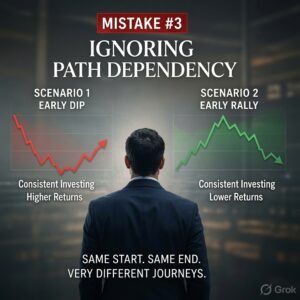
Imagine two different five-year journeys for the same market index, both starting at 100 and ending back at 100 — technically a flat, zero-return period on paper. In the first version, the market crashes to 50 early on and then slowly claws its way back up to 100. In the second version, the market rallies first to 150 and then falls back down to 100.
Scenario One — The Early Dip
If you were investing a fixed amount every month, and the fall happens early, you end up buying a large number of units cheaply during the downturn, and your overall return could end up strongly positive — potentially 60 to 70 percent — purely because of when the dip occurred relative to your buying schedule.
Scenario Two — The Early Rally
In the second scenario, where the rally happens first, you end up buying most of your units at inflated prices, and you could actually finish with a negative return, even though the market itself is “flat” from start to end.
What This Means for Systematic Investors
The lesson here isn’t about predicting which path a market will take — nobody can reliably do that. The lesson is that the path matters enormously for systematic investors, and that consistency through both good and bad stretches of a cycle is what allows the averaging effect to work in your favor over time.
The “I Don’t Know and I Don’t Care” Portfolio
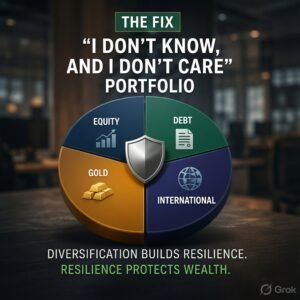
One of the more useful mental models in long-term investing sounds almost too simple to be powerful: build a portfolio that lets you comfortably say “I don’t know, and I don’t need to know.”
Why Confident Predictions Are Usually Noise
Think about how many confident predictions circulate in the financial world at any given time. Someone will insist a particular country’s markets are about to outperform every other market for the next five years. Someone else will claim a specific global sector is about to have its moment. The honest answer to almost all of these predictions, for almost all investors, should be: I don’t know, and I don’t need to know.
How Diversification Buys You Peace of Mind
The way you earn the right to say that comfortably — without anxiety, without feeling like you’re missing out — is by holding a genuinely diversified, multi-asset portfolio in the first place. When your portfolio already includes a mix of asset classes, sectors, and geographies, there will almost always be something inside it that is doing well at any given moment, even while other parts are lagging.
A well-diversified portfolio will rarely deliver the single highest possible return in any given year. But it will also rarely deliver the worst possible outcome, and that asymmetry is exactly what allows an investor to stay in the game long enough for compounding to actually do its work.
The New Version of an Old Trap: Chasing the Next Big Theme
Every era of investing produces its own version of the irresistible story.
From Infrastructure Stocks to AI Stocks
A few years ago, it was a fast-growing manufacturing and infrastructure narrative tied to a specific country’s economic rise. More recently, it has become viral stories of extraordinarily young analysts and fund managers who built enormous personal fortunes almost overnight by betting heavily on a single fast-moving technology theme.
Genuine Growth vs. Euphoric Pricing
The uncomfortable truth is that yes, certain narrow technology-driven themes genuinely have performed extremely well over the last few years. That part is factually true. But the conclusion many investors draw from it — that they need to abandon a sound, diversified strategy and pile into the same narrow bet — is exactly the mistake that has played out identically in previous cycles with previous themes.
The good news is that thoughtful, diversified fund options that participate meaningfully in global growth themes have existed for years, often launched well before any particular theme became a viral sensation. An investor doesn’t need to abandon discipline to get exposure to genuine global growth trends; they simply need to access that exposure through a diversified structure rather than betting the majority of their capital on a single narrow idea at its most euphoric moment.
Signs of Froth to Watch For
Ironically, some of the most crowded, hyped segments of global markets today have already experienced sharp corrections of 40, 50, even 70-plus percent in specific well-known names, even while headlines continued celebrating the broader theme. This is the exact same pattern investors have seen before — enthusiasm and eventual over-extension, followed by a painful reset that arrives one or two years after the excitement peaks, not immediately.
What Actually Works: Principles Over Predictions
If there’s one meta-lesson underlying all of this, it’s that good long-term investing is built on principles, not predictions. Nobody — no matter how experienced or well-informed — can reliably tell you what will happen in markets over the next six or twelve months. What experienced investors can tell you, with much higher confidence, is what tends to happen over long periods of time to disciplined, diversified, patient capital.
Buy reasonably good assets at reasonable valuations. Hold them across a full market cycle rather than jumping in and out based on the news of the week. Accept that the future is inherently uncertain in the near term, and structure your portfolio so that uncertainty doesn’t derail you.
ai image Practical Takeaways for Beginner Investors
Six Rules Worth Remembering
-
- Treat market downturns as opportunity, not danger. A falling price on a fundamentally sound asset is a discount, not a warning sign — provided the underlying value hasn’t actually deteriorated.
- Be suspicious of any story that everyone agrees on. When a narrative becomes universally accepted, it’s usually a sign that a lot of optimism is already priced in.
- Diversify across asset classes, not just stocks. A mix that includes different geographies, sectors, and asset types (equity, debt, gold, global exposure) smooths out the ride.
- Understand path dependency. If you’re investing systematically, remember that when gains and losses occur matters as much as how much you eventually gain or lose.
- Measure your time horizon in years, not months. The investors who actually captured the full long-term return were the ones who simply didn’t leave.
- Stay skeptical of “get rich fast” stories, including viral ones. For every spectacular short-term winner, there are far more quieter stories of people who piled in late and lost heavily.
Frequently Asked Questions
If bear markets are actually good buying opportunities, why do so few people invest during them?
Because bear markets don’t feel like opportunities while they’re happening — they feel like danger. Headlines are negative, portfolio values are falling, and job security often feels shakier. The disconnect between what looks safe (an already-inflated bull market) and what’s actually safer (a genuinely undervalued bear market) is precisely why disciplined investing is harder than it sounds.
What is path dependency in simple terms?
It means that the order in which gains and losses happen affects your final outcome, even if the start and end points of the market are identical. For a systematic investor adding money regularly, an early dip followed by a recovery tends to produce a better result than an early rally followed by a pullback.
Is chasing a “hot” investment theme always a bad idea?
Not always, but it’s risky when done with a large portion of your capital at the point of maximum hype. A more balanced approach is to gain exposure to promising themes through diversified funds that include them as one component, rather than making them your entire strategy.
How long does it really take to see the benefits of staying diversified and disciplined?
Historically, meaningful outperformance from discipline tends to show up over a full market cycle — which can mean anywhere from five to ten-plus years, including at least one significant downturn.
Does currency depreciation mean I should stop investing in domestic assets?
Currency movements are usually driven by a combination of factors — capital outflows, geopolitical tension, trade tensions, and global risk sentiment — and they tend to be cyclical rather than permanent trends. A well-diversified portfolio that includes some global exposure can help cushion this risk.

ai image Disclaimer
This article is for educational and informational purposes only and does not constitute personalized financial, investment, or tax advice. The examples used are illustrative and based on general historical market patterns rather than specific, named financial products or individuals. Past performance of any market, sector, or fund is not indicative of future results. Please consult a qualified financial advisor before making investment decisions based on your personal circumstances, risk tolerance, and financial goals.
-

Pranab Barman is a Financial Educator and Personal Finance Researcher with over 10 years of hands-on experience in stock markets, trading, and investing. Currently enrolled in the CFA Program, he is committed to continuous learning and professional excellence in finance.
As the Founder of PlayWithStock, Pranab covers a wide range of topics including Mutual Funds, SIP, Taxation, Stock Market Basics, and Financial Calculators — with a focus on simplifying complex financial concepts for everyday all investors.
Email: support@playwithstock.com
Website: playwithstock.com
Related posts:
 Common Behavioral Mistakes in Stock Trading
 What Is Sector Rotation? A Simple Guide for Indian Investors
 What is a Stock Split and Why Do Companies Do It
 Nifty July Seasonality: Why July Is Nifty’s Strongest Month (27-Year Data)
 India Crypto Tax Notices: 44,000 Investors Just Got a Letter
 Gold Price Correction 2026: What It Means for Indian Investors
 FATF Anti-Fraud Rules 2026: What They Mean for Indian Investors
 HDFC Bank Bonus Share: The Essential Guide for Investors 2026