
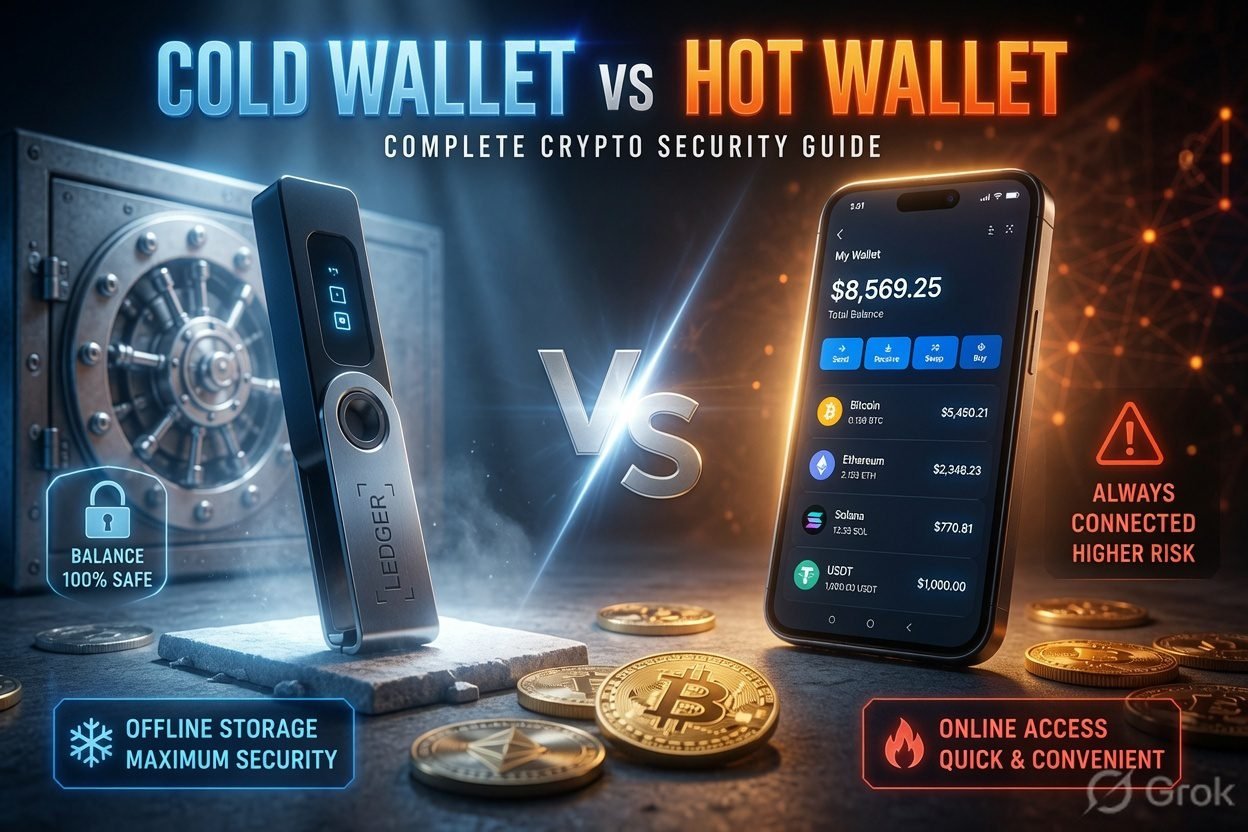

Cold Wallet vs Hot Wallet: The Complete Crypto Security Guide
$3.4 billion in crypto was stolen in 2025 alone — and 62% of it came out of hot wallets. The single biggest decision you'll make as a crypto holder isn't which coin to buy. It's where you keep the keys.
Table of Contents
- What Is a Crypto Wallet, Really?
- Cold Wallet vs Hot Wallet: The Core Difference
- Side-by-Side: Which Wins Where
- The Real Numbers: How Much Crypto Gets Stolen
- Which One Should You Actually Use
- Choosing a Cold Wallet: Ledger vs Trezor vs Others
- Universal Security Practices (Any Wallet Type)
- Common Mistakes That Lead to Theft
- Crypto Wallets and Indian Tax Considerations
- Frequently Asked Questions
Here's a fact that surprises most beginners: your cryptocurrency isn't actually stored inside your wallet at all. Every coin you own lives permanently on the blockchain — a shared public ledger. What your wallet actually holds is your private key: the cryptographic credential that proves you own those coins and authorizes you to move them.
The Keyring Analogy
Think of your wallet like a keyring rather than a safe. It doesn't store your money directly — it holds the key that unlocks access to money sitting elsewhere (on the blockchain). Whoever holds that key controls the coins, regardless of whose name is technically "on" the wallet. This single idea is the reason the entire cold wallet vs hot wallet debate exists in the first place: the question isn't really about wallets at all, it's about where your keys physically live.
The entire hot wallet vs cold wallet comparison comes down to one variable: internet connectivity. Everything else — convenience, cost, risk profile — flows directly from this single distinction.
Hot Wallets Explained
A hot wallet is any cryptocurrency wallet that maintains a persistent internet connection — typically a mobile app, browser extension, or desktop program. Because it's always online, a hot wallet lets you sign and broadcast transactions instantly, which makes it the natural choice for active trading, DeFi, and NFT activity.
Popular Hot Wallet Examples
- MetaMask — the default gateway for Ethereum and EVM-compatible DeFi activity
- Phantom — built for Solana, now expanded to Ethereum and Polygon, with built-in scam detection
- Trust Wallet — a popular mobile-first multi-chain option
- Blue Wallet — designed specifically for the Bitcoin ecosystem
Why Hot Wallets Feel Convenient
Nearly all hot wallets are free to download, require no additional hardware, and let you transact from anywhere in seconds. That convenience is precisely why hot wallets remain the default entry point for most new crypto users — but it's also exactly what creates their central weakness.
Cold Wallets Explained
A cold wallet stores private keys on a device that never connects to the internet, creating what security professionals call an "air gap" between your keys and anyone trying to reach them remotely. This offline isolation is what makes cold storage the recommended standard for any meaningful crypto holding.
Popular Cold Wallet Examples
- Ledger (Nano S Plus, Nano X, Nano Flex) — roughly 40% of the hardware wallet market
- Trezor (Model One, Model T, Safe 3, Safe 7) — roughly 30% of the hardware wallet market, fully open-source firmware
- Ellipal — a fully air-gapped device with no USB or Bluetooth connection at all
- Paper wallets — largely considered outdated and risky in 2026, due to physical damage risk and the awkward process of eventually importing keys back into a hot wallet to spend
How a Hardware Wallet Actually Works
A hardware wallet contains a secure element chip — similar to the chip inside a credit card or passport — that generates and stores your private key internally in a way that the key can never be extracted, even if the device is later plugged into a compromised computer. When you want to send a transaction, your phone or computer prepares an unsigned transaction and sends it to the hardware device, which signs it internally and returns only the signed result. Your private key itself never leaves the device or touches the internet at any point.
Rather than declaring one option universally "better," it's more useful to see exactly where each wallet type genuinely wins in this hot wallet vs cold wallet comparison.
Hot Wallet
Always Online
- Free to download, zero upfront cost
- Instant transactions — ideal for DeFi, NFTs, active trading
- Easy for absolute beginners to start with
- Higher exposure to phishing, malware, and remote attacks
- Best for smaller, frequently-used balances only
Cold Wallet
Always Offline
- One-time cost, typically $60-$220
- Immune to remote hacking — physical access is the only real threat
- Best for long-term holdings and larger balances
- Slightly slower and less convenient for frequent use
- Recommended once holdings exceed roughly $1,000-$5,000
Illustrative risk comparison based on 2025 theft data, where 62% of stolen funds came from hot wallets versus cold storage.
The cold wallet vs hot wallet decision isn't theoretical — the numbers behind crypto theft in 2025 make the stakes very concrete. Roughly $3.4-4.04 billion in cryptocurrency was stolen globally in 2025, and 62% of that total came directly out of hot wallets. Compromised private keys accounted for nearly half of all thefts industry-wide, according to Chainalysis data.
Self-custody — holding your own keys rather than leaving funds on an exchange — has surged as a result. Self-custody preference jumped to 59% in 2026, up from 42% in 2023, a 17-point increase driven substantially by two events: the FTX collapse and a massive 2025 hack on the Bybit exchange.
The Bybit Hack: A Case Study
In 2025, attackers linked to North Korea's Lazarus Group stole roughly $1.5 billion (401,000 ETH) from Bybit — one of the largest crypto thefts on record. Importantly, this wasn't a direct cold wallet compromise. The attackers exploited developer infrastructure at Safe{Wallet}, injecting malicious code to redirect funds during what should have been a routine transaction approval. Direct hardware cold wallet compromises, by contrast, remained statistically negligible through the same period.
Lazarus Group's crypto theft has escalated sharply year over year: $660.5 million in 2023 → $1.34 billion in 2024 (+102.9%) → a single 2025 breach that surpassed their entire 2024 total on its own.
Where Compromises Actually Happen
Individual (non-institutional) wallet breaches hit roughly 158,000 recorded cases in a single year, affecting around 80,000 victims. The overwhelming pattern across nearly all of these cases: the point of failure was a hot wallet, a phishing link, a compromised seed phrase, or a fake app — not a properly used, genuine hardware cold wallet.
The "Hot for Spending, Cold for Savings" Rule
Security researchers and institutional custodians converge on essentially the same practical rule for the hot wallet vs cold wallet question: use a hot wallet only for money you're actively using, and move everything else into cold storage. Security experts specifically recommend keeping 80% or more of total holdings in cold storage, reserving a hot wallet purely for active, everyday transactions.
A Simple Allocation Framework
- Under $1,000: A well-secured hot wallet with strong passwords, biometrics, and 2FA is generally acceptable
- $1,000-$5,000: This is the range where most security experts recommend making the jump to a hardware cold wallet
- Above $5,000, or if it's money you can't afford to lose: Cold storage is effectively non-negotiable
- Active DeFi/NFT users: Pair a hot wallet interface (like MetaMask) with a hardware signer (like Ledger) — you get a familiar interface with hardware-level signing security behind it
Matching the Choice to Your Actual Behaviour
The cold wallet vs hot wallet decision isn't purely about balance size — it's also about how you actually use crypto day to day. A day trader executing several transactions a week has fundamentally different needs than someone who bought Bitcoin two years ago and hasn't touched it since.
- The active trader: Needs a hot wallet for speed, but should still sweep profits into cold storage regularly rather than letting balances accumulate on a hot device or exchange
- The long-term holder ("HODLer"): Has almost no reason to keep meaningful funds anywhere but cold storage — access speed simply isn't a priority when the plan is to hold for years
- The DeFi participant: Benefits most from the hybrid model — a hot wallet interface signing through a connected hardware device, capturing both convenience and security
- The complete beginner: Reasonably starts with a small amount in a reputable hot wallet to learn the mechanics, then graduates to a hardware wallet once comfortable and once holdings grow
Framed this way, the hot wallet vs cold wallet question stops being a single one-time decision and becomes an ongoing habit — regularly reviewing how much sits in each, and moving funds accordingly as your balance and behaviour change.
Together, Ledger and Trezor command roughly 70% of the entire hardware wallet market — Ledger at approximately 40%, Trezor at approximately 30%.
| Device | Price | Security Chip | Notable Feature |
|---|---|---|---|
| Ledger Nano S Plus | $79 | EAL5+ | Entry-level, 5,500+ supported assets |
| Ledger Nano X | $149 | EAL5+ | Bluetooth connectivity |
| Trezor Model One | $69 | Standard | Fully open-source, budget entry point |
| Trezor Safe 3 | $79 | EAL6+ | Higher certification than same-priced Ledger |
| Trezor Model T / Safe 7 | $219 | EAL6+ | Quantum-ready security, Bluetooth, wireless charging |
Ledger
Ledger offers broader coin support (15,000+ assets) and more consumer-friendly features like Bluetooth pairing, but runs closed-source firmware — meaning the underlying code isn't independently auditable by the public in the same way Trezor's is.
Trezor
Trezor uses fully open-source firmware, allowing independent security researchers to audit the code directly. At an identical $79 price point, the Trezor Safe 3's EAL6+ security chip technically exceeds the Ledger Nano S Plus's EAL5+ certification.
What EAL6+ Actually Means
EAL (Evaluation Assurance Level) is a standardised security certification scale. EAL6+ confirms a chip has been tested against physical extraction attempts, side-channel attacks, and fault injection — the kinds of sophisticated physical attacks that matter most once you're already using cold storage correctly. For most individual investors, either EAL5+ or EAL6+ represents dramatically better security than any hot wallet, and the difference between the two matters far less than the difference between using a hardware wallet at all versus not using one.
Regardless of whether you land on a hot wallet, a cold wallet, or — like most experienced holders — a combination of both, a handful of practices apply universally.
Protecting Your Seed Phrase
Your seed phrase (also called a recovery phrase) is a set of 12-24 words that can fully regenerate your wallet and every key inside it on any device, anywhere. Whoever possesses your seed phrase effectively owns your crypto — full stop. This single string of words matters more than the wallet device itself.
What NOT to Do With Your Seed Phrase
- Never type it into any website, app, or "wallet verification" form — legitimate wallets never ask for it this way
- Never store it as a photo, screenshot, or note on an internet-connected device
- Never email it to yourself or store it in cloud storage or a password manager connected to the internet
- Never share it with anyone claiming to be "customer support" — this is one of the most common scam vectors in crypto
The safest approach remains genuinely offline: writing it on paper or, better, stamping it into a fireproof steel backup plate, stored somewhere physically secure.
Multi-Party Computation (MPC): The New Alternative
A newer technology, Multi-Party Computation, splits a private key into multiple encrypted fragments stored across separate locations, removing the need for a single seed phrase entirely and eliminating a single point of failure. MPC wallets are gaining traction particularly among institutional users, and represent a genuine third option beyond the traditional hot wallet vs cold wallet binary — though hardware cold storage remains the more battle-tested, widely understood choice for individual investors today.
Most losses in crypto don't happen because someone chose the "wrong side" of the cold wallet vs hot wallet decision — they happen because basic hygiene broke down regardless of which wallet type was in use. The following mistakes account for the overwhelming majority of individual losses:
- Keeping large, long-term holdings on an exchange — when an exchange holds your keys, your assets depend entirely on that exchange's security, which is outside your control (as the Bybit and FTX cases both demonstrated)
- Approving transactions too quickly — many losses trace back to a user approving a malicious transaction request without carefully reading what they were actually signing
- Using a paper wallet as a primary long-term solution — physical degradation and the need to eventually re-import the key into a hot wallet undermine the entire point of cold storage
- Buying a "discounted" hardware wallet from an unofficial reseller — devices can be tampered with before they reach you; always buy directly from the manufacturer
- Treating 2FA as optional — two-factor authentication remains one of the cheapest, highest-impact protections available for any hot wallet or exchange account
For Indian crypto holders, wallet choice has a practical bookkeeping dimension too. Hot wallets typically offer automated transaction history exports that integrate more easily with tax reporting tools, while cold wallet users often need to maintain manual transaction records for the same purpose. This record-keeping gap matters more than it might seem — Indian tax rules apply a flat 30% tax on crypto gains regardless of which wallet type held the asset, plus 1% TDS on qualifying transactions above prescribed thresholds, and neither obligation changes based on whether your keys sat in a hot wallet or a cold wallet.
Regardless of which wallet type you use, gains remain fully reportable — our coverage of India's crypto tax notices in 2026 walks through what's currently expected of individual filers, and how scrutiny has increased regardless of whether assets sit in a hot or cold wallet. Keeping clean, exportable records — easier with a hot wallet, but achievable with careful manual logs on cold storage too — makes filing considerably less stressful when the deadline approaches.
If you're new to crypto broadly, our coverage of Bitcoin's 2026 correction and general beginner investing guide are useful companion reads before allocating meaningful capital to any digital asset — and before deciding how to split that capital across hot and cold storage in the first place.
For security specifically, yes — cold wallets eliminate remote hacking as a threat entirely, since keys never touch the internet. But hot wallets remain genuinely better for convenience and frequent transactions. Most experienced holders use both: hot for spending, cold for savings.
Most security experts suggest making the move to a hardware cold wallet once holdings cross roughly $1,000-$5,000, since the one-time hardware cost becomes proportionally small relative to the assets being protected.
Remote hacking of a properly used hardware cold wallet is extremely rare — direct compromises were statistically negligible in 2025 industry data. The realistic risks with cold wallets are physical theft, loss, or a compromised seed phrase, not remote attacks.
For anything beyond small, active trading balances, this is generally discouraged. When an exchange holds your keys, your assets are exposed to risks entirely outside your control, as demonstrated by both the FTX collapse and the 2025 Bybit hack.
As long as you still have your seed phrase, your funds are fully recoverable on a new device — the hardware itself is just an interface. This is exactly why seed phrase security matters more than the physical device itself.

Pranab Barman is a Financial Educator and Personal Finance Researcher with over 10 years of hands-on experience in stock markets, trading, and investing. Currently enrolled in the CFA Program, he is committed to continuous learning and professional excellence in finance.
As the Founder of PlayWithStock, Pranab covers a wide range of topics including Mutual Funds, SIP, Taxation, Stock Market Basics, and Financial Calculators — with a focus on simplifying complex financial concepts for everyday all investors.
Email: support@playwithstock.com
Website: playwithstock.com
Related posts:
 Crypto Bookkeeping for Tax in India: The Complete 2026 Guide
 India Crypto Tax Notices: 44,000 Investors Just Got a Letter
 What is a Demat Account? A Complete Beginner’s Guide
 8th Pay Commission Salary Calculator: Complete 2026 Guide
 GST 2.0 for E-commerce Sellers (2026): Complete Guide
 How to Invest in Gold ETF: The Complete Gold ETF vs Physical Gold Guide
 Micro-Investing Apps for Beginners: A Complete Comparison
 The Ultimate Budgeting Guide That Works in 2026