
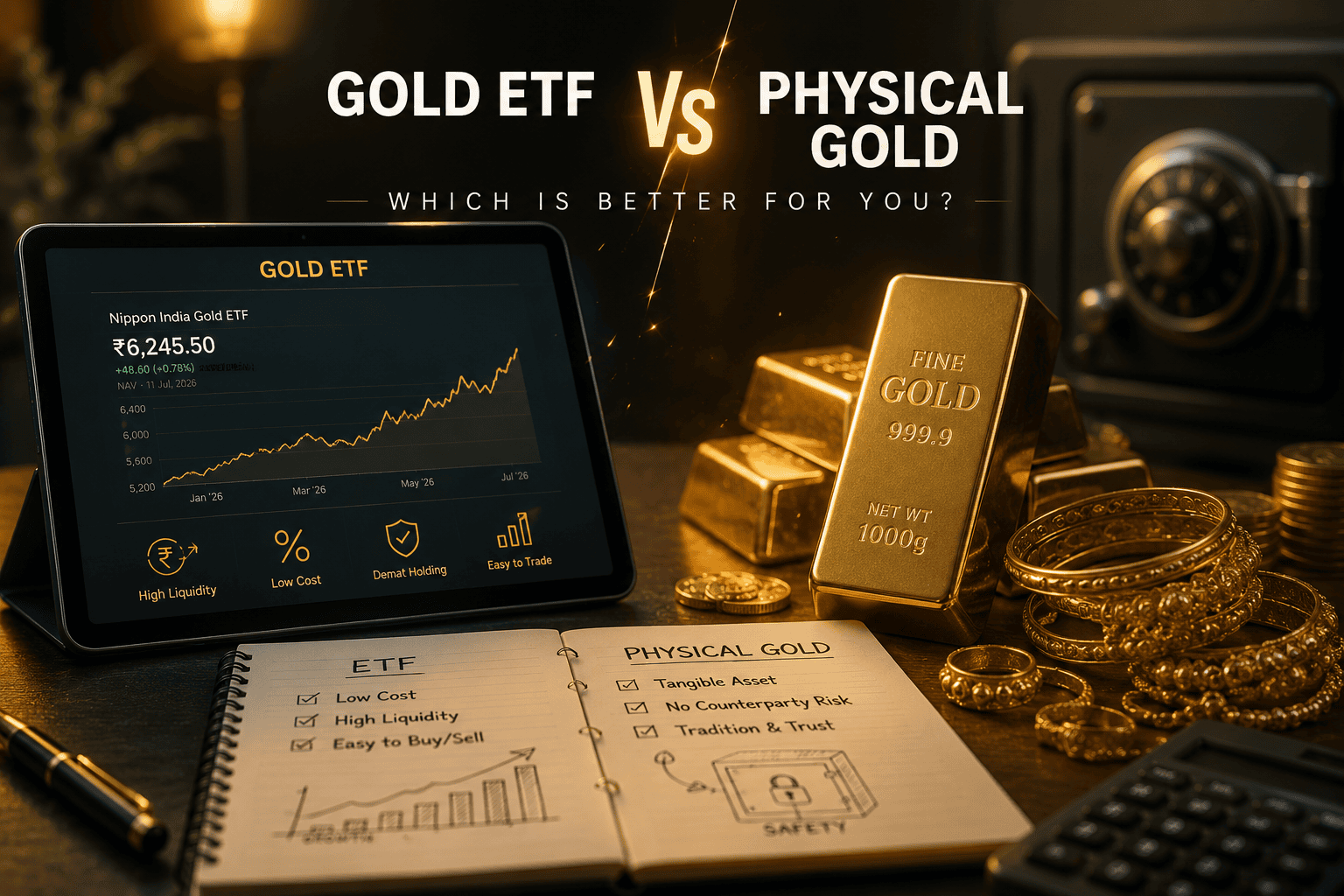

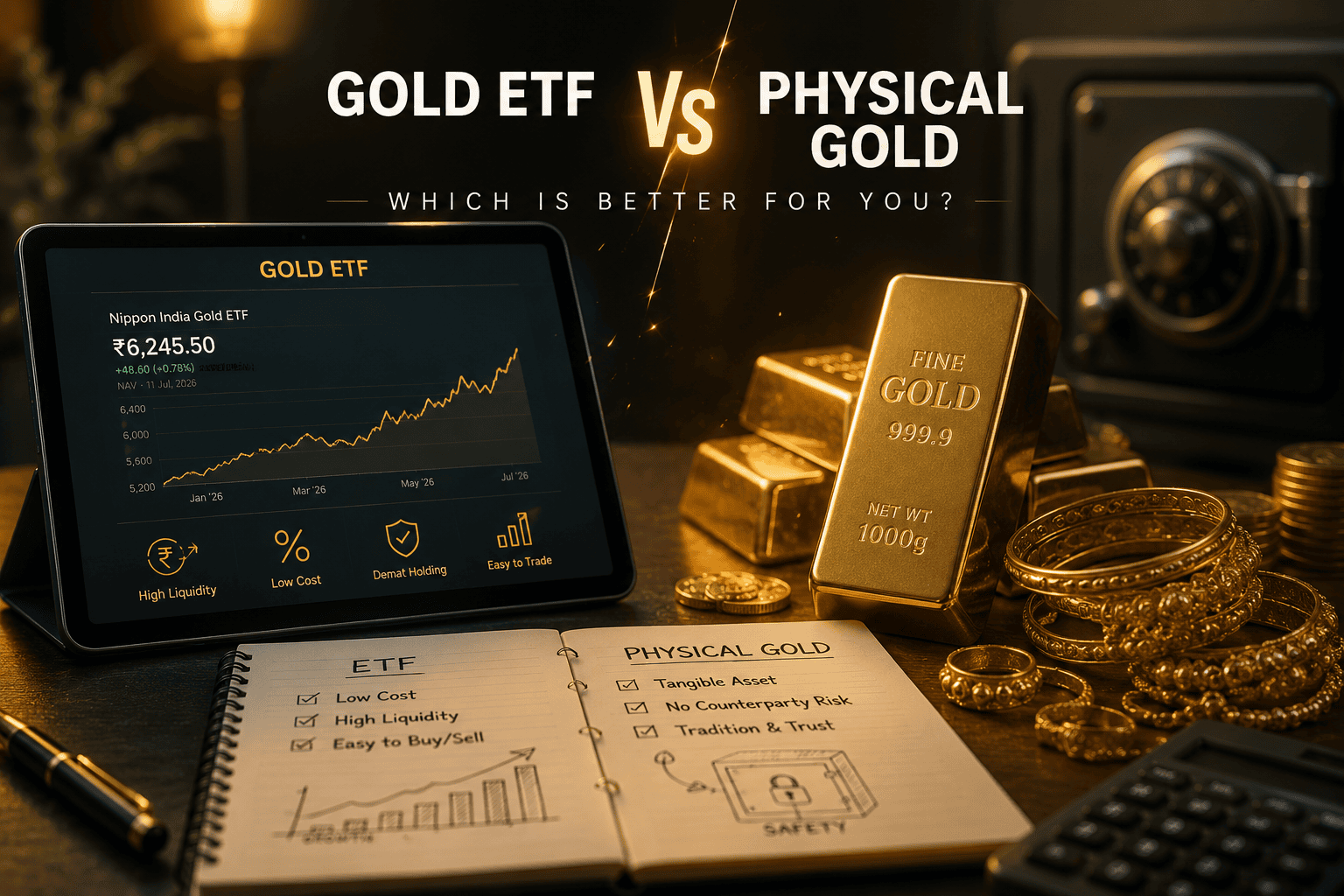
How to Invest in Gold ETF: The Complete Gold ETF vs Physical Gold Guide
Indian Gold ETF holdings grew 195% in a single year — while the country still imported ₹6 lakh crore worth of physical gold. Both can't be right for the same investor. Here's exactly how to know which one is right for you.
AMFI Data, May 2026
195% Growth in 1 Year
Gold ETF AUM jumped from ₹62,453 crore to ₹1,84,571 crore between May 2025 and May 2026, now held by 1.23 crore Indian investors.
Entry Cost Reality
0% GST on Gold ETFs
Jewellery carries a 15% entry gap (making charges + GST). Gold ETFs carry none — your ₹1,00,000 stays close to ₹1,00,000 of actual gold exposure.
Tax Advantage
12 Months vs 24 Months
Gold ETFs qualify for long-term 12.5% tax after just 12 months. Physical and digital gold need 24 months for the same rate.
India's Gold Habit
$71.98 Billion Import Bill
India's gold import bill hit a record in FY2025-26, with 186 tonnes imported in Q1 2026 alone — physical gold still dominates household buying.
Cost Efficiency
~0.5% Annual Expense
Leading Gold ETFs charge just 0.4-0.65% a year — no locker fees, no purity checks, no making charges eating into your investment.
Table of Contents
- The ₹71,000 Crore Question
- What Is a Gold ETF, Exactly?
- Side-by-Side: Gold ETF vs Physical Gold
- The Real Cost of Buying Physical Gold
- How to Invest in a Gold ETF: Step by Step
- Gold ETF vs Gold FoF vs Digital Gold vs SGB
- Tax Treatment Compared
- Calculator: Real Cost Comparison
- 2026 Data: Where Indians Are Actually Investing
- Who Should Choose What
- Common Mistakes to Avoid
- Frequently Asked Questions
Two numbers, published within weeks of each other in 2026, tell almost contradictory stories about how Indians actually invest in gold. Gold ETF assets under management (AUM) grew from ₹62,453 crore to ₹1,84,571 crore between May 2025 and May 2026 — a 195% increase in a single year, according to data from AMFI (Association of Mutual Funds in India), as tracked in recent industry reporting. At the very same time, India's gold import bill hit a record $71.98 billion for FY2025-26, with 186 tonnes imported in the first quarter of 2026 alone.
Both trends are real. Both are growing. And they represent two genuinely different philosophies about owning gold — one financial, one physical. This guide walks through exactly how to invest in a Gold ETF, how it actually compares to physical gold on cost, liquidity, and tax, and which one makes sense for your specific situation.
A Gold Exchange-Traded Fund (ETF) is a SEBI-regulated mutual fund scheme that holds physical gold of at least 99.5% purity in secure, insured custody, and issues units that trade on the stock exchange — NSE or BSE — exactly like a company's shares, as detailed in Upstox's 2026 gold investment guide. Most Gold ETF units represent approximately 1 gram of gold each, though some products like Gold BeES offer micro-units around 0.01 gram, enabling very small entry amounts.
How Gold ETFs Actually Work
When you buy a Gold ETF unit through your demat account, you're buying a claim on real, physically-held gold sitting in a fund's vault — not a derivative or a synthetic contract. As gold prices move, the ETF's Net Asset Value (NAV) moves correspondingly, though not perfectly, due to a small effect called tracking error, a nuance explored in depth by Finology's Gold ETF ranking methodology.
SEBI's 95% Rule
Under SEBI regulations, at least 95% of a Gold ETF's assets must be invested directly in physical gold, with the small remainder held in cash or liquid instruments to manage day-to-day redemptions. This cash buffer, combined with the fund's annual expense ratio and minor execution-timing differences, is what causes a Gold ETF's returns to deviate very slightly from the actual spot price of gold — a gap known as tracking error, which tends to matter more to long-term holders than the headline expense ratio alone.
Rather than declaring one option universally superior, here's exactly where each genuinely wins — a comparison worth revisiting periodically alongside your broader portfolio allocation as goals and market conditions evolve.
Gold ETF
Paper Gold, Demat-Held
- Zero GST at purchase, no making charges
- Highly liquid — buy or sell in seconds during market hours
- LTCG tax kicks in after just 12 months
- Annual expense ratio of roughly 0.4-0.65%
- Requires a demat account; no physical possession
Physical Gold
Jewellery, Coins & Bars
- Tangible asset — usable as jewellery, giftable, culturally significant
- 3% GST plus making charges (jewellery) or purity premium (coins/bars)
- LTCG tax requires a 24-month holding period
- Ongoing locker/storage costs, plus theft and purity risk
- Selling involves purity checks and typically a 5-10% discount to spot
The sticker price of gold is never the real price you pay for physical gold — and this gap is exactly what most first-time buyers underestimate, a pattern OroPocket's detailed cost breakdown quantifies clearly across every physical route.
Jewellery's Hidden Double GST
As of 2026, buying gold jewellery involves what's effectively a double GST structure: 3% tax on the gold's metal value, plus a separate 5% tax on the making charges (treated as a service fee). Add typical making charges of 10-25% on top, and jewellery buyers face an entry gap of roughly 15% before the gold has moved in price at all — meaning a ₹1,00,000 purchase might represent closer to ₹85,000 of actual gold exposure from day one.
Coins and Bars: A Cheaper Physical Option
BIS-hallmarked coins and bars carry a considerably smaller entry gap — typically a 4% premium over spot plus 3% GST, roughly a 7% total gap, since there's no making-charge component. This makes coins and bars the more cost-efficient physical route if tangible ownership genuinely matters to you, though the gap still exceeds what a Gold ETF investor pays. Beyond the purchase-time gap, physical gold also carries ongoing costs that Gold ETFs simply don't — bank locker rentals, insurance premiums, and the risk of theft from home storage, all of which independent comparison research consistently flags as underweighted costs in most buyers' mental math.
Open a demat and trading account
Any SEBI-registered broker works — the same account you'd use for stocks. If you already trade equities on the NSE or BSE, you can buy Gold ETFs through it immediately.
Choose a Gold ETF based on liquidity and tracking accuracy
Prioritise funds with high trading volume (to minimise bid-ask spreads) and a strong record of low tracking error — Nippon India Gold BeES, SBI Gold ETF, HDFC Gold ETF, and ICICI Prudential Gold ETF together hold roughly two-thirds of the category's total AUM.
Place your order during market hours
Buy units just like you would a stock — market or limit order, executed in seconds, with settlement typically completed by T+1.
Consider a monthly SIP rather than a lump sum
Many brokers support recurring Gold ETF purchases, applying the same rupee cost averaging principle used in equity SIPs — smoothing your entry price over time rather than betting on a single day's gold price.
Track holding period for tax planning
Note your purchase date carefully — crossing the 12-month mark shifts your eventual sale from slab-rate taxation to the flat 12.5% long-term rate, a distinction worth planning redemptions around.
Gold ETFs aren't the only "paper gold" option — three related alternatives are worth understanding before you choose.
Gold Fund of Funds (FoF)
A Gold FoF doesn't hold gold directly — it invests in an underlying Gold ETF, creating a dual-layer expense structure where you effectively pay both the ETF's expense ratio and the FoF's own additional charges. The upside: Gold FoFs don't require a demat account, making them accessible via a simple mutual fund SIP for investors who haven't opened a trading account. The tradeoff is a 24-month LTCG holding period, same as physical gold, rather than the ETF's 12-month advantage.
Digital Gold
Platforms offering digital gold let you buy fractional gold (sometimes from ₹1) that's held in insured vaults by the provider. Unlike Gold ETFs, digital gold is not regulated by SEBI or RBI — its safety depends entirely on the credibility of the specific platform offering it, an important distinction from the regulatory backing that a demat-held ETF carries, a gap OroPocket's platform comparison specifically flags for first-time digital gold buyers.
Sovereign Gold Bonds (SGB)
SGBs remain the most tax-efficient gold instrument on paper — historically offering fully tax-free capital gains if bought directly from RBI at issuance and held to the full 8-year maturity, plus a 2.5% annual interest component (itself taxed at your slab rate). However, the RBI has not issued new SGB tranches since 2024, meaning this option is now only available to existing holders or via secondary-market purchase — and buying on the secondary market, or exiting before maturity, both now attract the standard 12.5% tax under rules revised from April 1, 2026, per Grip Invest's 2026 gold taxation breakdown. If you're holding legacy SGBs, understanding premature redemption mechanics is worth reviewing before any early exit.
Tax treatment is where paper gold carries its clearest structural edge over every physical or physical-adjacent option, as confirmed by Appreciate Wealth's detailed taxation guide and Zerodha Fund House's own tax documentation.
| Instrument | LTCG Holding Period | LTCG Tax Rate | STCG Tax |
|---|---|---|---|
| Gold ETF | 12 months | 12.5% (no indexation) | Slab rate |
| Physical Gold / Digital Gold | 24 months | 12.5% (no indexation) | Slab rate |
| Gold Mutual Fund (FoF) | 24 months | 12.5% (no indexation) | Slab rate |
| SGB (RBI issuance, held to maturity) | 8 years | Tax-free | N/A |
| SGB (secondary market or early exit) | — | 12.5% | Slab rate |
The 12-Month vs 24-Month Advantage
This one-year difference is more consequential than it first appears. An investor who buys ETF units in March 2026 can exit at the favourable 12.5% long-term rate as early as April 2027. A physical gold buyer making the identical purchase remains locked into slab-rate taxation until 2028 to access the same rate — a full extra year of tax exposure on any gains, purely due to the instrument chosen, not the investment decision itself.
A Real Worked Example
Consider an investor who buys 100 units worth ₹7,00,000 in May 2025 and sells them in July 2026 for ₹12,00,000. The holding period works out to 14 months — comfortably past the 12-month LTCG threshold. Tax owed: 12.5% of the ₹5,00,000 gain, or ₹62,500 (plus applicable cess). Had the same investor held physical gold with an identical purchase and sale timeline, the 14-month holding period would still fall short of the 24-month LTCG requirement — meaning the entire gain would instead be taxed at the investor's income slab rate, potentially 30% for a higher earner, more than double the effective tax outgo on an identical gain.
Filing Your Gold Investment Gains
Regardless of which route you choose, capital gains from gold investments must be reported under the "Capital Gains" section of your income tax return — typically ITR-2 for individuals without business income, filed correctly by the annual filing deadline. Keeping clean transaction records, including purchase dates for each individual lot if you've bought gradually via SIP, makes this reporting considerably less stressful when tax season arrives, a discipline closely related to the recordkeeping habits discussed in our tax-loss harvesting guide.
Enter your investment amount to see how much actual gold exposure you'd start with across the four common routes — before any price movement at all.
Gold ETF vs Physical Gold: Entry Cost Comparator
Based on typical 2026 GST, making charge, and premium structures
Figures are illustrative averages based on typical 2026 market rates; actual costs vary by jeweller, platform, and specific fund. Gold ETF figures include an approximate annual expense ratio drag over the selected holding period.
The category recorded a net outflow of ₹725 crore in May 2026 — a notable reversal after months of strong inflows, largely reflecting profit-booking after gold's sharp rally, consistent with broader trends explored in our coverage of the 2026 gold price correction. Indian funds collectively hold 116.3 tonnes of gold, with year-to-date net inflows of $3.48 billion despite the recent monthly outflow. Major funds delivered returns of roughly 61-62% over the past year — tracking just below gold's actual spot price rise, once fees and minor tracking error are accounted for. For readers who prefer directly comparing this performance against their equity holdings or broader index exposure, tracking both asset classes side by side over the same period offers a genuinely useful reality check on how differently gold and stocks actually move.
Despite this financialisation trend, physical gold remains deeply embedded in Indian household behaviour — weddings, festivals, and generational wealth transfer continue to drive substantial coin and jewellery demand, even as a growing share of purely investment-oriented capital shifts toward the paper-gold route. This dual pattern mirrors broader macro dynamics too: a weaker rupee, tracked closely via the Dollar Index, tends to push India's gold import bill even higher in rupee terms, reinforcing why understanding currency movements alongside gold allocation decisions matters for a complete picture.
- Pure investors seeking gold as a portfolio hedge: The exchange-traded route is generally the more efficient choice — lower entry cost, faster tax efficiency, and no storage risk
- Buyers needing gold for weddings, gifting, or cultural use: Physical gold (preferably BIS-hallmarked coins/bars over ornate jewellery) remains the natural choice, since paper gold can't be worn or gifted as a physical object
- Investors without a demat account: A Gold FoF offers similar exposure via a standard mutual fund SIP, accepting the tradeoff of a 24-month LTCG period and a slightly higher combined expense structure
- Long-horizon investors who can commit 8 years: Existing SGB holders should generally hold to maturity where possible, given the tax-free treatment that route alone retains
- First-time investors testing the waters: Starting with a small, regular monthly commitment — even ₹2,000-3,000 — via either a direct fund purchase or a Gold FoF SIP builds the habit without requiring a large upfront decision, mirroring the same low-barrier philosophy behind micro-investing apps more broadly
Most financial planners suggest allocating roughly 5-10% of a total portfolio to gold as a diversification and inflation hedge — a principle that applies regardless of which specific instrument you choose, and one that complements a core equity investing strategy and regular SIP contributions rather than replacing them. For broader context on gold's own price behaviour, see our coverage of the 2026 gold price cycle, and for those also holding equity via a demat account, comparing this allocation against broader Nifty 50 performance helps confirm whether your overall diversification is genuinely balanced rather than accidentally concentrated in one direction.
Even investors who understand the theory get tripped up by a handful of recurring, avoidable mistakes when actually executing a gold investment plan:
- Buying jewellery as a pure investment: The 15% entry gap from making charges and double GST makes ornate jewellery a poor vehicle for anyone whose primary goal is investment return rather than wearability
- Ignoring tracking error when comparing funds: A fund charging a slightly higher expense ratio but tracking gold more tightly can outperform a cheaper, more volatile alternative — expense ratio alone doesn't tell the full story
- Forgetting the holding-period difference: Selling a physical gold holding at the 20-month mark, assuming LTCG treatment, results in an unwelcome slab-rate tax surprise since the threshold is 24 months, not 12
- Treating digital gold as SEBI-regulated: Unlike demat-held funds, digital gold platforms are not overseen by SEBI or RBI — safety depends entirely on the specific provider's own credibility and insurance arrangements
- Overallocating to gold during a rally: Chasing gold after a strong price run, rather than maintaining a steady target allocation, is the same behavioral trap that affects equity investors buying near market tops
- Confusing a Gold FoF with a direct Gold ETF purchase: The dual-layer expense structure of a Fund of Funds, and its longer 24-month holding period, make it a meaningfully different product from a direct ETF purchase, even though both ultimately provide gold price exposure
Building sound gold exposure into a broader financial plan pairs naturally with other core habits — comparing fund costs via our Mutual Fund TER vs BER calculator, maintaining a structured budgeting approach, and reporting gains correctly by the annual ITR filing deadline. As FinPlann's founder-authored guidance notes, gold works best as a long-term portfolio stabiliser rather than a trading instrument — its ~8% historical CAGR trails equity's 12-14%, but it moves differently, which is precisely the point. Broader macro factors — including Dollar Index movements, Fed policy decisions, and domestic inflation trends — all influence gold prices in ways worth tracking alongside your allocation decision. For more, explore our full Personal Finance section or browse the complete Play With Stock article library.
For pure investment purposes, Gold ETFs are generally more efficient — no GST or making charges, better liquidity, faster tax efficiency (12-month vs 24-month LTCG threshold), and full SEBI regulatory backing. Physical gold remains preferable for cultural, wearable, or gifting purposes.
Yes, Gold ETFs require a demat and trading account since they trade on the stock exchange like shares. If you don't have one, a Gold Fund of Funds (FoF) offers similar exposure via a standard mutual fund SIP, though with a longer 24-month LTCG holding period.
Most financial planners suggest allocating roughly 5-10% of a total portfolio to gold as a diversification tool and inflation hedge, though this varies based on individual risk tolerance and existing asset allocation.
The RBI has not issued new SGB tranches since 2024. Existing SGBs can still be bought on the secondary market via stock exchanges, but such purchases (and any early exit) no longer qualify for the tax-free treatment reserved for original RBI-issuance holders who stay invested to maturity.
No. Unlike Gold ETFs, digital gold is not regulated by SEBI or RBI. Its safety depends entirely on the credibility and insurance arrangements of the specific platform offering it, which is an important distinction from the regulatory backing Gold ETFs carry.


Pranab Barman is a Financial Educator and Personal Finance Researcher with over 10 years of hands-on experience in stock markets, trading, and investing. Currently enrolled in the CFA Program, he is committed to continuous learning and professional excellence in finance.
As the Founder of PlayWithStock, Pranab covers a wide range of topics including Mutual Funds, SIP, Taxation, Stock Market Basics, and Financial Calculators — with a focus on simplifying complex financial concepts for everyday all investors.
Email: support@playwithstock.com
Website: playwithstock.com
Related posts:
 What is a Demat Account? A Complete Beginner’s Guide
 GST 2.0 for E-commerce Sellers (2026): Complete Guide
 Gold Price All Time High India: Should You Buy Now or Wait in 2026
 Gold Price Correction 2026: What It Means for Indian Investors
 8th Pay Commission Salary Calculator: Complete 2026 Guide
 Cold Wallet vs Hot Wallet: The Complete Crypto Security Guide
 Crypto Bookkeeping for Tax in India: The Complete 2026 Guide
 Micro-Investing Apps for Beginners: A Complete Comparison