

HDFC Bank, ICICI Bank, Axis Bank & Kotak Bank Q1 FY27 Results: The Complete Comparison
All four major private banks report on the same day — July 18, 2026. Here's how their profit, margins, and loan growth stack up against each other, before and after the numbers land.
Q1 FY27 results for India's four biggest private banks — HDFC Bank, ICICI Bank, Axis Bank, and Kotak Mahindra Bank — all land on the same date this year: Saturday, July 18, 2026. That's unusual, and it means investors get a rare same-day snapshot of the entire private banking sector's health for the April–June quarter, instead of the numbers trickling in over two separate weeks.
We've been tracking each bank's pre-results commentary from brokerages all week, and one thing stands out immediately: this isn't a uniform quarter. Axis Bank is heading into results with some of the strongest brokerage optimism in years, while ICICI Bank's own analyst coverage is unusually flat. That divergence alone makes this earnings day worth watching closely, rather than assuming "banks did fine" as a blanket read.
ContextWhy All Four Banks Report the Same Day
It's not a coincidence, exactly — but it is a scheduling overlap that doesn't happen every quarter. HDFC Bank, ICICI Bank, Axis Bank, and Kotak Mahindra Bank have each individually informed the exchanges of a July 18, 2026 board meeting to approve their unaudited Q1 FY27 financial results. Axis Bank confirmed its board meeting date back in June, and the other three followed with similar filings over the following weeks.
For readers tracking the broader banking sector rather than a single stock, this is actually useful: instead of piecing together a sector view from results spread across ten days, you get one clean data point across all four lenders simultaneously. We'd treat this less as noise and more as a genuine opportunity to compare like-for-like, since all four banks faced the identical macro backdrop — the same RBI rate environment, the same deposit competition, the same seasonal agri-slippage pattern — during the exact same 90-day window.
It's worth remembering that a shared reporting date doesn't mean a shared outcome. Each of these four banks runs a genuinely different loan book: HDFC Bank leans heavily into mortgages and secured retail lending following its 2023 merger with HDFC Ltd, ICICI Bank has meaningful rural and agri exposure that shows up in seasonal provisioning patterns, Axis Bank has been actively integrating its Citi India retail acquisition into its core book, and Kotak Mahindra Bank runs a comparatively smaller, more conservative balance sheet relative to the other three. A single results day doesn't erase those structural differences — if anything, reporting on the same date makes those differences easier to see clearly, since every other variable in the quarter was identical.
There's also a simple practical reason this matters for readers: earnings-day stock reactions tend to be sharper when multiple large-cap names report together, since the entire banking sector, and by extension the Nifty Bank index, can move meaningfully within a single trading session based on how these four prints land relative to expectations. Anyone holding banking-sector mutual funds or a Bank Nifty-linked product, not just individual bank shares, has a stake in how this day plays out.
SnapshotQuick Comparison: All 4 Banks at a Glance
Before diving into each bank individually, here's the consolidated view of what brokerages are pricing in ahead of results. These are estimates, not confirmed numbers — treat the ranges as the market's current expectation, not a guarantee.
| Bank | Results Date | PAT Estimate Trend | NII/Margin Outlook | Loan Growth Signal |
|---|---|---|---|---|
| HDFC Bank | 18 Jul 2026 | PAT +9% YoY (Motilal Oswal) | NII +8.5% YoY to ~₹34,100 Cr; NIM flat-to-moderate QoQ | Healthy double-digit, gold/corporate/mortgage-led |
| ICICI Bank | 18 Jul 2026 | PAT ~flat, +2.3% YoY (Axis Direct: ₹13,062 Cr) | NII +10% YoY; NIM seen ~4.25%, slightly lower QoQ | Loan growth to lead peers, ~4% QoQ |
| Axis Bank | 18 Jul 2026 | PAT +28.4% YoY est. (Systematix: ₹7,452 Cr) | NII +9.4% YoY to ₹14,840 Cr; NIM ~4%, marginal dip | Advances +18.8% YoY to ₹12.73 lakh Cr (provisional, confirmed) |
| Kotak Mahindra Bank | 18 Jul 2026 | Credit cost may tick up moderately | NIM to contract ~14 bps QoQ | Loan-deposit growth ~3.5% QoQ |
Sources: Business Standard, Motilal Oswal, Systematix Research, Axis Direct, Deven Choksey Research — full citations in the References section below.
Bank 1HDFC Bank Q1 FY27 Preview
HDFC Bank, India's largest private lender, is scheduled to report results on Saturday, July 18. Analysts describe this as a likely "mixed quarter" — not a clean beat, not a clear miss, but steady, unremarkable progress on most fronts.
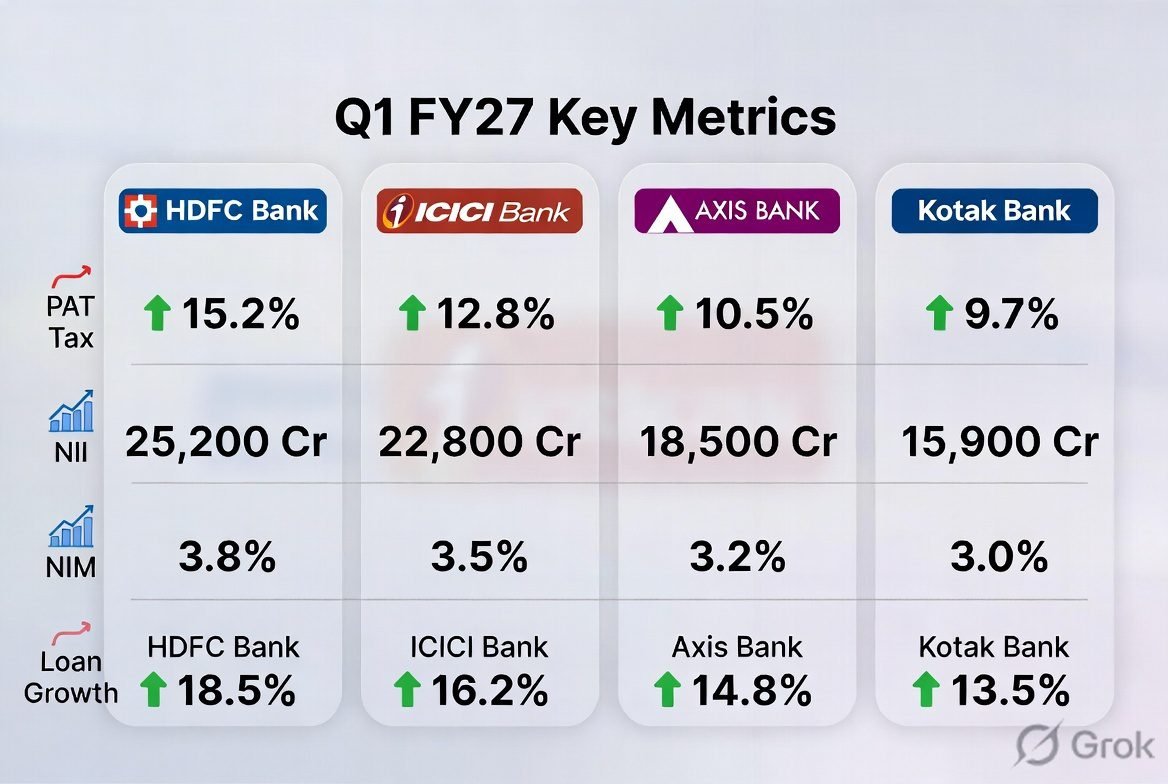
Motilal Oswal's estimate has Net Interest Income (NII) rising 8.5% year-on-year to roughly ₹34,100 crore, with Profit After Tax (PAT) expected to grow around 9% YoY. Net Interest Margins are broadly expected to stay flat or moderate slightly quarter-on-quarter, and asset quality across loan segments is expected to remain steady.
What we'd actually watch here isn't the headline profit number — it's loan growth composition. Gold loans, corporate lending, and mortgages are all flagged by Motilal Oswal as the segments driving growth this quarter, and deposits are projected to rise around 15.2% annually. If that mix holds, it suggests HDFC Bank is leaning into secured, lower-risk lending rather than chasing unsecured retail growth — a conservative posture worth noting if you're evaluating the stock for the next few quarters, not just this one print.
We'd treat HDFC Bank's management commentary as more important than the PAT number itself this quarter. The stock has faced governance-related scrutiny through 2026, and how directly management addresses that on the earnings call — rather than the specific NIM print — is likely to move sentiment more than the headline beat or miss.
There's also a longer-running storyline worth keeping in view: HDFC Bank has spent much of the past two years digesting its 2023 merger with parent HDFC Ltd, which roughly doubled its balance sheet overnight and shifted its loan mix meaningfully toward mortgages. That integration process affects how comparable this quarter's numbers are to pre-merger periods, and it's part of why brokerages tend to focus more on sequential (QoQ) trends than year-on-year comparisons when reading HDFC Bank's recent quarters. If Saturday's print shows continued stability in the merged loan book's asset quality, that's arguably a more meaningful signal for the stock's medium-term trajectory than whether PAT growth lands at 8% or 10% YoY.
Bank 2ICICI Bank Q1 FY27 Preview
ICICI Bank's preview commentary this quarter is notably more cautious than HDFC Bank's or Axis Bank's. Axis Direct pegs PAT at ₹13,062 crore, down 4.7% quarter-on-quarter but still up 2.3% year-on-year. Deven Choksey Research's estimate is nearly identical — a 4.4% sequential decline to ₹13,093 crore, with a similar 2.5% YoY gain.
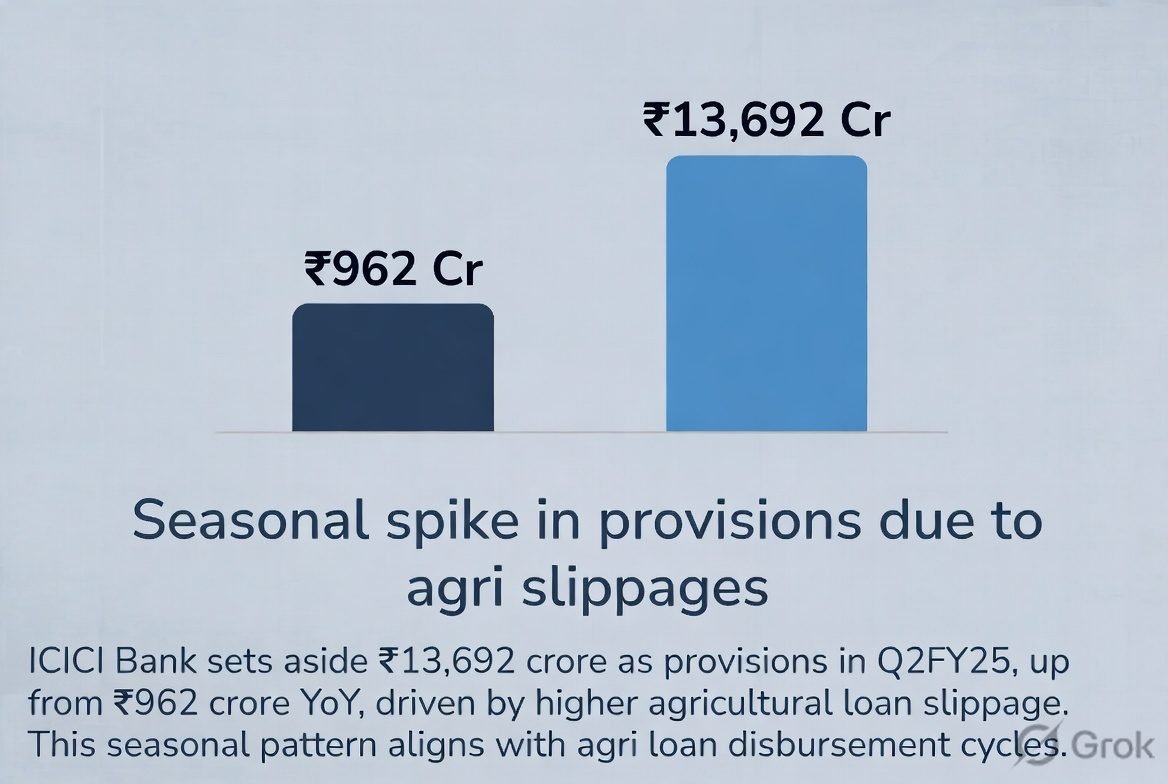
NII is expected to grow a healthier 10% YoY, pointing to steady core operating performance even as the headline profit number looks flat. The gap between "NII growing fine" and "PAT barely moving" usually comes down to one thing: provisions. Deven Choksey Research sees provisions jumping sharply to around ₹13,692 crore from just ₹962 crore the previous quarter — a swing largely tied to seasonal KCC (Kisan Credit Card) and agri-linked slippages, which is a recurring, expected pattern in India's June quarter for banks with meaningful rural exposure.
| Metric | Q1 FY27 Estimate | QoQ Change | YoY Change |
|---|---|---|---|
| Net Profit (PAT) | ₹13,062 – ₹13,093 Cr | -4.4% to -4.7% | +2.3% to +2.5% |
| Net Interest Income | Growing ~10% YoY | +3-4% | +10% |
| Net Interest Margin | ~4.25% (reported basis) | Slightly lower | — |
| Provisions | ~₹13,692 Cr | +1,324% (seasonal) | -24.5% |
ICICI Bank's loan book growth is still expected to lead the large-bank pack at around 4% QoQ, according to Motilal Oswal — so the flat profit story here is really a provisioning story, not a growth story. Worth remembering before assuming a soft headline number means a soft quarter.
It's also worth putting this quarter in context against ICICI Bank's own recent history. The bank has generally been one of the more consistent performers among large private lenders over the past several years, with a provision buffer that Deven Choksey Research describes as "among the strongest in coverage" at roughly 84 basis points of loans — well above what many peers carry. That buffer matters practically: it gives management room to absorb a seasonal slippage spike like the one expected this quarter without it translating into a genuine credit-quality scare. A bank with a thinner provision cushion facing the same seasonal pattern would likely see a sharper stock reaction to an identical set of numbers.
Bank 3Axis Bank Q1 FY27 Preview
Axis Bank goes into this results day with the most bullish brokerage commentary of the four. Systematix Research expects a 28.4% year-on-year jump in net profit to ₹7,452 crore — a meaningfully sharper gain than what analysts are pricing in for HDFC Bank or ICICI Bank. NII is projected to rise 9.4% YoY (2.6% QoQ) to ₹14,840 crore.
Some of this is already partly confirmed: Axis Bank's own provisional business update, filed with exchanges ahead of results, shows gross advances at ₹12,72,900 crore, up a strong 18.8% year-on-year and 2.3% quarter-on-quarter. Total deposits rose to ₹13,72,900 crore, up 18.2% YoY. That's real, filed data — not a brokerage guess — and it's a meaningfully stronger growth print than what Axis Bank was posting in the same quarter a year ago, when loan growth was closer to 7-8% YoY and margins were under visible pressure.
Credit costs are expected to moderate in FY27 "due to a reduction in technical slippages," per Systematix, and operating expenses are projected to decline sequentially even with seasonal bonus payouts factored in. The one soft spot flagged across brokerage notes: a marginal NIM decline is still expected, driven by a slight uptick in the cost of deposits.
We'd flag Axis Bank as the one name this quarter where the pre-results setup and analyst tone diverge sharply from where the stock was a year ago. A near-19% YoY advances number, already confirmed via provisional filing, is a genuinely different growth profile than the "muted, low single-digit" story that defined Axis Bank's Q1 FY26 print. Whether that translates into a strong headline PAT beat on July 18 is the real test.
Two more data points worth noting from Axis Bank's recent disclosures: the bank raised ₹5,000 crore via 10-year infrastructure bonds in May 2026 to support its long-term lending book, and its digital platform "Neo by Axis" crossed 10 million active users in April 2026. Neither of these shows up directly in a single quarter's PAT number, but both point toward a bank investing in funding diversification and digital distribution simultaneously — the kind of groundwork that tends to support loan growth over several quarters rather than just one. Given the closed trading window in effect for Axis Bank's designated persons from July 1 to July 20, 2026, the bank's own insiders are barred from trading around this results window, which is standard compliance practice but underscores how closely this particular print is being watched internally as well.
Bank 4Kotak Mahindra Bank Q1 FY27 Preview
Kotak Mahindra Bank's preview commentary reads differently from the other three — less about profit growth, more about margin compression. Brokerage notes flag Kotak's Net Interest Margin as likely to contract by around 14 basis points on a sequential basis, with credit costs also seeing a "marginal uptick." Loan-deposit growth is estimated at a comparatively modest 3.5% QoQ.
Motilal Oswal's sector-wide note groups Kotak alongside HDFC Bank, ICICI Bank, and Axis Bank as likely to see "a marginal decline" in NIM this quarter, but singles out Kotak specifically as facing "moderation" — slightly softer language than the "marginal decline" used for the other three, suggesting analysts see a somewhat larger margin hit here relative to peers.
None of this points to a bad quarter outright — Kotak remains one of the brokerage community's top sector picks alongside SBI, ICICI Bank, HDFC Bank, and AU Bank, according to Goodreturns' compiled preview. But it does mean investors comparing all four banks side by side on July 18 should expect Kotak's margin story to look the softest of the group, even if the absolute profit number holds up reasonably well.
Kotak Mahindra Bank has historically run one of the more conservative balance sheets among India's large private banks, with a comparatively smaller unsecured retail book than some peers. That conservatism has generally meant lower credit costs during downturns, but it can also mean less operating leverage to absorb a NIM squeeze compared to a bank with a larger, higher-yielding loan mix. Whether this quarter's expected margin contraction proves to be a temporary rate-cycle effect or the start of a longer trend is likely to be one of the more closely watched questions on the bank's earnings call.
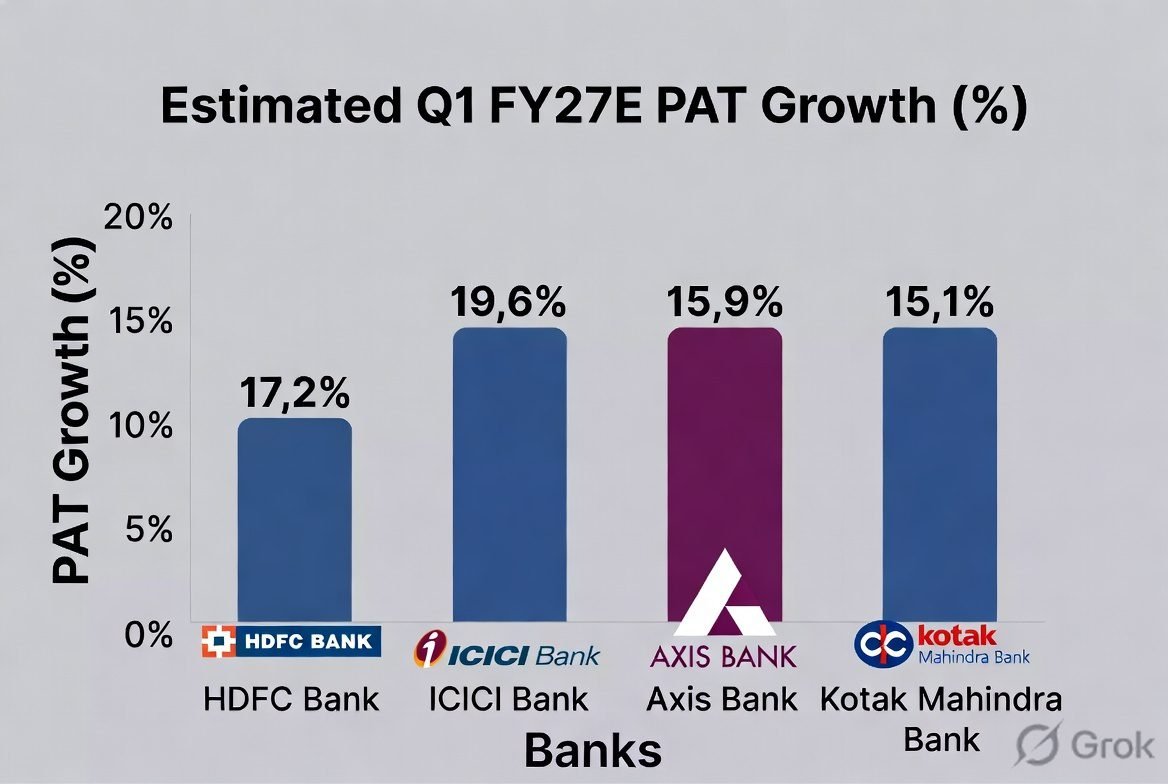
VisualProfit Growth Estimates: Visual Comparison
Putting the four banks' estimated year-on-year PAT growth side by side makes the divergence easier to see at a glance than reading through four separate paragraphs of brokerage notes.
Estimated PAT Growth (YoY) — Q1 FY27 vs Q1 FY26
Bar lengths are scaled to the estimated YoY PAT growth percentage where available. Kotak Mahindra Bank's preview commentary focused on margin compression rather than a consolidated PAT estimate, so it's shown for context rather than direct comparison.
ExplainerWhy NIM Matters More Than Profit This Quarter
Net Interest Margin (NIM) is the difference between what a bank earns on loans and what it pays on deposits, expressed as a percentage of its interest-earning assets. It's the single number that best explains a bank's core profitability — separate from one-off items, treasury gains, or provision swings that can distort a single quarter's headline PAT.
This quarter, nearly every major private bank is expected to see some NIM pressure — HDFC Bank, ICICI Bank, and Axis Bank are all flagged for a "marginal decline," while Kotak's is expected to be sharper. The underlying cause is consistent across all four: deposit costs haven't fallen as quickly as yields on loans, particularly on floating-rate books that reprice faster when rates move.
We'd treat a small NIM decline across the board as a sector-wide, macro-driven story rather than a company-specific red flag for any single bank. Where it becomes genuinely useful information is in the relative comparison — a bank losing significantly more margin than its peers in the same rate environment is telling you something about its specific funding mix or pricing power, not just the broader interest rate cycle.
Sector ViewSector-Wide Trends Shaping Q1 FY27
A few threads run across all four banks' previews, and understanding them helps make sense of results day beyond just the four individual stock stories:
- Credit growth is accelerating sector-wide. Motilal Oswal projects banking systemic credit growth could reach 17.7% this quarter, driven by higher working capital loans, a regulatory shift away from strict loan-to-deposit ratio targeting, and a surge in corporate borrowing as bond yields rose through the quarter.
- Mid-sized private banks may outperform large-caps on growth. Names like AU Small Finance Bank, RBL Bank, DCB Bank, and IDFC First Bank are projected to post loan growth in the 3.9-5.4% QoQ range — ahead of what's expected from some of the "big four" this quarter, according to Motilal Oswal's sector note.
- PSU banks likely stay subdued. In contrast to private banks, public sector lenders are expected to see comparatively muted growth in Q1 FY27, continuing a pattern seen across recent quarters.
- FCNR deposit inflows are a story for Q2, not Q1. Bankers are reportedly expecting around $50 billion in FCNR(B) deposit inflows by August, but Dolat Capital's research flags that the benefit of this won't show up meaningfully until the second quarter of FY27 — worth knowing so you don't expect this tailwind in Saturday's numbers.
Taken together, these threads suggest Q1 FY27 is shaping up as a quarter of genuine divergence within the banking sector, rather than a uniform "banks did well" or "banks struggled" story. Large private banks are growing loans faster than PSU peers, but even among the four names covered here, growth and margin trajectories differ meaningfully. That's a useful reminder that "the banking sector" isn't a single trade — it's four (or more) individual businesses that happen to share a regulator and a rate cycle, and treating them as interchangeable misses real differences in loan mix, funding cost, and provisioning discipline that show up clearly once results land.

Checklist5 Things to Watch When Results Land
- 1 Actual PAT vs the estimate range. A beat or miss against the brokerage consensus (not against last year's number) is usually what moves the stock in the first hour of trading after results.
- 2 NIM direction and magnitude. A small decline that's already priced in by brokerages won't move much. A bigger-than-expected contraction, especially at Kotak given the sharper pre-results warning, could.
- 3 Provisions and slippage commentary. Given ICICI Bank's flagged seasonal spike, watch whether management frames this as expected/seasonal or as a genuine asset-quality concern on the earnings call.
- 4 Deposit growth and CASA ratio. With deposit competition intensifying across the sector, a bank growing deposits without sacrificing its CASA (low-cost deposit) mix is in a stronger structural position than one growing purely through higher-cost term deposits.
- 5 Forward guidance on FY27, not just the Q1 print. A single quarter's number matters less than what management says about the rest of the year — particularly around the FCNR inflow tailwind expected in Q2 and beyond.
Investor ViewWhat This Means If You Hold These Stocks
If you're holding any of these four banks — or comparing them for a new position — the pre-results setup suggests a genuinely different story for each, not a uniform "banking sector" trade:
- HDFC Bank looks like a steady-as-she-goes quarter, with the real story being governance commentary rather than the numbers themselves.
- ICICI Bank's flat headline profit is largely a seasonal provisioning story, not a growth slowdown — its underlying loan book growth is still expected to lead the pack.
- Axis Bank enters results with the strongest brokerage optimism and already-confirmed double-digit advances growth, making it the name with the most room to surprise either way.
- Kotak Mahindra Bank is the one name where margin pressure is flagged as more pronounced than peers — worth watching closely if NIM trajectory matters more to your thesis than headline profit.
We'd avoid treating "banks report Saturday" as one single event to react to. Each of these four businesses has a different loan mix, a different provisioning cycle, and — per the estimates above — a meaningfully different growth trajectory heading into the same 90-day window. Reading all four results individually, rather than reacting to a single "banking sector" headline number, is the more useful exercise here.
For readers who hold a diversified banking-sector fund rather than individual stocks, the takeaway is slightly different but no less useful: the dispersion in these four estimates — from Axis Bank's near-30% projected growth to ICICI Bank's near-flat number — is itself informative. It suggests active fund managers who are overweight one of these names relative to their benchmark are making a genuine bet on that bank's specific quarter, not just riding a uniform sector tailwind. Understanding which of these four banks a fund is overweight in can help explain why that fund's returns might diverge from a plain Bank Nifty index this week, even though all four results land on the same day.
PitfallsMistakes Investors Make on Bank Results Day
- ✕Comparing raw PAT numbers across banks of different sizes. HDFC Bank's profit base is roughly double ICICI Bank's — comparing absolute crore figures instead of growth rates or return ratios gives a misleading picture of which bank actually performed better.
- ✕Reacting to the headline PAT number alone. As ICICI Bank's preview shows, a flat or declining profit can be entirely explained by a known, seasonal provisioning pattern — not a genuine business slowdown.
- ✕Ignoring already-confirmed provisional data. Axis Bank's advances and deposit growth were filed with exchanges before results day — that's real, audited-adjacent data, not speculation, and it's often overlooked in favor of waiting for the full results.
- ✕Assuming a NIM decline is bank-specific. When nearly every major private bank previews a small margin contraction in the same quarter, it's usually a rate-cycle story affecting the whole sector, not a red flag unique to one lender.
- ✕Trading purely on the estimate range without a plan. Brokerage estimates vary meaningfully bank to bank (see ICICI Bank's ₹13,062-13,093 crore range vs Axis Bank's single ₹7,452 crore Systematix number) — treat any pre-results estimate as a range of outcomes, not a precise target.
ContextHow This Quarter Compares to Recent History
It's easy to read a single quarter's estimates in isolation without asking how they fit into the broader trend for these four banks. A quick look back adds useful context to Saturday's numbers.
Axis Bank's own Q4FY26 print, reported earlier this year, showed a net profit of ₹7,130 crore — meaning the ₹7,452 crore estimate for Q1 FY27 would represent continued sequential strength, not a one-off spike. That matters, because a single strong quarter following several weak ones tends to be treated with more skepticism by the market than a strong quarter that extends an already-improving trend. Based on the confirmed provisional advances and deposit growth figures, Axis Bank appears to be in the latter camp heading into this results day.
ICICI Bank's pattern looks different but not concerning on closer inspection. The bank has posted several consecutive quarters of steady, unspectacular profit growth, and this quarter's near-flat estimate continues that pattern rather than breaking from it. The seasonal provisioning spike tied to agri and KCC slippages is, per multiple brokerage notes, a recurring June-quarter phenomenon for banks with meaningful rural loan exposure — meaning readers comparing ICICI Bank's Q1 FY27 number to its Q4 FY26 number should expect a sequential dip almost every year around this time, rather than treating it as new information about the bank's health.
HDFC Bank's trajectory since its 2023 merger with HDFC Ltd has generally been one of gradual normalization — early post-merger quarters saw larger swings in reported numbers as the two loan books were integrated, and more recent quarters, including this one, are expected to show steadier, more predictable growth patterns. A roughly 9% YoY PAT growth estimate, in that context, reads as a bank settling into a more mature, post-merger growth rate rather than either accelerating or decelerating sharply.
Kotak Mahindra Bank's margin story this quarter continues a theme that's shown up in its results for several quarters now: a comparatively more conservative loan book that offers downside protection during credit-quality stress, but less margin expansion during periods when peers are growing more aggressively into higher-yielding segments. Investors who have followed Kotak's results over the past year will likely find this quarter's expected NIM compression consistent with, rather than a departure from, the bank's recent pattern.
FAQFrequently Asked Questions
Q.When do HDFC Bank, ICICI Bank, Axis Bank, and Kotak Bank report Q1 FY27 results?
All four banks are scheduled to announce their Q1 FY27 (April–June 2026 quarter) results on Saturday, July 18, 2026, following their respective board meetings.
Q.Which bank is expected to show the strongest profit growth this quarter?
Based on pre-results brokerage estimates, Axis Bank has the most bullish outlook, with Systematix Research projecting a 28.4% year-on-year increase in net profit to around ₹7,452 crore — notably stronger than the estimates for HDFC Bank or ICICI Bank.
Q.Why is ICICI Bank's profit growth estimate so much lower than Axis Bank's?
ICICI Bank's flat profit estimate is largely explained by an expected seasonal spike in provisions tied to agriculture and Kisan Credit Card-linked slippages, a recurring pattern in the June quarter, rather than a slowdown in its core lending business, which is still projected to lead peers in loan growth.
Q.What is Net Interest Margin (NIM) and why does it matter this quarter?
NIM measures the difference between what a bank earns on loans and pays on deposits, as a percentage of interest-earning assets. Nearly all major private banks are expected to see a modest NIM decline this quarter due to deposit costs not falling as fast as loan yields, making it a useful indicator of core, non-one-off profitability.
Q.Is Kotak Mahindra Bank expected to underperform its peers this quarter?
Not necessarily in absolute terms, but its pre-results commentary flags a sharper NIM contraction (around 14 basis points sequentially) compared to the more modest declines expected at HDFC Bank, ICICI Bank, and Axis Bank, along with relatively modest 3.5% quarter-on-quarter loan-deposit growth.
Q.Are these numbers confirmed, or still estimates?
As of publishing, these are brokerage estimates and, in Axis Bank's case, provisional business figures already filed with exchanges — not final audited results. Actual figures will be confirmed once each bank's board approves results on July 18, 2026.
Q.What should I watch for beyond the headline profit number?
Net Interest Margin direction, provisioning commentary (especially whether it's flagged as seasonal or a genuine concern), deposit growth quality (CASA mix), and forward guidance on FY27 tend to matter more for a stock's medium-term direction than a single quarter's PAT beat or miss.
Q.How does this quarter compare to the same period last year?
Credit growth is notably stronger sector-wide this year, with Motilal Oswal projecting systemic credit growth of around 17.7% in Q1 FY27, and Axis Bank's confirmed 18.8% YoY advances growth is meaningfully ahead of the low single-digit growth several of these banks posted in the same quarter last year.
References
- Business Standard — HDFC Bank Q1 FY27 Preview
- Business Standard — ICICI Bank Q1 FY27 Preview
- Business Standard — Axis Bank Q1 FY27 Preview
- Business Standard — Axis Bank Provisional Q1 FY27 Business Update
- Goodreturns — Bank Q1 Results Preview (Sector-Wide)
- Multibagg — HDFC Bank & ICICI Bank Results Date Preview
- Upstox — Q1 FY27 Earnings Calendar
- TipRanks — Axis Bank Provisional Growth Filing
- NSE India — Corporate Announcements

Pranab Barman is a Financial Educator and Personal Finance Researcher with over 10 years of hands-on experience in stock markets, trading, and investing. Currently enrolled in the CFA Program, he is committed to continuous learning and professional excellence in finance.
As the Founder of PlayWithStock, Pranab covers a wide range of topics including Mutual Funds, SIP, Taxation, Stock Market Basics, and Financial Calculators — with a focus on simplifying complex financial concepts for everyday all investors.
Email: support@playwithstock.com
Website: playwithstock.com
Related posts:
 Micro-Investing Apps for Beginners: A Complete Comparison
 Bank of Maharashtra Q1 FY27 Results: QIP Update, Business Growth & Preview
 Indian Bank Q1 FY27 Results: Preview, Estimates & What to Expect Today
 Reliance Industries Q1 FY27 Results Preview: What to Expect on July 17
 Vodafone Idea Stock 2026: The Complete ₹35,000 Crore Guide
 Q1 FY27 Results Preview: What to Expect from Auto and FMCG Sectors This Quarter
 Jio Financial Services Q1 FY27 Results Preview: Date, Estimates & Stock Analysis
 TCS Q1 FY27 Results: Profit Rises 5%, Sensex Jumps 828 Points