
Request a Free Quote

Tell us a bit about what you need — we'll get back to you within 1-2 business days.

TCS Q1 FY27 Results: Profit Rises 5%, Sensex Jumps 828 Points

Business · Quarterly Results · IT Sector

TCS Q1 FY27 Results: Profit Rises 5%, Sensex Jumps 828 Points

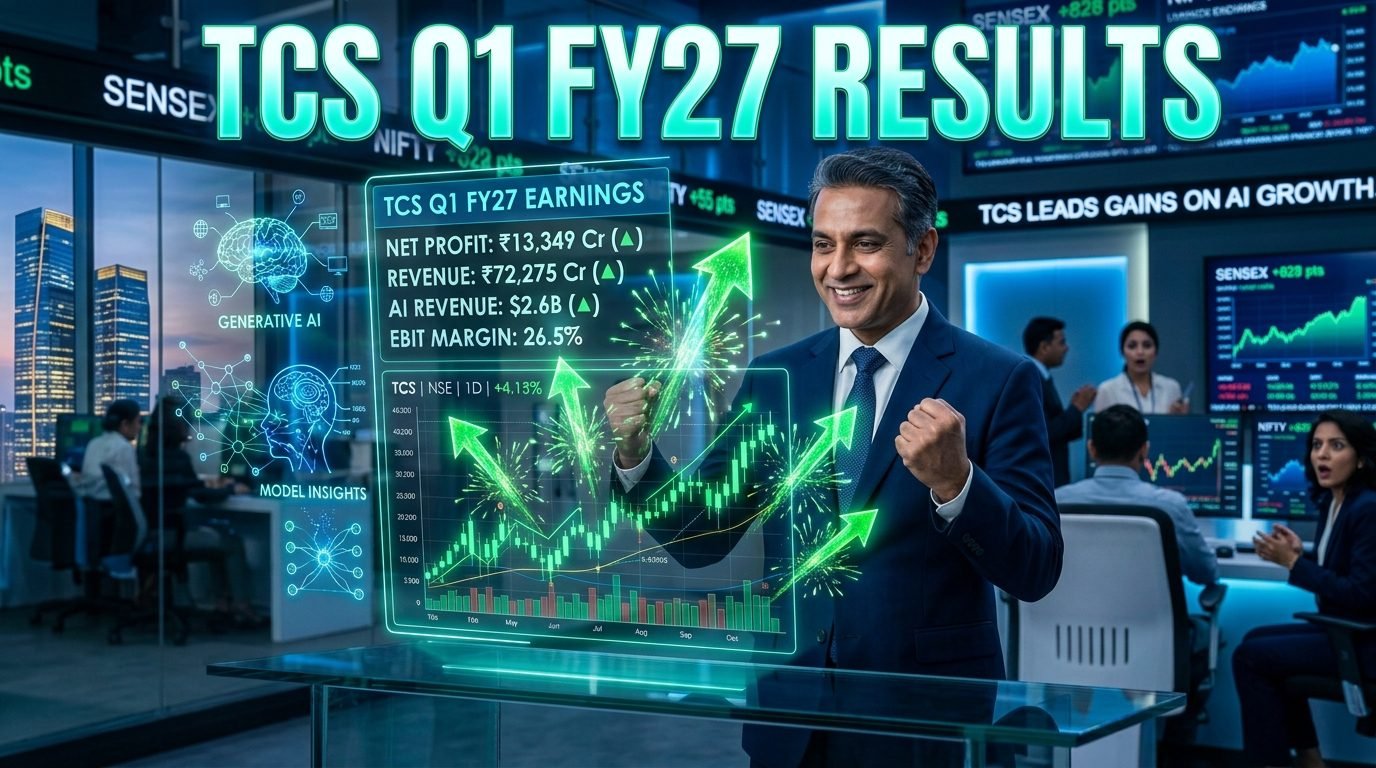
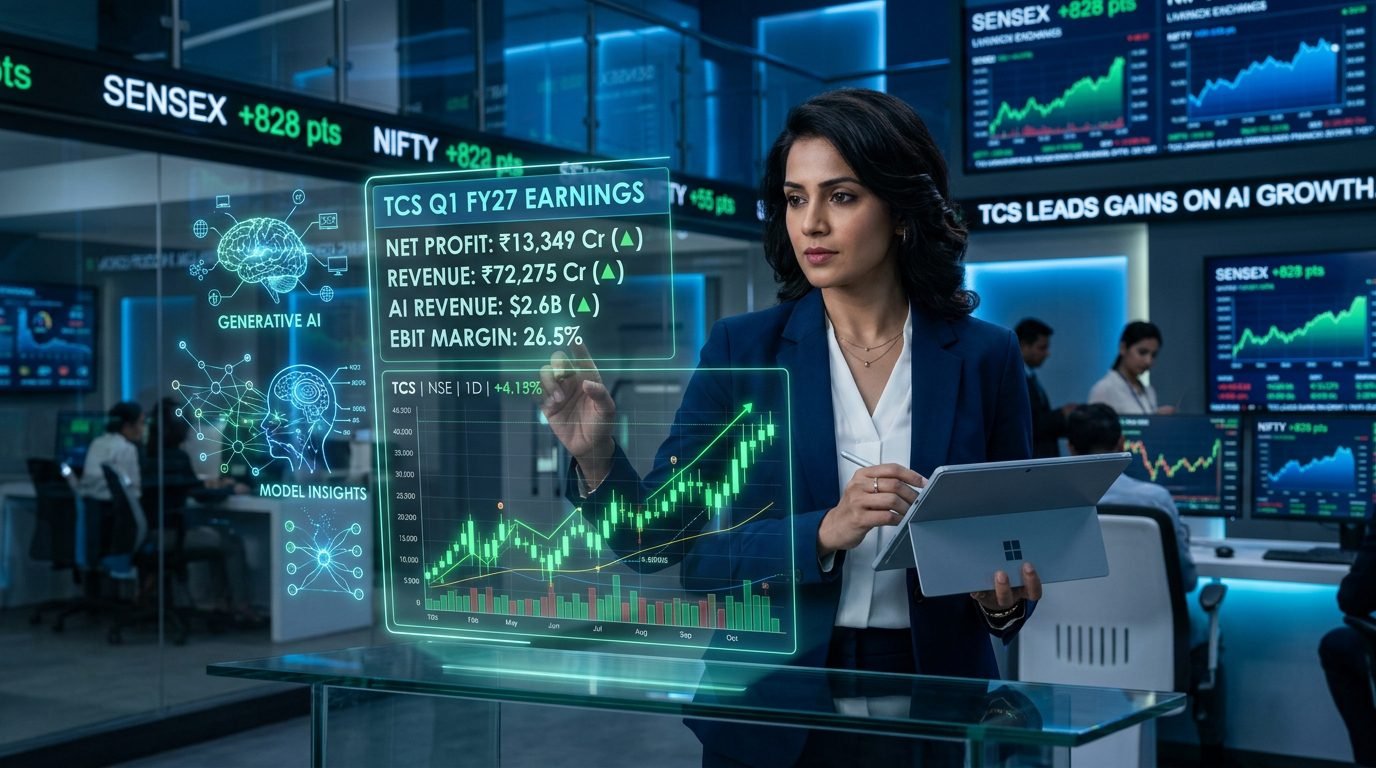
TCS Q1 FY27 results are officially out — and the numbers just sent the entire IT sector higher, dragging the Sensex up 828 points in a single session. Here's the complete, verified breakdown.

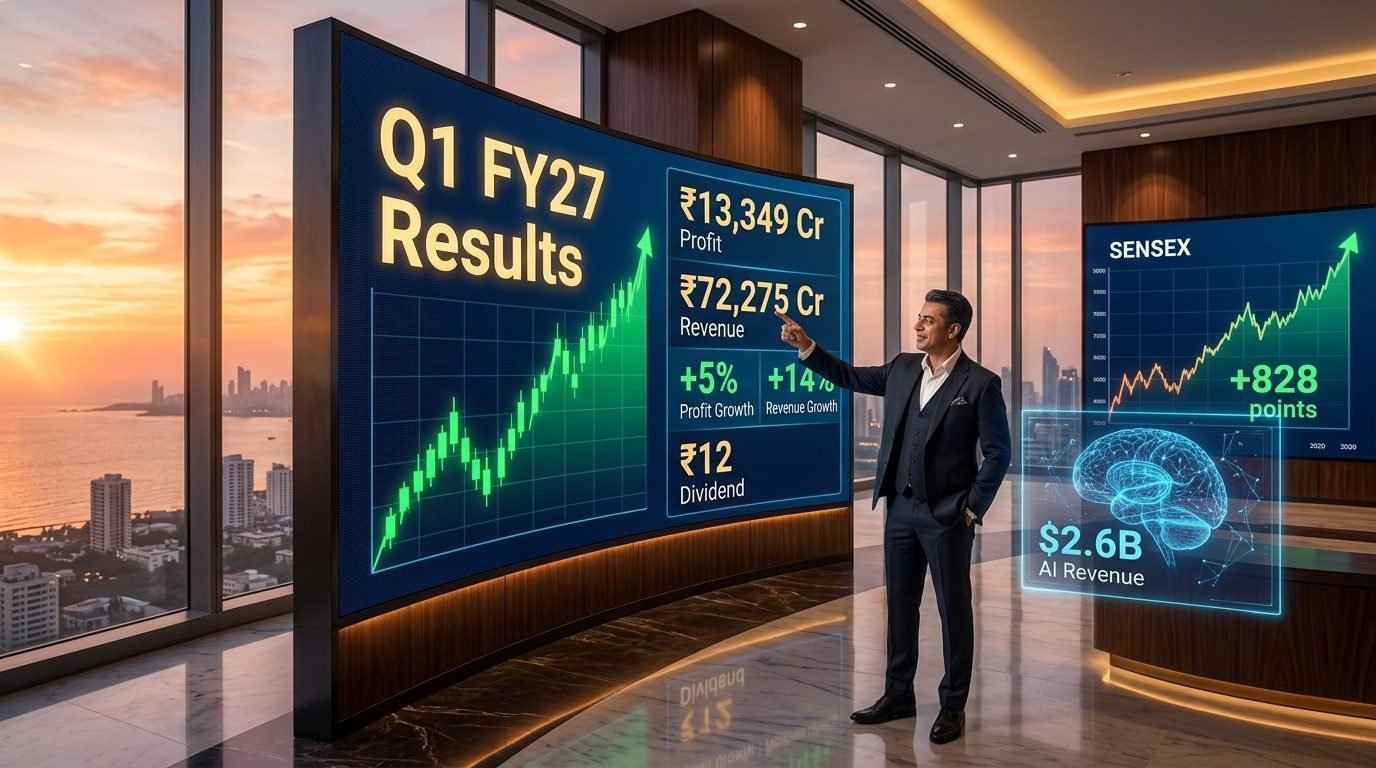
₹13,349 Cr Net profit, +5% YoY
₹72,275 Cr Revenue, +14% YoY
$2.6B Annualized AI revenue
₹12 Interim dividend per share

TCS Q1 FY27 results landed on July 9, 2026, and the market reaction was immediate. By Friday's close, the Sensex had jumped 828 points, led almost entirely by IT stocks reacting to TCS's numbers. Here's the complete, verified breakdown of what the country's largest IT services company actually delivered.

1. TCS Q1 FY27 Results: The Full Numbers

According to the official TCS press release, consolidated net profit for the quarter ended June 30, 2026 came in at ₹13,349 crore, up 5% year-on-year from ₹12,760 crore in Q1 FY26, but down 3% sequentially from ₹13,718 crore in Q4 FY26.

Revenue from operations reached ₹72,275 crore, up 14% year-on-year from ₹63,437 crore, and up 2.2% quarter-on-quarter, according to detailed reporting from Business Today's live coverage. Operating margin held at 24.0%, with net margin at 19.2%, figures confirmed across multiple outlets including Communications Today's earnings summary.

MetricQ1 FY27YoY ChangeQoQ Change
Net Profit₹13,349 crore+5%−3%
Revenue₹72,275 crore+14%+2.2%
Operating Margin24.0%Maintained
Net Margin19.2%Maintained
Order Book (TCV)$9.5 billion

2. The $2.6 Billion AI Story

TCS's annualized AI revenue run rate reached $2.6 billion in Q1 FY27, up 13.6% quarter-on-quarter, according to figures reported by Upstox's live results blog. This makes AI one of the fastest-growing individual revenue lines within the company, even as overall growth stays in the mid-single digits sequentially.

The company also disclosed its patent portfolio for the quarter: 9,803 total patents applied for as of June 30, 2026, including 207 filed during the quarter, with 5,670 patents granted overall. Within that, 1,996 patents relate specifically to AI-led inventions.

3. Interim Dividend Details

TCS's board approved an interim dividend of ₹12 per equity share for the quarter. The record date for eligible shareholders is Wednesday, July 15, 2026, with payment scheduled for Friday, July 31, 2026, confirmed in reporting from NewKerala's coverage of the results.

This continues TCS's consistent pattern of raising its Q1 interim dividend year over year, a trend covered in more depth in our earlier TCS Q1 FY27 preview article, published ahead of today's official announcement.

4. Big Deal Wins: SKF and Beyond

The marquee deal of the quarter was a landmark $800 million global AI-led business transformation deal with SKF, redesigning enterprise operations around an intelligent digital core, according to details reported by BizzBuzz News.

Beyond SKF, TCS also secured a deal with a North American utility major for AI-driven utility transformation, and a multi-million dollar engagement with a Europe-based Fortune Global 50 firm for HR and employee experience transformation using an Agentic AI-driven operating model.

5. How the IT Sector Reacted

The market response was immediate and broad-based. The Sensex closed up 828 points, or 1.08%, at 77,569, according to live index data from Trading Economics, with technology stocks leading the charge.

Tech Mahindra gained 2.2%, Infosys rose 1.7%, HCL Tech advanced 1.5%, and TCS itself added roughly 1%. Beyond the large caps, mid-cap IT names saw even sharper moves: Zensar Tech surged 8.8%, Newgen climbed 7.8%, and KPIT gained 2.6%, reflecting how a strong TCS print tends to lift sentiment across the entire IT services sector, not just the company reporting.

"TCS's earnings, order book, and guidance for the year are always the bellwether for how the rest of the IT pack gets priced through earnings season."

6. The Number That Matters More Than Headline Growth

While rupee-term revenue grew 14% year-on-year, the more closely watched constant-currency (CC) growth number came in at just 0.4% quarter-on-quarter, a reminder that a meaningful share of the headline growth reflects currency movements rather than pure organic demand.

This distinction matters for anyone trying to gauge underlying business momentum rather than currency-driven optics, a theme relevant across index-level analysis too, covered further in our explainer on how Nifty and Sensex are constructed.

7. What Management Is Saying

CEO and Managing Director K Krithivasan struck a cautiously confident tone: "Q1 FY27 reflects continued growth momentum and the strength of our strategic positioning, despite geopolitical and macro-economic headwinds," citing the $9.5 billion order book and the AI business scaling to a $2.6 billion annualized run rate.

CFO Samir Seksaria specifically flagged the impact of this quarter's annual wage hikes: "In Q1, we rolled out annual wage hikes, strengthened our partnership ecosystem, and targeted investments to enhance long-term competitiveness," while emphasizing continued focus on "industry-leading profitability and return ratios" despite that cost pressure.

8. What This Means for Investors

TCS reporting first each earnings season makes it a genuine bellwether, and today's broad IT sector rally shows how directly that plays out in practice. Investors tracking other major results this season may find our coverage of Jio Financial Services' upcoming Q1 FY27 results and the SBI Mutual Fund IPO useful for the broader picture of how capital is moving across India's financial and technology sectors this quarter.

Worth tracking alongside this result

Broader risk sentiment this week has also been shaped by moves in gold's record 2026 rally, and understanding why markets swing on macro news more generally is covered in our piece on why the stock market moves the way it does.

Real-World Example

Consider an investor who saw only the headline "revenue up 14%" figure and assumed the business was accelerating sharply. That investor would miss that constant-currency growth was just 0.4% quarter-on-quarter, and that net profit actually declined 3% sequentially due to wage hikes. A fuller read of the results, revenue, margins, constant-currency growth, and order book together, gives a much more accurate picture than any single number in isolation. Readers building this kind of analytical habit can start with our beginner investing guide, and explore related patterns in our piece on common investing mistakes. More coverage is available in our Business category and Stock Market category.

9. FAQs

What are the TCS Q1 FY27 results?

TCS reported a consolidated net profit of ₹13,349 crore (up 5% YoY, down 3% QoQ) and revenue of ₹72,275 crore (up 14% YoY) for the quarter ended June 30, 2026, with an operating margin of 24.0% and net margin of 19.2%.

What dividend did TCS announce with its Q1 FY27 results?

TCS announced an interim dividend of ₹12 per equity share, with a record date of July 15, 2026, and payment date of July 31, 2026.

Why did the Sensex jump after TCS results?

The Sensex rose 828 points (1.08%) to close at 77,569, led by IT stocks including Tech Mahindra, Infosys, and HCL Tech, as TCS's stronger-than-expected order book and AI revenue growth lifted sentiment across the entire IT services sector.

What is TCS's annualized AI revenue?

TCS's annualized AI revenue reached $2.6 billion in Q1 FY27, up 13.6% quarter-on-quarter, making it one of the fastest-growing segments of the business.

What was TCS's biggest deal win this quarter?

The marquee deal was a landmark $800 million global AI-led business transformation deal with SKF, part of a broader $9.5 billion order book for the quarter. This is not investment advice; consult a SEBI-registered financial advisor for guidance specific to your situation.

Disclaimer: This article reports official TCS Q1 FY27 results as announced and is for informational and educational purposes only. It does not constitute investment advice. Please refer to our Disclaimer page and consult a SEBI-registered financial advisor before making investment decisions.
References

Leave a Comment

Your email address will not be published. Required fields are marked *

Scroll to Top