
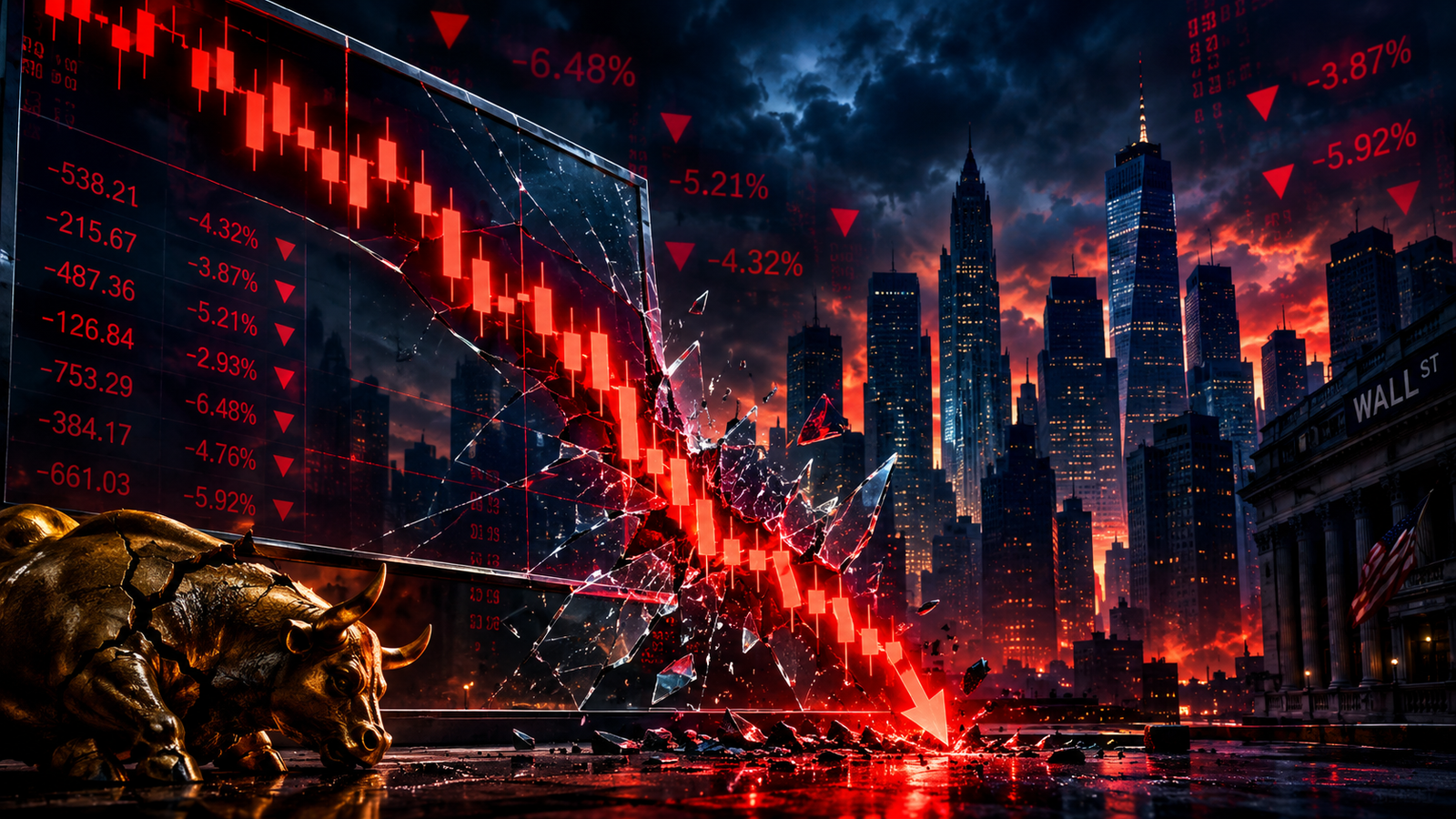

10 Biggest Stock Market Crashes in History and What We Learned

The stock market has never moved in a straight line. For every long stretch of steady growth, history has recorded a matching story of sudden panic, sharp collapse, and eventual recovery. Studying the biggest stock market crashes in history is one of the most valuable exercises any investor can undertake, because these events reveal the same warning signs, the same human emotions of fear and greed, and often the same mistakes repeating themselves across more than a century of financial markets.
In this detailed guide, we will walk through the 10 biggest stock market crashes in history, explain what caused each one, look at how deep and how long each downturn was, and break down the practical lessons that beginner and advanced investors can apply to their own portfolios today. If you want to understand the basics first, you may also want to read our guide on what the stock market is and how it works before diving into these historical events.
Why the Biggest Stock Market Crashes in History Matter to Every Investor
Before we look at the individual events, it helps to understand why history matters so much in investing. Financial markets are driven by human psychology as much as by numbers on a balance sheet. Greed pushes prices higher than they should reasonably go, and fear pushes them lower than their true value once panic sets in. Because human behavior does not really change from one generation to the next, the patterns behind the biggest stock market crashes in history tend to repeat themselves in new forms, even though the exact trigger is always different.
By studying how previous stock market crashes started, how deep they fell, and how markets eventually recovered, investors can learn to recognize dangerous conditions early, avoid panic-selling at the worst possible time, and use downturns as long-term opportunities instead of reasons to give up on investing altogether. According to historical data published by Investopedia's overview of famous market crashes, most major downturns share common warning signs long before the actual collapse.
1. The Wall Street Crash of 1929 — The Most Infamous Stock Market Crash in History
The 1929 crash remains the most famous stock market collapse in history and the event that triggered the Great Depression. Throughout the 1920s, the U.S. stock market experienced a period of rapid, speculative growth, with many investors buying shares using borrowed money, a practice known as buying "on margin." Confidence was extremely high, and very few people believed prices could ever fall significantly.
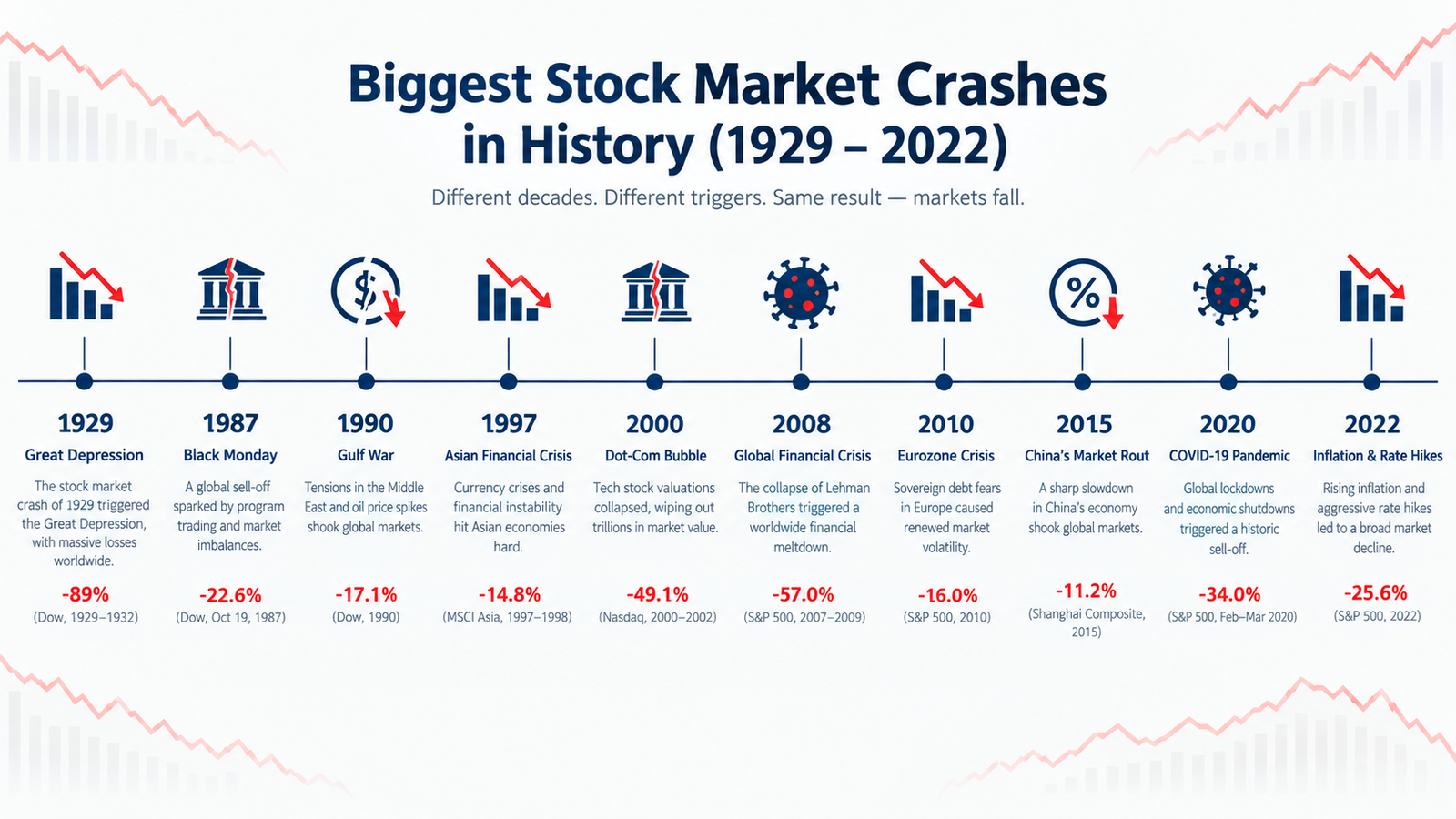
When prices finally began to slide in October 1929, panic selling took over. Because so many investors had borrowed heavily to buy stocks, falling prices forced brokers to demand repayment, which led to even more forced selling. Between 1929 and 1932, the U.S. stock market lost close to 90% of its total value, and it would take roughly 25 years for prices to fully recover to their pre-crash levels. Even today, the 1929 crash is used as the benchmark against which every other stock market crash in history is measured.
What we learned: Excessive leverage and speculation create extremely fragile markets. When large numbers of investors buy stocks with borrowed money, even a small trigger can set off a chain reaction of forced selling that spirals far beyond what the original event would normally justify.
2. Black Monday, 1987
On October 19, 1987, now known as "Black Monday," the Dow Jones Industrial Average fell by more than 22% in a single trading day, still the largest one-day percentage drop of any stock market crash in history. Unlike 1929, there was no single dramatic news event behind the crash. Instead, the decline was worsened significantly by early computer-driven trading programs, known as "portfolio insurance" strategies, which automatically sold stocks as prices fell, creating a feedback loop of accelerating panic.
Despite the severity of the single-day drop, the broader economy did not fall into recession, and markets recovered relatively quickly compared to earlier crashes in history.
What we learned: Automated and algorithm-driven trading systems can dramatically amplify market volatility if they are not properly understood or regulated. In direct response to this event, stock exchanges introduced "circuit breakers," which automatically pause trading during extreme price drops to give the market time to stabilize and prevent purely mechanical panic.
3. The Japanese Asset Bubble Collapse, 1990
Throughout the 1980s, Japan experienced one of the largest asset bubbles ever recorded, with both stock prices and real estate values rising to extraordinary levels. At the peak of the bubble, the land under Japan's Imperial Palace was famously estimated to be worth more than all the real estate in the state of California.
When the bubble finally burst in 1990, Japan's Nikkei stock index lost more than half of its value, and the country entered a prolonged period of economic stagnation that came to be known as the "Lost Decade," which in many ways extended well beyond ten years. Economic historians still refer to this as one of the biggest stock market crashes in history in terms of how long the recovery took.
What we learned: Asset prices that rise far beyond their underlying economic value will eventually correct, sometimes sharply and sometimes over a very long period. Long-term investors should always remain cautious of markets and asset classes that appear detached from real earnings, rental yields, or economic fundamentals, no matter how strong the current momentum feels.
4. The Asian Financial Crisis, 1997
Starting in Thailand in mid-1997, the Asian Financial Crisis spread rapidly across Indonesia, South Korea, Malaysia, the Philippines, and other fast-growing emerging economies. Many of these countries had borrowed heavily in foreign currency, particularly U.S. dollars, to fund rapid economic expansion. When investor confidence weakened, local currencies collapsed in value, making it extremely difficult for governments and companies to repay their foreign debt.
Stock markets across the region fell dramatically, in some cases by more than 70% from their highs, wiping out years or even decades of economic gains within a matter of months. The crisis eventually required large financial rescue packages from the International Monetary Fund to help stabilize the affected economies. You can read more background on this event on the Wikipedia page for the 1997 Asian Financial Crisis.
What we learned: Emerging markets can be highly vulnerable to currency risk and heavy foreign debt exposure. Diversifying investments across different regions, currencies, and asset classes can help protect a portfolio from the impact of a single country's or region's financial crisis.
5. The Dot-Com Bubble Burst, 2000
During the late 1990s, the rise of the internet created enormous excitement among investors, and money poured into new technology and internet-based companies, many of which had little to no actual profit or even a clear business model. Simply adding ".com" to a company name was often enough to send its share price soaring.
When reality finally set in and investors realized that many of these companies would never become profitable, the technology-heavy Nasdaq index fell nearly 78% from its peak between March 2000 and October 2002, wiping out trillions of dollars in market value and forcing thousands of internet start-ups out of business entirely. This remains one of the biggest stock market crashes in history driven purely by speculation rather than a banking or currency crisis.
What we learned: Hype and speculation around a new and exciting technology can push valuations far beyond any reasonable level. Before investing in any trending sector, always take the time to evaluate a company's actual revenue, profitability, and long-term business model, rather than investing purely based on excitement or a popular narrative.
6. The Global Financial Crisis, 2008
The 2008 financial crisis was triggered by the collapse of the U.S. housing market and the widespread use of risky mortgage-backed financial products that had been sold to banks and investors around the world. When homeowners began defaulting on their mortgages in large numbers, the value of these complex securities collapsed almost overnight.
Major financial institutions, including the investment bank Lehman Brothers, either collapsed or required emergency government support. Credit markets around the world froze, and stock markets fell sharply, with the S&P 500 index losing more than 50% of its value from its 2007 peak to its low point in early 2009. The crisis led to a severe global recession and reshaped banking regulation for years to come, and it is frequently ranked among the biggest stock market crashes in history by economists.
What we learned: Complex financial products can hide enormous amounts of hidden risk that even professional investors sometimes fail to fully understand. This crisis taught individual investors the critical importance of understanding exactly what they are investing in, rather than blindly trusting high returns or complex products they cannot clearly explain.
7. The Flash Crash, 2010
On May 6, 2010, U.S. stock markets experienced a sudden and dramatic crash, with the Dow Jones Industrial Average dropping nearly 1,000 points within minutes before recovering almost as quickly, all within the same trading session. Investigations later traced the cause to high-frequency algorithmic trading systems reacting rapidly to an unusually large sell order in the futures market.
Although the market recovered most of its losses by the end of the day, the event raised serious concerns about the stability of increasingly automated financial markets and how quickly a purely technical event could spiral out of control.
What we learned: As markets become increasingly dominated by automated and algorithmic trading, short-term volatility can occur without any real change in a company's underlying fundamentals. Long-term investors should avoid panic-selling during sudden, unexplained market swings and instead focus on the actual value of the businesses they own.
8. The Chinese Stock Market Crash, 2015
After a massive speculative rally fueled largely by retail investors and heavy use of margin trading, Chinese stock markets more than doubled in value within about a year. Much of this rally was disconnected from actual corporate earnings growth. When the rally finally reversed in mid-2015, the Shanghai stock market lost around 30% of its value within just a few weeks, despite significant government intervention, including trading halts and direct market support, aimed at stabilizing prices.
What we learned: Markets that are dominated by retail speculation and heavy margin debt are especially prone to sharp, sudden corrections once sentiment turns negative. Government intervention can help slow the pace of a crash, but it cannot fully prevent a market from eventually correcting an unsustainable, speculation-driven rally.
9. The COVID-19 Crash, 2020 — One of the Fastest Stock Market Crashes in History
In February and March 2020, global stock markets crashed at record speed as the COVID-19 pandemic spread rapidly around the world and governments imposed widespread lockdowns to control the outbreak. The S&P 500 index fell more than 30% in just over a month, making it one of the fastest stock market declines in history, even faster than the crash of 1929.
However, thanks to unprecedented government stimulus and central bank support around the world, markets recovered with equal speed, with many major indices reaching new all-time highs before the end of the same year, a recovery pace that surprised even experienced investors.
What we learned: In today's highly interconnected and fast-moving financial system, markets can fall and recover faster than ever before in history. This crash strongly reinforced the importance of staying invested during periods of extreme volatility rather than attempting to perfectly time an exit and re-entry into the market.
10. The 2022 Global Market Selloff
Rising inflation across the world, combined with aggressive interest rate hikes by central banks such as the U.S. Federal Reserve, triggered a prolonged and painful decline in both stock and bond markets throughout 2022. This was somewhat unusual, since stocks and bonds typically do not fall together, and the shift caught many traditionally diversified investors off guard.
Technology and other high-growth stocks were hit especially hard during this period, since higher interest rates significantly reduce the present value of a company's expected future earnings, which is a key factor in how growth stocks are valued by the market.
What we learned: Interest rates have a direct and extremely powerful impact on stock market valuations, particularly for growth-oriented companies. Investors should always pay close attention to central bank policy and inflation trends, since these broad macroeconomic factors can move markets just as strongly as any individual company's news or earnings report.
Key Lessons From the Biggest Stock Market Crashes in History
Looking across all 10 of these historic stock market crashes, a few powerful and recurring themes stand out clearly:
- Excessive borrowing and leverage make markets fragile and much more prone to sharp, sudden corrections.
- Speculative bubbles eventually correct once asset prices disconnect too far from real, underlying fundamentals.
- Diversification across sectors, countries, currencies, and asset classes helps reduce overall portfolio risk.
- Panic-selling during a crash often locks in permanent losses that a patient, long-term investor could have avoided entirely.
- Interest rates and macroeconomic policy can move markets just as powerfully as company-specific news.
- Markets have historically recovered from every single major crash in this list and gone on to reach new all-time highs over time.
If you want to put these lessons into practice, our guide on how to diversify your stock portfolio explains practical steps you can take today.
How to Protect Your Portfolio During a Stock Market Crash
While no investor can predict exactly when the next stock market crash will happen, there are several practical steps that can help protect a portfolio when volatility eventually returns:
- Build a diversified portfolio across different sectors, company sizes, and geographic regions, rather than concentrating your investments in a single stock or industry.
- Maintain an emergency fund separate from your investments, so that you are never forced to sell stocks at a loss simply to cover short-term expenses.
- Avoid excessive leverage or margin trading, since borrowed money dramatically increases both potential gains and potential losses during a downturn.
- Stay focused on the long term and avoid making emotional decisions based on short-term price movements or daily news headlines.
- Continue investing regularly through systematic investment plans, which allow you to buy more shares when prices are low and naturally average out your purchase cost over time. Learn more in our article on SIP in stocks vs SIP in mutual funds.
Are We Due for Another of the Biggest Stock Market Crashes in History?
This is one of the most common questions investors ask, and unfortunately, there is no precise answer. Stock market crashes do not follow a fixed schedule or a predictable cycle, even though many people try to find patterns based on the number of years between past crashes. What history does show clearly is that major stock market crashes have happened roughly once every seven to ten years on average over the past century, but the exact timing, depth, and cause of the next one remains impossible to forecast with any real accuracy. For up-to-date market data, resources like the National Stock Exchange of India (NSE) publish live index movements that can help you track current conditions.
Instead of trying to predict the next crash, most experienced investors focus their energy on building a portfolio that can survive one whenever it eventually arrives. This means keeping a healthy mix of asset classes, avoiding excessive debt, and maintaining enough cash reserves to avoid being forced into a bad decision during a period of market stress. The investors who consistently build wealth over decades are rarely the ones who successfully predicted a crash in advance; they are the ones who simply stayed prepared, stayed diversified, and stayed invested through the ups and downs.
Frequently Asked Questions About the Biggest Stock Market Crashes in History
What is considered a stock market crash?
A stock market crash is generally defined as a sudden and severe drop in stock prices across a broad range of stocks, often 10% or more within a very short period, usually driven by panic selling rather than a gradual change in company fundamentals. A crash is different from a normal market correction, which tends to happen more slowly and is considered a routine part of the market cycle.
How long does it usually take for the stock market to recover after a crash?
Recovery time varies enormously depending on the cause of the crash. Some crashes, like the 2020 COVID-19 crash, saw a full recovery within months due to strong government stimulus. Others, like the 1929 crash, took around 25 years to fully recover, while the Japanese market from 1990 has still not returned to its previous all-time high even decades later. On average, most modern stock market crashes recover within one to three years.
Should I sell my stocks during a market crash?
For most long-term investors, selling during a crash locks in losses and removes the chance to benefit from the eventual recovery. Historically, investors who stayed invested through past crashes and continued adding to their portfolios during the downturn have generally fared better than those who sold in a panic and tried to time their re-entry into the market.
What causes most stock market crashes?
While the exact trigger is different every time, most of the biggest stock market crashes in history share common underlying causes, including excessive speculation, high levels of borrowed money or leverage, asset prices that have become disconnected from real fundamentals, and a sudden loss of investor confidence that turns into widespread panic selling.
Can stock market crashes be predicted in advance?
No reliable method exists to predict the exact timing of a stock market crash, even among professional economists and fund managers. However, certain warning signs, such as extremely high valuations, rapid growth in margin debt, and widespread public speculation, have historically appeared before many major crashes, which is why disciplined, diversified investing remains the most reliable long-term strategy.
Final Thoughts on the Biggest Stock Market Crashes in History
Every major crash in stock market history has followed a broadly similar pattern: a period of rising optimism and rising prices, a specific trigger event, panic-driven selling that pushes prices below their fair value, and eventually, a gradual recovery as confidence slowly returns. While no investor can predict exactly when the next crash will occur, understanding these historical patterns can help you invest with far more discipline, patience, and confidence.
Rather than fearing stock market crashes, experienced and successful investors tend to treat them as a natural and expected part of the market cycle, using downturns as opportunities to build long-term wealth rather than as reasons to exit the market permanently. History has shown, time and again, that markets which fall eventually find a way to recover and grow. If you're just starting out, check out our related post on common mistakes new investors make to avoid repeating history's costliest errors.

Pranab Barman is a Financial Educator and Personal Finance Researcher with over 10 years of hands-on experience in stock markets, trading, and investing. Currently enrolled in the CFA Program, he is committed to continuous learning and professional excellence in finance.
As the Founder of PlayWithStock, Pranab covers a wide range of topics including Mutual Funds, SIP, Taxation, Stock Market Basics, and Financial Calculators — with a focus on simplifying complex financial concepts for everyday all investors.
Email: support@playwithstock.com
Website: playwithstock.com
Related posts:
 Sensex Jumps 550 Points, Nifty Reclaims 23,900 as Crude Oil Crashes on US-Iran De-Escalation: What Changed Today
 Reliance Jio IPO 2026: India’s Biggest-Ever Listing, Explained
 Bull Market vs Bear Market: Meaning, Examples & How to Identify Them
 What Is Circuit Breaker Stock Market: Meaning, Limits & 2026 Update
 Nifty July 2026: Will It Hit 24,800? Complete Market Outlook and Stock Guide
 Why Is the Stock Market Falling Today? US-Iran Tensions, Crude Oil Spike & FII Selling Explained
 Today Nifty India Market Outlook: Oil, Rupee, VIX and FII Selling Explained
 Nifty, Sensex Today: Market Outlook for July 24, 2026 — Global Cues, Crude Oil, Rupee & Key Levels