



Request a Free Quote

Tell us a bit about what you need — we'll get back to you within 1-2 business days.

What Is Circuit Breaker Stock Market: Meaning, Limits & 2026 Update

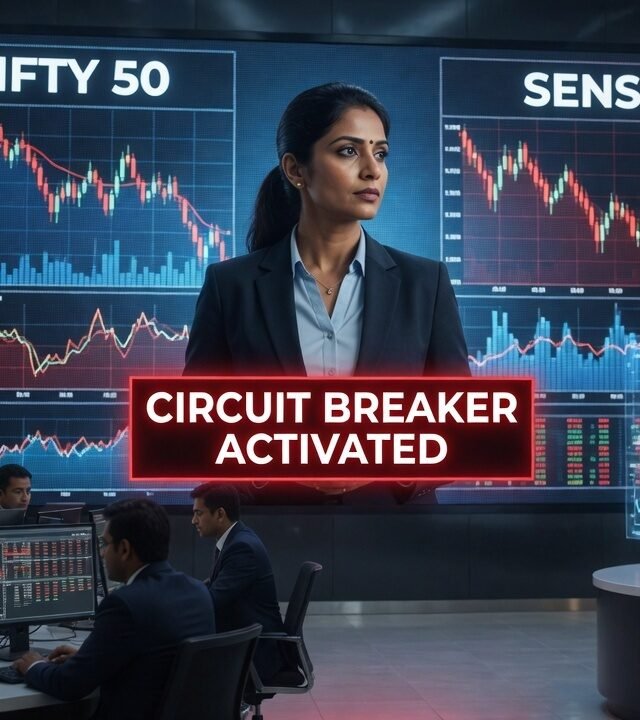
what is circuit breaker stock market explained chart

What is circuit breaker stock market mechanics all beginners should understand, especially after Indian markets came close to triggering one earlier this year. A circuit breaker is a safety mechanism that halts trading when prices move too sharply, too fast. Here’s exactly how it works, with the latest regulatory update from SEBI.

1. Latest Update: SEBI's 2026 Circuit Breaker Rule Simplification

  • Before getting into the mechanics, here’s a genuinely current development. On January 9, 2026, SEBI floated a consultation paper proposing a comprehensive overhaul of the trading framework governing stock exchanges.

    As part of this proposal, market-wide circuit breaker norms, along with dynamic price band flexing, IPO price bands, and call auction procedures, are set to be presented in a simplified tabular format. Outdated and repetitive operational examples are also being removed from the existing circulars.

    The goal is easier compliance and clearer rules for market participants, not a change to the actual 10%, 15%, and 20% trigger levels themselves. Still, it signals that SEBI continues to actively refine this framework, so it’s worth checking for updates before assuming the mechanics never change.

2. What Is Circuit Breaker Stock Market Mechanism, Simply Explained

  • A circuit breaker is a rule that temporarily halts trading across the entire market when a benchmark index moves sharply in a single session. In India, this applies to the Nifty 50 and the Sensex, whichever breaches the limit first.

    The purpose is straightforward. Markets don’t always behave rationally during panic, and prices can drift far from reality when fear takes over. A circuit breaker forces a pause, giving investors time to process information rather than reacting purely on emotion.

    This is different from an individual stock hitting its own upper or lower limit, which is called a price band. Circuit breakers apply to the whole market at once, not a single stock.

3. How Index-Based Market-Wide Circuit Breakers Work

  • According to NSE’s official framework, India’s market-wide circuit breaker system applies at three stages of index movement, in either direction: 10%, 15%, and 20%.

    These percentages are calculated fresh each day, based on the previous trading session’s closing level of whichever index breaches first. When triggered, all pending orders are cancelled and both the cash market and F&O market halt simultaneously nationwide.

    The halt duration depends on both the percentage breached and the time of day:

    At a 10% move, a breach before 1:00 PM triggers a 45-minute halt. Between 1:00 PM and 2:30 PM, the halt is 15 minutes. After 2:30 PM, there is no halt at all, and trading continues as usual.

    At a 15% move, a breach before 1:00 PM triggers a 1 hour 45 minute halt. Between 1:00 PM and 2:00 PM, it’s 45 minutes. After 2:00 PM, trading is suspended for the rest of the day.

    At a 20% move, trading is suspended for the remainder of the trading day, regardless of when the breach occurs.

    Once a halt ends, the market reopens through a pre-open call auction session, a 15-minute window used to discover a fair equilibrium price before normal trading resumes.

4. Circuit Breakers vs Individual Stock Price Bands

  • It’s easy to confuse circuit breakers with price bands, but they serve different purposes. Circuit breakers apply to the overall index movement, Nifty or Sensex. Price bands apply to individual stocks.

    A price band is the maximum percentage an individual stock’s price can move in a single day, commonly 2%, 5%, 10%, or 20% depending on the stock. When a stock hits its upper or lower price band, it’s often described as being “locked” in an upper or lower circuit.

    Stocks in the Futures and Options segment don’t have fixed daily price bands. Instead, they operate with dynamic price bands that widen further if the price continues moving beyond the initial limit, according to Zerodha’s official trading FAQ.

5. Why India Introduced Circuit Breakers

  • Before 2001, Indian markets had no coordinated safety net of this kind. The 1992 Harshad Mehta scam wiped out enormous wealth within days, and the 1997 Asian financial crisis sent further shockwaves through Indian equities, with political events sometimes causing double-digit single-session collapses.

    SEBI introduced index-based market-wide circuit breakers effective July 2, 2001, through a formal circular, later partially revised in 2013 to update halt durations in line with revised market hours. The framework has remained largely stable since, with periodic refinements like the one proposed in January 2026.

6. Real-World Example: The June 2026 Near-Miss

  • Indian markets came uncomfortably close to a circuit breaker trigger earlier this year. On June 2, 2026, Business Standard reported that the Sensex tanked 3,939.68 points, a fall of 5.22%, during one of the worst single-day openings since COVID, driven by a global selloff following US tariff hikes.

    The Nifty 50 plunged similarly, down 5.06% intraday. While this was a sharp, alarming move for anyone watching a portfolio in real time, it stayed well short of the 10% threshold needed to trigger even the first-stage circuit breaker halt.

    This example is useful precisely because it shows how far markets can fall in genuinely bad sessions without a circuit breaker kicking in at all. Readers who want the full context on how such single-day crashes unfold can read our explainer on why the stock market falls sharply on days driven by global macro shocks.

7. Pros and Cons of Circuit Breakers

  • Circuit breakers offer genuine protection during panic-driven selloffs. They give investors time to process new information rather than reacting purely on fear, and they prevent a single chaotic session from destroying value that a calmer assessment might have preserved.

    However, they come with real trade-offs. Circuit breakers temporarily prevent real-time price discovery, meaning the “true” market price during a halt remains unknown. Early traders who exit before a halt can benefit at the expense of those who get frozen out of the market once trading stops.

    Understanding both sides helps set realistic expectations. A circuit breaker slows panic, but it doesn’t eliminate the underlying volatility that caused the move in the first place. Beginners building foundational market knowledge may also find it useful to understand related concepts like the difference between the Nifty 50 and Sensex themselves, since both indices jointly determine when a market-wide halt triggers.


FAQs

  • What is circuit breaker stock market mechanism in simple terms? A circuit breaker is a rule that temporarily halts trading across the entire market when the Nifty 50 or Sensex moves 10%, 15%, or 20% in a single session, giving investors time to process information rather than react purely on panic.

    What are the three circuit breaker levels in India? India’s market-wide circuit breakers trigger at 10%, 15%, and 20% index movement, with halt durations depending on both the percentage breached and the time of day the breach occurs.

    What is the difference between a circuit breaker and a price band? A circuit breaker applies to the entire market based on index movement (Nifty or Sensex), while a price band applies to an individual stock’s maximum daily price movement, commonly 2% to 20% depending on the stock.

    Has SEBI changed circuit breaker rules in 2026? In January 2026, SEBI proposed simplifying how circuit breaker norms are presented in regulatory circulars, as part of a broader trading framework overhaul, though the core 10%, 15%, 20% trigger levels remain unchanged as of this update.

    Do stop-loss orders carry forward through a circuit breaker halt? No. When a circuit breaker triggers, all pending orders, including stop-loss orders, are cancelled. Investors need to place fresh orders once trading resumes after the halt. This is not investment advice; consult your broker or a SEBI-registered advisor for guidance specific to your trades.

References

  • NSE India — Equity Market Circuit Breakers official framework
  • SEBI — Securities and Exchange Board of India regulatory circulars
  • Business Standard — Market crash circuit filter explainer, June 2026
  • Zerodha — Market-wide circuit breaker trading FAQ
  • Angel One — SEBI’s 2026 trading framework consultation paper summary
  • HDFC Securities — Stock market circuit breaker guide
  • Upstox Learning Center — How circuit breakers on Nifty and Sensex work
  • IIFL Capital — Circuit filters and price bands explained

Disclaimer: This article is for informational and educational purposes only and does not constitute investment advice. Circuit breaker rules are subject to change by SEBI and stock exchanges. Please refer to our Disclaimer page and verify current rules on official NSE/BSE sources before making trading decisions.

Author: Pranab | Play With Stock Last Updated: July 10, 2026

Leave a Comment

Your email address will not be published. Required fields are marked *

Scroll to Top