


Nifty July 2026: Will It Hit 24,800? Complete Market Outlook, Q1 Results Analysis, and Stock Guide
Nifty July 2026 is shaping up to be one of the most critical months for Indian equity markets this year. On July 17, the Sensex jumped 964 points — its biggest single-day rally since June 12 — closing at 78,151. Nifty ended at 24,334. The question on every investor's mind right now: is this the beginning of a sustained breakout toward 24,800 and beyond, or is this a temporary relief rally before the market consolidates again? This article gives you the full picture — real Q1 FY27 results, technical levels, sector-wise outlook, and an honest answer on what to do with your portfolio this week.
What Just Happened — The July 17 Rally Explained
Let us start with exactly what happened on Friday, July 17, 2026 — because understanding the cause of a rally matters far more than simply noting that it occurred.
The Sensex gained 964.58 points — its largest single-session move in over five weeks. For both indices, Friday's gain was the biggest since June 12, 2026. The rally was not random. Three things happened simultaneously that gave markets a meaningful reason to move higher.
First, Jio Financial Services delivered a blockbuster Q1 FY27 result — net profit jumped 156% year-on-year to ₹830 crore. The stock of Jio Financial Services rose 3.1 per cent after the company reported this jump in consolidated net profit. When a Nifty constituent surges 3% on results day, it lifts the index mechanically.
Second, US inflation data came in softer than expected. Softer inflation in the US reduced fears of further aggressive interest rate increases, and supported demand for riskier assets — particularly positive for Indian technology companies which depend heavily on spending by overseas clients. Tech stocks across the board rallied, with the Nifty IT index rising 1.8% and Tech Mahindra surging 3.91% after reporting 28.4% profit growth.
Third, the biggest Nifty heavyweights — Reliance Industries and HDFC Bank — were both expected to report strong Q1 results over the weekend. Reliance gained 2.4% in pre-results anticipation. When two stocks with a combined ~18% weight in the Nifty move up sharply, the index follows.
The combination of domestic earnings strength, benign US data, and institutional positioning ahead of major results created the perfect condition for a sharp single-day move. The question is whether the underlying conditions are strong enough to sustain the move — or whether it was simply a relief bounce in an otherwise consolidating market.
Technical Picture — Key Levels for Nifty This Week
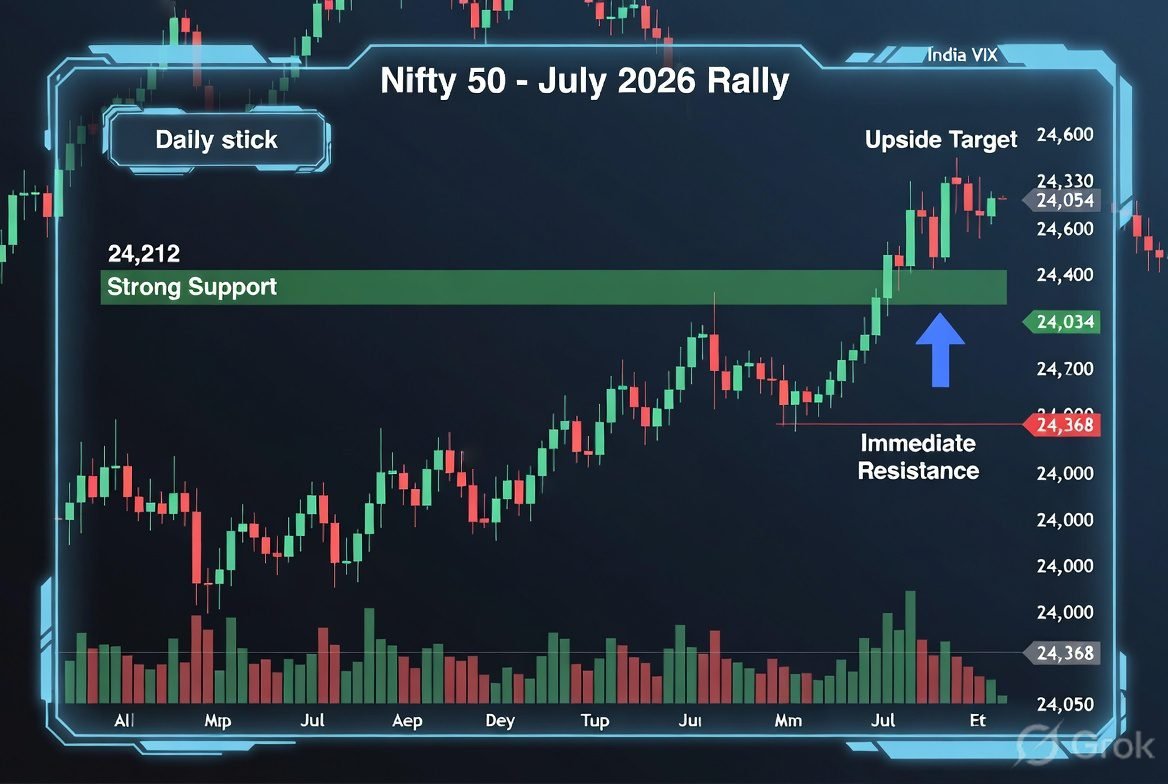
For investors who track charts, the setup for July 20 onwards is defined by a few critical levels. Nifty Prediction for July 20: Support at 24,212 and resistance at 24,368. A sustained move above 24,368 opens Upside Target 1 at 24,473 and Target 2 at 24,530.
Beyond those immediate targets, market participants will watch for a decisive close above the 24,400–24,450 resistance zone, which chart analysts view as a precondition for extending gains toward 24,600 and higher. The 24,600 level has been described as a trendline resistance zone — breaking it decisively would shift the near-term bias to clearly bullish.
The India VIX — India's fear gauge — remains contained at 13.235, reflecting subdued implied volatility and favorable conditions for directional trades. Low VIX is generally good for the market. It means options sellers are comfortable, institutional traders are not hedging aggressively, and the probability of a sudden sharp fall is relatively low. Compare this to VIX's 52-week high of 28.90 — we are far from panic territory.
One derivatives-based signal worth noting: the Nifty PCR stands at 1.62, signaling strong put-writing conviction on the support side. A PCR above 1.5 is considered a bullish signal — it means options traders are writing (selling) more puts than calls, which happens when they are confident the market will hold its support levels.
The honest technical summary: bulls are in control above 24,212. A close above 24,368 this week opens the path to 24,600. The broader bias is constructive but not runaway bullish — this is a market that rewards stock-specific positions rather than aggressive directional bets. Understanding how Nifty indices are structured helps frame these moves — our article on Nifty 50 and Sensex explained covers the foundations. And for understanding volatility signals, our piece on circuit breakers and market stress indicators provides useful context.
Q1 FY27 Results — The Bigger Picture
The Q1 FY27 earnings season is now well underway, and the picture that is emerging is nuanced — not uniformly bullish, not uniformly disappointing, but sector-dependent in a meaningful way. Let us look at what has actually been reported so far and what it tells us.
| Company | Net Profit Q1 FY27 | YoY Change | Key Highlight | Verdict |
|---|---|---|---|---|
| Jio Financial Services | ₹830 crore | +156% YoY | Fee income up 5x, JioBlackRock AUM ₹18,412 crore | 🟢 Exceptional |
| Tech Mahindra | ₹1,465 crore | +28.4% YoY | Revenue recovery in IT services, margin expansion | 🟢 Strong |
| HDFC Bank | ₹19,060 crore | +5% YoY | NIM compressed to 3.26% — record low | 🟡 Mixed |
| ICICI Bank | ₹15,440 crore | +4.6% QoQ | Core operating profit up 15.6%, strong NIM at 4.3%+ | 🟢 Good |
| Reliance Industries | Results awaited | ~+5% YoY est. | Revenue jump ~29% despite West Asia logistics costs | ⏳ Pending |
| Infosys | Results July 23 | TBD | Focus: FY27 revenue guidance revision | ⏳ Pending |
The pattern that is emerging across Q1 FY27 results: IT sector is recovering meaningfully, financial stocks are growing profits but facing margin headwinds, and consumer-facing businesses are benefiting from domestic demand. This is not a market where every sector is firing — it is a selective rally that rewards quality businesses. Understanding how to read quarterly results properly is essential right now — our guide on Q1 FY27 private bank results comparison covers the banking sector in detail.
HDFC Bank and ICICI Bank — The Banking Sector Story
Both HDFC Bank and ICICI Bank reported Q1 FY27 results on Saturday, July 18 — and the contrast between the two tells a larger story about Indian private banking in 2026.
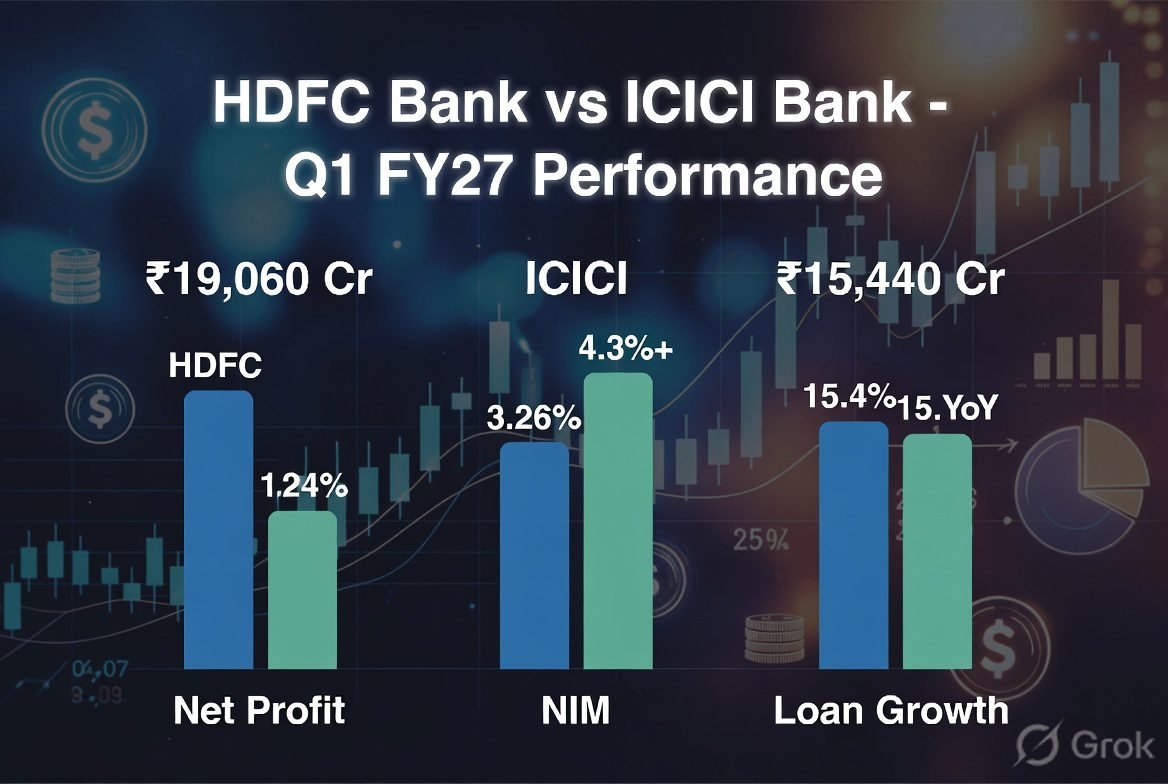
HDFC Bank reported the headline number that everyone expected: India's largest private sector lender reported a 5 per cent year-on-year rise in standalone net profit to ₹19,060 crore for the quarter ended June (Q1FY27), supported by lower provisions and a nearly 7 per cent increase in net interest income.
But the number that matters more is NIM — net interest margin. The bank's net interest margin narrowed to 3.26 per cent in Q1FY27 from 3.38 per cent in the March quarter, its lowest level on record, as cost of funds remained the same but yield on assets declined. When a bank's NIM falls to a record low, it means the spread between what it earns on loans and what it pays on deposits is shrinking — which is a structural headwind on profitability going forward.
On asset quality: Gross non-performing assets rose to 1.17 per cent as of June 30, 2026, from 1.15 per cent at the end of March, while gross advances grew 15.4 per cent YoY to ₹30.61 trillion.
ICICI Bank told a better story. ICICI Bank posted consolidated profit of ₹15,440 crore, up 4.6% QoQ. More importantly, its NIM held above 4.3% — significantly higher than HDFC Bank — and its core operating profit grew 15.6%, suggesting operational efficiency is improving. For investors choosing between the two, ICICI Bank's Q1 FY27 results were the stronger print.
Sector-Wise Outlook — Where Is the Market Headed?
Not all sectors are equal in this market. Here is where each major sector stands right now based on Q1 FY27 data and technical trends.
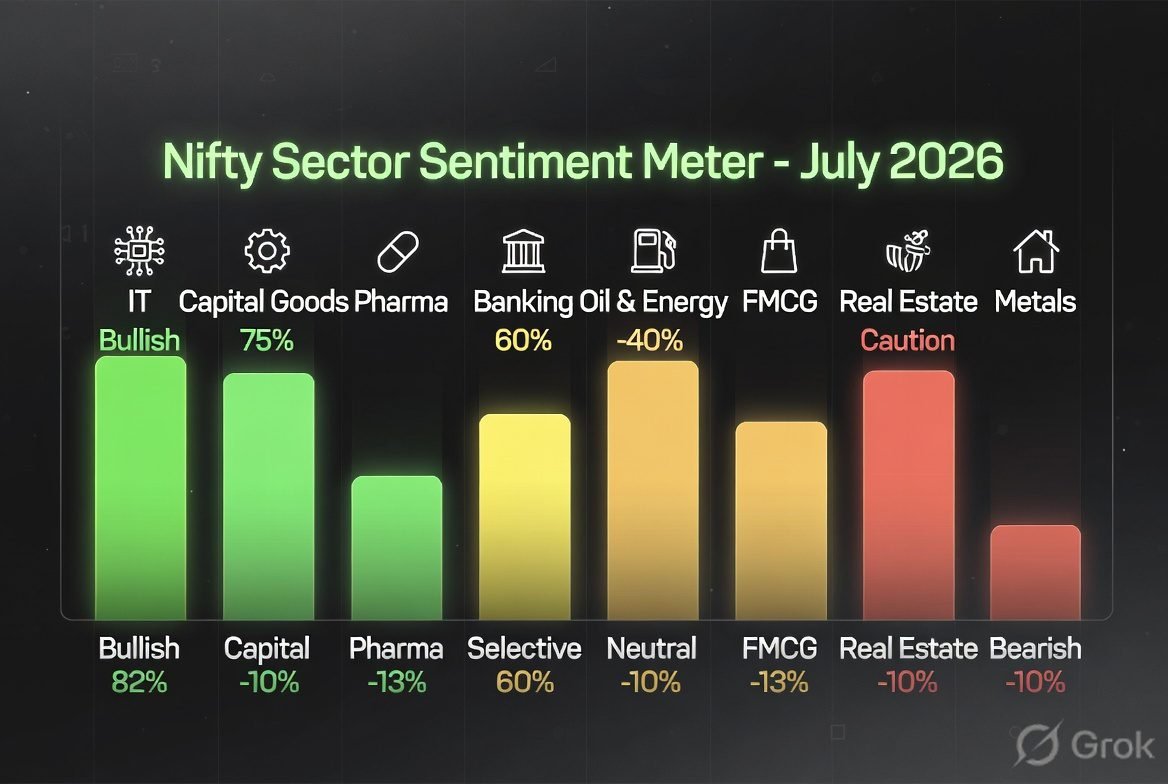
Sector Sentiment Meter — July 2026
IT — Strongest Sector Right Now: Tech Mahindra's 28.4% profit jump is not an outlier — it signals a genuine recovery in discretionary IT spending by US enterprises after nearly two years of cost-cutting. With Infosys results due July 23, the IT sector is the single most watched space this week. Our AI stocks India 2026 guide covers which IT companies are best positioned for this AI-driven demand cycle.
Capital Goods — Quietly Strong: Defence orders, infrastructure spending, and India's PLI scheme continue to drive order books for capital goods companies. This sector benefits from both domestic government spending and the global supply chain diversification away from China. It is not flashy but it is one of the most fundamentally supported sectors in the Indian market right now.
Metals — Most Risky: China's economic slowdown continues to export deflationary pressure on global commodity prices. Indian steel and aluminium companies face a double challenge — lower realisation prices and domestic competition from Chinese imports through third countries. Avoid fresh positions in metals until there is clarity on China's demand recovery. Our article on global commodity price impacts on India explains this transmission in detail.
To understand how to position across sectors during an earnings season, our complete sector rotation guide is essential reading right now.
5 Stocks Worth Watching This Week
These are not buy recommendations. These are companies where Q1 FY27 results or upcoming events make them worth tracking closely this week.
| # | Stock | Why Watch | Key Event | Risk Level |
|---|---|---|---|---|
| 1 | Infosys (INFY) | Results July 23 — guidance revision could move entire IT sector | Q1 FY27 results + FY27 guidance | 🟡 Medium |
| 2 | ICICI Bank (ICICIBANK) | Best Q1 FY27 print among large private banks — NIM holding | Post-results momentum | 🟢 Low-Medium |
| 3 | Tech Mahindra (TECHM) | 28.4% profit jump confirms IT recovery — breakout setup | Momentum continuation | 🟡 Medium |
| 4 | Jio Financial (JIOFIN) | 156% profit jump, JioBlackRock scaling — early stage compounder | Post-results momentum | 🔴 High |
| 5 | Reliance Industries (RELIANCE) | Q1 results declared after market hours Friday — reaction this week | Market reaction to results | 🟡 Medium |
For a deeper understanding of how to evaluate these companies, our comparison of Jio Financial Q1 FY27 preview and our Reliance Industries Q1 FY27 preview give the fundamental context needed to assess these results properly. For beginners who want to understand how to read company results, our beginner investing guide starts from the foundations.
FII vs DII — What the Smart Money is Doing
One of the most watched data points in Indian markets is the daily buying and selling by Foreign Institutional Investors (FIIs) and Domestic Institutional Investors (DIIs). In July 2026, the pattern has been telling.
FIIs — the foreign money — were net sellers through most of early July, partly driven by geopolitical uncertainty in West Asia and crude oil rising above $85 per barrel. Brent crude prices rose by 1.14 per cent, reaching $85.5 per barrel — elevated crude is a tax on India's current account and tends to push FIIs to reduce India exposure temporarily.
But DIIs — domestic mutual funds, insurance companies, and pension funds — have been consistent buyers. India's domestic SIP inflows crossed ₹24,323 crore in April 2026, a new record. This sustained domestic buying has been the floor under the market during periods of FII selling. With several index heavyweights reporting earnings over the weekend, investor focus will remain on management commentary and earnings reactions, which are expected to shape sectoral performance and define the near-term market narrative.
3 Common Investor Mistakes Right Now
Every market cycle creates its own version of the same mistakes. Here is what we are seeing investors get wrong in July 2026.
Mistake 1 — Chasing the Rally Without Checking Valuations. The July 17 rally was real, but Nifty is not cheap. At 24,334, the index trades at approximately 21-22x forward earnings — not expensive by historical standards for India, but not a screaming buy either. Buying indiscriminately after a 965-point Sensex day is how investors end up buying at the top of a local move. The correct approach is identifying specific stocks where Q1 results have confirmed earnings recovery, and buying those selectively rather than chasing the index. Our article on why investors lose money in the stock market covers the behavioural traps that cost retail investors the most.
Mistake 2 — Ignoring Crude Oil Risk. West Asia tensions have pushed Brent crude above $85. Every $10 per barrel rise in crude oil costs India approximately $12-14 billion in additional import bills annually. This feeds into the rupee (which has been under pressure), inflation, and eventually corporate margins for companies with high energy input costs. Ignoring the crude oil overhang while being bullish on Indian equities is not a complete picture. Our article on how oil prices affect Indian stocks explains the sector-by-sector impact clearly.
Mistake 3 — Selling Long-Term SIPs Because of Short-Term Volatility. If you have a Nifty 50 or midcap index fund SIP, nothing that happened in July 2026 is a reason to stop it. Market volatility in the 23,800-24,600 range is completely normal for the Nifty. Long-term investors who paused SIPs during the correction of early July missed the July 17 rally — exactly the mistake that costs most retail investors their long-term returns. Our SIP calculator and guide shows with real numbers why continuity matters more than timing for SIP investors.
What Should You Actually Do This Week?
Our Honest Market View — July 20, 2026
Short-term (1-4 weeks): Constructive but selective. Nifty needs to sustain above 24,212 and break 24,368 convincingly to confirm the bullish case. IT sector is the strongest sector fundamentally. Banking is a selective story — ICICI over HDFC in the near term based on Q1 results quality.
Medium-term (3-6 months): The earnings season will be the real test. If Q1 FY27 results broadly confirm 12-15% earnings growth across sectors, the path to 25,000-25,500 by December is realistic. The key risk is crude oil — any spike above $95-100 changes the picture materially.
For long-term SIP investors: Continue SIPs without change. This is exactly the market environment where doing nothing and letting your SIP run is the correct strategy. Add to index funds on any 5-8% correction.
Not investment advice. Based on publicly available data as of July 20, 2026.
For investors wondering how to structure their overall portfolio during earnings season, our article on complete mutual fund guide for India explains how to think about equity allocation across different market conditions. And if you want to understand whether your current portfolio is appropriately diversified for this kind of market, our piece on behavioural mistakes in stock trading is worth reading before making any major changes.
One important framework that has served Indian long-term investors consistently: inflation and its impact on your portfolio is a structural consideration that many investors miss. With crude above $85 and the rupee under pressure, understanding the inflation transmission into equity returns matters more than usual right now.
If you are a new investor trying to make sense of all of this, our Nifty 50 and Sensex primer explains what these index moves actually mean for your investments in plain language. And the most important thing any investor can do right now — regardless of market level — is understand how sector rotation works so you are positioned in the right sectors at the right stage of the economic cycle.
Disclaimer: This article is for educational and informational purposes only. It does not constitute investment advice, a buy/sell recommendation, or any solicitation to invest in any security. All market data, stock prices, and company results cited are sourced from publicly available NSE/BSE filings, company presentations, and business news as of July 20, 2026. Market data is subject to change. Investments in equity markets are subject to market risk. Please consult a SEBI-registered financial adviser before making any investment decisions. Past performance is not indicative of future results.
Frequently Asked Questions
1. Will Nifty reach 24,800 in July 2026?
Based on current technical and fundamental analysis, 24,800 is possible in July 2026 but not guaranteed. The immediate path is: first break 24,368 resistance, then 24,473-24,530, then 24,600 (trendline resistance). Each level needs to be broken convincingly. If Infosys delivers strong results on July 23 and FIIs turn net buyers, 24,600 is achievable by end-July. 24,800 would require additional catalysts — possibly a RBI rate cut signal in the August MPC meeting or a positive India-US trade deal development. Start by watching the 24,368 level this week.
2. Is it a good time to invest in the stock market in July 2026?
For long-term investors with a 5+ year horizon investing through SIPs, any time is a reasonable time to invest. Timing the market precisely is proven to be less important than time in the market for most retail investors. For lump sum investing, the current level (Nifty 24,334) is not cheap — we are at roughly 21-22x forward earnings. Investing in tranches (spreading lump sum over 3-6 months via Systematic Transfer Plans) rather than all at once is a prudent approach at current valuations. The earnings season over July-August will clarify whether the market deserves higher multiples.
3. Which sector is best to invest in July 2026?
Based on Q1 FY27 results and technical trends as of July 20, 2026, the IT sector has the strongest combination of earnings recovery and technical momentum — Tech Mahindra's 28.4% profit growth is a signal. Capital goods and defence also remain fundamentally well-supported. ICICI Bank is the preferred large-cap banking pick based on Q1 results. Metals and real estate carry the highest near-term risk. However, sector allocation should be based on your individual financial goals and risk profile — a diversified index fund provides balanced sector exposure without the need to pick individual sectors.
4. What happened to HDFC Bank's stock in Q1 FY27?
HDFC Bank reported Q1 FY27 results on July 18, 2026, with standalone net profit of ₹19,060 crore, up 5% YoY. While profit growth was modest and positive, the net interest margin fell to a record low of 3.26%, down from 3.38% in the previous quarter. Gross NPAs ticked up slightly to 1.17%. The mixed results reflected ongoing post-merger integration pressures and a challenging margin environment. Gross advances grew strongly at 15.4% YoY. The market's reaction to HDFC Bank results this week will be an important signal for the broader banking sector.
5. What should I do if Nifty falls below 24,000?
A fall below 24,000 would represent approximately a 1.4% decline from current levels (24,334) — a relatively modest move in the context of normal market volatility. The strong support zone lies between 23,900 and 24,000 based on current technical analysis. If Nifty falls below 24,000, it would not necessarily signal a trend reversal — it would need to be assessed in context (FII flows, crude oil price, global cues). For long-term SIP investors, a Nifty dip below 24,000 is actually a good opportunity — your monthly SIP buys more units at lower prices. Do not stop SIPs because the market falls.
6. What is India VIX and what does 13.23 mean for July 2026?
India VIX (Volatility Index) measures the market's expectation of near-term volatility — sometimes called the "fear gauge." A higher VIX means more expected volatility (fear); a lower VIX means markets are calm. India VIX at 13.23 as of July 20 is well below its 52-week high of 28.90 — indicating a relatively calm market with low implied volatility. This is generally positive for markets — it means institutional investors are not aggressively hedging against sharp falls, and option sellers are comfortable writing at current levels. VIX below 15 is typically considered a low-volatility, favorable environment for equity investing.
7. Infosys results are on July 23 — should I buy before the results?
Buying stocks before their quarterly results specifically to profit from post-result moves is a speculative approach rather than an investment strategy. The market's reaction to Infosys Q1 FY27 results will depend not just on the profit number but on the full-year FY27 revenue guidance — if Infosys raises its guidance, the entire IT sector could rally. If it disappoints or maintains guidance without raising it, the opposite could happen. The risk-reward of such speculative positions is uneven for most retail investors. A more prudent approach is to assess the results after they are declared and make allocation decisions based on fundamental clarity rather than pre-results speculation.
8. Is this Sensex rally sustainable or just a short-term bounce?
The July 17 Sensex rally of 964 points was driven by three genuine fundamental catalysts — strong Q1 FY27 earnings from major companies, softer US inflation data, and institutional positioning ahead of heavyweights' results. This was not purely technical or sentiment-driven. However, sustainability depends on two things that will play out over the next 2-3 weeks: whether the broader Q1 FY27 earnings season confirms 12-15% corporate profit growth, and whether crude oil stabilises below $90. If both conditions are met, the rally has legs. If crude spikes further and earnings disappoint, we could see a retest of 24,000-24,200 before the next leg higher. Stay invested but do not chase aggressively at current levels.

Pranab Barman is a Financial Educator and Personal Finance Researcher with over 10 years of hands-on experience in stock markets, trading, and investing. Currently enrolled in the CFA Program, he is committed to continuous learning and professional excellence in finance.
As the Founder of PlayWithStock, Pranab covers a wide range of topics including Mutual Funds, SIP, Taxation, Stock Market Basics, and Financial Calculators — with a focus on simplifying complex financial concepts for everyday all investors.
Email: support@playwithstock.com
Website: playwithstock.com
Related posts:
 Nifty July Seasonality: Why July Is Nifty’s Strongest Month (27-Year Data)
 What Is Circuit Breaker Stock Market: Meaning, Limits & 2026 Update
 What is Nifty Midcap 150? Complete Guide and Should You Invest in 2026
 Why Is the Stock Market Falling Today? US-Iran Tensions, Crude Oil Spike & FII Selling Explained
 Vodafone Idea Stock 2026: The Complete ₹35,000 Crore Guide
 AI Investing 2026: The Complete India-US Stock Guide
 Nifty 50 and Sensex: 7 Things Every Investor Should Know
 HDFC Bank, ICICI Bank, Axis Bank & Kotak Bank Q1 FY27 Results: The Complete Comparison
2 thoughts on “Nifty July 2026: Will It Hit 24,800? Complete Market Outlook and Stock Guide”
You ought to be a part of a contest for
one of the highest quality sites on the net. I will highly recommend this blog!
thank you. keeping support of US alwayes…