
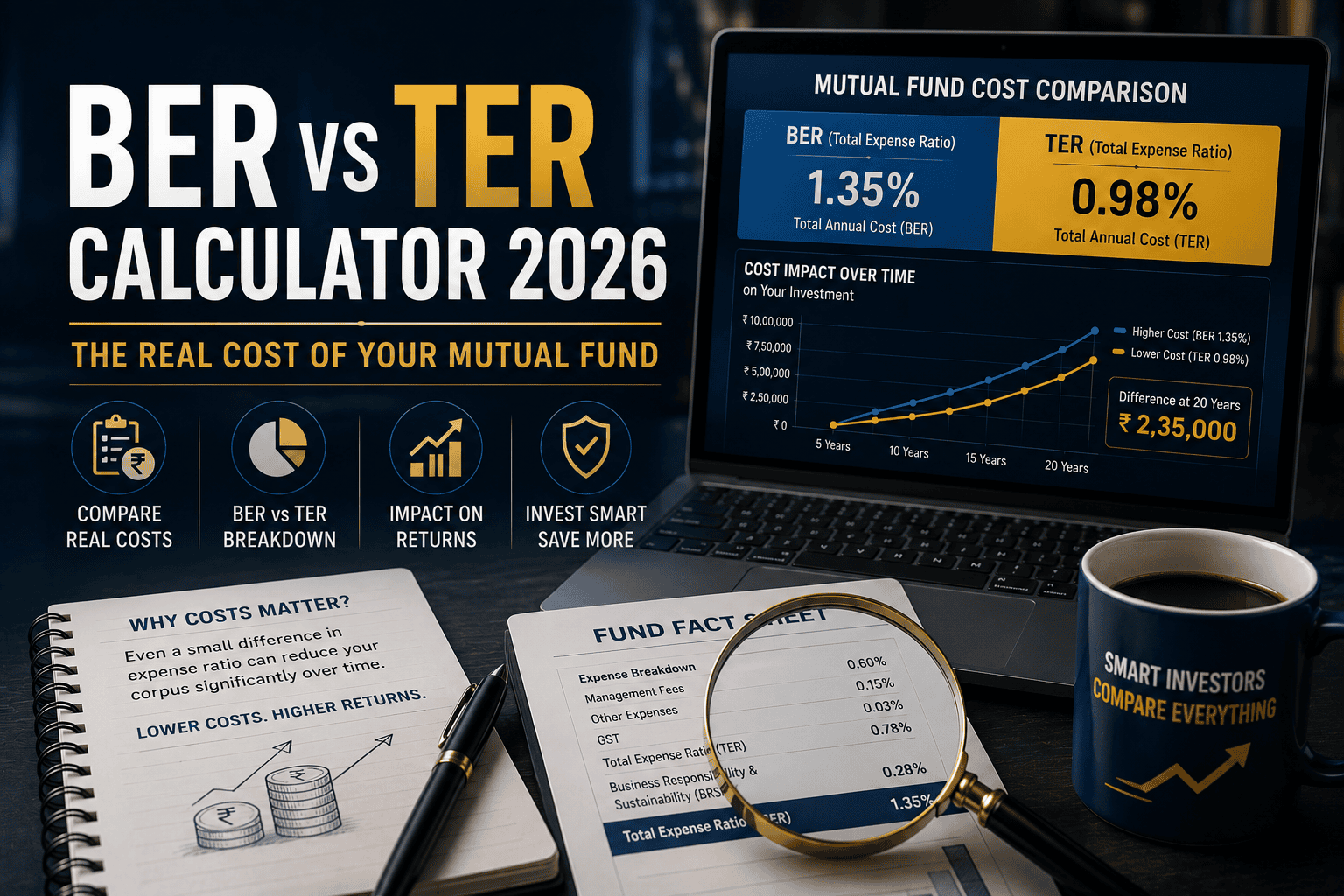

BER vs TER Calculator 2026: The Complete Guide
See what SEBI's new expense ratio unbundling actually means in rupees — and how much cost drag your fund is quietly building into your returns.
BER vs TER Cost Calculator
Enter your fund's cost components below to see the real impact on your returns. This is an educational estimate only.
Introduction
Until April 2026, mutual fund investors saw one bundled number — Total Expense Ratio — that mixed together the fund manager's fee with trading costs and government taxes the fund manager doesn't control. SEBI's 2026 regulations unbundled that figure, and this calculator applies the same unbundled logic to show you what you're actually paying for skill versus what you're paying for tax and turnover.
Complete Guide: What Changed in 2026
SEBI notified the SEBI (Mutual Funds) Regulations, 2026 on 14 January 2026, effective from 1 April 2026, replacing the nearly three-decade-old 1996 framework. The centrepiece of the overhaul is a restructured expense disclosure: Total Expense Ratio is now explicitly defined as the sum of three separate components rather than one bundled cap.
Base Expense Ratio (BER) covers only what the Asset Management Company charges for managing your money — fund management, distributor commissions, and registrar/transfer agent charges. Brokerage and transaction costs cover what the fund spends buying and selling securities, now capped at reduced limits of 5 basis points for cash market trades and 1 basis point for derivatives, down from 12 and 2 basis points respectively. Statutory levies — GST, STT, CTT, stamp duty, and exchange fees — are now charged strictly on actuals, sitting outside the BER cap entirely rather than being absorbed within it.
Alongside the unbundling, SEBI reduced the maximum BER ceilings themselves. Equity schemes with AUM up to ₹500 crore saw their cap fall from 2.25% to 2.10%; debt schemes in the same bracket moved from 2.00% to 1.85%; and index funds and ETFs saw their cap reduced from 1.00% to 0.90%. For funds of funds, the BER is now capped at twice the weighted average BER of the underlying schemes they invest in.
How to Use This Calculator
The BER vs TER Formula
| Fund Type | Old BER/TER Cap | New BER Cap (2026) |
|---|---|---|
| Equity (AUM ≤ ₹500 cr) | 2.25% | 2.10% |
| Debt (AUM ≤ ₹500 cr) | 2.00% | 1.85% |
| Index Funds / ETFs | 1.00% | 0.90% |
Common Mistakes to Avoid
- Comparing old TER figures directly with new BER figures. They measure different things now — BER excludes levies that old TER included, so a lower BER doesn't automatically mean a cheaper fund overall.
- Ignoring statutory levies when comparing funds. A high-churn fund can carry meaningfully higher brokerage and STT costs even with an identical BER to a low-churn peer.
- Assuming index funds have zero meaningful cost difference. Even the gap between a 0.10% and 0.30% index fund compounds into a real rupee difference over 15-20 years.
- Underestimating small percentage differences. A 0.10% cost reduction on a large, long-held corpus can mean lakhs of rupees over two decades, purely from reduced compounding drag.
Worked Example
Example — Higher-Cost Active Fund. ₹10,00,000 invested for 20 years at a 12% gross return, in a fund with BER 1.8%, brokerage 0.05%, and levies 0.15% (TER 2.00%), grows to approximately ₹66.5 lakh net of costs — versus roughly ₹96.5 lakh at the full 12% gross rate, a cost drag of around ₹30 lakh over the period.
Example — Lower-Cost Index Fund. The same ₹10,00,000 for 20 years at 12% gross, but with BER 0.30%, brokerage 0.02%, and levies 0.08% (TER 0.40%), grows to approximately ₹90.7 lakh — a cost drag of only about ₹5.8 lakh, illustrating roughly ₹24 lakh in preserved returns purely from the lower-cost structure.
Conclusion
The unbundling of BER and TER doesn't lower your actual cost by itself — that depends on the specific fund you hold — but it does let you see, for the first time in one clean breakdown, exactly which rupee pays for management skill and which pays for trading and taxes. Running your own fund's disclosed BER, brokerage, and levies through this calculator turns a fact-sheet footnote into a concrete rupee number worth comparing before you commit fresh capital.
FAQs
BER is only the AMC's management fee. TER is the total cost you actually pay, calculated as BER plus brokerage/transaction costs plus statutory levies like GST and STT.
1 April 2026, under the SEBI (Mutual Funds) Regulations, 2026, notified on 14 January 2026.
For most schemes, the maximum permissible BER decreased by roughly 10-15 basis points compared to the old TER cap, though your fund's specific brokerage and levy costs depend on how actively it trades.
No. Existing investments and folios are unaffected structurally. The changes only affect how costs are disclosed and capped going forward — reviewing your next fact sheet is the only recommended action.
Related Reading on Play With Stock

Pranab Barman is a Financial Educator and Personal Finance Researcher with over 10 years of hands-on experience in stock markets, trading, and investing. Currently enrolled in the CFA Program, he is committed to continuous learning and professional excellence in finance.
As the Founder of PlayWithStock, Pranab covers a wide range of topics including Mutual Funds, SIP, Taxation, Stock Market Basics, and Financial Calculators — with a focus on simplifying complex financial concepts for everyday all investors.
Email: support@playwithstock.com
Website: playwithstock.com
Related posts:
 Mutual Fund BER vs TER Calculator (2026): Compare BER vs TER Online
 UPS Pension Calculator 2026: The Complete Guide
 SSY Maturity Calculator 2026: The Complete Guide
 Amrit Vrishti FD Calculator 2026: The Complete Guide
 SIP Compounding Calculator 2026: The Complete Guide
 SGB Redemption Tax Calculator 2026: The Complete Guide
 8th Pay Commission Salary Calculator: Complete 2026 Guide
 Free STT Hike Breakeven Calculator 2026 — see exactly how much extra STT the Budget 2026 hike adds to your F&O trades and how many points you now need to break even.