
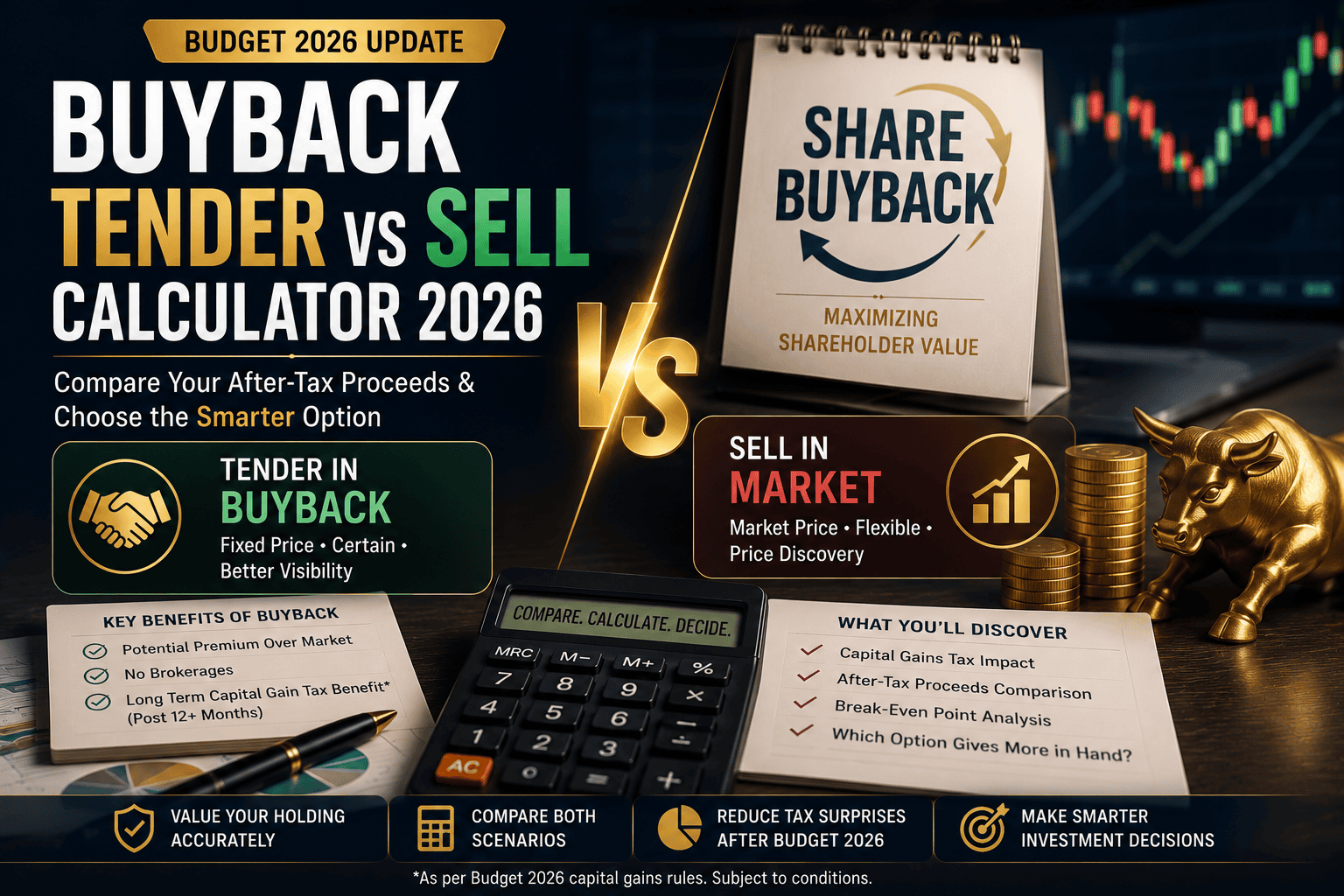

Buyback Tender vs Sell Calculator 2026: The Complete Guide
Buyback tax rules changed three times since 2024. Here's how to compare tendering versus open-market selling correctly, under the rules that actually apply right now.
Tender vs Sell Calculator
Enter your details below to compare after-tax proceeds. This is an educational estimate only.
Introduction
Deciding whether to tender your shares into a buyback offer or sell them on the open market used to hinge almost entirely on tax treatment. As of the current rules effective 1 April 2026, that's no longer true — both routes are taxed identically as capital gains. The decision now comes down almost entirely to price, and this calculator compares the two routes exactly as the current rules require.
Complete Guide: Three Tax Regimes Since 2024
Buyback taxation in India has changed three times in under two years, and knowing which regime applies to your specific transaction matters enormously. Before 1 October 2024, the company itself paid a buyback distribution tax at an effective rate of roughly 23.3% under Section 115QA, and shareholders received their proceeds completely tax-free.
From 1 October 2024 to 31 March 2026, that company-level tax was abolished, and the entire buyback consideration became taxable in the shareholder's hands as a deemed dividend at their slab rate — with no deduction allowed for the cost of acquisition, though that cost could be claimed separately as a capital loss carried forward for up to eight years.
From 1 April 2026 onward — the regime currently in effect — the Finance Act 2026 restored capital gains treatment. Shareholders now pay tax only on the actual gain (buyback price minus cost of acquisition), at 12.5% LTCG for holdings beyond 12 months (with an annual exemption of up to ₹1.25 lakh on listed equity gains) or 20% STCG for shorter holdings. Promoters face an additional differential levy, pushing their effective rate to roughly 30% for individuals or 22% for corporate promoters. SEBI has also proposed reintroducing the open market buyback route from 1 August 2026, alongside the existing tender offer mechanism.
How to Use This Calculator
The Comparison Formula
| Period | Buyback Tax Treatment |
|---|---|
| Before 1 Oct 2024 | Company paid ~23.3% tax; shareholders received proceeds tax-free |
| 1 Oct 2024 – 31 Mar 2026 | Deemed dividend, taxed at shareholder's slab rate on full amount |
| From 1 Apr 2026 (current) | Capital gains — 12.5% LTCG or 20% STCG on actual gain only |
Common Mistakes to Avoid
- Applying the old deemed-dividend logic to a current buyback. That regime ended 31 March 2026 — using it today will significantly overstate your tax liability.
- Forgetting the acceptance ratio. In oversubscribed tender offers, not all tendered shares may be accepted — the untendered portion remains yours, subject to separate tax treatment if later sold.
- Ignoring that both routes are now taxed the same way. Since tax treatment is now identical, comparing purely on price (buyback premium vs current market price) is the correct approach.
- Missing the promoter surcharge. If you're classified as a promoter, your effective rate is meaningfully higher than the standard 12.5%/20% rates.
Worked Example
Example — Tender Route. 100 shares bought at ₹200, tendered into a buyback at ₹500, held over 12 months. Gain = ₹30,000. With the full ₹1.25 lakh exemption available, this falls entirely within the exemption — zero tax, net proceeds of ₹50,000.
Example — Open Market Sell, Same Shares. If instead sold on the open market at ₹420 (below the buyback premium), gain = ₹22,000 — also fully exempt, but net proceeds of only ₹42,000, meaningfully less than the tender route purely because of the lower price, not different tax treatment.
Conclusion
The tender-versus-sell decision has genuinely simplified since April 2026 — with identical tax treatment on both sides, the choice now comes down to which route offers the better price, adjusted for the risk that not all tendered shares get accepted in an oversubscribed offer. Running your specific numbers through this calculator, rather than relying on outdated deemed-dividend assumptions, gives you the comparison that actually matters under today's rules.
FAQs
No. Since 1 April 2026, buyback proceeds are taxed as capital gains — 12.5% LTCG or 20% STCG on the actual gain, not tax-free as they were before October 2024.
No. Under the current regime, both routes use the identical capital gains framework and tax rates — the main practical difference is the price you receive.
It falls under a different regime. Buybacks between 1 October 2024 and 31 March 2026 were taxed as deemed dividends at your slab rate, with no deduction for cost of acquisition.
No. Promoters face an additional differential levy on top of standard capital gains tax, pushing their effective rate to roughly 30% for individuals or 22% for corporate promoters.
Related Reading on Play With Stock

Pranab Barman is a Financial Educator and Personal Finance Researcher with over 10 years of hands-on experience in stock markets, trading, and investing. Currently enrolled in the CFA Program, he is committed to continuous learning and professional excellence in finance.
As the Founder of PlayWithStock, Pranab covers a wide range of topics including Mutual Funds, SIP, Taxation, Stock Market Basics, and Financial Calculators — with a focus on simplifying complex financial concepts for everyday all investors.
Email: support@playwithstock.com
Website: playwithstock.com
Related posts:
 Share Buyback Tender vs Sell Calculator: 2026 Tax Guide
 UPS Pension Calculator 2026: The Complete Guide
 SSY Maturity Calculator 2026: The Complete Guide
 Amrit Vrishti FD Calculator 2026: The Complete Guide
 SIP Compounding Calculator 2026: The Complete Guide
 SGB Redemption Tax Calculator 2026: The Complete Guide
 BER vs TER Calculator 2026: The Complete Guide
 8th Pay Commission Salary Calculator: Complete 2026 Guide