
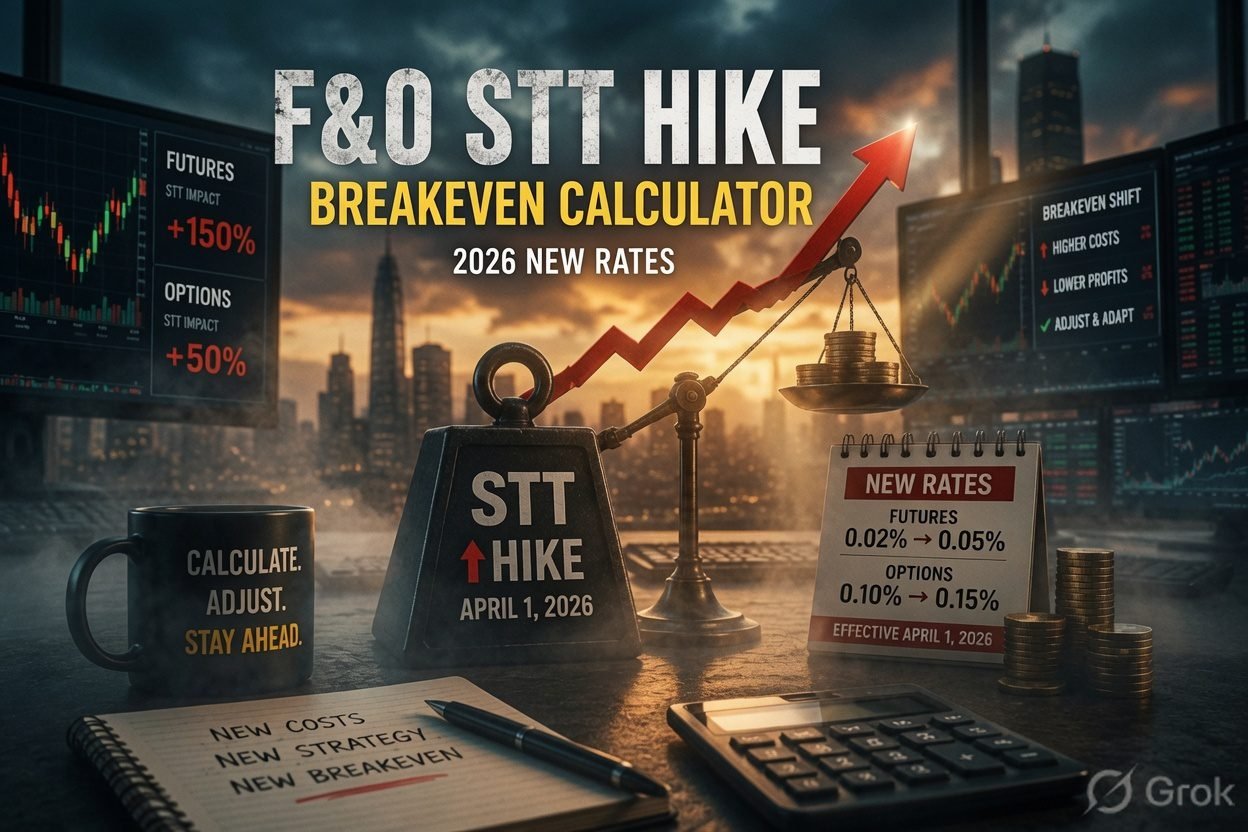

F&O STT Hike Breakeven Calculator: 2026 New Rates
Futures STT jumped 150%, options 50% — from 1 April 2026. Here's exactly how many extra points you now need just to break even.
An F&O STT hike breakeven calculator isn't the kind of tool most traders think they need — until they realise a strategy that was quietly profitable in March 2026 has been bleeding small losses every month since April, for no reason other than a tax change nobody re-priced into their math. Securities Transaction Tax is charged on turnover, not on profit, which means it doesn't care whether your trade wins or loses — and when the rate jumps by 150% on futures overnight, your breakeven point moves whether you noticed or not.
This guide breaks down exactly what changed in Budget 2026, works through real rupee numbers on actual contract sizes, explains why the government did this, and gives you a calculator to see precisely how many extra points or how much extra premium movement your specific trade now needs just to get back to where it was before 1 April 2026.
Table of Contents
- 1. What Changed: The New STT Rates
- 2. Real Numbers: What This Costs Per Trade
- 3. Why the Government Did This
- 4. F&O STT Breakeven Calculator
- 5. It's Not Just STT: Other 2026 Derivatives Changes
- 6. Is STT Deductible? Business Income vs Capital Gains
- 7. What Traders Should Actually Do
- 8. Who Gets Hit Hardest — and Who Barely Notices
- FAQs
1. What Changed: The New STT Rates
Presenting Budget 2026, Finance Minister Nirmala Sitharaman was specific about the numbers: futures STT rises from 0.02% to 0.05% of the traded price, options premium STT rises from 0.10% to 0.15%, and STT on exercised options rises from 0.125% to 0.15% of intrinsic value. The change came via Clause 143 of the Finance Bill 2026, amending Section 98 of the Finance (No. 2) Act, 2004, and applies to every F&O transaction entered into on or after 1 April 2026.
| Transaction Type | Old Rate | New Rate (from 1 Apr 2026) | Increase |
|---|---|---|---|
| Futures — sell side, on traded price | 0.02% | 0.05% | 150% |
| Options — sell side, on premium | 0.10% | 0.15% | 50% |
| Options — on exercise, on intrinsic value | 0.125% | 0.15% | 20% |
| Equity delivery, intraday equity | Unchanged | Unchanged | — |
Two things worth being precise about, because they trip people up. First, this hike is scoped narrowly — it only touches the equity F&O segment. Delivery-based equity (0.1% on both buy and sell) and intraday equity (0.025% on sell) are completely untouched, as are commodity derivatives. Second, STT on futures and the "sell premium" leg of options is charged only on the sell side — the buyer of a fresh position doesn't pay STT on entry, only on exit (or on exercise, for options that go in-the-money).
It's worth walking through exactly how the number gets calculated, because the mechanics matter for the calculator later in this article. For a futures trade, STT is levied on the full traded value of the contract — lot size multiplied by the price at which the future trades — not on your margin or your profit. Sell one lot of a future worth ₹5,00,000 at the new 0.05% rate and the STT bill is a flat ₹250, regardless of whether that trade eventually makes or loses money. For options, the calculation depends on whether you're simply selling the position or letting it get exercised: selling an option is taxed on the premium received (lot size × premium per unit), while an option that gets exercised is taxed on its intrinsic value (the difference between spot and strike, multiplied by lot size) at the point of exercise. Both events now attract the same 0.15% rate, which wasn't the case before — the old regime taxed exercised options very slightly more expensively (0.125%) than sold ones (0.10%), a gap the 2026 change has effectively closed by raising both to the same ceiling.
2. Real Numbers: What This Costs Per Trade
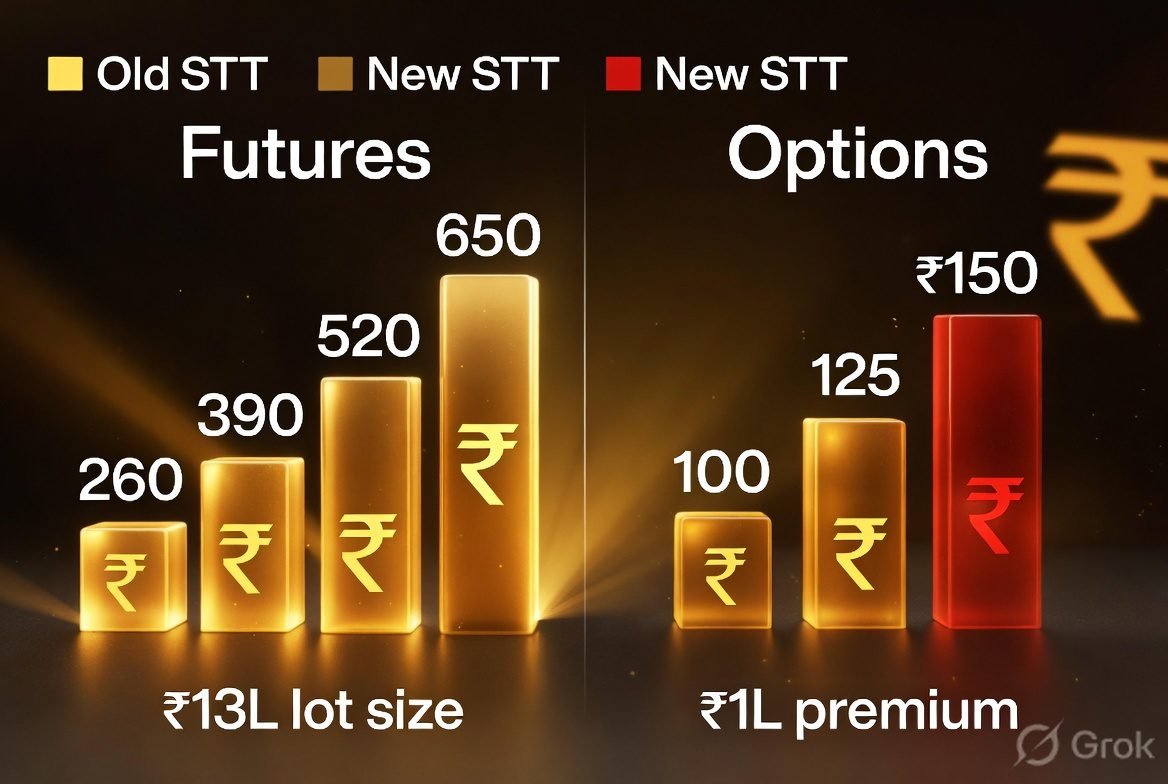
Percentages this small are easy to wave away until you put an actual contract size behind them. A trader selling one lot of Nifty futures with a contract value of ₹13 lakh paid roughly ₹260 in STT at the old 0.02% rate. From 1 April 2026, the identical trade attracts ₹650 — an increase of ₹390 on that single lot, before brokerage, exchange charges, or GST enter the picture at all. For an options trader selling ₹1,00,000 worth of premium, STT moves from ₹100 to ₹150 per trade — a smaller jump in absolute terms, but still a real, permanent 50% increase in a cost that was already there on every single sell.
Scale that up and the numbers stop being trivial. An active futures trader running 10 Nifty lots a day sees their monthly STT bill rise by roughly ₹46,875, which works out to close to ₹5.6 lakh a year in additional tax alone — a sum that has to be recovered purely through trading profit just to keep net income unchanged from pre-April-2026 levels. For a smaller trader executing 20 similar option trades a month, the extra STT outgo alone runs to roughly ₹6,000 a month, even before other costs.
What makes this genuinely different from a routine annual tax tweak is the sheer size of the percentage jump on the futures side specifically. A 150% increase is not a rounding adjustment — it's the kind of change that, on its own, can flip a strategy from marginally profitable to marginally loss-making without a single thing about your actual trading skill or market view changing. Compare that to the options side, where the 50% increase on premium sales and the smaller 20% increase on exercised positions are meaningful but proportionally gentler — which is itself a useful signal about where the government's policy intent was most concentrated: futures, where leverage and turnover tend to be highest relative to capital deployed, absorbed by far the largest single rate change of the entire Budget 2026 derivatives package.
Real STT-per-trade comparison at fixed contract sizes: one Nifty futures lot worth ₹13 lakh, and an options trade with ₹1 lakh of premium sold.
3. Why the Government Did This
The stated rationale, repeated across the Budget speech and post-Budget briefings, wasn't revenue — it was investor protection. Revenue Secretary Arvind Shrivastava specifically described a large share of F&O activity as sitting "largely in the realm of heavy speculation." That framing is backed by SEBI's own study of individual trader outcomes in the equity F&O segment: roughly 9 out of 10 individual traders lose money, and collectively individual traders lost over ₹1.06 lakh crore in the F&O segment in a single recent financial year, despite SEBI already tightening rules around upfront premium collection and exposure limits in late 2024. The number of unique individual traders in the derivatives segment has itself been falling — from roughly 1.06 crore down to the 75-lakh range across recent reporting periods — even before this STT hike, suggesting the segment was already shrinking under the weight of previous restrictions and repeated retail losses.
4. F&O STT Breakeven Calculator
This F&O STT hike breakeven calculator converts the rate change into the number that actually matters when you're placing a trade: how many extra points (for futures) or how much extra premium movement (for options) you now need just to cover the additional tax, before you've made a single rupee of real profit.
Work Out Your New Breakeven
"Extra Points/Premium Needed to Breakeven" divides the extra STT cost per trade by the lot size, giving you the additional price movement (in the underlying's points, or in premium per unit for options) needed purely to offset the higher tax — before brokerage, exchange charges, GST, or your actual trading edge are factored in. This tool assumes one STT charge per round-trip trade on the sell leg only, consistent with how STT is levied; it does not include brokerage or other transaction costs. Verify exact figures with your broker's contract note.
5. It's Not Just STT: Other 2026 Derivatives Changes
The STT hike landed alongside a broader SEBI push to cool the derivatives segment, and treating it in isolation understates the actual shift in cost and structure traders are dealing with in 2026. Alongside the tax change, SEBI has been rolling out: rationalisation of weekly expiry contracts (fewer weekly options series across the board), increases to minimum lot sizes (raising the capital required per lot), tighter margin norms, mandatory upfront collection of option premiums (removing the ability to trade on unfunded exposure), withdrawal of calendar spread margin benefits specifically on expiry day, and intraday position limit monitoring to catch excessive concentration during the trading session itself.
Individually, each of these is a smaller story than the STT hike. Together, they represent a coordinated multi-year effort to raise the cost and capital requirement of high-frequency retail F&O trading specifically — which is worth knowing if you're evaluating whether a strategy that worked in 2023 or 2024 is still structurally viable in its original form today.
A couple of these are worth a slightly closer look because they interact directly with the breakeven math this article is about. Mandatory upfront premium collection means option sellers can no longer run positions on unfunded or under-margined exposure the way some previously did — brokers now block the full premium (or margin equivalent) at the time the position is opened, which changes the capital efficiency of option-writing strategies independently of the STT change. The withdrawal of calendar spread margin benefits specifically on expiry day removes a mechanism many traders used to reduce margin requirements when rolling positions from one expiry to the next, meaning expiry-day rollovers now typically require more capital than they used to. Neither of these shows up in an F&O STT hike breakeven calculator directly, but both push in the same direction as the tax change: higher effective cost, more capital required, for the same nominal position size.
6. Is STT Deductible? Business Income vs Capital Gains
Here's a detail that becomes more financially meaningful precisely because the STT amounts involved are now bigger: STT paid on F&O transactions is deductible as a business expense under Section 36 of the Income Tax Act — but only if your F&O trading income is classified as business income and reported in ITR-3, not if it's incorrectly treated as capital gains. Getting this classification right was always good practice; at the new, higher STT rates, misclassifying it and losing the deduction is a materially bigger mistake than it used to be. If you're unsure how your F&O activity should be classified or filed, it's worth resolving that well before your ITR filing deadline for 2026 rather than scrambling in the final weeks — correct classification from the start avoids both an overpayment and the risk of a later notice.
7. What Traders Should Actually Do
Recalculate every strategy's breakeven, not just the ones that "feel" affected
The single most common mistake right now is assuming a strategy is safe because it wasn't obviously STT-sensitive before. A strategy running dozens of small, frequent trades a month was already more exposed to turnover-based costs than a strategy holding fewer, larger positions — and that gap has only widened. Run every active strategy through the calculator above with its real numbers before assuming nothing's changed.
Separate genuine edge from what was actually just low friction
Some strategies that looked profitable pre-April 2026 were arguably profitable partly because transaction costs were low enough not to matter. If a strategy's margin per trade was already thin relative to the old STT, brokerage, and slippage combined, it's worth being honest about whether the underlying edge was ever large, or whether low friction was quietly doing a lot of the work.
Remember this is a narrow, targeted change
If your investing is primarily long-term equity delivery rather than F&O trading, none of this directly touches you — delivery-based STT is completely unchanged. If the SEBI loss statistics above sound uncomfortably close to home, it's also worth reading our piece on why most investors lose money in the stock market, since the same behavioural patterns that show up in F&O loss data — overtrading, chasing losses, treating speculation as investing — tend to generalise well beyond derivatives specifically. For the other major 2026 rule changes reshaping the cost of investing this year, our pieces on the new mutual fund expense ratio rules and the share buyback tax changes cover similar ground from this same Budget cycle, and our Stock Market section has more on how these pieces fit together.
8. Who Gets Hit Hardest — and Who Barely Notices
Not every F&O participant feels this hike the same way, and it's worth being specific about where on that spectrum you sit.
Intraday scalpers and high-frequency small-margin traders
This group is affected the most, structurally. If your typical trade targets a small, fast move — a few points on an index future, or a modest premium swing on an option held for minutes to hours — the extra STT eats directly into a thin margin that was already competing against brokerage and slippage. Several previously marginal strategies in this bucket are now genuinely loss-making at the same trade parameters that worked before April 2026.
Swing traders holding positions for days to weeks
This group notices the change but usually isn't structurally broken by it. Because STT is charged once per sell-side transaction rather than scaling with how long you hold, a trader making fewer, larger, longer-held trades pays proportionally less total STT per rupee of capital deployed than someone churning the same capital through dozens of quick trades in the same period.
Hedgers using F&O to protect an existing equity or business position
This group is affected the least in relative terms. If you're buying a protective put against a large equity portfolio, or hedging a business's raw material exposure through commodity-linked derivatives, the STT increase is a real but usually small addition to what is fundamentally an insurance cost, not a speculative trade — the additional expense is worth weighing against the protection it buys, rather than against a profit target.
Long-term equity investors with no F&O exposure
This group is unaffected entirely. If your investing is built around SIPs, direct equity holdings, or index funds rather than derivatives, nothing about this specific change touches your costs at all.
FAQs
What is the new STT rate on futures in 2026?
From 1 April 2026, STT on the sale of futures contracts is 0.05% of the traded price, up from 0.02% — a 150% increase, introduced via Budget 2026 and the Finance Bill 2026's amendment to the Finance (No. 2) Act, 2004.
What is the new STT rate on options in 2026?
STT on the sale of options premium rose from 0.10% to 0.15% (a 50% increase), and STT on exercised options rose from 0.125% to 0.15% of intrinsic value, both effective 1 April 2026.
Does the STT hike affect equity delivery or intraday trading?
No. The hike is scoped specifically to the equity F&O (futures and options) segment. Delivery-based equity STT (0.1%) and intraday equity STT (0.025%) are completely unchanged.
Is STT on F&O trades tax-deductible?
Yes, but only if your F&O income is classified as business income and filed via ITR-3 — in that case, STT paid is deductible as a business expense under Section 36 of the Income Tax Act. If misclassified as capital gains, this deduction is lost.
Why did the government raise STT on F&O specifically?
The stated rationale is curbing excessive speculation and protecting retail traders, citing SEBI data showing roughly 9 out of 10 individual F&O traders lose money, with aggregate losses exceeding ₹1 lakh crore in a recent financial year — rather than being framed primarily as a revenue-raising measure.
How much extra will I pay in STT as an active trader?
It depends heavily on your trade frequency and contract sizes — an active trader running 10 Nifty futures lots daily could see annual STT costs rise by roughly ₹5.6 lakh, while a smaller trader doing 20 option trades a month might see an extra ₹6,000 or so monthly. Use the calculator above with your own numbers for an accurate figure.
- SEBI — study on profit and loss of individual traders in the equity F&O segment
- Union Budget, Government of India — Finance Bill 2026 official text
- TaxGuru — Finance Bill 2026 Clause 143 amendment details
- ClearTax — STT computation guide and worked examples
- Bajaj Finserv — Budget 2026 STT rate change coverage
- PL Capital — market and trader impact analysis
- Bigul — real contract-value STT examples

Pranab Barman is a Financial Educator and Personal Finance Researcher with over 10 years of hands-on experience in stock markets, trading, and investing. Currently enrolled in the CFA Program, he is committed to continuous learning and professional excellence in finance.
As the Founder of PlayWithStock, Pranab covers a wide range of topics including Mutual Funds, SIP, Taxation, Stock Market Basics, and Financial Calculators — with a focus on simplifying complex financial concepts for everyday all investors.
Email: support@playwithstock.com
Website: playwithstock.com
Related posts:
 Fed Rate Hike 2026: Why the July 28-29 FOMC Meeting Could Change Everything
 8th Pay Commission Salary Calculator: Complete 2026 Guide
 Share Buyback Tender vs Sell Calculator: 2026 Tax Guide
 SGB Premature Redemption Calculator 2026: Tax Rules, RBI Dates & Exit Guide
 Mutual Fund BER vs TER Calculator (2026): Compare BER vs TER Online
 ITR-4 Investment Disclosure Calculator: New 2026 Rule for Presumptive Taxpayers
 Jio IPO 2026: 10 Crucial Facts Every Investor Must Know
 What Is Circuit Breaker Stock Market: Meaning, Limits & 2026 Update