
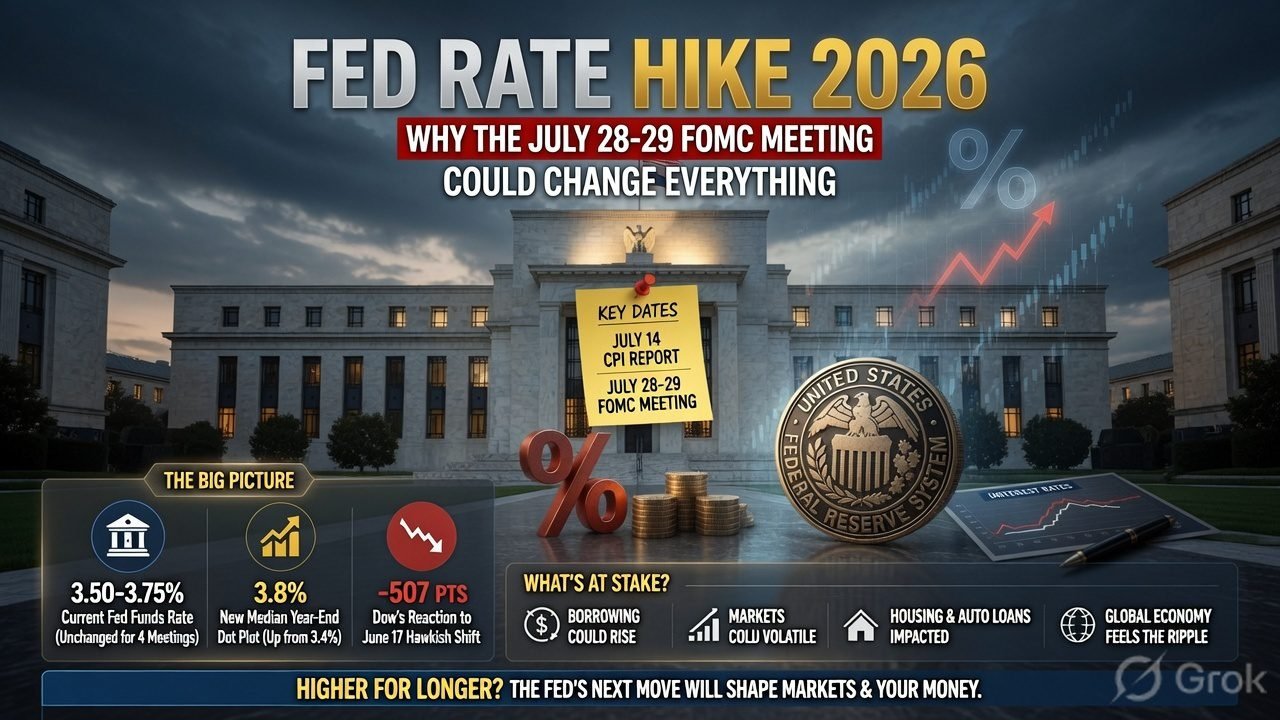

Fed Rate Hike 2026: Why the July 28-29 FOMC Meeting Could Change Everything
For the first time since 2023, the Federal Reserve is seriously considering a rate hike, not a cut. Here's the complete, data-verified story ahead of the July 14 CPI report and the July 28-29 FOMC decision.
Fed rate hike 2026 speculation has gone from a fringe idea to the market's central question in just a few weeks. After holding steady at 3.50%-3.75% for four consecutive meetings, the Federal Reserve's own projections now suggest the next move could be up, not down. Here's everything worth understanding before the next two critical dates.
The Setup, In Five Charts
Swipe / scroll →Rate Has Been Steady
The Fed has held its benchmark rate flat across four straight meetings through June 2026.
Projection Moved Up
The median year-end 2026 projection jumped from 3.4% in March to 3.8% in June — implying a hike.
Stocks Fell on the News
All three major indices fell on June 17 as investors digested the Fed's hawkish dot plot shift.
Hike Odds Nearly Doubled
September hike odds jumped from 27% to 49% in a single day, per CME's FedWatch tool.
Already Feeling It
Tariffs and the Iran conflict already cost the average household over $3,100 from 2025 to May 2026.
1. Fed Rate Hike 2026: What Just Happened and Why It's Different
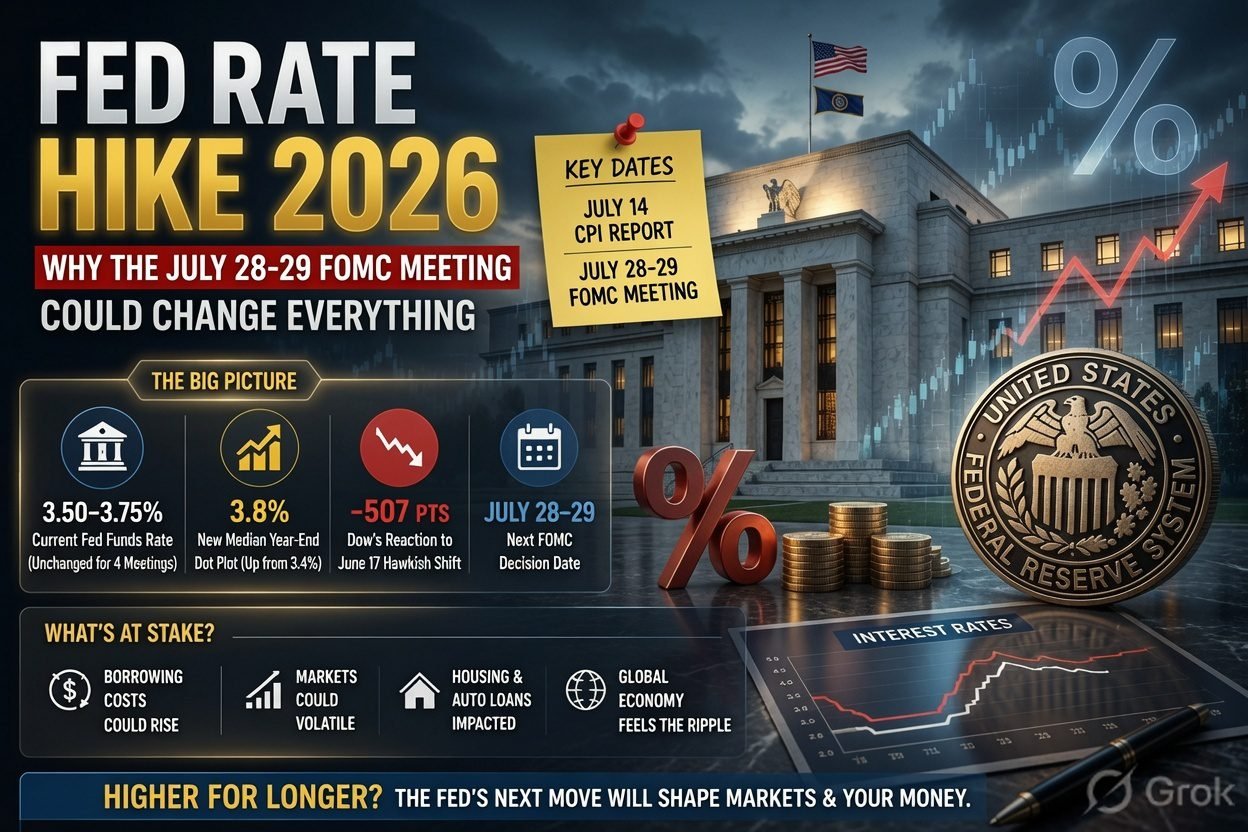
The Federal Reserve held its benchmark rate steady at 3.50%-3.75% at its June 16-17, 2026 meeting, the fourth consecutive hold, according to CNN's live coverage of the decision. That part wasn't surprising. What caught markets off guard was everything underneath the headline.
This was Kevin Warsh's first meeting as Fed Chair, and nine of 18 officials signaled a rate hike is needed by year-end, according to CNBC's meeting recap. The vote to hold was unanimous, 12-0, but the accompanying projections told a genuinely different story than markets had priced in just months earlier.
2. The Dot Plot That Flipped Everything
The Fed's "dot plot," its quarterly summary of individual officials' rate projections, showed the median forecast for where rates will end 2026 at 3.8%, up from 3.4% in the March projections, a quarter-percentage-point shift above the current target range. That's a genuine reversal from a forecast that had implied a rate cut just three months earlier.
Warsh himself notably abstained from submitting an individual dot, and overhauled the Fed's policy statement to remove language some had read as a cutting bias, describing the new, shorter statement as intentionally "curt" in his press conference, reported by Newsweek.
3. Two Critical Dates Ahead
Two dates now matter more than almost anything else on the economic calendar. The June Consumer Price Index report lands July 14, 2026, and will be the clearest single signal of whether the inflation trend that drove June's hawkish pivot is continuing or easing. The Fed's next policy meeting runs July 28-29, 2026, with the decision announced at approximately 2 p.m. ET on the final day, followed by a press conference, according to details confirmed by the Federal Reserve's official site.
Speaking at the European Central Bank's annual forum in Sintra on July 1, Warsh declined to signal a July rate cut and said inflation remains "too high," a stance that keeps a hike genuinely on the table for the July meeting or the one following it in September.
4. Why Prices Won't Come Down Easily
May's Consumer Price Index came in around 4.2% year-on-year, the highest reading in more than three years, according to data compiled from the Bureau of Labor Statistics. Unlike earlier 2025 inflation, which was more concentrated in specific categories like energy, this round has spread more broadly across services, housing, and core goods.
Elevated energy costs tied to ongoing Middle East tensions, alongside tariff-related cost pass-through, are the two most frequently cited structural drivers, according to analysis from Intellectia's Fed policy coverage. That combination is exactly why several Fed officials no longer view current inflation as purely transitory.
5. What a Hike Would Mean for Your Wallet
The Fed's rate doesn't move every part of your financial life the same way or on the same timeline. Short-term rates, like credit card APRs, are closely pegged to the Fed's benchmark and would move relatively quickly. Longer-term rates, like mortgage rates, are more influenced by Treasury yields and broader growth expectations, and have already drifted back toward 7% even without an actual hike yet, according to reporting cited by CNBC's household-impact coverage.
| Financial Product | How Quickly It Reacts | Primary Driver |
|---|---|---|
| Credit Cards | Fast (weeks) | Directly pegged to Fed benchmark |
| Auto Loans | Fast to moderate | Fed benchmark + lender risk pricing |
| Mortgages (30-yr) | Slower, often pre-emptive | Treasury yields, inflation expectations |
| Savings Accounts | Variable, lender discretion | Competitive deposit rates |
Two-year Treasury yields jumped 16 basis points to 4.21% on June 17 alone, their highest level in over a year, a direct reflection of the market repricing for a more hawkish path, tracked live via Trading Economics.
6. The Case Against a Hike
The June ADP private payrolls report added just 98,000 jobs, well below the roughly 120,000 economists expected, according to ADP's official release. Historically, weak jobs data reads as a signal for rate cuts, not hikes, creating a genuine tension with the Fed's own hawkish dot plot.
Some economists argue the Fed's inflation concern will outweigh a single soft jobs report, while others believe a meaningful labor market slowdown could still force a cut later in 2026 regardless of the current hawkish signal. This genuine disagreement is exactly why the July 14 CPI print carries so much weight, since it's the data point most likely to resolve which narrative wins out.
7. What Traders Are Betting
Prediction markets show a real but not overwhelming lean toward a 2026 hike. September hike odds on CME's FedWatch tool jumped from 27% to 49% in the single trading day following the June 17 dot plot release. Broader 2026 hike probability sits in the 54% to 59% range across different prediction platforms, reflecting genuine, roughly even-odds uncertainty rather than a market that's confidently pricing in one outcome.
8. What This Means for Investors
A more hawkish Fed reshapes pricing across nearly every asset class simultaneously. A stronger-for-longer dollar tends to follow hawkish Fed repricing, a dynamic explored in depth in our Dollar Index explainer. Gold and Bitcoin, both of which had dramatic 2026 stories of their own, are directly sensitive to shifting rate expectations too, covered in our pieces on gold's record rally and Bitcoin's 50% drawdown.
Equity markets broadly tend to compress valuation multiples when discount rates rise, a pattern worth understanding alongside our explainer on why markets react sharply to macro shocks.
Worth reading alongside this
If you're building broader US financial literacy this month, our explainer on Trump Accounts for kids, also launched this quarter, covers a very different but equally significant policy story shaping American household finances right now.
Real-World Example
Consider someone carrying a $5,000 balance on a 22% APR credit card, deciding whether to wait for a possible Fed rate cut before aggressively paying it down. Since credit card rates track the Fed's benchmark far more directly than mortgage rates do, and the Fed's own June projections point toward a hike rather than a cut, waiting on high-APR variable debt in hopes of relief is a bet against the Fed's own stated direction, not a neutral choice. This is exactly the kind of decision where understanding actual Fed signals, not headline assumptions from a single jobs report, changes the math. Readers building this kind of financial literacy can start with our beginner investing guide, and explore related behavioral patterns in our piece on why investors lose money. More coverage is available in our Global Economy category and Personal Finance category.
9. FAQs
Is the Fed going to raise interest rates in 2026?
It's genuinely uncertain. The Fed's own June 2026 dot plot showed nine of 18 officials projecting a rate hike by year-end, and prediction markets put 2026 hike odds between 54% and 59%, though weak recent jobs data complicates the picture.
When is the next Fed meeting?
The next FOMC meeting is July 28-29, 2026, with the rate decision announced around 2 p.m. ET on July 29, following the June CPI report on July 14.
What is the Fed's current interest rate?
As of the June 2026 meeting, the Fed's benchmark federal funds rate sits in a target range of 3.50% to 3.75%, unchanged across four consecutive meetings.
How would a Fed rate hike affect my mortgage?
Mortgage rates are more directly influenced by Treasury yields and inflation expectations than the Fed's benchmark rate itself, but they've already drifted back toward 7% amid hawkish Fed signaling, even without an actual hike yet.
Who is Kevin Warsh?
Kevin Warsh is the current Federal Reserve Chair, sworn in around May 2026, whose first meeting as chair in June 2026 delivered the hawkish dot plot shift now driving 2026 rate-hike speculation. This is not financial advice; consult a licensed financial advisor for guidance specific to your situation.
- CNN Business — Live coverage of the June 2026 Fed decision
- CNBC — Fed meeting recap and dot plot analysis
- CNBC — Household impact and Warsh Fed outlook
- Newsweek — What the Fed decision means for consumers
- Federal Reserve — Official FOMC meeting calendar and statements
- Bureau of Labor Statistics — Official CPI inflation data
- ADP Research Institute — June private payrolls data
- Trading Economics — US Treasury yield data
- Intellectia — Fed rate decision analysis for investors
- Get Out of Debt — Consumer debt impact of the dot plot shift

Pranab Barman is a Financial Educator and Personal Finance Researcher with over 10 years of hands-on experience in stock markets, trading, and investing. Currently enrolled in the CFA Program, he is committed to continuous learning and professional excellence in finance.
As the Founder of PlayWithStock, Pranab covers a wide range of topics including Mutual Funds, SIP, Taxation, Stock Market Basics, and Financial Calculators — with a focus on simplifying complex financial concepts for everyday all investors.
Email: support@playwithstock.com
Website: playwithstock.com
Related posts:
 Big Bank Earnings July 14: Alarming Preview of JPMorgan, BofA & More
 India US Trade Deal 2026: Inside the Tariff Rollercoaster Before July 22
 F&O STT Hike Breakeven Calculator: 2026 New Rates
 SBI Mutual Fund IPO Opens Tomorrow: Everything Before You Apply
 Monsoon 2026 India Inflation: Why a Dry June Hits Grocery Bills
 What Happens to Your EPF When You Change Jobs
 What is the Dollar Index (DXY) and Why It Matters for India
 Why Is the Stock Market Falling Today? US-Iran Tensions, Crude Oil Spike & FII Selling Explained