
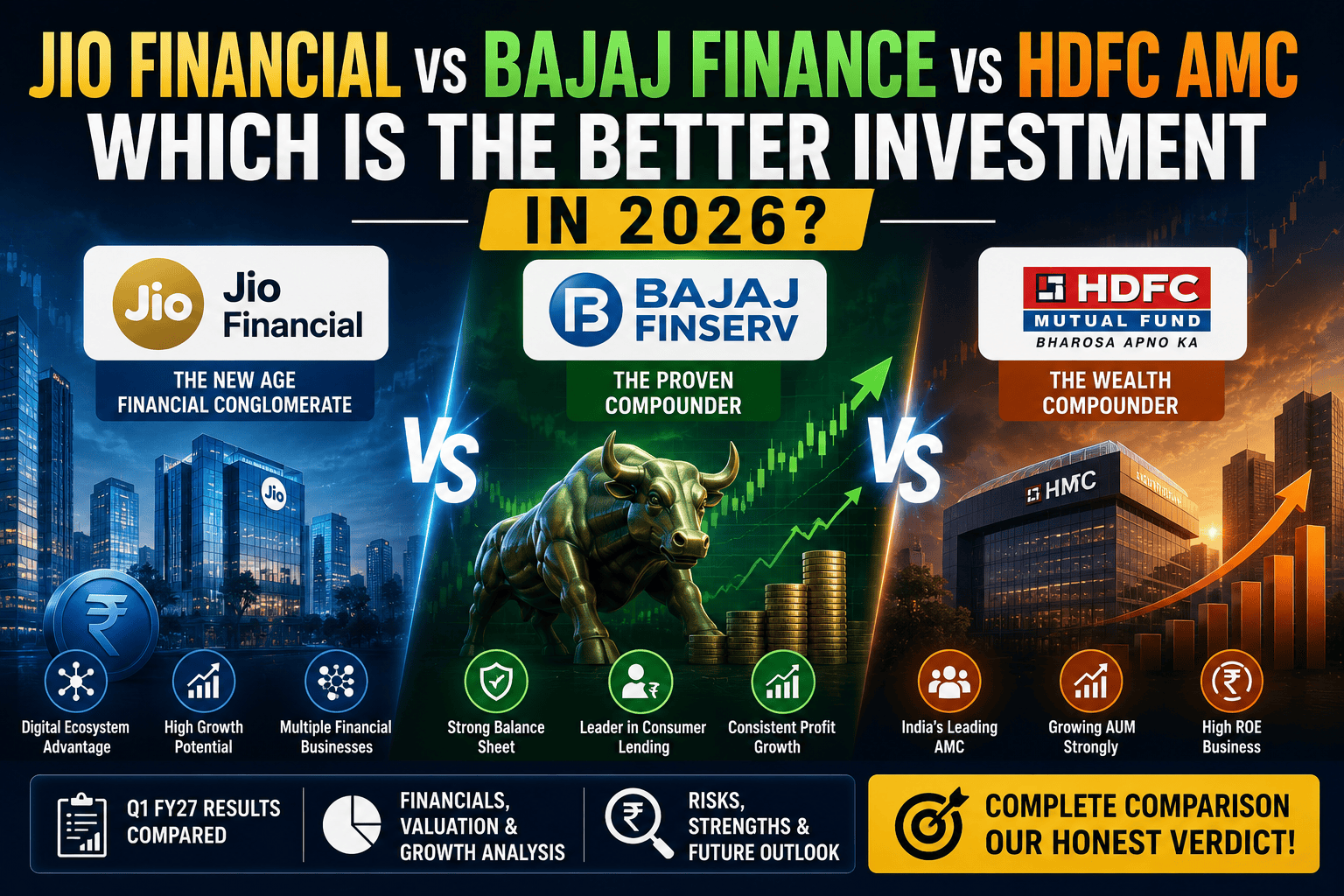

Jio Financial vs Bajaj Finance vs HDFC AMC: Which is the Better Investment in 2026?
Three companies. Three completely different stories. But one question that keeps coming up on every Indian investor's mind right now: Jio Financial vs Bajaj Finance vs HDFC AMC — which one should you actually put your money in?
This is not a simple question to answer, because these three companies are not even in the same business. One is a brand-new financial services conglomerate backed by Reliance still building its foundation. Another is India's most dominant consumer lending NBFC, quietly compounding for a decade. And the third is the mutual fund industry's most profitable asset manager, growing steadily as India's SIP culture deepens. Comparing them without that context would be like comparing a startup, a bank, and a fund house — because that is essentially what you are doing.
We tracked all three companies through their most recent quarterly results — all three reported Q1 FY27 earnings within days of each other in July 2026 — and this comparison is grounded in the actual numbers, not just brand names or market buzz.
Quick Company Overview — Who Are These Three?
Before numbers, let us understand what each company actually does, because the investment thesis for each is entirely different.
Jio Financial Services (JIOFIN) is the financial services arm carved out of Reliance Industries through a demerger in 2023. It is essentially a holding company that sits on top of a web of subsidiaries — Jio Credit (lending), Jio Insurance Broking, Jio Payments Bank, Jio Payment Solutions, Jio Leasing Services, and most excitingly, JioBlackRock AMC, a joint venture with the world's largest asset manager BlackRock. Think of Jio Financial as a financial conglomerate that is still being built from scratch but has the Reliance engine behind it. It is early-stage, capital-rich, and operating in nearly every corner of financial services simultaneously.
Bajaj Finance (BAJFINANCE) is India's largest non-banking financial company by AUM and arguably the most admired consumer lender in the country. It gives personal loans, consumer durable loans, EMI cards, business loans, home loans, and fixed deposits. What makes Bajaj Finance exceptional is not just its scale — AUM crossing ₹5.47 lakh crore in Q1 FY27 — but its ability to cross-sell across 12.4 crore customers. It is a decade-long compounder that has compounded wealth for shareholders at exceptional rates. This is the settled, proven, blue-chip NBFC.
HDFC AMC (HDFCAMC) is the second-largest mutual fund house in India by total AUM, with ₹9.35 lakh crore in quarterly average AUM as of Q1 FY27. It earns money by managing other people's money — taking a small percentage cut of the total assets managed. It does not lend money, does not take deposit risk, and carries none of the credit risk that banks or NBFCs face. As India's mutual fund industry grows — total industry AUM crossed ₹83 lakh crore in Q1 FY27 — HDFC AMC benefits automatically. It is the most capital-light, least risky of the three.
If you want the broader context of how India's financial sector works, our articles on how NSE and BSE function and the complete mutual fund guide for India give useful background before diving into a company comparison like this.
Q1 FY27 Results — What the Latest Numbers Say
All three companies reported their April–June 2026 quarter results in July 2026. Here is what actually happened.
Jio Financial Q1 FY27 was the biggest positive surprise of the three. Net profit surged 156% year-on-year to ₹830 crore, from ₹325 crore in Q1 FY26. Revenue from operations jumped 227% YoY to ₹2,004 crore. The big driver was fee and commission income rising nearly 5x to ₹325 crore, alongside ₹509 crore in dividend income from its investment portfolio. JioBlackRock AMC crossed ₹18,412 crore in AUM — still small compared to incumbents but growing fast. The stock jumped 6% on the day results were announced, July 17, 2026.
Bajaj Finance Q1 FY27 provisional data (full results due July 30) showed AUM growing 24% YoY to ₹5.47 lakh crore. New loans booked rose 20% to 1.61 crore. Customer franchise expanded to 12.44 crore — nearly 1 in 10 Indians. In the most recently declared quarterly results (Q4 FY26), net profit had grown 22% YoY to ₹5,465 crore. Citi, Morgan Stanley, and JPMorgan all remained bullish after the Q1 update.
HDFC AMC Q1 FY27 reported net profit of ₹837 crore, up 12% YoY. Revenue from core operations rose 13.5% to ₹1,100 crore. QAAUM reached ₹9.35 lakh crore, up from ₹8.29 lakh crore a year ago. The company processed 1.72 crore systematic transactions (SIPs) worth ₹4,810 crore in June 2026 alone. Market share stood at 11.2% in total QAAUM. A cybersecurity incident in May 2026 was flagged in the filings but did not materially impact operations.
Financial Comparison — The Numbers Side by Side
| Parameter | Jio Financial (JIOFIN) | Bajaj Finance (BAJFINANCE) | HDFC AMC (HDFCAMC) |
|---|---|---|---|
| Market Cap (Jul 2026) | ~₹1.56–1.60 lakh crore | ~₹6.57 lakh crore | ~₹1.13–1.17 lakh crore |
| Q1 FY27 Net Profit | ₹830 crore (+156% YoY) | ~₹5,200–5,400 cr est. (results Jul 30) | ₹837 crore (+12% YoY) |
| Revenue / Income Q1 FY27 | ₹2,004 crore (+227% YoY) | ~₹21,000+ crore est. | ₹1,100 crore (+13.5% YoY) |
| AUM / Loan Book | JioBlackRock AUM ₹18,412 crore | Loan AUM ₹5.47 lakh crore (+24% YoY) | Closing AUM ₹9.32 lakh crore |
| Annual Profit (FY26) | ~₹2,066 crore | ~₹19,332 crore | ~₹2,950 crore |
| Return on Equity (ROE) | ~1.2% (very early stage) | ~19–21% (industry-leading) | ~28–30% (asset-light model) |
| Promoter Holding | 49.1% (Reliance) | 54.7% (Bajaj Group) | 52.3% (HDFC/Abrdn) |
| Dividend (FY26) | ₹0 (none paid) | ₹28 per share | ₹54 per share |
| Business Stage | Early / building phase | Mature / high-growth | Established / steady growth |
The first thing that jumps out is the scale difference. Bajaj Finance's loan AUM of ₹5.47 lakh crore is roughly 30 times larger than JioBlackRock's entire mutual fund AUM of ₹18,412 crore. Jio Financial is in a completely different stage of its journey. Comparing their current profits directly is a bit like comparing a marathon runner mid-race to one who just started training — the starting points are not the same.
What is also visible: HDFC AMC and Jio Financial have similar-ish net profits in Q1 FY27 (₹837 crore vs ₹830 crore) but their market caps differ significantly — ₹1.13 lakh crore for HDFC AMC vs ₹1.56 lakh crore for Jio Financial. The market is clearly paying a premium for Jio Financial's future potential rather than its current earnings. That premium is the central debate around the stock.
Valuation Comparison — What You Are Actually Paying For
| Valuation Metric | Jio Financial | Bajaj Finance | HDFC AMC |
|---|---|---|---|
| PE Ratio (approx) | ~75–100x (loss of future earnings) | ~29–34x | ~38–42x |
| Price to Book (PB) | ~2.5–3x | ~4.9–5.1x | ~11–13x |
| Valuation Grade | Very Expensive | Expensive | Expensive to Very Expensive |
| ROE | ~1.2% | ~19–21% | ~28–30% |
| Revenue Growth YoY | +227% (base effect + real) | +18–24% | +13–14% |
| Dividend Yield | 0% | ~0.3% | ~2.0% |
| Stock Price (Jul 2026) | ~₹245 | ~₹1,033 | ~₹2,724 |
Growth Rate Visual — Who is Growing Fastest?
Jio Financial's growth numbers look spectacular but need context. A 156% profit jump and 227% revenue jump sound extraordinary until you remember the base was very low — the company had just begun monetising its businesses in Q1 FY26. The growth is real but partly a base effect. In absolute terms, Bajaj Finance's ₹5,000+ crore quarterly profit is what 22% growth looks like at massive scale. That is the difference between growth rate and growth in absolute rupees.
Jio Financial — The Wildcard Bet
Investing in Jio Financial today is not a bet on what it currently earns. It is a bet on what it will become by FY28–FY30. And that future picture, if it plays out, is genuinely large.
The JioBlackRock AMC JV is perhaps the most watched piece. BlackRock is the world's largest asset manager with over $10 trillion in global AUM. Its entry into Indian mutual funds with a Reliance distribution network behind it could disrupt the AMC landscape meaningfully. JioBlackRock crossed ₹18,412 crore in AUM just in its early months — still tiny compared to HDFC AMC's ₹9.32 lakh crore but growing fast. If Jio's distribution network translates to SIP customers the way Jio telecom translated to mobile subscribers, the ramp could be steep.
Beyond AMC, Jio Financial is building simultaneously in lending (Jio Credit), insurance broking (Jio Allianz General Insurance incorporated recently as a 50:50 JV with German major Allianz), payments banking, and wealth management. That is five major financial businesses being built at the same time, with the Reliance name on the door and ₹15,500 crore in cash inherited at demerger.
The risks are real though. First, execution. Running five financial businesses simultaneously is operationally complex, and Jio Financial is competing against companies that have 10–20 years of head start. Second, the stock's ROE of 1.2% is embarrassingly low — because most of the capital inherited from Reliance is sitting in treasury investments while the businesses scale up. That ROE will need to improve significantly to justify current valuations. Third, Jio Financial has paid zero dividends since listing. Patient capital required.
Bajaj Finance — The Proven Compounder
Bajaj Finance does not need introduction in Indian investing circles. It has been one of the best-performing large-cap stocks in India over the last decade — not because of luck, but because of a genuinely differentiated business model built around customer acquisition, cross-selling, and technology-driven credit underwriting.
The Q1 FY27 provisional numbers are strong. AUM of ₹5.47 lakh crore, 24% growth, 1.61 crore new loans in a single quarter, and a customer base of 12.44 crore. When Bajaj Finance adds a new customer, it does not just give them one product. The same customer gets offered EMI cards, personal loans, home loans, fixed deposits, and insurance products over their lifetime. That customer lifetime value is what makes the franchise so powerful.
The concern — and it is a legitimate one — is valuation. Bajaj Finance's PE of 29–34x and PB of ~5x are not cheap for an NBFC. The credit cycle risk is also real. NPA (non-performing asset) ratios have been rising modestly across the retail lending sector in India. Bajaj Finance's GNPA was 1.21% as of December 2025 — still low, but the market watches any tick-up closely. The new Labour Codes also added one-time charges in recent quarters. And RBI's evolving regulations on NBFCs require ongoing monitoring.
But here is the thing about Bajaj Finance: it has faced multiple "it's too expensive" cycles over the last decade, and long-term holders have been consistently rewarded despite those concerns. The stock trades at a premium because it deserves a premium — it earns one of the highest ROEs in the Indian NBFC sector at 19–21% consistently. To understand how NBFCs and banking stocks are analysed in India, our article on Q1 FY27 results of HDFC, ICICI, Axis, and Kotak Bank provides useful context on how lending businesses are valued.
HDFC AMC — The Quiet Winner Most People Underestimate
HDFC AMC does not get the headlines that Jio Financial gets or the analyst attention that Bajaj Finance commands. But its business model is arguably the most elegant of the three.
Here is why. Every time an Indian household starts a new SIP, every time equity markets rise, every time the middle class financialises its savings — HDFC AMC benefits. It does not need to underwrite credit risk. It does not need to deal with NPAs or loan defaults. It simply manages money and earns a percentage of AUM. As India's total mutual fund industry AUM crosses ₹83 lakh crore — and it is growing 15% year-on-year — HDFC AMC's revenue and profits grow almost automatically.
The Q1 FY27 results confirmed this. Profit up 12%, revenue up 13.5%, AUM up 12.7%. These are not explosive numbers but they are consistent, and they come with a business model that requires almost no additional capital to scale. The company's ROE of 28–30% is higher than either Jio Financial or Bajaj Finance, and it paid a ₹54 per share dividend in FY26 — the highest of the three.
HDFC AMC's risk is different from the others. It is not credit risk — it is market risk and competitive risk. If equity markets fall sharply, AUM falls and so does revenue. The entry of JioBlackRock AMC into the industry introduces new competition, though HDFC AMC's 280 offices, 1.1 lakh distribution partners, and decades of brand trust give it a durable moat. Individual investors contributed 69% of HDFC AMC's QAAUM versus 61% for the industry — a sign of deeper retail penetration, which tends to be stickier than institutional AUM. You can understand this SIP-driven growth better through our analysis of India's record SIP inflows in June 2026.
Risks You Cannot Ignore
Jio Financial risks: The ROE of 1.2% means shareholders' capital is not yet working efficiently. The stock is priced for a future that may take longer to materialise than the market expects. JioBlackRock AMC has barely begun — it is not yet a revenue driver. Regulatory risks in financial services (RBI, SEBI, IRDAI) apply across all five business verticals simultaneously. And the Reliance group's track record in financial services specifically — rather than telecom or retail — is still being established.
Bajaj Finance risks: A rising NPA cycle in consumer credit is the biggest risk. The global interest rate environment, if it shifts, affects borrowing costs for NBFCs. Bajaj Finance borrows short and lends long — if the yield curve moves adversely, spreads compress. The stock's high PE means even a modest earnings miss can cause significant price correction. The new Labour Codes add ongoing cost pressure.
HDFC AMC risks: Market-linked revenue means a prolonged equity market downturn directly hits the business. The entry of well-funded new competitors (JioBlackRock, Zepto-like digital platforms targeting young investors) could compress market share over time. A cybersecurity incident was flagged in May 2026 filings — digital infrastructure risk is real in the asset management industry. And the stock trades at 11–13x book value, which leaves limited room for disappointment.
For any of these investments, it is worth understanding how common investor mistakes in the stock market play out — because picking the right company is only half the battle. Holding through volatility is the other half.
Our Honest Verdict — Who Should Buy What
Final Verdict by Investor Type
If you want high-risk, high-reward exposure to Reliance's financial empire being built from scratch:
→ Jio Financial. But go in with eyes open — this is a 5–7 year story minimum, ROE is near zero today, and you are paying a very high valuation for a future that is not yet visible in the financials. Position size accordingly.
If you want India's best consumer lending franchise with a proven track record of compounding:
→ Bajaj Finance. Yes, the valuation is high. But Bajaj Finance has earned its premium over 10 years, and the AUM and customer franchise numbers in Q1 FY27 show the growth engine is intact. Hold for 3–5 years minimum through credit cycles.
If you want the most capital-efficient, lowest-credit-risk play on India's savings revolution:
→ HDFC AMC. It gives you dividend income, consistent double-digit profit growth, and India's financialisation tailwind without taking any loan default risk. The least exciting of the three, but possibly the most underrated.
Our overall framework: own all three only if you have a large portfolio where you can afford the different risk profiles. For most retail investors, Bajaj Finance + HDFC AMC is a more grounded combination than adding Jio Financial at current valuations — unless you are specifically betting on the Reliance financial services story with patient capital.
None of these three are cheap. Jio Financial at PE 75–100x, Bajaj Finance at PE 29–34x, and HDFC AMC at PE 38–42x are all priced for growth. The question is not which one is cheap — none of them are. The question is which growth story you trust most over the next 3–7 years, and whether the price you are paying today is reasonable for that story.
For beginner investors who are just starting out and want to understand the fundamentals of investing before picking individual stocks, our complete guide to beginning investing is a better starting point than comparing individual financial stocks at elevated valuations. These three companies are best held as part of a diversified portfolio that includes broad index fund exposure rather than as concentrated positions.
Disclaimer: This article is for educational and informational purposes only and does not constitute investment advice, a buy/sell recommendation, or a solicitation to invest. All financial data is sourced from publicly available regulatory filings, quarterly results, and company presentations as of July 2026. Stock prices, valuations, and financial metrics are subject to change. Consult a SEBI-registered financial adviser before making investment decisions. Investments in equities are subject to market risk.
Frequently Asked Questions
1. Is Jio Financial better than Bajaj Finance for long-term investment?
They serve very different investor needs. Bajaj Finance is an established compounder with proven ROE of 19–21%, consistent profits, and a 10-year track record. Jio Financial is an early-stage financial conglomerate with low current ROE (~1.2%) but high optionality through its multiple business verticals including JioBlackRock AMC. For most investors, Bajaj Finance offers a more predictable long-term return profile. Jio Financial suits investors with higher risk tolerance and a longer time horizon of 5–7 years who specifically want exposure to Reliance's financial services ambition.
2. What is Bajaj Finance's AUM as of Q1 FY27?
Bajaj Finance's AUM (Assets Under Management — its total loan book) stood at approximately ₹5.47 lakh crore (₹546,900 crore) as of June 30, 2026, representing 24% year-on-year growth from ₹4.41 lakh crore a year earlier. New loans booked in Q1 FY27 grew 20% to 1.61 crore, and the customer franchise expanded to 12.44 crore customers. Full Q1 FY27 profit and NII numbers are expected at the July 30, 2026 board meeting.
3. What is HDFC AMC's AUM and market share?
HDFC AMC's quarterly average AUM (QAAUM) for Q1 FY27 was ₹9.35 lakh crore, with a closing AUM of approximately ₹9.32 lakh crore as of June 30, 2026. Its market share in the mutual fund industry stood at 11.2% of total QAAUM. In actively managed equity funds, market share was higher at 12.8%. The overall Indian mutual fund industry's AUM grew 15% YoY to ₹83.1 lakh crore in Q1 FY27.
4. Why is Jio Financial's PE ratio so high?
Jio Financial's PE ratio of approximately 75–100x is high because its current earnings are very low relative to its market capitalisation. The company is in a heavy investment and build-out phase across five business verticals simultaneously. A significant portion of its income still comes from treasury returns on the ₹15,500 crore cash base inherited from Reliance, rather than from operating businesses. The market is pricing in future earnings potential — particularly from JioBlackRock AMC and Jio Credit — rather than current profitability. This makes PE a less meaningful metric for Jio Financial at this stage compared to Bajaj Finance or HDFC AMC.
5. Which of the three pays the best dividend?
HDFC AMC clearly wins on dividends. It paid ₹54 per share as a final dividend for FY26, which at the current stock price of ~₹2,724 implies a dividend yield of approximately 2%. Bajaj Finance paid ₹28 per share in FY26, yielding approximately 0.3% at current prices. Jio Financial paid no dividend at all in FY26 and is unlikely to pay dividends in the near term as it reinvests capital into building its business. For income-seeking investors, HDFC AMC is the clear choice among the three.
6. What is the JioBlackRock AMC and how does it affect Jio Financial?
JioBlackRock AMC is a 50:50 joint venture between Jio Financial Services and BlackRock, the world's largest asset manager with over $10 trillion in global AUM. The AMC was approved by SEBI and has already crossed ₹18,412 crore in AUM as of Q1 FY27. If the JioBlackRock AMC can scale using Reliance's vast distribution network and digital reach — similar to how Jio disrupted telecom — it could become a significant competitor to incumbents like HDFC AMC over 5–10 years. This is one of the key reasons the market pays a premium for Jio Financial stock today despite low current earnings.
7. Is HDFC AMC a buy at current levels in 2026?
HDFC AMC is trading at approximately 38–42x PE and 11–13x book value, which is not cheap. However, the business fundamentals remain strong — Q1 FY27 profit up 12%, AUM growing 13% YoY, high ROE of 28–30%, and a meaningful dividend yield of ~2%. The company benefits structurally from India's SIP culture deepening. At current valuations, it may not deliver quick gains but offers a reasonable investment for patient long-term holders who want capital-light exposure to India's financialisation without credit risk. Always buy in tranches rather than lump sum at elevated valuations.
8. Can I invest in all three — Jio Financial, Bajaj Finance, and HDFC AMC?
Yes, and for investors with sufficient portfolio size, owning all three actually makes sense as they serve different roles. Jio Financial is your high-risk, high-optionality bet on Reliance's financial ambitions. Bajaj Finance is the proven core holding in the NBFC/lending space. HDFC AMC is the low-credit-risk, dividend-paying play on India's mutual fund growth. Together they give balanced exposure to lending, asset management, and financial innovation. Just ensure no single stock dominates your portfolio excessively, and balance all three with broader index fund holdings.

Pranab Barman is a Financial Educator and Personal Finance Researcher with over 10 years of hands-on experience in stock markets, trading, and investing. Currently enrolled in the CFA Program, he is committed to continuous learning and professional excellence in finance.
As the Founder of PlayWithStock, Pranab covers a wide range of topics including Mutual Funds, SIP, Taxation, Stock Market Basics, and Financial Calculators — with a focus on simplifying complex financial concepts for everyday all investors.
Email: support@playwithstock.com
Website: playwithstock.com
Related posts:
 Jio Financial Services Q1 FY27 Results Preview: Date, Estimates & Stock Analysis
 HDFC Bank, ICICI Bank, Axis Bank & Kotak Bank Q1 FY27 Results: The Complete Comparison
 Jio IPO 2026: 10 Crucial Facts Every Investor Must Know
 ITR-4 Investment Disclosure Calculator: New 2026 Rule for Presumptive Taxpayers
 HDFC Bank Bonus Share: The Essential Guide for Investors 2026
 Reliance Jio IPO 2026: India’s Biggest-Ever Listing, Explained
 Crypto Investment Scam: Warning Signs Every Indian Investor Must Know
 Best AI Stocks India 2026: 7 Picks That Are Actually Worth Watching