

If you’ve watched even five minutes of business news in India, you’ve heard these two words together: — Nifty 50 and Sensex. They move up, being investing they move down, and news anchors react to every point change as if it were breaking news. But what are they actually measuring, and why should you, as an individual investor, care?
The short answer: Nifty 50 and Sensex are the two numbers that summarize how India’s stock market is doing on any given day. Understanding them properly will help you make sense of market news instead of just watching the numbers scroll by.
What Are Nifty 50 and Sensex?
Both Nifty 50 and Sensex are stock market indices — a single number that represents the combined performance of a group of selected stocks. Instead of tracking thousands of individual companies, an index gives you one number that tells you, broadly, whether the market went up or down.
What is Nifty 50?
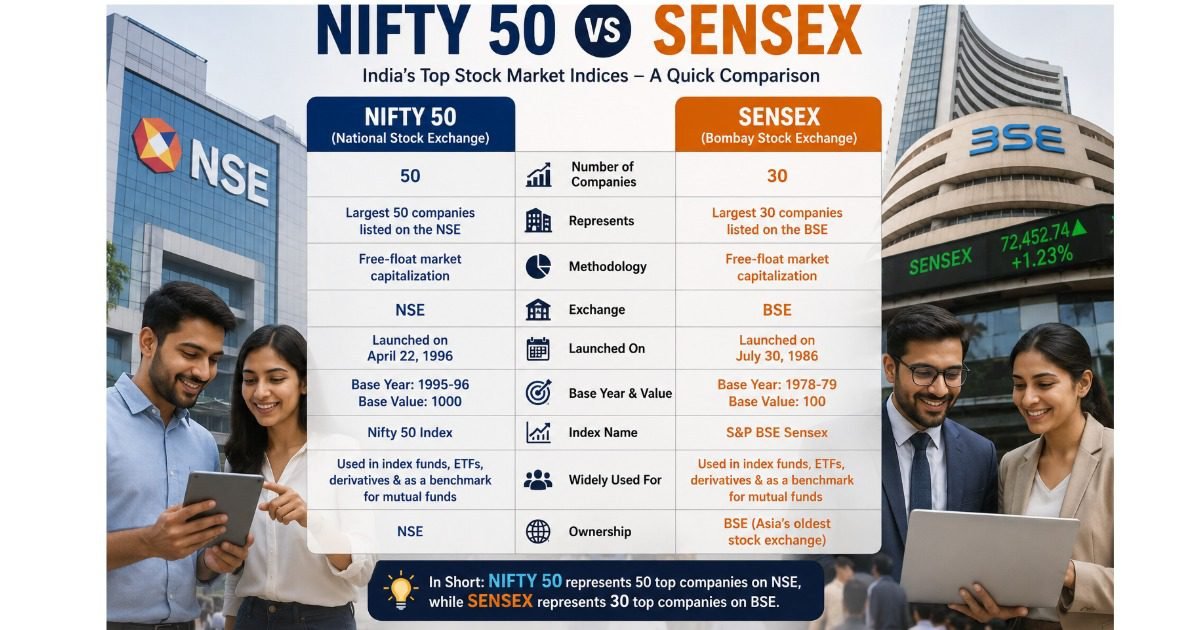
Nifty 50 is the benchmark index of the National Stock Exchange (NSE). It tracks the performance of the 50 largest and most liquid companies listed on NSE, spanning sectors like banking, IT, energy, and consumer goods.
When you hear “Nifty crossed 25,000 today,” it means the combined value of these 50 companies, calculated using a specific formula, has reached that level.
What is Sensex?
Sensex is the benchmark index of the Bombay Stock Exchange (BSE). It tracks the 30 largest and most actively traded companies listed on BSE. Sensex is the older of the two indices and is often considered the more traditional symbol of the Indian stock market.
If you want a deeper comparison of the exchanges themselves, our NSE vs BSE guide covers that in detail.
How Are Nifty 50 and Sensex Calculated?
You don’t need to do the math yourself, but understanding the logic behind it makes the index far less mysterious.
Free-Float Market Capitalization Explained
Both indices use a method called free-float market capitalization. This means only the shares that are actually available for public trading are counted — not shares held by the company’s founders, the government, or other locked-in stakeholders.
Larger companies (by this free-float value) have a bigger impact on the index’s movement than smaller ones. So if a heavyweight like Reliance or HDFC Bank has a big day, it can move the entire index noticeably, even if smaller companies in the index barely moved at all.

Why the Index Changes Every Day
Throughout the trading day, stock prices of the companies in the index constantly change as buyers and sellers place orders. The index recalculates in real time, reflecting the combined, weighted movement of all the companies within it. That’s why you’ll see the Nifty or Sensex number update continuously during market hours.
7 Key Things Every Investor Should Know
1. They Represent Different Exchanges
Nifty 50 belongs to NSE. Sensex belongs to BSE. They are calculated independently, even though many of the same large companies appear in both.
2. They Track a Different Number of Companies
Nifty 50 covers 50 companies; Sensex covers 30. This is why Nifty is often seen as offering a slightly broader view of market performance.
3. They Are Reviewed and Rebalanced Periodically
The companies included in each index aren’t fixed forever. Both NSE and BSE periodically review their index composition — typically twice a year — replacing companies that no longer meet size, liquidity, or performance criteria with ones that do.
4. They Move Almost Together
Because both indices include many of the same large-cap companies, they tend to rise and fall in a very similar pattern on any given day. It’s rare to see one index up significantly while the other is down significantly.
5. You Can Invest in Them Directly
You don’t have to buy all 50 (or 30) individual stocks to gain exposure to these indices. Index funds and ETFs that track Nifty 50 or Sensex let you invest in the entire index through a single fund. This is one of the simplest ways for beginners to get diversified market exposure.
6. They Reflect the Broader Economy
Since these indices are dominated by large companies across major sectors, their long-term trend is often used as a rough proxy for the health of the Indian economy overall — though it’s important to remember they don’t capture smaller businesses or informal sectors.
7. They Are Not the Only Indices That Matter
Beyond Nifty 50 and Sensex, there are sector-specific indices (like Nifty Bank or Nifty IT) and broader indices (like Nifty 500) that track different slices of the market. Nifty 50 and Sensex are simply the most widely referenced.

Why Do Nifty 50 and Sensex Matter to You?
Even if you don’t plan to actively trade individual stocks, these indices matter because they give you a quick, reliable pulse check on the market.
As a Benchmark for Your Portfolio
If your mutual fund or stock portfolio consistently underperforms Nifty 50 or Sensex over several years, it’s worth asking why. These indices serve as a practical benchmark — a reference point to evaluate whether your own investments are keeping pace with the broader market.
Quick Tip: Comparing Your Returns
When checking your portfolio’s performance, always compare it against the same time period’s Nifty 50 or Sensex return, not just a general “gut feeling” of whether the market did well or poorly.
How to Start Investing in Nifty 50 or Sensex
You don’t need to be an expert stock-picker to gain exposure to these indices. Here’s the simplest path:
- Open a Demat and trading account — see our Demat account guide for the full process.
- Choose an index fund or ETF that tracks Nifty 50 or Sensex — these are widely available through most brokers and mutual fund platforms.
- Start with a SIP (Systematic Investment Plan) if you’d rather invest a fixed amount monthly instead of a lump sum.
- Stay invested for the long term — index investing works best when given years, not weeks, to compound.
If you’re completely new to investing, our Beginner Investing guide is a good starting point before diving into index-specific strategies.
Common Misconceptions
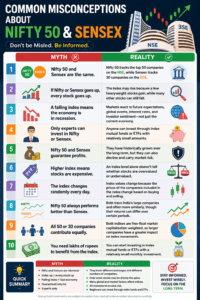
Misconception 1: “A rising Nifty means every stock is doing well.” Reality: The index can rise even if many individual stocks are flat or falling, as long as a few heavyweight companies are performing strongly.
Misconception 2: “Sensex and Nifty are the same thing with different names.“ Reality: They are separate indices, calculated independently, on two different exchanges — they just tend to move in a similar direction because of overlapping large companies.
Misconception 3: “You need a lot of money to invest in Nifty 50 or Sensex.” Reality: Through index funds and ETFs, you can start investing with a relatively small amount, sometimes as low as a few hundred rupees through a SIP.
Frequently Asked Questions
What is the difference between Nifty 50 and Sensex? Nifty 50 tracks 50 companies on the NSE, while Sensex tracks 30 companies on the BSE. Both measure overall market performance but are calculated independently.
Which is more accurate, Nifty or Sensex? Neither is “more accurate” — they simply track a different number of companies. Nifty 50’s broader coverage is sometimes considered a slightly more comprehensive market snapshot.
Can I directly buy Nifty 50 or Sensex? You cannot buy the index itself, but you can invest in index funds or ETFs that replicate its performance by holding the same companies in the same proportions.
How often does the composition of these indices change? Both NSE and BSE typically review and rebalance their index composition twice a year, replacing companies that no longer meet the inclusion criteria.
Is investing in an index fund safer than buying individual stocks? Index funds offer built-in diversification across many companies, which generally reduces risk compared to holding a single stock — though all equity investments carry some level of market risk.
Best Books: click here!
Final Thoughts
Nifty 50 and Sensex are the two numbers that summarize the health of India’s stock market on any given day. Nifty 50 represents NSE’s top 50 companies; Sensex represents BSE’s top 30. They move in similar patterns because of overlapping large-cap companies, and together, they give investors a fast, reliable way to gauge overall market sentiment.
You don’t need to memorize their exact calculation formula. What matters is understanding what they represent, using them as a benchmark for your own investments, and recognizing that investing in these indices — through index funds or ETFs — is one of the simplest ways to build long-term wealth without picking individual stocks.
Author: Founder of Play With Stock Last Updated: July 2026 Disclaimer: This article is for educational purposes only and does not constitute financial advice. Stock market investments are subject to market risks. Please consult a SEBI-registered financial advisor before making investment decisions.

Pranab Barman is a Financial Educator and Personal Finance Researcher with over 10 years of hands-on experience in stock markets, trading, and investing. Currently enrolled in the CFA Program, he is committed to continuous learning and professional excellence in finance.
As the Founder of PlayWithStock, Pranab covers a wide range of topics including Mutual Funds, SIP, Taxation, Stock Market Basics, and Financial Calculators — with a focus on simplifying complex financial concepts for everyday all investors.
Email: support@playwithstock.com
Website: playwithstock.com
Related posts:
 NSE vs BSE: 9 Key Differences Every Investor Must Know
 Jio IPO 2026: 10 Crucial Facts Every Investor Must Know
 TCS Q1 FY27 Results: Profit Rises 5%, Sensex Jumps 828 Points
 Beginner Investing: 7 Proven Steps to Start the Right Way
 What is a Stock Split and Why Do Companies Do It
 What Is Circuit Breaker Stock Market: Meaning, Limits & 2026 Update
 Jio Financial Services Q1 FY27 Results Preview: Date, Estimates & Stock Analysis
 Micro-Investing Apps for Beginners: A Complete Comparison