
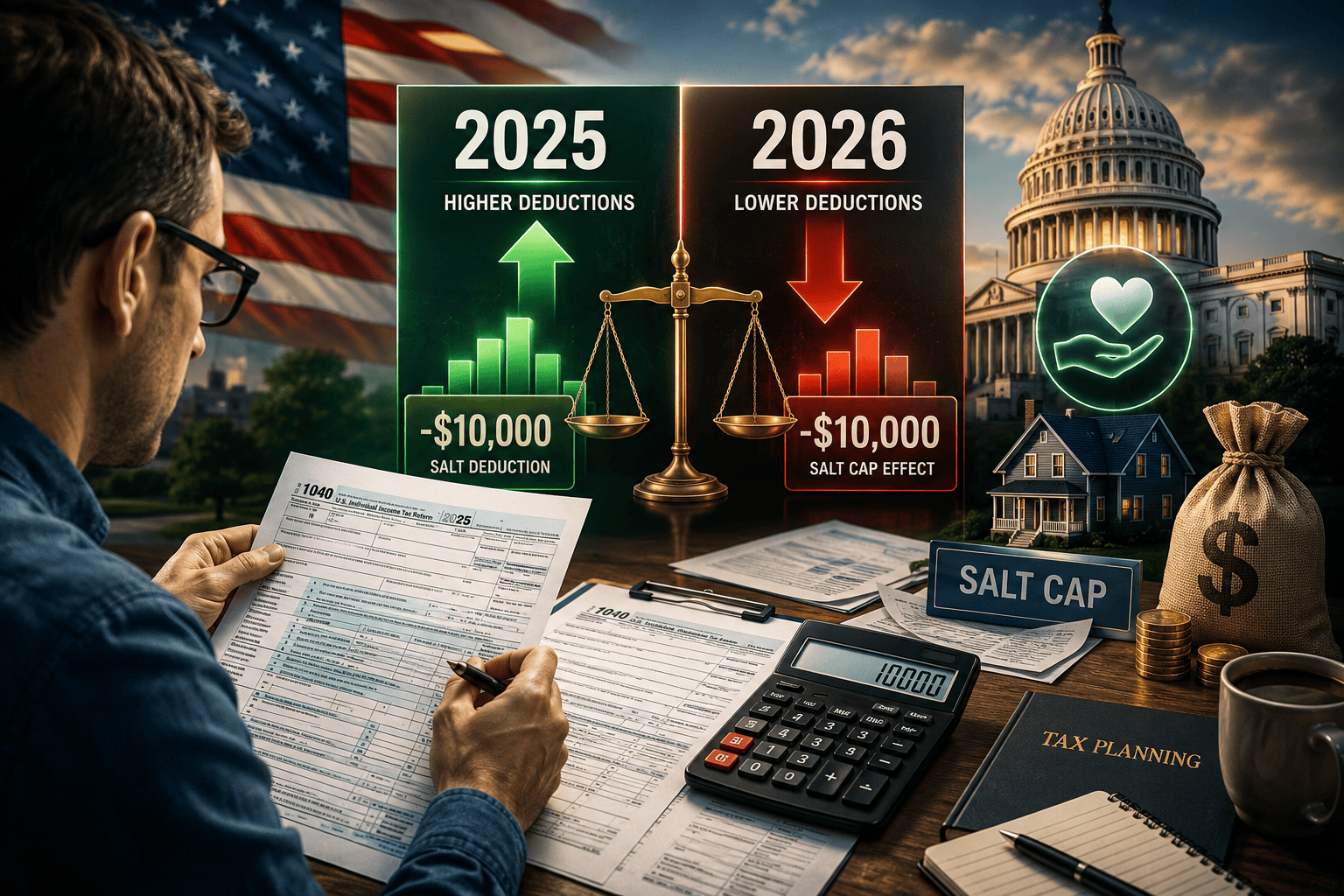

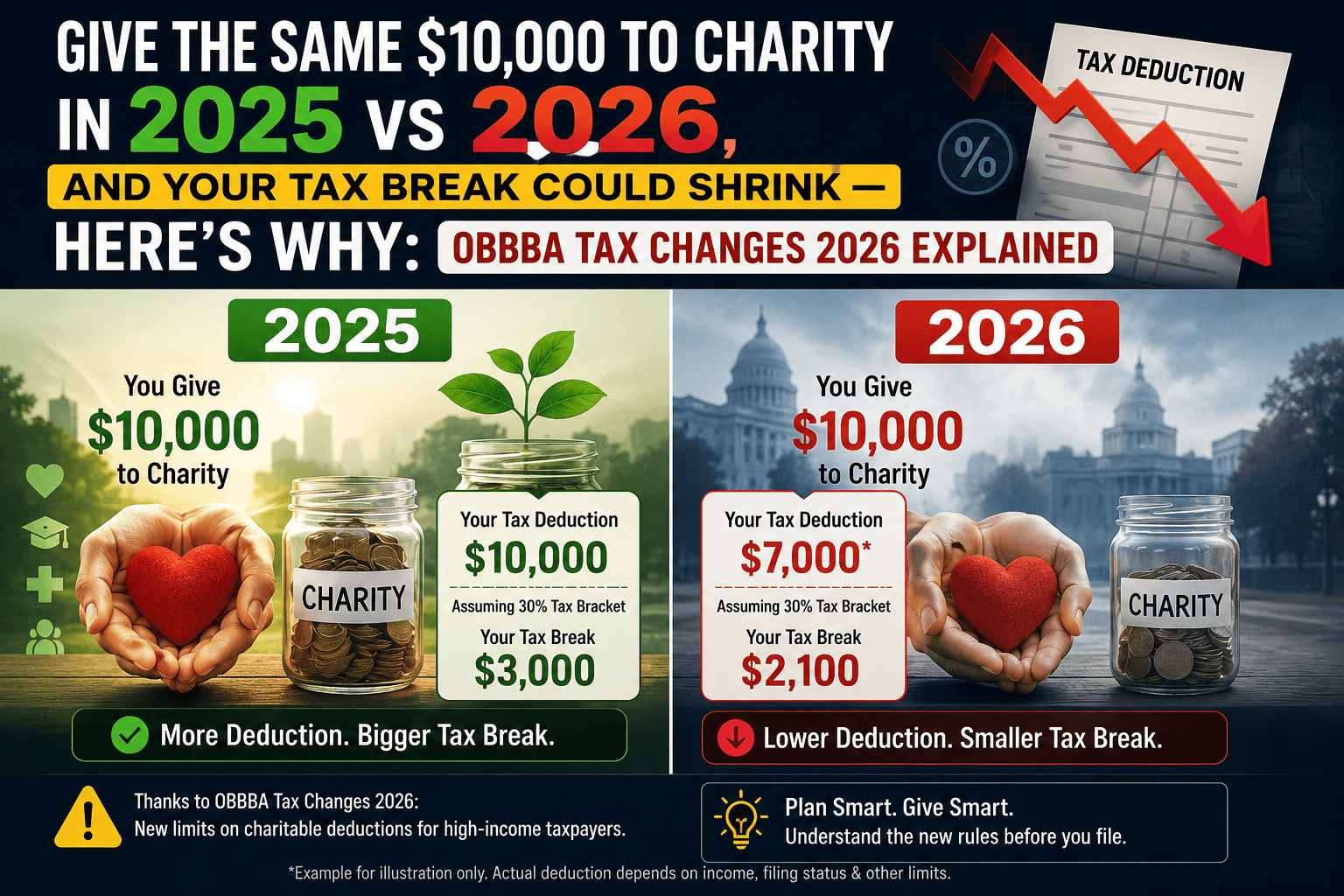
Give the Same $10,000 to Charity in 2025 vs 2026, and Your Tax Break Could Shrink — Here's Why: OBBBA Tax Changes 2026 Explained
The One Big Beautiful Bill Act quietly rewired how charitable deductions, the SALT cap, and standard deductions work for every US taxpayer starting this year. We built a calculator to show you exactly what changes for your specific numbers.
- 1. What Is the OBBBA, in Plain English
- 2. The 5 OBBBA Tax Changes 2026 That Actually Matter
- 3. OBBBA Tax Impact Calculator
- 4. How to Use This Calculator
- 5. A Full Worked Example
- 6. OBBBA Tax Changes 2026: Pros and Cons
- 7. The SALT Cap Change Nobody's Talking About Enough
- 8. Planning Strategies Before Year-End
- 9. What This Means If You're a US-Based NRI or Global Investor
- 10. FAQs
The OBBBA tax changes 2026 represent the most significant rewrite of US charitable giving and itemized deduction rules since the 2017 Tax Cuts and Jobs Act. Signed into law on July 4, 2025, the One Big Beautiful Bill Act (OBBBA) made most of TCJA's temporary provisions permanent, but it also introduced a set of brand-new limitations that specifically hit charitable donors starting with the 2026 tax year. If you give to charity, itemize deductions, or live in a high-tax state, the OBBBA tax changes 2026 affect your actual after-tax cost of giving in ways that are easy to misunderstand from headlines alone. This guide breaks down exactly what changed, includes a working calculator so you can see your own numbers, and walks through what smart taxpayers are doing differently this year.
⚡ OBBBA Tax Changes 2026 — Quick Reference
| Signed Into Law | July 4, 2025 |
| Most Provisions Effective | Tax Year 2026 |
| New Charitable Floor (Itemizers) | 0.5% of AGI |
| New Non-Itemizer Deduction | $1,000 single / $2,000 joint |
| Top-Bracket Deduction Cap | 35% (down from 37%) |
| SALT Cap (was $10,000) | $40,400 (MFJ/single) / $20,200 (MFS) |
| Standard Deduction (2025 base) | ~$15,750 single / ~$31,500 MFJ |
1. What Is the OBBBA, in Plain English
The One Big Beautiful Bill Act, also referred to as the Working Families Tax Cut, permanently extended most of the individual tax provisions from the 2017 Tax Cuts and Jobs Act that were otherwise set to expire. Income tax brackets and rates were made permanent, and the larger standard deduction introduced under TCJA was locked in for good rather than reverting to older, lower levels.
But the OBBBA tax changes 2026 aren't purely about extending old rules — the law also paid for some of its tax cuts by trimming specific tax breaks, and charitable giving was one of the areas that took a direct hit. This is the part of the OBBBA tax changes 2026 that surprises most taxpayers, because "extending tax cuts" headlines don't capture that some deductions actually got smaller for certain filers — a pattern of headline-versus-reality gaps our inflation and portfolio guide and beginner investing guide touch on in a broader context.
2. The 5 OBBBA Tax Changes 2026 That Actually Matter
Cutting through the legislative language, here are the five OBBBA tax changes 2026 with genuine, measurable impact on individual taxpayers:
| # | Change | Who It Affects |
|---|---|---|
| 1 | New 0.5% AGI floor on itemized charitable deductions | Itemizers who give to charity |
| 2 | New $1,000/$2,000 non-itemizer charitable deduction | Standard deduction filers who donate |
| 3 | 35% cap on deduction value for top (37%) bracket filers | High-income itemizers |
| 4 | SALT cap raised from $10,000 to $40,400 | High-tax-state residents who itemize |
| 5 | Standard deduction and current tax brackets made permanent | Every taxpayer |
Each of these OBBBA tax changes 2026 interacts with the others, which is exactly why a simple percentage or headline number doesn't tell you your actual outcome — you need to run your specific filing status, income, and donation total through the rules together, which is exactly what our calculator below does.
3. OBBBA Tax Impact Calculator
Use the calculator below to see how the OBBBA tax changes 2026 affect your specific charitable deduction, based on your filing status, deduction method, AGI, and donation amount.
🧮 OBBBA Charitable Deduction Calculator
This calculator provides an educational estimate based on published OBBBA provisions and does not account for every possible tax situation, phase-outs, or state-level rules. Always confirm with a qualified CPA or tax advisor before filing.
4. How to Use This Calculator
Getting an accurate result from the OBBBA tax changes 2026 calculator above takes just four steps:
- Step 1 — Select your filing status. The non-itemizer cap and standard deduction amounts differ between Single and Married Filing Jointly.
- Step 2 — Choose your deduction method. If you're not sure whether you itemize, check last year's return for Schedule A — if you filed one, you itemized.
- Step 3 — Enter your AGI. This is your Adjusted Gross Income, found on Line 11 of Form 1040, not your gross salary.
- Step 4 — Enter your total charitable donations for the year, combining cash and the fair market value of any non-cash gifts.
If you itemize and expect to be in the top 37% bracket, also select "Yes" on the top-bracket question — this triggers the additional 35% deduction-value cap that specifically applies to the OBBBA tax changes 2026 for high earners.
5. A Full Worked Example
Here's how the OBBBA tax changes 2026 play out for a real hypothetical household. Consider a married couple filing jointly with an AGI of $200,000, itemizing deductions, donating $3,000 annually to charity, and in the 24% tax bracket, not the top 37% bracket.
| Step | Calculation | Result |
|---|---|---|
| 0.5% AGI Floor | $200,000 × 0.5% | $1,000 |
| Donations | Given as-is | $3,000 |
| Deductible After Floor | $3,000 − $1,000 | $2,000 |
| Tax Savings at 24% Bracket | $2,000 × 24% | $480 |
Before the OBBBA tax changes 2026, this same $3,000 donation would have been fully deductible, generating $720 in tax savings at the same 24% rate. The 0.5% floor alone reduces this household's tax benefit by $240 — not because their tax rate changed, but purely because of the new floor mechanic. Planning charitable giving with the same forward-looking discipline as a sinking fund for a known future expense can help smooth this kind of impact across years. As the earlier research on this topic points out, a married couple donating $3,000 annually who instead "bunches" $10,000 into 2026 in a single year could see $9,000 become deductible after the $1,000 floor — a far more tax-efficient outcome than spreading the same total giving evenly across years.
6. OBBBA Tax Changes 2026: Pros and Cons
✅ Pros
- Standard deduction and current tax brackets permanently locked in — no more expiration uncertainty
- Non-itemizers can now deduct up to $1,000/$2,000 in donations for the first time since the pandemic-era provision expired
- SALT cap increase to $40,400 is a major win for itemizers in high-tax states like California, New York, and New Jersey
- 60% AGI ceiling on cash donations remains unchanged — no new restriction there
❌ Cons
- New 0.5% AGI floor reduces the deductible amount for every itemizing donor, regardless of income level
- Top-bracket (37%) filers see the value of each donated dollar capped at 35 cents, not 37 cents
- Corporate charitable giving faces a new 1% floor of its own, with stricter carryover rules
- Smaller, routine annual donors are hit relatively harder than large one-time or "bunched" donors
7. The SALT Cap Change Nobody's Talking About Enough
Amid all the charitable-deduction discussion, one of the most consequential OBBBA tax changes 2026 is the State and Local Tax (SALT) deduction cap increase — from $10,000, where TCJA had frozen it since 2017, to $40,400 for both single filers and those married filing jointly, and $20,200 for married filing separately. For itemizers in high-tax states, this single change can be worth far more than the charitable deduction adjustments combined, since it directly increases how much state income tax and property tax can be deducted on a federal return. This kind of structural cap change is worth comparing against similar asset-allocation caps and thresholds covered in our Gold ETF vs physical gold comparison, where thresholds and holding structures similarly determine the actual tax and cost outcome.
This SALT cap increase also has a secondary effect worth understanding: it makes itemizing worthwhile for a meaningfully larger group of taxpayers than before, since the combination of a higher SALT cap plus charitable donations can now more easily exceed the standard deduction threshold, even for households that previously found itemizing not worth the effort.
8. Planning Strategies Before Year-End
Several concrete strategies help taxpayers navigate the OBBBA tax changes 2026 more efficiently, beyond simply accepting the new floor and cap as fixed costs:
- Bunch multiple years of giving into a single tax year to push more of your total donation above the 0.5% AGI floor, rather than spreading equal amounts evenly across years — the same "lump vs. spread" timing logic covered in our life cycle funds explainer.
- Consider a donor-advised fund (DAF) — contributing a larger sum in one year for an immediate deduction, then distributing to charities gradually over following years, decouples the tax-optimal timing from your actual giving schedule.
- Donate appreciated securities instead of cash where possible, since this can avoid capital gains tax on the appreciation while still counting toward your itemized deduction, subject to the same new floor — a similar principle to the timing strategies in our tax-loss harvesting guide.
- Re-run your itemize-vs-standard comparison given the higher SALT cap — many households that took the standard deduction under the old $10,000 SALT cap may now find itemizing worthwhile. Our 50-30-20 budgeting rule is a useful framework for seeing where deductible expenses fit into your broader annual budget.
- Work with a CPA before December 31 if you're a high-net-worth donor near the top bracket threshold, since the 35% cap specifically changes the math for accelerating or deferring large gifts.
9. What This Means If You're a US-Based NRI or Global Investor
For readers who split financial life between India and the US — a substantial and growing group given US-India trade and investment ties — the OBBBA tax changes 2026 matter alongside, not instead of, Indian tax planning. Our India-US trade deal coverage and stocks to buy after the trade deal pieces cover the broader bilateral economic relationship this sits within, while our ITR filing guide and tax refund interest calculator cover the Indian-side equivalent planning US-based NRIs with Indian income still need to track separately. Our Global Economy category has ongoing coverage of how US, Indian, and other major economies' policy decisions interact for cross-border investors.
US-based NRIs donating to India-based charities should note that the OBBBA's charitable deduction rules apply specifically to US-qualified charitable organizations — donations to most India-based nonprofits generally don't qualify for a US federal charitable deduction at all, floor or no floor, which is a distinct and separate consideration from everything covered above.
10. Frequently Asked Questions
What is the OBBBA and when did it take effect?
The One Big Beautiful Bill Act (OBBBA) was signed into law on July 4, 2025. Most of its individual tax provisions, including the new charitable deduction rules, took effect starting with the 2026 tax year.
What is the new 0.5% AGI floor on charitable deductions?
Starting in 2026, itemizers can only deduct the portion of their charitable donations that exceeds 0.5% of their Adjusted Gross Income. For example, with a $200,000 AGI, only donations above $1,000 are deductible.
Can I still deduct charitable donations if I take the standard deduction?
Yes. The OBBBA introduced a new above-the-line deduction of up to $1,000 for single filers and $2,000 for married couples filing jointly, available even to those who don't itemize.
How much did the SALT deduction cap change under OBBBA?
The SALT cap increased from $10,000 to $40,400 for single filers and married couples filing jointly, and to $20,200 for married filing separately, a major change for itemizers in high-tax states.
Does the OBBBA reduce charitable deductions for high earners specifically?
Yes. Taxpayers in the top 37% tax bracket see the value of their itemized charitable deductions capped at 35%, meaning each dollar donated yields a slightly smaller tax benefit than for taxpayers in lower brackets.
What is "bunching" donations and why does it help under the new rules?
Bunching means combining multiple years of planned charitable giving into a single tax year. Since the 0.5% AGI floor is a fixed dollar threshold each year, a larger one-time donation pushes proportionally more of the total gift above the floor than the same amount split evenly across several years.
- IRS — Official Tax Guidance
- Congress.gov — Legislative Text
- Tax Foundation
- Fidelity Charitable
- TurboTax Tax Tips
- RBC Wealth Management
- DAFgiving360
- Greenberg Traurig LLP
- Fidelity
- Yahoo Finance
- Experian
- Federal Reserve Bank of New York
- Federal Reserve
- Bureau of Labor Statistics
- US Department of the Treasury
- Forbes Advisor
- Investopedia
- NerdWallet
- SmartAsset
- Kiplinger
- Charles Schwab

Pranab Barman is a Financial Educator and Personal Finance Researcher with over 10 years of hands-on experience in stock markets, trading, and investing. Currently enrolled in the CFA Program, he is committed to continuous learning and professional excellence in finance.
As the Founder of PlayWithStock, Pranab covers a wide range of topics including Mutual Funds, SIP, Taxation, Stock Market Basics, and Financial Calculators — with a focus on simplifying complex financial concepts for everyday all investors.
Email: support@playwithstock.com
Website: playwithstock.com
Related posts:
 Trump Accounts Explained: The $1,000 Baby Bonus Already Reaching 6 Million Kids
 Why Is the Stock Market Falling Today? US-Iran Tensions, Crude Oil Spike & FII Selling Explained
 India Crypto Tax Notices: 44,000 Investors Just Got a Letter
 Free STT Hike Breakeven Calculator 2026 — see exactly how much extra STT the Budget 2026 hike adds to your F&O trades and how many points you now need to break even.
 Nominee vs Legal Heir India: The Difference That Can Break a Family
 Senior Citizens Savings Scheme 2026: Interest Rate, Limits and Tax Rules Explained
 SEBI 2026 F&O Rules: 8 Crucial Position Limit Changes Every Trader Must Know
 SGB Premature Redemption Calculator 2026: Tax Rules, RBI Dates & Exit Guide