


Senior Citizens Savings Scheme 2026: Interest Rate, Limits and Tax Rules Explained
Senior Citizens Savings Scheme 2026 is genuinely the article we should have written before our NPS and APY pieces, if we're being honest about the order most families actually need this information — because SCSS isn't about building a retirement corpus, it's about what to do once you already have one. If your parents just retired, or you're approaching retirement yourself and wondering where a lump sum provident fund payout or gratuity should actually sit, this is the scheme most financial planners bring up first.
We've covered the accumulation side of retirement planning in our NPS guide and EPF vs NPS vs PPF comparison. SCSS sits on the other side of that line — it's a post-retirement, income-generating instrument, not a growth one.

Table of Contents
- What Is SCSS, and Who Is It Actually For
- Eligibility: The Three Categories Most People Miss
- Current Interest Rate and Deposit Limits
- Tax Rules — Where SCSS Genuinely Differs From PPF
- Premature Closure and Extension Rules
- The Joint Account Rule Couples Should Know
- SCSS vs FD vs PPF for Retirees
- How to Open an SCSS Account
- Frequently Asked Questions
What Is SCSS, and Who Is It Actually For
The Senior Citizen Savings Scheme is a Government of India savings instrument designed exclusively for citizens aged 60 and above, launched in 2004. It has become the most trusted income-generating investment for retirees because it combines guaranteed returns, sovereign safety, quarterly interest payouts, and tax benefits under Section 80C.
What sets it apart from almost every other product we've written about on this blog is the payout structure. Unlike fixed deposits, which give a single maturity payout, or mutual funds, where returns are market-linked, SCSS pays interest every quarter — genuinely useful for retirees who need regular cash flow to cover monthly expenses without needing to sell any underlying investment. Official scheme rules and updates are published by India Post's savings schemes page, since SCSS was originally, and remains primarily, a post office savings product.
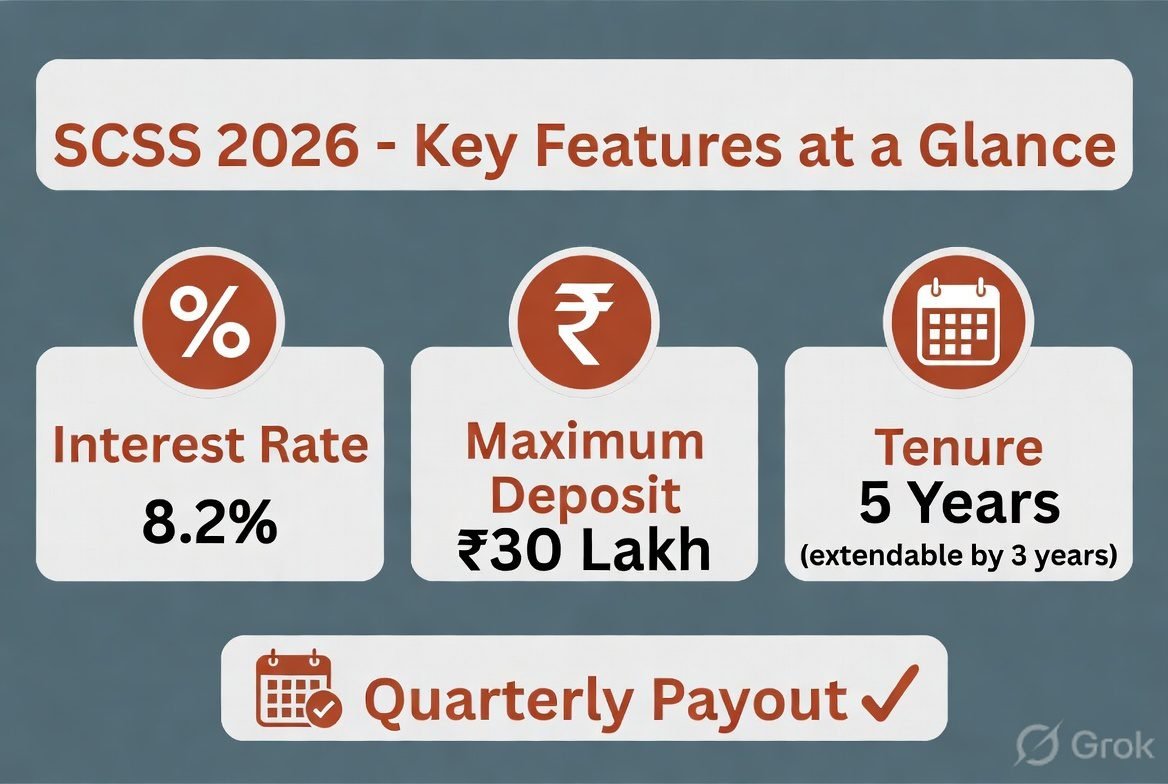
SCSS at a Glance — 2026
| Interest Rate (Q1 FY 2026-27) | 8.2% |
| Maximum Investment | ₹30 lakh per individual |
| Minimum Investment | ₹1,000 |
| Tenure | 5 years |
| Extension | 3 years, one-time |
| Payout Frequency | Quarterly |
Eligibility: The Three Categories Most People Miss
Most people assume SCSS is strictly for those who've already turned 60, and while that's the primary route, eligibility actually spans three distinct categories under the Senior Citizen Savings Scheme Rules, 2004 and its amendments:
60 and Above
Any resident Indian aged 60 or older can open an account — the most common route, applying to the vast majority of applicants.
55–60, Retired Early
Those who retired through superannuation, VRS, or special VRS may qualify, but the account must be opened within one month of receiving retirement benefits, and the invested amount cannot exceed those benefits.
50+, Defence Personnel
Defence personnel, excluding Civil Defence employees, can open an SCSS account from age 50 onward.
Non-Resident individuals and Hindu Undivided Families (HUFs) are not eligible for SCSS, and it's mandatory to have both a PAN and Aadhaar to open an account. This NRI exclusion catches a genuine number of families off guard, especially when adult children living abroad try to help set up an account for a parent — the account has to be opened and held by the eligible resident senior citizen themselves.
Current Interest Rate and Deposit Limits
SCSS will maintain its 8.2% annual interest rate for April-June 2026, alongside recent updates that raised deposit limits and clarified eligibility rules. The 2026 updates increased the maximum deposit limit to ₹30 lakh, a meaningful increase from the scheme's earlier ceiling, reflecting the government's periodic review of small savings instruments against inflation and typical retirement corpus sizes.
The SCSS interest rate is reviewed and can change every quarter, with interest payments also made quarterly — on the first day of each quarter, meaning April 1, July 1, October 1, and January 1. The government has kept interest rates for small savings schemes, including SCSS, unchanged for the April to June quarter of FY26, following the last revision in the January-March quarter of FY24.
Live quarterly rate announcements for SCSS and other small savings schemes are published by the National Savings Institute, and historical rate trends can be tracked through ClearTax's SCSS tracker.
Tax Rules — Where SCSS Genuinely Differs From PPF
This is genuinely the part of SCSS that surprises people who assume it works like PPF, and it's worth understanding clearly before you invest a large lump sum. Investors enjoy an SCSS tax benefit of up to ₹1.5 lakh under Section 80C, but this benefit is not allowed under the new tax regime, and importantly, the interest earned from SCSS is still fully taxable in the hands of the taxpayer at their applicable income tax slab rate.
Unlike products such as PPF or Sukanya Samriddhi Yojana, where interest enjoys tax-free treatment, SCSS interest is fully taxable, and every quarterly interest payment must be reported as "Income from Other Sources" when filing your income tax return. For instance, if you invest the full ₹30 lakh into SCSS in a given financial year, your deduction is still capped at ₹1.5 lakh — the deduction doesn't scale up simply because the investment amount is larger.
| Feature | SCSS | PPF |
|---|---|---|
| Contribution Deduction | Up to ₹1.5L (80C) | Up to ₹1.5L (80C) |
| Interest Tax Treatment | Fully taxable at slab rate | Fully tax-free (EEE) |
| TDS Applicability | Yes, if interest exceeds ₹50,000/year | Not applicable |
| Senior Citizen Relief | ₹50,000 deduction under Section 80TTB | Not needed (already tax-free) |
TDS is applicable if your total accrued interest exceeds ₹50,000 in a financial year, though Form 15G or 15H can be submitted, as applicable, to prevent TDS if your total income falls below the taxable threshold. Senior citizens do receive some relief through Section 80TTB, which provides a ₹50,000 deduction on interest income from banks and post offices, including SCSS. We cover the mechanics of this deduction and TDS avoidance more broadly in our tax planning guide.
Premature Closure and Extension Rules
Although SCSS is designed as a five-year investment, premature closure is permitted, though it comes with penalties. Premature withdrawal generally attracts a penalty of 1% to 1.5% of the principal investment, depending on how long the account has been held before closure.
The tenure is 5 years, extendable by 3 years, once — meaning a retiree can genuinely stretch a single SCSS investment to 8 years total if they don't need the lump sum back immediately at the 5-year mark, continuing to earn the prevailing interest rate on the extended balance.
The Joint Account Rule Couples Should Know
If only one spouse is 60 or above, the other spouse can open a joint account with the senior spouse as the primary account holder — this counts toward the senior's ₹30 lakh limit. The non-senior spouse gets eligibility access through the joint structure but doesn't get a separate quota of their own.
This detail matters for couples planning their retirement lump sum together — the effective household limit becomes ₹60 lakh if both spouses are independently eligible and each opens their own ₹30 lakh account, rather than one combined ₹30 lakh joint account. Structuring this correctly, with each spouse holding their own account where both qualify independently, meaningfully increases the total amount a household can shelter in SCSS's guaranteed, quarterly-payout structure.
SCSS vs FD vs PPF for Retirees
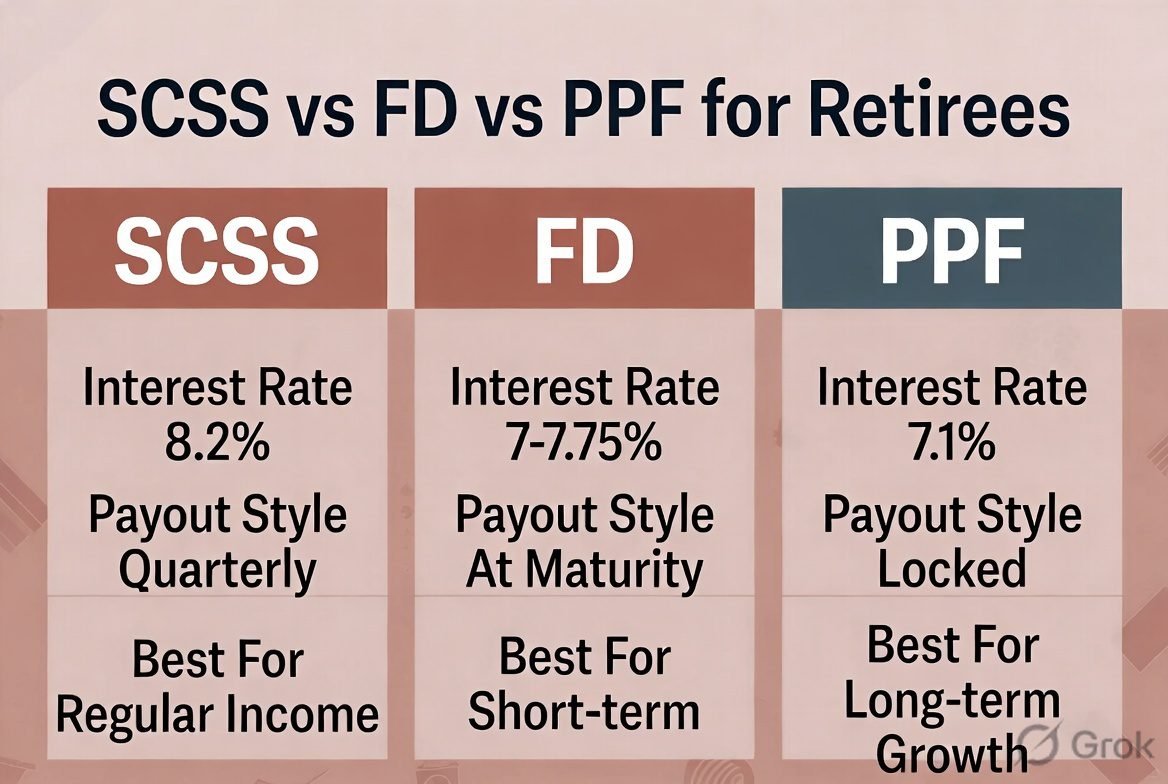
| Feature | SCSS | Bank FD | PPF |
|---|---|---|---|
| Current Rate | 8.2% | ~7-7.75% (varies) | 7.1% |
| Payout Style | Quarterly income | Maturity or periodic | Locked till maturity |
| Sovereign Guarantee | Yes | DICGC insured up to ₹5L | Yes |
| Best Suited For | Regular retirement income | Short-term parking | Long-term, tax-free growth |
For a retiree who needs predictable monthly or quarterly cash flow to cover living expenses, SCSS's structure is genuinely purpose-built in a way neither FDs nor PPF quite match — FDs typically pay out at maturity or require choosing a cumulative-vs-payout option upfront, and PPF is fundamentally a long-term accumulation vehicle rather than an income-generating one at this life stage. We've covered FD comparisons in more depth in our Amrit Vrishti FD calculator if you're weighing SCSS against a specific bank's FD offering.
Read Our EPF vs NPS vs PPF Comparison →How to Open an SCSS Account
SCSS was originally introduced as a post-office savings scheme, but seeing the demand, all government banks and most major private banks now offer it alongside post offices. It's currently available at all post offices and roughly 28 scheduled commercial banks, including SBI, HDFC, ICICI, Axis, and Canara. You'll need PAN, Aadhaar, age proof, and, for the 55-60 early-retirement category, documentation of your retirement benefits and the date they were received. Bank-specific SCSS account opening details are typically listed on each bank's official site — for example, SBI's SCSS page.
Frequently Asked Questions
What is the current SCSS interest rate?
The SCSS interest rate for Q1 FY 2026-27 (April-June 2026) is 8.2% per annum, paid quarterly, and has remained stable at this level for several consecutive quarters.
Who is eligible to open an SCSS account?
Resident Indians aged 60 and above are eligible, along with those aged 55-60 who retired through superannuation or VRS (within one month of receiving benefits), and defence personnel from age 50 onward.
What is the maximum amount I can invest in SCSS?
The maximum investment limit is ₹30 lakh per individual as of the 2026 update, or effectively up to ₹60 lakh for a couple if both spouses independently qualify and open separate accounts.
Is SCSS interest tax-free?
No. Unlike PPF, SCSS interest is fully taxable at your applicable income tax slab rate, and TDS applies if your total interest exceeds ₹50,000 in a financial year, though Form 15G/15H can help avoid TDS if your income is below the taxable threshold.
Can I withdraw from SCSS before 5 years?
Yes, premature closure is allowed, but it attracts a penalty of 1% to 1.5% of the principal invested, depending on how long the account has been held.
Can NRIs invest in SCSS?
No, Non-Resident Indians and Hindu Undivided Families (HUFs) are not eligible to open SCSS accounts.
Our Bottom Line
SCSS genuinely does one job extremely well — turning a retirement lump sum into predictable, government-guaranteed quarterly income — and that's exactly why it remains one of the first recommendations most financial planners make to newly retired clients. The tax treatment is the one detail that trips people up most often, so factoring the fully-taxable interest into your actual post-tax income expectation, rather than assuming it behaves like tax-free PPF, is the single most important thing to get right before committing a large sum.
If you're helping a parent or family member plan a retirement lump sum, our retirement calculator and Atal Pension Yojana guide cover complementary pieces of the same broader retirement income picture.

Pranab Barman is a Financial Educator and Personal Finance Researcher with over 10 years of hands-on experience in stock markets, trading, and investing. Currently enrolled in the CFA Program, he is committed to continuous learning and professional excellence in finance.
As the Founder of PlayWithStock, Pranab covers a wide range of topics including Mutual Funds, SIP, Taxation, Stock Market Basics, and Financial Calculators — with a focus on simplifying complex financial concepts for everyday all investors.
Email: support@playwithstock.com
Website: playwithstock.com
Related posts:
 NPS National Pension System 2026: Complete Guide to Rules, Tax Benefits and Withdrawal
 Give the Same $10,000 to Charity in 2025 vs 2026, and Your Tax Break Could Shrink — Here’s Why: OBBBA Tax Changes 2026 Explained
 Section 244A Refund Interest Calculator
 What Is Circuit Breaker Stock Market: Meaning, Limits & 2026 Update
 119 Years Old and Still Beating Every Major Private Bank on FD Rates — Inside the Bank of Baroda FD Scheme Lineup
 SGB Premature Redemption Calculator 2026: Tax Rules, RBI Dates & Exit Guide
 RBI Repo Rate Cut 2026: The Complete Home Loan EMI Guide
 RBI MPC August 2026: 5 Key Things to Watch Before the Repo Rate Decision