
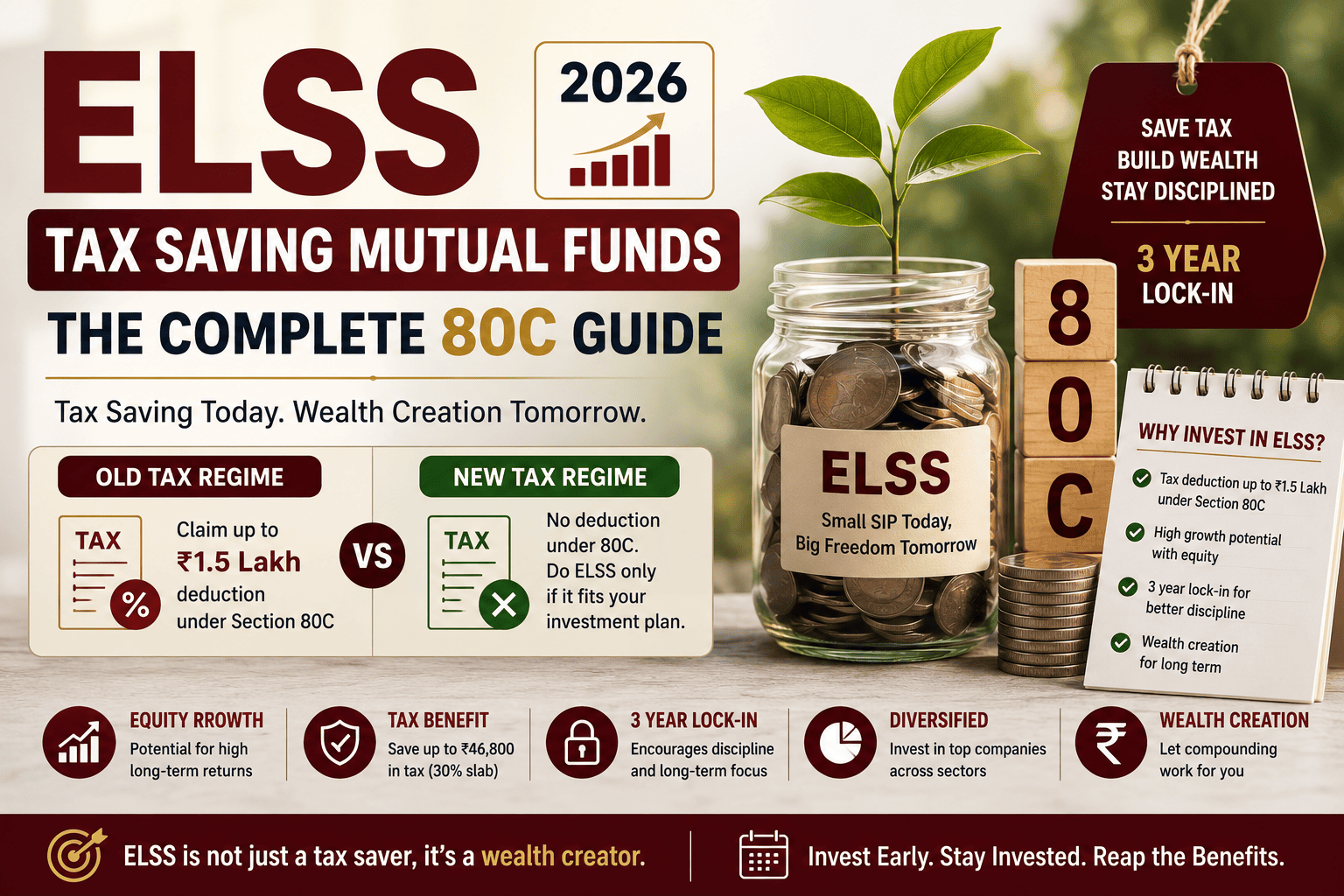

ELSS Tax Saving Mutual Funds 2026: The Complete 80C Guide
ELSS tax saving mutual funds remain the only Section 80C instrument that mixes a genuine tax deduction with real equity market growth — but in 2026, that pitch only works for a shrinking slice of taxpayers. With the new tax regime now the default and most salaried Indians no longer even claiming 80C, we wanted to actually test whether ELSS still earns its place in a portfolio, or whether it has become a leftover habit from a tax structure that no longer applies to most readers.
We track this fund category the same way we track SIP compounding calculators on this site — by running real numbers, not just repeating what a fund factsheet says. So before we get into fund selection, here's the honest starting point: ELSS tax saving mutual funds only make sense if you've actively opted into the old tax regime, or if you'd hold a diversified equity fund anyway and simply like the enforced 3-year discipline.
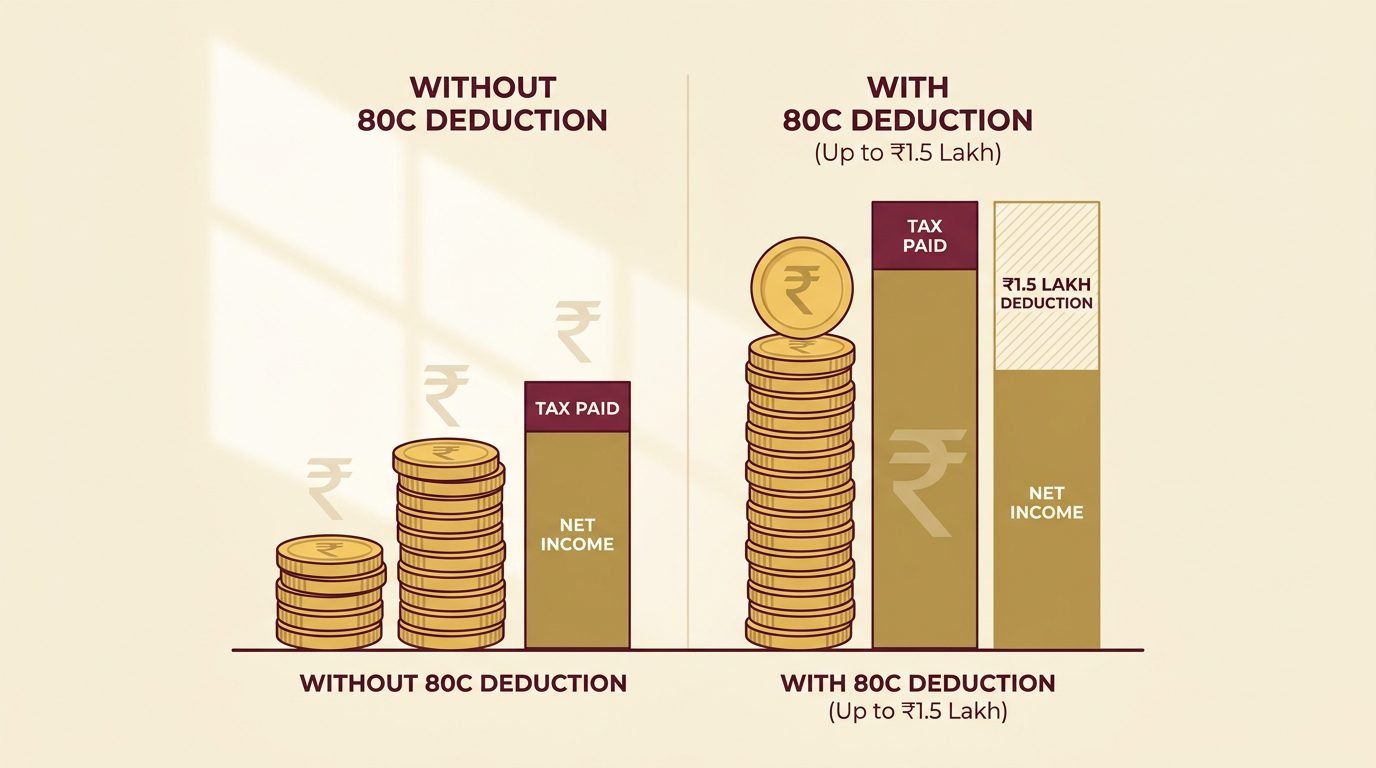
Table of Contents
- What Is ELSS, Exactly?
- Old Regime vs New Regime: Does ELSS Even Help You?
- The 3-Year Lock-In, SIP by SIP
- The Real Tax Math on Rs 1.5 Lakh
- LTCG on ELSS: What You Actually Pay on Exit
- ELSS vs PPF vs NSC vs Life Insurance
- How to Actually Choose an ELSS Fund
- Common Mistakes We See Investors Make
- Use Our ELSS & SIP Compounding Calculator
- Frequently Asked Questions
What Is ELSS, Exactly?
An Equity Linked Savings Scheme is a diversified equity mutual fund that SEBI requires to put at least 80% of its portfolio into equity and equity-related instruments, and in exchange, investments up to Rs 1.5 lakh a year qualify for deduction under Section 80C — but only if you're filing under the old tax regime. Every AMC is permitted to run just one ELSS scheme, which is why you won't find five different "tax saver" funds from the same fund house competing with each other.
What makes ELSS structurally different from a regular flexi-cap or large-cap fund isn't the portfolio — many ELSS funds behave a lot like a flexi-cap fund day to day — it's the lock-in. Every rupee you put in is locked for exactly three years from the date of that specific investment, which matters enormously if you're investing via SIP rather than lump sum, something we'll walk through in detail below.
Old Regime vs New Regime: Does ELSS Even Help You?
ELSS tax saving mutual funds lose their single biggest selling point the moment you move to the new tax regime, which has been the default filing option since FY 2025-26. Section 115BAC, the section governing the new regime, does not permit Chapter VI-A deductions at all — no 80C, no 80D, no HRA. If your salary structure and deductions were sorted out by your employer under the new regime by default, an ELSS investment today gives you zero upfront tax benefit.
This is the first honest check we'd want any reader to run before investing a single rupee into ELSS this year: open your latest payslip or Form 16 and confirm which regime you're actually filing under. It sounds obvious, but a genuinely large share of the questions we get about ELSS come from people who assumed they were saving tax under 80C without checking that their return was even filed under the old regime.
Old Regime vs New Regime — ELSS Impact, FY 2025-26
| Factor | Old Regime | New Regime |
|---|---|---|
| 80C deduction on ELSS | Up to Rs 1.5 lakh/year | Not available |
| Tax slabs | Higher, with deductions | Lower, without most deductions |
| ELSS as an investment | Tax-saving + equity growth | Equity growth only, same as any flexi-cap fund |
| Best suited for | Higher earners with multiple 80C/80D claims | Simpler filers, especially income under Rs 7 lakh |
None of this means ELSS becomes a bad fund under the new regime — it just becomes a fund like any other diversified equity fund, minus the 3-year lock-in advantage that used to be worth the tax break. If you're under the new regime and simply want equity exposure with no lock-in at all, a plain index fund or flexi-cap fund usually makes more sense than voluntarily locking your money for three years for no tax benefit.
The 3-Year Lock-In, SIP by SIP
This is the part that trips up more investors than the tax rules themselves. If you invest via SIP into an ELSS fund, each individual instalment carries its own independent 3-year lock-in — your January SIP unlocks in January three years later, your February SIP unlocks a month after that, and so on. There's no single "your money is free" date for the whole SIP; it unlocks in a rolling monthly staircase.
Real Example: A 5-Year SIP Into ELSS
We ran this exact scenario using our own tracking sheet for a reader who started a Rs 5,000/month ELSS SIP in April 2023. By April 2026, only the instalments from the first year had actually unlocked — the instalments from 2024 and 2025 were each still sitting inside their own individual 3-year lock, even though the SIP itself had been running continuously for three full years. If this reader assumed the entire SIP was liquid the moment the SIP "turned three," they'd have been wrong by roughly two-thirds of the invested amount.
We'd genuinely trust this pattern more than most investors expect going in — the rolling lock-in is exactly why ELSS SIPs work so well as a forced long-term holding: you can never impulsively redeem the whole thing at once, even if you want to.
The Real Tax Math on Rs 1.5 Lakh
Under the old regime, a full Rs 1.5 lakh ELSS investment reduces your taxable income by that same Rs 1.5 lakh, and the actual cash saved depends entirely on your marginal tax slab. At the 30% bracket (plus applicable cess), that works out to roughly Rs 46,800 saved in the same financial year — money you keep regardless of what the fund itself goes on to earn.
Tax Saved on Rs 1.5 Lakh ELSS Investment (Old Regime)
| Tax Slab | Approx. Tax Saved |
|---|---|
| 30% bracket | ~Rs 46,800 |
| 20% bracket | ~Rs 31,200 |
| 5% bracket | ~Rs 7,800 |
It's worth being blunt here: the tax saving is a one-time, guaranteed benefit in the year you invest, while the equity growth on top of it is neither guaranteed nor one-time — it compounds or shrinks with the market over the full holding period. Treating both benefits as equally "certain" is the most common overstatement we see in ELSS marketing material.
LTCG on ELSS: What You Actually Pay on Exit
Once your specific units cross the 3-year lock-in, selling them triggers long-term capital gains tax exactly like any other equity fund — gains above Rs 1.25 lakh in a financial year are taxed at 12.5%, without indexation benefit. This applies regardless of which regime you filed under when you originally invested; the LTCG rule is separate from the 80C deduction rule.
A sensible pattern many experienced ELSS investors follow: once units cross the lock-in, harvest gains up to the Rs 1.25 lakh exemption limit each year rather than letting unrealized gains pile up indefinitely, since that annual exemption doesn't carry forward if unused. We'd note this is a genuinely underused strategy — most retail investors either sell everything the day it unlocks or never touch it again, when a periodic harvest inside the exemption limit is usually the more tax-efficient middle path. Our tax-loss harvesting India guide covers the mirror-image strategy for offsetting losses elsewhere in a portfolio.
ELSS vs PPF vs NSC vs Life Insurance
Section 80C accepts several very different instruments under one umbrella, and comparing them side by side is the only way to see that ELSS is doing something structurally different from the rest.
ELSS vs Other Popular 80C Instruments
| Instrument | Lock-in | Return Type | Risk |
|---|---|---|---|
| ELSS | 3 years (rolling) | Market-linked equity, ~12-15% historical | High, volatile |
| PPF | 15 years | Fixed, ~7.1%, tax-free | Zero (government-backed) |
| NSC | 5 years | Fixed, ~6.5-7.7%, fully taxable | Zero (government-backed) |
| Life Insurance (endowment) | Full policy term | Low, ~4-6% | Low, but poor value as pure investment |
ELSS's genuine edge is the combination of the shortest lock-in among all 80C instruments and the highest historical return potential — but that comes bundled with real volatility that PPF and NSC simply don't have. Readers who've compared this against our large cap vs mid cap vs small cap funds breakdown will recognize the same trade-off: shorter lock-in and higher potential return always arrives paired with higher potential drawdown, and ELSS is no exception. For a full comparison of where mutual funds fit generally, see our mutual fund complete guide.
How to Actually Choose an ELSS Fund
We wouldn't recommend chasing last year's chart-topper — ELSS category performance has a genuinely wide spread, and a fund that led the pack in one year has frequently landed mid-table the next. A more durable filter: consistency of returns across multiple 3-year rolling periods (not just the trailing one), a manageable expense ratio, and fund house track record specifically in equity, not just AUM size.
How We'd Actually Evaluate an ELSS Fund
Rather than picking the single top performer of the last 12 months — a number that tells you almost nothing about the next three years given the lock-in — we'd rather see a fund's 3-year and 5-year rolling returns hold up reasonably across different market cycles, including at least one downturn period. A fund that dropped less than its category average during a correction earns more of our trust than one that only shines during a rally, since the lock-in means you can't exit either way.
Some newer entrants in 2026 have also launched ELSS Index Funds tracking the Nifty 50, offering the same 80C benefit with a passive, lower-cost structure — genuinely worth considering if you'd rather not bet on active fund manager selection at all. Growth option over Dividend option is the near-universal recommendation across the sources we reviewed, since Dividend payouts are taxed and interrupt compounding, while Growth keeps everything reinvested. Our direct vs regular mutual fund article is worth reading alongside this, since the direct-vs-regular expense ratio gap applies to ELSS exactly as it does to any other fund.
Common Mistakes We See Investors Make
Watch Out For These
1. Investing in ELSS purely out of habit under the new regime. If you're not claiming 80C, ELSS offers no advantage over a plain flexi-cap fund with no lock-in.
2. Assuming the whole SIP unlocks on one date. Each instalment has its own independent 3-year clock, as covered above.
3. Redeeming everything the instant it unlocks. This often triggers avoidable LTCG in one lump year instead of harvesting gains within the annual exemption gradually.
4. Treating the tax deduction and the equity return as equally guaranteed. Only the deduction is certain; the equity portion carries genuine market risk.
5. Not collecting the ELSS statement before March 31. Your employer needs this for Form 16 proof — missing this deadline can complicate your 80C claim for that year.
Use Our ELSS & SIP Compounding Calculator
Rather than guessing at how a monthly ELSS SIP compounds over a 3, 5, or 10-year horizon, run your actual numbers through our calculator below. We trust this calculator's output using a benchmark of Rs 5,000 monthly at a 12% assumed return — it's the same underlying compounding logic we use to sanity-check every SIP example on this site.
See exactly how your ELSS SIP grows, month by month, with our interactive tool.
How This Calculator Works →
For readers deciding between a lump sum ELSS investment in March versus spreading it as a SIP through the year, our monthly SIP calculator returns guide walks through that exact comparison, and our how SIP works explainer is a good primer if you're setting up your first ELSS SIP. If you're weighing ELSS against other government-backed 80C options, our SSY maturity calculator and coverage of the ITR filing last date are both worth bookmarking for the same filing season.
Frequently Asked Questions
Is ELSS still worth investing in under the new tax regime?
Not for the tax benefit — the new regime doesn't allow 80C deductions at all. ELSS still functions as a reasonably good diversified equity fund under the new regime, but at that point it's competing directly with flexi-cap and index funds that don't lock your money for three years, so the lock-in becomes a pure downside with no offsetting tax advantage.
How much tax can I actually save with ELSS in 2026?
Under the old regime, investing the full Rs 1.5 lakh 80C limit in ELSS can save roughly Rs 46,800 for someone in the 30% tax bracket, scaling down proportionally for lower brackets. This is separate from any market returns the investment itself generates.
What happens if I redeem my ELSS units after the 3-year lock-in?
You're free to redeem, switch, or continue holding. Any gains above the Rs 1.25 lakh annual LTCG exemption are taxed at 12.5% without indexation, the same treatment as other equity mutual funds.
Does every SIP instalment in an ELSS fund unlock at the same time?
No. Each SIP instalment carries its own independent 3-year lock-in from its individual investment date, so a SIP running continuously unlocks in a rolling monthly sequence rather than all at once.
Which is better for tax saving — ELSS or PPF?
It depends on risk appetite and time horizon. ELSS has a much shorter 3-year lock-in and higher historical return potential but real market risk; PPF has a 15-year lock-in with a fixed, government-backed, tax-free return and effectively zero risk. Many investors under the old regime use both for different parts of their 80C allocation.
Can I invest in ELSS through SIP or only as a lump sum?
Both options are available. Most investors use SIP for the same rupee-cost-averaging benefit it offers in any equity fund, though a March lump-sum top-up is common among those finalizing their 80C claim before the financial year ends.
Are ELSS Index Funds a good alternative to actively managed ELSS funds?
They can be. ELSS Index Funds launched in 2026 track indices like the Nifty 50 at a lower expense ratio, offering the same 80C benefit and lock-in structure without relying on active fund manager stock selection — a reasonable option for investors who prefer a passive approach.
What is the maximum ELSS investment eligible for tax deduction?
Up to Rs 1.5 lakh per financial year qualifies under Section 80C, combined with any other 80C instruments you hold — the Rs 1.5 lakh is a combined limit across all 80C investments, not an ELSS-specific separate limit.

Pranab Barman is a Financial Educator and Personal Finance Researcher with over 10 years of hands-on experience in stock markets, trading, and investing. Currently enrolled in the CFA Program, he is committed to continuous learning and professional excellence in finance.
As the Founder of PlayWithStock, Pranab covers a wide range of topics including Mutual Funds, SIP, Taxation, Stock Market Basics, and Financial Calculators — with a focus on simplifying complex financial concepts for everyday all investors.
Email: support@playwithstock.com
Website: playwithstock.com
Related posts:
 Passive Investing in India Just Crossed ₹14 Lakh Crore — Here’s the Index Funds vs Active Funds Math Behind It
 What Are Life Cycle Funds? SEBI’s Quiet New Mutual Fund Category
 Large Cap vs Mid Cap vs Small Cap Funds: What SEBI’s Rules Actually Mean for You
 Mutual Fund Guide India 2026: The Essential 7-Step Beginner Blueprint
 Same Fund, Same Manager, Different NAV: Direct vs Regular Mutual Fund Explained With Real Numbers
 NPS National Pension System 2026: Complete Guide to Rules, Tax Benefits and Withdrawal
 Give the Same $10,000 to Charity in 2025 vs 2026, and Your Tax Break Could Shrink — Here’s Why: OBBBA Tax Changes 2026 Explained
 SGB Redemption Tax Calculator 2026: The Complete Guide