

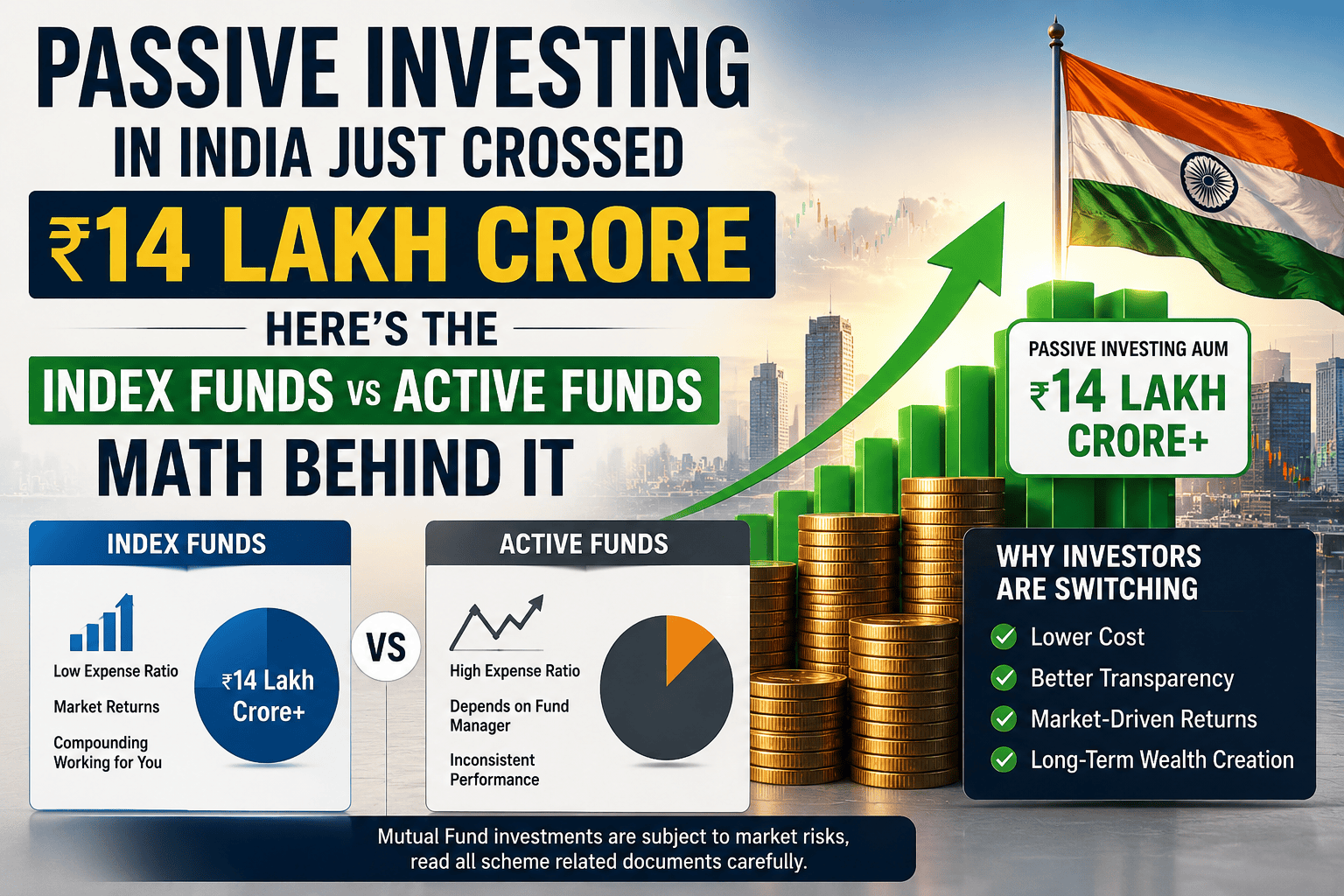
Passive Investing in India Just Crossed ₹14 Lakh Crore — Here's the Index Funds vs Active Funds Math Behind It
Nearly two-thirds of active large-cap funds underperformed their benchmark last year. Here's exactly when passive investing wins, when active management still earns its fee, and how to actually decide.
- 1. Index Funds vs Active Funds: The Basic Distinction
- 2. Why Passive Investing in India Is Suddenly Everywhere
- 3. Index Funds vs Active Funds: The Large-Cap Verdict
- 4. Where Active Management Still Earns Its Fee
- 5. The Real Cost Gap Between the Two
- 6. The Core-Satellite Approach Most Advisors Now Recommend
- 7. When You Should Still Consider Active Funds
- 8. How to Actually Build a Passive Core
- 9. FAQs
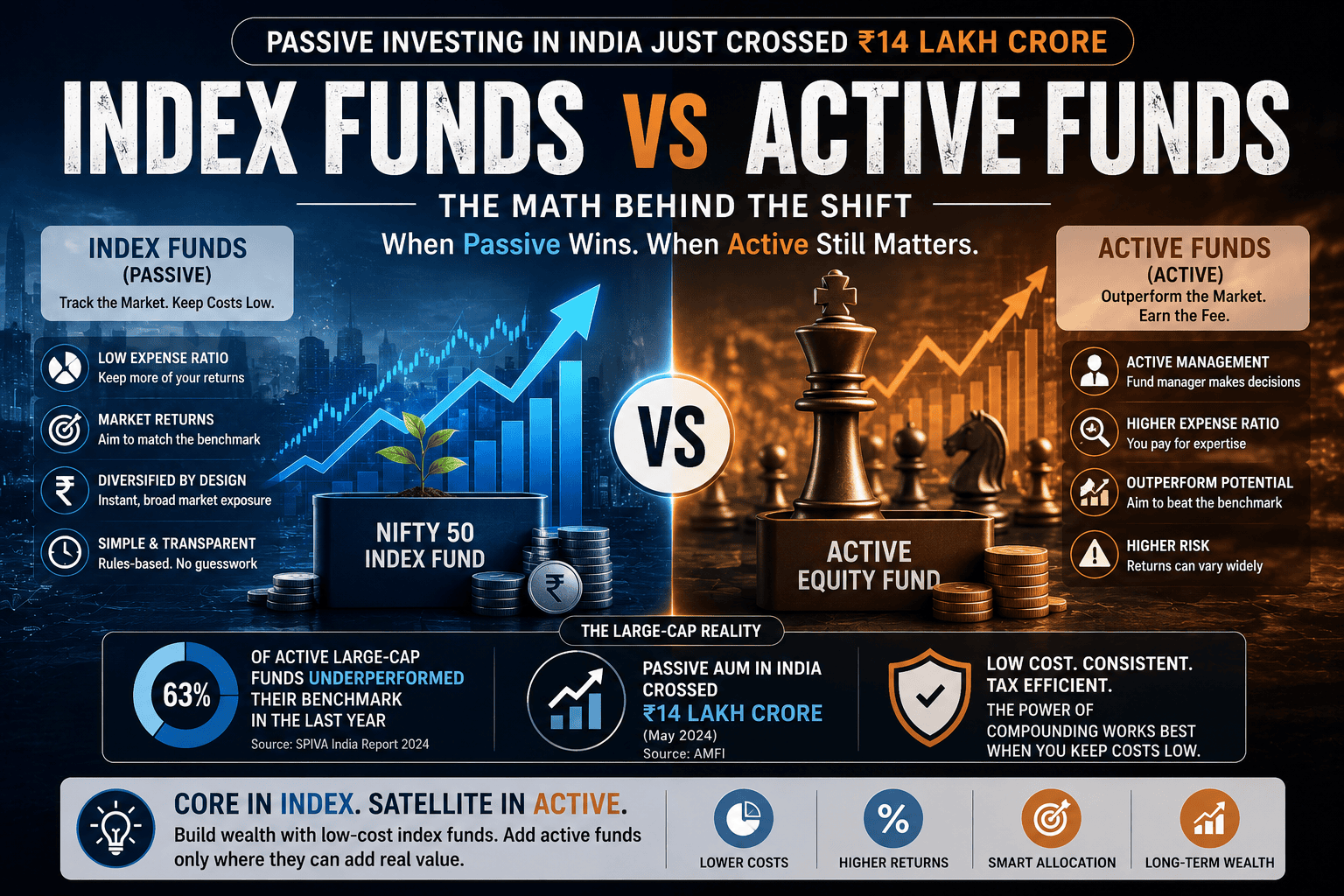
The Index Funds vs Active Funds debate in India has quietly shifted over the past two years, and the numbers explain why. Passive investing in India — index funds, index ETFs, and other funds that simply track a market benchmark rather than trying to beat it — has grown to roughly ₹14.20 lakh crore in assets, about 18% of the entire mutual fund industry, according to AMFI data, on the back of a 31% year-on-year surge. This isn't a niche trend anymore; it's a genuine structural shift in how Indian investors are choosing to put their money to work.
⚡ Index Funds vs Active Funds — Quick Reference
| Passive Fund AUM (Dec 2025) | ~₹14.20 lakh crore |
| Share of Total MF Industry | ~18% |
| YoY Growth in Passive AUM | 31% |
| Active Large-Cap Funds Underperforming (2025) | 65-66% |
| Record Monthly ETF Inflow | ₹19,056 crore (April 2025) |
| Total Indian MF Industry AUM | ~₹80 lakh crore (Nov 2025) |
1. Index Funds vs Active Funds: The Basic Distinction
An index fund simply buys and holds the same stocks as a market index — the Nifty 50 or the Sensex, for example — in the same proportion, with no attempt to pick winners or time the market. An active fund puts a human fund manager in charge, researching and selecting individual stocks with the explicit goal of beating the benchmark, not just matching it.
The Index Funds vs Active Funds choice isn't really about which style is "better" in the abstract — it's about which style has actually delivered better after-fee, after-tax results in specific market segments, and that answer varies significantly depending on where in the market you're investing. Our complete mutual fund guide and Direct vs Regular Mutual Fund guide cover related cost decisions worth understanding alongside this one.
2. Why Passive Investing in India Is Suddenly Everywhere
A few converging trends explain the acceleration. First, cost-consciousness among Indian investors has risen sharply, and the mechanics of how fees compound against returns over decades have become far better understood — our Direct vs Regular Mutual Fund breakdown covers exactly this compounding-cost math. Second, actual performance data has increasingly favoured passive strategies in the most closely watched segment of the market — large-cap funds — making the case harder to argue against.
ETF inflows alone hit a record ₹19,056 crore in a single month in April 2025, and select passive funds — largely those with international or sector index exposure — delivered returns as high as 76% in 2025, capturing momentum that many active large-cap managers struggled to match on a net basis.
3. Index Funds vs Active Funds: The Large-Cap Verdict Is Clear
This is where the Index Funds vs Active Funds data is least ambiguous. According to SPIVA India data, roughly 65-66% of active large-cap funds underperformed their benchmark indices in 2025. Large-cap stocks are among the most heavily researched, closely tracked names in the market — dozens of analysts cover every major company, which makes it genuinely difficult for any single fund manager to find an information edge consistently.
| Fund Category | Active Fund Track Record | Where Passive Tends to Win |
|---|---|---|
| Large-Cap Equity | ~65-66% underperformed benchmark (2025) | Strongly favours passive/index |
| Mid-Cap Equity | Mixed, several outperformed | Genuine case for active |
| Small-Cap Equity | Mixed, wider dispersion of results | Genuine case for skilled active managers |
| Sector/Thematic | Requires specialised expertise | Active often better suited |
4. Where Active Management Still Earns Its Fee
The Index Funds vs Active Funds story changes meaningfully once you move outside large-caps. Mid-cap and small-cap markets are less efficiently researched — not every stock gets the same institutional analyst coverage a Nifty 50 name receives, which leaves genuine room for a skilled fund manager to add value through stock selection. In 2025, several active mid-cap and small-cap funds did outperform their benchmarks, though results varied widely across funds, which is itself an important caveat: picking the right active fund in this segment carries real selection risk, since you're also running the risk of choosing one of the underperforming majority.
Active managers also retain a structural advantage during sharp downturns — they can shift to defensive sectors or raise cash, while a passive fund must stay fully invested and falls exactly in line with the index, for better or worse. This is worth reading alongside our why is the stock market falling coverage and circuit breaker explainer for context on how downturns actually unfold in Indian markets.
5. The Real Cost Gap in the Index Funds vs Active Funds Comparison
Cost is the most consistent, predictable difference in the Index Funds vs Active Funds comparison. Passive funds typically carry expense ratios as low as 0.04% to 0.20% for direct plans, while actively managed equity funds average 0.55% to 0.70% for large-cap and flexi-cap categories, and can run higher for small-cap active funds. Over a long SIP horizon, this gap compounds meaningfully — the same math covered in detail in our Direct vs Regular Mutual Fund analysis, where a comparable expense ratio gap worked out to roughly ₹12 lakh over 20 years on a ₹15,000 monthly SIP.
Passive funds also tend to be more tax-efficient in practice, since lower portfolio turnover generally means fewer realised capital gains events along the way compared to actively traded portfolios. Our tax-loss harvesting guide covers related capital gains timing strategies.
6. The Core-Satellite Approach Most Advisors Now Recommend
Rather than treating Index Funds vs Active Funds as an all-or-nothing choice, a growing number of Indian advisors now recommend a core-satellite structure: build the bulk of your portfolio — the "core" — around low-cost passive index funds covering large-cap exposure, then add selective active funds as "satellite" positions specifically in mid-cap, small-cap, or thematic segments where genuine manager skill has a better chance of adding value.
This approach captures the cost and consistency advantage of passive investing where the data supports it most strongly, while still leaving room for active management exactly where the case for it is genuinely stronger. Our sector rotation guide, life cycle funds explainer, and SIP compounding calculator are useful companion tools for structuring this kind of blended portfolio.
7. When You Should Still Consider Active Funds
Active funds make the most sense in market segments where research genuinely matters — mid-cap, small-cap, and specialised sector or thematic exposure — and for investors who specifically want a fund manager able to reduce equity exposure or shift defensively during a downturn, something a passive index fund structurally cannot do. Investors need to accept, though, that choosing active management also means accepting real fund-selection risk, since a meaningful share of active funds still underperform even in segments where skilled managers can add value.
Investment horizon matters here too: for horizons under 3-5 years, neither active nor passive equity funds are appropriate — that money belongs in debt instruments or liquid funds regardless of management style. Our beginner investing guide, how SIP works explainer, and 50-30-20 budgeting rule cover the broader horizon-matching and financial planning principles worth understanding alongside this decision.
8. How to Actually Build a Passive Core
Getting started with the passive side of an Index Funds vs Active Funds strategy is straightforward. Choose a low-cost Nifty 50 or Nifty 100 index fund with a stable, adequately-sized AUM — you can verify current index composition on NSE's own index pages. Very small index funds under roughly ₹100 crore can face liquidity issues, so favour established, mid-sized-to-large funds over the newest launches. Compare expense ratios directly, since for a passive fund tracking the same index, the expense ratio is close to the entire basis for choosing between competing options.
- Complete your KYC and open a demat or direct mutual fund platform account.
- Choose a broad-market index fund — Nifty 50 or Nifty 100 — as your core holding.
- Set up a SIP rather than a lump sum, to smooth entry timing through rupee cost averaging.
- Add active satellite positions only in mid-cap, small-cap, or thematic segments if you choose to, keeping the core passive allocation dominant.
9. Frequently Asked Questions
What is the difference between index funds and active funds?
Index funds passively track a market index like the Nifty 50 with no attempt to beat it, while active funds are managed by a fund manager who selects individual stocks specifically to try to outperform the benchmark.
Do index funds beat active funds in India?
In large-cap equity, yes, most of the time — roughly 65-66% of active large-cap funds underperformed their benchmark in 2025. In mid-cap and small-cap segments, results are more mixed, with several active funds outperforming.
How big has passive investing in India become?
Passive fund assets reached roughly ₹14.20 lakh crore by December 2025, about 18% of the total Indian mutual fund industry, growing 31% year-on-year.
What is a core-satellite portfolio strategy?
It's an approach where the bulk of a portfolio (the "core") is built using low-cost passive index funds, while smaller "satellite" allocations use active funds in segments like mid-cap or small-cap, where skilled managers have a better chance of adding value.
Are index funds cheaper than active funds?
Yes, significantly. Direct-plan index funds typically carry expense ratios of 0.04% to 0.20%, while actively managed equity funds average 0.55% to 0.70% or higher, a gap that compounds meaningfully over a long investment horizon.
Should a beginner choose index funds or active funds?
For most beginners, a low-cost Nifty 50 or Nifty 100 index fund is a reasonable, simple starting point, since it avoids fund-selection risk entirely. Active funds can be added later as a smaller allocation once an investor has a clearer sense of their risk appetite and goals.

Pranab Barman is a Financial Educator and Personal Finance Researcher with over 10 years of hands-on experience in stock markets, trading, and investing. Currently enrolled in the CFA Program, he is committed to continuous learning and professional excellence in finance.
As the Founder of PlayWithStock, Pranab covers a wide range of topics including Mutual Funds, SIP, Taxation, Stock Market Basics, and Financial Calculators — with a focus on simplifying complex financial concepts for everyday all investors.
Email: support@playwithstock.com
Website: playwithstock.com
Related posts:
 Silver Shortage 2026: Why Prices Crossed ₹2.25 Lakh and Keep Climbing
 India IPO Boom 2026: ₹2.65 Lakh Crore Pipeline Explained in Simple Terms
 Reliance Q1 FY27 Results: Revenue Hits Record ₹3.12 Lakh Crore, Profit Slips 22%
 Large Cap vs Mid Cap vs Small Cap Funds: What SEBI’s Rules Actually Mean for You
 Dividend Aristocrats for Passive Income: Does India Have Its Own?
 Sensex Nifty Crash July 2026: 3 Real Reasons Behind the Fall
 What is the Dollar Index (DXY) and Why It Matters for India
 What Are Life Cycle Funds? SEBI’s Quiet New Mutual Fund Category