


How SIP Works: 7 Things Every First-Time Indian Investor Must Understand
Millions of Indians invest through SIP every month, but most couldn't explain what actually happens to their money after it leaves their bank account. Here's the complete mechanics, with real numbers.
- 1. How SIP Works: The Basic Idea
- 2. How SIP Works Behind the Scenes: NAV and Units
- 3. Rupee Cost Averaging Explained
- 4. The Compounding Effect: A Real Example
- 5. How to Actually Start a SIP
- 6. Step-Up SIP: The Advanced Version
- 7. SIP vs Lump Sum: Which Is Better
- 8. Common SIP Mistakes to Avoid
- 9. FAQs
How SIP Works is one of those questions almost every Indian investor has asked at some point, usually right after opening their first SIP and watching money leave their account automatically each month. A Systematic Investment Plan is simply a way of investing a fixed amount into a mutual fund at regular intervals — usually monthly — rather than putting in one large lump sum. India's mutual fund industry crossed ₹50 lakh crore in assets under management as of late 2025, according to the Association of Mutual Funds in India (AMFI), and understanding exactly how SIP works mechanically, not just conceptually, is what separates investors who stay disciplined through market volatility from those who panic and stop.
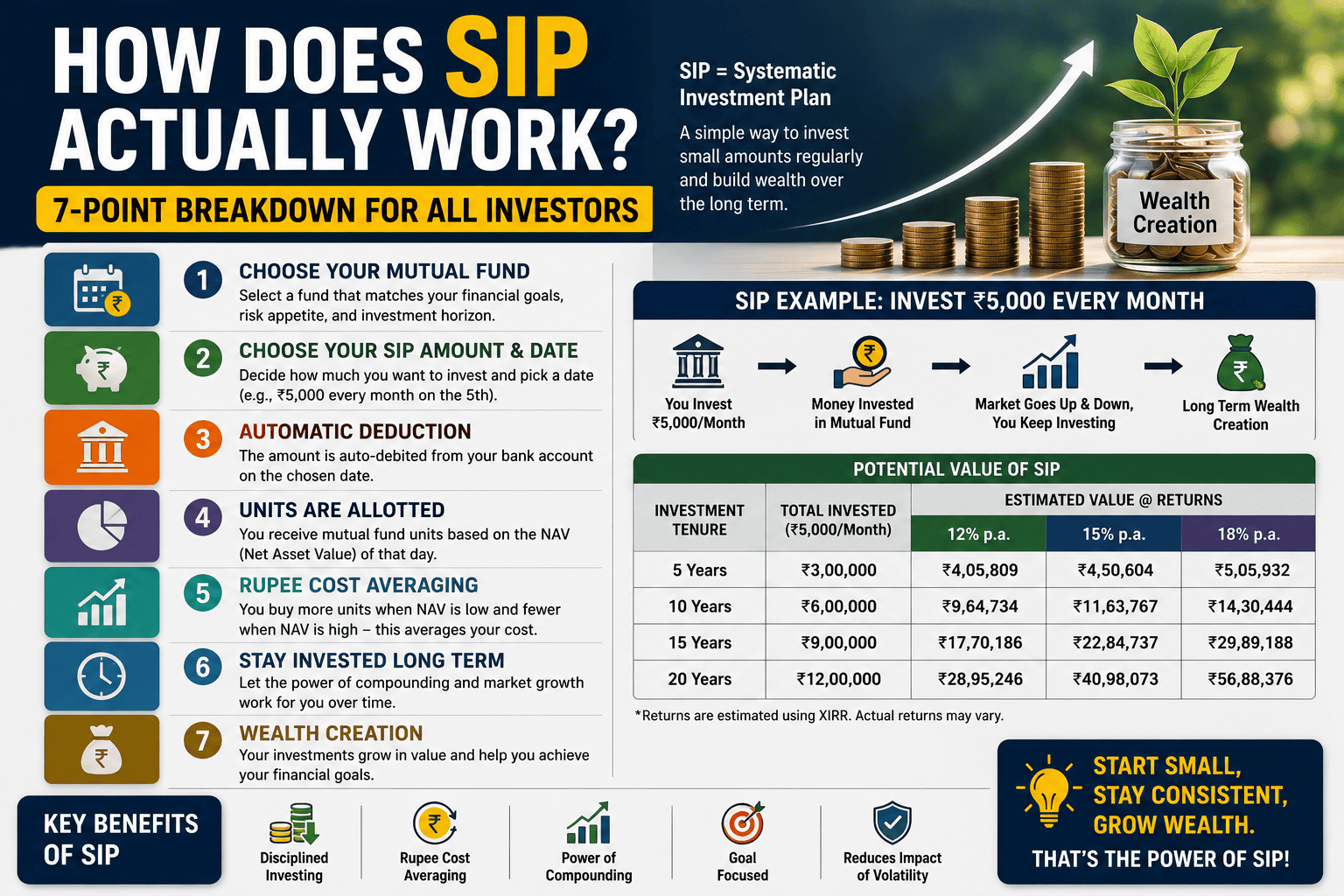
⚡ How SIP Works — Quick Reference
| What SIP Stands For | Systematic Investment Plan |
| Minimum Investment | As low as ₹100-500/month (fund-dependent) |
| Core Mechanism | Fixed amount buys units at that day's NAV |
| Key Benefit | Rupee cost averaging + compounding |
| India MF AUM (Oct 2025) | ₹50+ lakh crore |
| ₹10,000/month, 20 yrs, 12% return | ~₹1 crore (from ₹24 lakh invested) |
1. How SIP Works: The Basic Idea
At its core, a SIP is a method, not a product — it's a way of investing in mutual funds at regular intervals that removes the need to time the market, enforces financial discipline, and lets compounding work in the background. When you set up a SIP, you authorise a fixed amount — say ₹5,000 — to be automatically debited from your bank account every month and invested into the mutual fund scheme of your choice.
Understanding how SIP works matters more than most beginners realise, because the mechanics directly explain why SIPs are recommended for volatile markets specifically, not despite the volatility. This is the heart of how SIP works as a long-term wealth tool: consistency, not cleverness. If you're brand new to investing, our beginner investing guide and complete mutual fund guide are useful starting points before this deeper dive.
2. How SIP Works Behind the Scenes: NAV and Units
Every mutual fund has a Net Asset Value (NAV) — essentially the price of one unit of that fund on a given day, calculated after markets close. When your SIP amount is invested, it buys you a number of units equal to your investment amount divided by that day's NAV. If NAV is ₹100 and you invest ₹10,000, you get 100 units. The following month, if NAV has fallen to ₹80, the same ₹10,000 buys you 125 units instead.
This single mechanic — the number of units varying inversely with NAV — is the entire foundation of how SIP works as a wealth-building tool, and it's worth sitting with until it genuinely clicks, because everything else about SIP investing builds on this.
3. Rupee Cost Averaging: The Core of How SIP Works
Because your fixed monthly amount buys more units when prices are low and fewer units when prices are high, your average cost per unit over time ends up lower than the average NAV over the same period. This effect is called rupee cost averaging, and it's the reason SIP investors don't need to worry about timing their entry into the market.
| Month | NAV | Investment | Units Purchased |
|---|---|---|---|
| Month 1 | ₹100 | ₹10,000 | 100 |
| Month 2 | ₹80 (market fell) | ₹10,000 | 125 |
| Month 3 | ₹120 (market rose) | ₹10,000 | 83.3 |
Over these three months, you invested ₹30,000 and received 308.3 units, working out to an average cost of roughly ₹97.3 per unit — lower than the simple average NAV of ₹100 across the three months. This is exactly how SIP works to your advantage during volatile, choppy markets, automatically buying more when things are cheap without you having to make that decision manually.
4. How SIP Works With Compounding: A Real Example
Once your SIP has been running for a while, a second force takes over: compounding. Returns generated by your mutual fund investment get reinvested automatically, and those reinvested returns start generating their own returns. The longer the SIP runs, the more dramatic this effect becomes, which is why starting early consistently beats starting with a larger amount later.
Consider a concrete example: investing ₹10,000 every month for 20 years at an assumed 12% annual return can grow to nearly ₹1 crore — even though your total contribution over those 20 years is only ₹24 lakh. The remaining roughly ₹76 lakh comes entirely from compounding. Our SIP compounding calculator lets you run your own numbers with different monthly amounts, return assumptions, and time horizons — a hands-on way to see exactly how SIP works for your specific goal.
5. How to Actually Start a SIP: Step by Step
Getting started is simpler than most first-time investors expect, and walking through how SIP works in practice removes most of the intimidation. Here's the practical, step-by-step version of how SIP works from a completely blank starting point, using SEBI-registered platforms and funds:
- Complete your KYC — this can usually be done fully online using your PAN card, Aadhaar, and a recent photograph, through any SEBI-registered intermediary.
- Open a demat and trading account if you plan to invest through a broker platform, or use a direct mutual fund app if you're going commission-free. Our demat account explainer covers this step in detail.
- Choose your fund category — for most first-time SIP investors, a low-cost Nifty 50 or Nifty 100 index fund is a reasonable, simple starting point.
- Set your SIP date and amount, and link your bank account for auto-debit.
- Let it run — the entire point of understanding how SIP works is trusting the mechanism enough not to interrupt it every time the market has a bad month.
6. Step-Up SIP: How SIP Works for Investors With Rising Income
Once you understand how SIP works at a basic level, the natural next step is a Step-Up SIP — also called a Top-Up SIP — which automatically increases your monthly contribution by a fixed percentage every year, matching the reality that most salaried investors get annual raises. Fund NAVs for this are published daily and can be cross-checked on NSE or BSE-linked mutual fund platforms. For example, a ₹10,000 SIP with a 10% annual step-up becomes ₹11,000 in year two, ₹12,100 in year three, and so on.
Over a 10-year horizon at 12% annual returns with a 10% yearly step-up, an investor might contribute roughly ₹3.56 lakh more in total than a flat SIP, but receive around ₹5.14 lakh more in final returns — the step-up amplifies compounding specifically because the larger contributions happen earlier in the compounding timeline than they would if you waited to increase your SIP manually.
7. SIP vs Lump Sum: How SIP Works Differently
This is one of the most common follow-up questions once someone understands how SIP works. SIPs suit salaried individuals with regular monthly income who want to invest consistently without worrying about market timing. Lump sum investing can work well if you have a large amount of idle money and markets happen to be at a relatively low point, but timing that correctly is genuinely difficult even for experienced investors.
For most beginners, a practical middle path works best: run a core SIP consistently, and add lump sum investments opportunistically from bonuses or windfalls, rather than treating it as an either-or decision. Our life cycle funds explainer, record SIP inflows coverage, and Gold ETF vs physical gold comparison give useful additional context on how disciplined, systematic investing plays out across different asset classes in India.
8. Common Mistakes That Undermine How SIP Works for You
Understanding how SIP works in theory doesn't automatically protect you from the behavioural mistakes that undermine it in practice. The most damaging mistake is stopping or pausing a SIP the moment markets fall — this is precisely the period when rupee cost averaging is working hardest in your favour, since you're buying more units at lower prices. Our behavioral mistakes in stock trading guide covers this exact pattern in more depth.
A second common mistake is chasing last year's best-performing fund rather than sticking with a consistent, well-diversified strategy — historical outperformance rarely repeats reliably, a pattern also covered in our sector rotation guide. A third mistake is setting an unrealistically aggressive step-up rate that gets paused or cancelled the first time money is tight; a step-up SIP that keeps getting interrupted is often worse than a smaller flat SIP you never touch. For more on this, our why investors lose money analysis and 50-30-20 budgeting rule are useful companion reads for building the underlying financial discipline SIP investing requires.
9. Frequently Asked Questions
How does SIP actually work, step by step?
A fixed amount is auto-debited from your bank account at regular intervals and used to purchase units of a mutual fund at that day's NAV. Over time, this buys more units when prices are low and fewer when prices are high, averaging your purchase cost.
What is the minimum amount needed to start a SIP?
Many Indian mutual funds allow SIPs starting from as low as ₹100 to ₹500 per month, though the exact minimum varies by fund house and scheme.
How does compounding work in a SIP?
Returns generated by your mutual fund investment are reinvested automatically, and those reinvested returns generate their own further returns. Over long horizons, this compounding effect can account for a majority of your final corpus.
What is rupee cost averaging in a SIP?
Rupee cost averaging is the effect where your fixed SIP amount automatically buys more fund units when the NAV is low and fewer units when the NAV is high, lowering your average purchase cost over time compared to investing a lump sum at a single price point.
Is SIP better than a lump sum investment?
Neither is universally better — this comes down to how SIP works for your specific income pattern. SIPs suit investors with regular monthly income who want disciplined, timing-free investing, while lump sum investing can work well with idle capital deployed during a genuinely low market point, which is difficult to time reliably.
What is a Step-Up SIP?
A Step-Up SIP automatically increases your monthly contribution by a fixed percentage each year, matching income growth and amplifying compounding by front-loading larger contributions earlier in the investment timeline.

Pranab Barman is a Financial Educator and Personal Finance Researcher with over 10 years of hands-on experience in stock markets, trading, and investing. Currently enrolled in the CFA Program, he is committed to continuous learning and professional excellence in finance.
As the Founder of PlayWithStock, Pranab covers a wide range of topics including Mutual Funds, SIP, Taxation, Stock Market Basics, and Financial Calculators — with a focus on simplifying complex financial concepts for everyday all investors.
Email: support@playwithstock.com
Website: playwithstock.com
Related posts:
 Monthly SIP of ₹5,000 for 20 Years: Real Numbers, Real Story, and a Calculator
 Large Cap vs Mid Cap vs Small Cap Funds: What SEBI’s Rules Actually Mean for You
 Stocks to Buy After India-US Trade Deal 2026: A Sector-by-Sector Breakdown
 Record SIP Inflows June 2026: Indians Just Invested ₹31,781 Crore
 Dividend Aristocrats for Passive Income: Does India Have Its Own?
 What is the Strait of Hormuz and Why Does It Affect India? Complete Guide 2026
 EPF vs NPS vs PPF 2026: Which Retirement Option Actually Suits You
 Retirement Calculator India 2026: How Much You Actually Need to Save