


NPS National Pension System 2026: Complete Guide to Rules, Tax Benefits and Withdrawal
NPS National Pension System 2026 comes up in almost every retirement conversation we have with readers, and honestly it deserves the attention — it's one of the few investment options in India that genuinely combines market-linked growth with a tax deduction most other instruments simply can't match. But it's also a scheme that changed meaningfully in the last year, with new withdrawal rules that solve one of the biggest long-standing complaints people had about it. We wanted to write the version of this guide that actually reflects those 2026 changes, not a rehash of rules that stopped applying months ago.
If retirement planning feels like a topic you've been putting off, our beginner investing guide is a good starting point before diving into NPS specifically — this article assumes you're at least comfortable with basic investing concepts like equity and debt allocation. If you're also thinking about how NPS fits alongside your existing mutual fund investments, our complete guide to mutual funds in India and index funds vs active funds comparison are useful companion reads.

Table of Contents
- What Is NPS, Actually
- Tier 1 vs Tier 2: The Two Account Types
- The Three-Layer Tax Benefit Explained
- Does NPS Work Under the New Tax Regime
- The New 2026 Withdrawal Rules — What Actually Changed
- How NPS Returns Actually Work
- NPS Vatsalya: For Your Children
- How to Open an NPS Account
- NPS vs EPF vs PPF: Quick Comparison
- Frequently Asked Questions
What Is NPS, Actually
NPS is a voluntary, market-linked pension scheme regulated by the Pension Fund Regulatory and Development Authority (PFRDA), and any Indian citizen aged 18 to 70 can open an account and stay invested until age 75. Launched by the Government of India in 2004 for government employees and later opened to all citizens in 2009, NPS combines market-linked growth with genuinely compelling tax advantages.
Your money is managed by PFRDA-registered pension fund managers across four asset classes — equity (E), corporate bonds (C), government securities (G), and alternative assets (A). As of March 2025, the total subscriber base of NPS had grown to over 165 lakh, which gives you a sense of how mainstream this scheme has become for retirement planning in India. Subscriber growth data and official scheme statistics are published on the PFRDA's official statistics page, and detailed fund manager performance comparisons are available through NPS Trust's official portal.
NPS at a Glance — 2026
| Regulator | PFRDA |
| Eligibility Age | 18–70 years (can stay invested till 75) |
| Minimum to Open (Tier 1) | ₹500 |
| Minimum Annual Contribution | ₹1,000 |
| Historical Returns Range | 7.6% – 13.2% (asset-mix dependent) |
| Total Subscribers (Mar 2025) | 165+ lakh |
Tier 1 vs Tier 2: The Two Account Types
Tier 1 is the main retirement account, locked until age 60, with the tax benefits attached to it — minimum ₹500 per contribution and ₹1,000 a year to keep it active. Tier 2 is an optional add-on account with no lock-in, requiring a minimum of just ₹250 per contribution.
The distinction matters more than it might first appear. Tier 1 is where the actual retirement corpus builds and where the tax deductions apply — this is the account most people mean when they say "I have an NPS account." Tier 2 behaves more like a flexible investment account, useful if you want market-linked exposure through the same NPS infrastructure without locking your money away until 60, but it doesn't carry the same tax advantages as Tier 1.
Think of the two accounts as serving genuinely different purposes in a financial plan. Tier 1 fits into the same long-horizon, disciplined-saving category as SIPs you might already be running — our SIP compounding calculator shows how consistent long-term contributions compound over decades, a principle that applies just as much to NPS Tier 1 as it does to mutual fund SIPs. Tier 2, by contrast, sits closer to a regular market-linked investment account, with the flexibility to withdraw whenever needed.
The Three-Layer Tax Benefit Explained
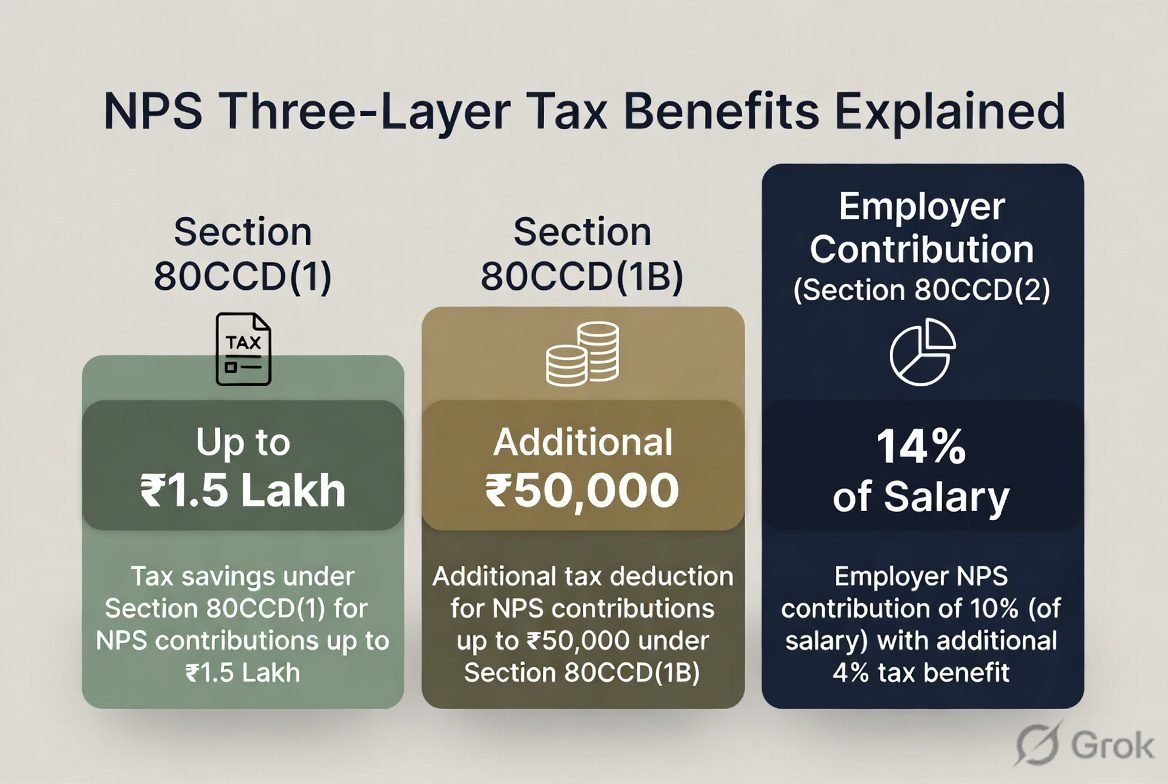
This is genuinely what sets NPS apart from most other tax-saving instruments. Unlike most tax-saving options capped at ₹1.5 lakh under Section 80C, NPS gives you an additional ₹50,000 deduction that sits entirely outside that limit. Three distinct Income Tax provisions apply: contributions enjoy deduction under Section 80CCD(1) and 80CCD(1B), while employer contributions get deductions under Section 80CCD(2).
| Section | What It Covers | Limit |
|---|---|---|
| 80CCD(1) | Your own contribution (within 80C umbrella) | Up to ₹1.5 lakh |
| 80CCD(1B) | Additional own contribution, outside 80C | Up to ₹50,000 extra |
| 80CCD(2) | Employer's contribution | Up to 14% of basic salary |
The maximum tax benefit under NPS can reach ₹2 lakh on the investor's own contribution combined across these two self-contribution sections. For the full calculation walkthrough with real salary examples, our tax planning guide covers how NPS deductions interact with your overall tax computation, and the ITR filing deadline 2026 article is worth bookmarking when it's time to actually claim these deductions. The official rules governing these deduction sections are laid out on the Income Tax Department's official portal, and ClearTax's NPS guide offers a useful plain-language cross-reference.
Does NPS Work Under the New Tax Regime
This is one of the most common questions we get, and the answer genuinely depends on whose contribution you're talking about. Employee contributions to NPS are not eligible for tax deduction under the new tax regime. However, employer contributions of up to 14% of basic salary are fully exempt from tax under Section 80CCD(2) — and from FY 2025-26, this 14% limit has been extended to private sector employees as well, not just government employees.
Practically, this means if you're on the new tax regime, your own NPS contributions won't reduce your taxable income — but if your employer restructures your CTC to route a portion through NPS (up to 14% of basic salary), that specific portion stays tax-free regardless of which regime you're on. It's genuinely worth asking your HR department about this if you're on the new regime and haven't already checked whether your compensation structure takes advantage of it.
This creates a genuinely important decision point for salaried professionals choosing between tax regimes. Under the old regime, the combined 80CCD(1) and 80CCD(1B) deductions on your own contribution can meaningfully lower taxable income if you're already maximizing other 80C options like PPF or ELSS funds. Under the new regime, that particular lever disappears for your own contributions, which shifts the calculation toward whether your employer's NPS contribution structure alone makes the scheme worthwhile, separate from any tax-saving motive on your part.
The New 2026 Withdrawal Rules — What Actually Changed
This is the part of NPS that's changed the most recently, and it directly addresses the biggest historical complaint about the scheme. PFRDA notified revised exit rules in December 2025 that solve the long-standing issue of too much money being forced into a mandatory annuity. This matters for the same reason we emphasize reading the fine print on any long-term financial product — the rules governing an instrument you might hold for 20-30 years can genuinely change mid-way through, and staying current on them is part of managing the investment properly, not a one-time decision made when you first opened the account.
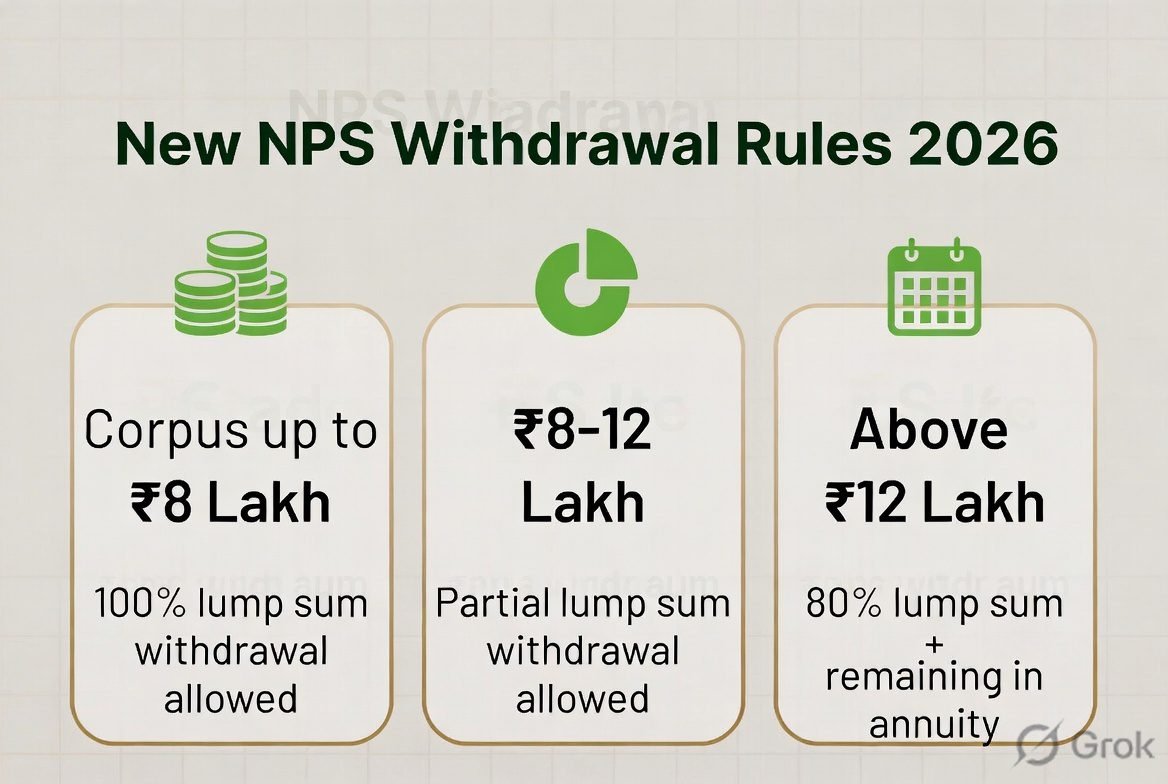
Corpus up to ₹8 Lakh
Withdraw 100% as a lump sum. No annuity purchase required at all under the new rules.
Corpus ₹8–12 Lakh
Take up to ₹6 lakh as a lump sum, and redeem the rest through systematic withdrawals over at least six years.
Corpus Above ₹12 Lakh
Withdraw up to 80% as a lump sum. At least 20% must still purchase an annuity that pays a monthly pension for life.
The old rule required a 60% lump sum and 40% mandatory annuity split for everyone, regardless of corpus size — the new tiered approach is a genuine improvement for smaller and mid-sized corpuses. One detail long-time NPS subscribers watch closely: the Income Tax Act still exempts only 60% of the corpus under Section 10(12A), even though the withdrawal percentage allowed has increased — meaning the tax treatment of the newly allowed larger lump sum withdrawal needs careful reading, not an assumption that the entire withdrawn amount is automatically tax-free.
At normal exit at age 60, 60% of the accumulated corpus can be withdrawn as a lump sum, completely tax-free under Section 10(12A), while the remaining 40% (or whatever portion is mandated based on corpus size) must purchase an annuity plan — and the monthly pension from that annuity is fully taxable as income at your applicable slab rate in the year you receive it. Before retirement, up to 25% of your own contributions can be withdrawn for specific purposes like higher education, medical treatment, or a home purchase, tax-free under Section 10(12B).
How NPS Returns Actually Work
Unlike a fixed deposit or PPF, NPS returns depend on market performance and there's no fixed interest rate — returns currently range from roughly 7.6% to 13.2% depending on the asset mix and duration chosen. Over the scheme's lifetime, it has delivered annualized returns in the 11% to 20% range for equity-heavy allocations, though that range reflects a mix of strong and weaker years rather than a guaranteed annual figure.
There's a cap on equity exposure ranging from 50% to 75% depending on your choice, with government employees and senior citizens capped at 50%. You can choose between "auto choice," which automatically shifts your allocation toward safer options as you age, or "active choice," where you decide the scheme and split your own investments across asset classes. Historical NAV performance for individual pension fund managers can be compared directly on the NPS Trust returns comparison page.
NPS Vatsalya: For Your Children
Tax benefits have been extended to NPS Vatsalya, allowing parents to contribute toward a pension account for minor children, with the same deductions applying once the account is converted at adulthood. This is a genuinely newer addition to the NPS family and worth knowing about if you're already thinking about long-term financial planning for children — it works alongside more traditional options we've covered in our sinking fund planning guide for shorter-term family goals.
How to Open an NPS Account
Opening an NPS account today is genuinely straightforward and mostly digital. You'll need a PAN card and basic KYC documents similar to what's required for opening a demat account for stock investing. Most major banks and the official NPS portal allow online account opening within minutes, with e-KYC verification through Aadhaar.
The official government portal for account opening and management is eNPS (NSDL), and the regulator's own resources are available on the PFRDA official website. Several banks and brokers also offer NPS account opening integrated into their existing platforms if you already have accounts there — worth checking whether your existing bank, the same one you might use for your demat and trading account, already offers this integration before opening a separate NPS account elsewhere.
NPS vs EPF vs PPF: Quick Comparison
| Feature | NPS | EPF | PPF |
|---|---|---|---|
| Returns | Market-linked, ~7.6-13.2% | Fixed, government-declared | Fixed, government-declared |
| Lock-in | Till age 60 | Till retirement/job change | 15 years |
| Extra Tax Deduction | ₹50,000 outside 80C | Within 80C only | Within 80C only |
| Equity Exposure | Up to 75% | None (fixed income) | None (fixed income) |
| Who It Suits | Growth-seeking, long horizon | Salaried employees (automatic) | Conservative, guaranteed-return seekers |
We'll be covering EPF and PPF in dedicated, equally detailed guides soon as we build out this Retirement Planning section further — for now, the core distinction worth remembering is that NPS is the only one of the three with meaningful equity exposure and growth potential, which comes with proportionally more volatility than EPF or PPF's fixed, predictable returns.
For most salaried readers, the practical reality is that these three instruments aren't mutually exclusive — EPF typically happens automatically through payroll, PPF works well as a conservative, guaranteed-return complement, and NPS adds the equity growth component along with its distinctive extra tax deduction. Thinking of them as three separate tools serving three separate roles in a retirement plan, rather than competing options where you must pick just one, tends to produce a more genuinely diversified outcome. If you're mapping out how much of your monthly savings should go toward retirement versus other goals, our 50-30-20 budgeting rule guide is a useful starting framework.
Related: What Is a Demat Account →Frequently Asked Questions
What is NPS and who can open an account?
NPS (National Pension System) is a voluntary, market-linked pension scheme regulated by PFRDA. Any Indian citizen aged 18 to 70 can open an account, and you can stay invested until age 75.
What are the tax benefits of NPS in 2026?
NPS offers deductions under three sections: up to ₹1.5 lakh under Section 80CCD(1) within the 80C limit, an additional ₹50,000 under Section 80CCD(1B) outside the 80C limit, and employer contributions up to 14% of basic salary under Section 80CCD(2).
Is NPS beneficial under the new tax regime?
Your own NPS contributions don't get a deduction under the new tax regime, but employer contributions of up to 14% of basic salary remain fully tax-exempt under Section 80CCD(2), regardless of which regime you choose.
What are the new NPS withdrawal rules for 2026?
Under PFRDA's revised rules from December 2025, corpus up to ₹8 lakh can be withdrawn 100% as a lump sum with no annuity required. Corpus of ₹8-12 lakh allows up to ₹6 lakh as lump sum with the rest via systematic withdrawal. Corpus above ₹12 lakh allows up to 80% lump sum, with at least 20% mandatorily used to purchase an annuity.
What returns does NPS offer?
NPS returns are market-linked and not fixed, currently ranging from roughly 7.6% to 13.2% depending on asset allocation, with the scheme having delivered 11-20% annualized returns historically for equity-heavy allocations over its full lifetime.
Can I withdraw from NPS before retirement?
Yes, up to 25% of your own contributions can be withdrawn before maturity for specific purposes like higher education, medical treatment, or home purchase, tax-free under Section 10(12B).
What is the difference between NPS Tier 1 and Tier 2?
Tier 1 is the main retirement account, locked until age 60, carrying all the tax benefits. Tier 2 is an optional account with no lock-in and a lower minimum contribution, but it doesn't offer the same tax deductions as Tier 1.
Our Bottom Line on NPS in 2026
NPS genuinely occupies a unique space in Indian retirement planning — no other mainstream instrument offers this specific combination of a dedicated tax deduction outside the 80C limit, meaningful equity exposure, and now, with the December 2025 rule changes, considerably more flexibility at exit than it used to have. It's not the right fit for every investor, particularly those who are deeply uncomfortable with market-linked returns close to retirement, but for anyone with a genuinely long investment horizon and room in their tax planning for an additional ₹50,000 deduction, it's worth serious consideration.
If you're building out a full retirement plan rather than looking at NPS in isolation, our SIP compounding calculator and index funds vs active funds comparison are useful companion tools for the equity portion of your broader retirement portfolio alongside NPS.

Pranab Barman is a Financial Educator and Personal Finance Researcher with over 10 years of hands-on experience in stock markets, trading, and investing. Currently enrolled in the CFA Program, he is committed to continuous learning and professional excellence in finance.
As the Founder of PlayWithStock, Pranab covers a wide range of topics including Mutual Funds, SIP, Taxation, Stock Market Basics, and Financial Calculators — with a focus on simplifying complex financial concepts for everyday all investors.
Email: support@playwithstock.com
Website: playwithstock.com
Related posts:
 UPS Pension Calculator 2026: The Complete Guide
 SGB Premature Redemption Calculator 2026: Tax Rules, RBI Dates & Exit Guide
 Circle National Trust Bank: What the OCC Approval Means for USDC and CRCL
 Give the Same $10,000 to Charity in 2025 vs 2026, and Your Tax Break Could Shrink — Here’s Why: OBBBA Tax Changes 2026 Explained
 Crypto Bookkeeping for Tax in India: The Complete 2026 Guide
 SGB Redemption Tax Calculator 2026: The Complete Guide
 FATF Anti-Fraud Rules 2026: What They Mean for Indian Investors
 SEBI 2026 F&O Rules: 8 Crucial Position Limit Changes Every Trader Must Know