


Tax Year vs Financial Year vs Assessment Year: What Actually Changed in 2026
Tax Year is the single new term that quietly replaced two of the most confusing words in Indian taxation — Financial Year and Assessment Year — the moment the Income-tax Act, 2025 came into force on April 1, 2026. If you've filed returns before, you already know the old headache: income earned in one year gets taxed and filed in a completely different year with a different label, and explaining that gap to someone new to taxes always took an extra five minutes.
We've fielded enough confused questions on this exact topic to know it deserves a plain, no-jargon explanation rather than another dense legal summary. So here's the honest starting point: nothing about how much tax you owe has changed because of this. What's changed is purely the label attached to the 12-month period — but that label shows up on your ITR filing, your Form 16, your TDS certificates, and basically every tax document you'll touch going forward, so it's worth actually understanding.
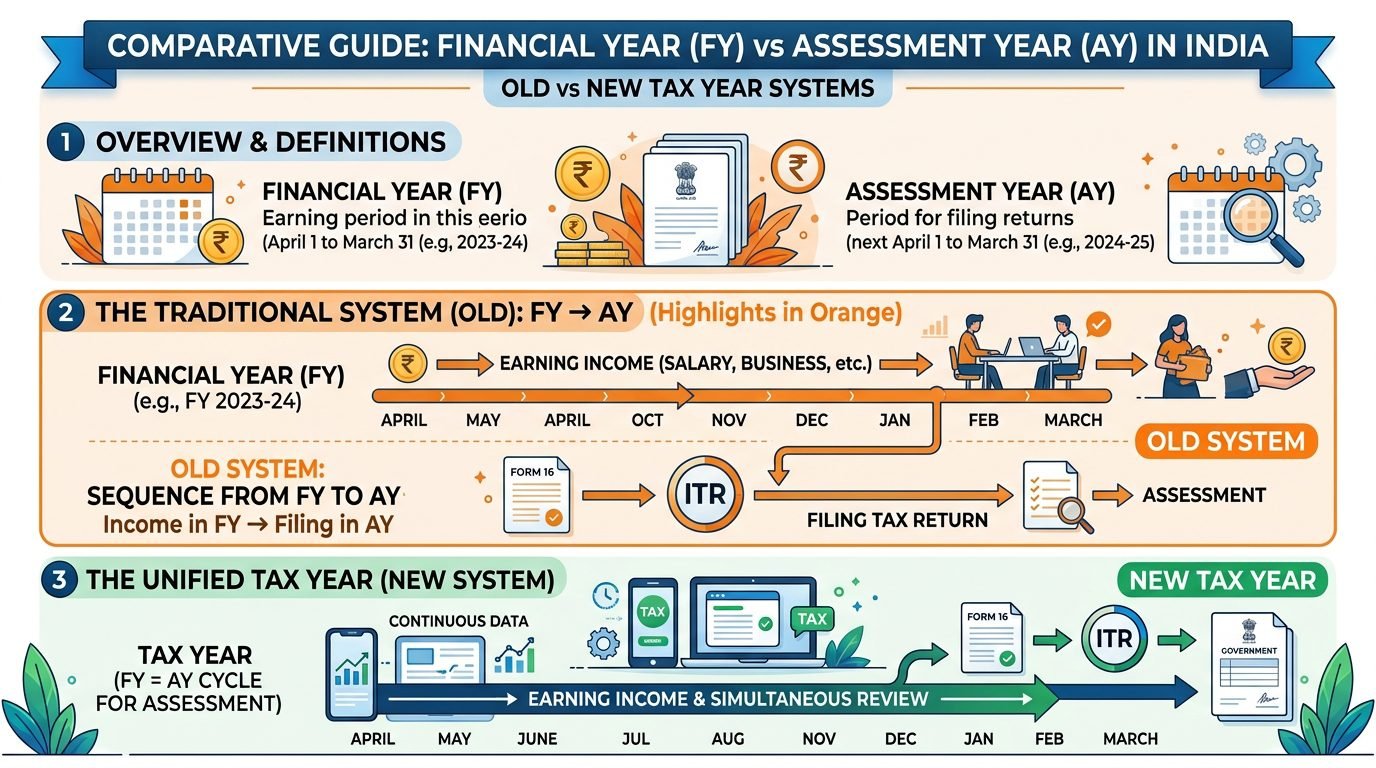
Table of Contents
The Old System: Why FY and AY Confused Everyone
Under the Income Tax Act, 1961, India ran on a dual-year system that genuinely confused a large share of first-time taxpayers. The Previous Year (commonly just called the Financial Year) was the actual 12-month period — April 1 to March 31 — in which you earned your income. The Assessment Year was the following 12-month period, during which that same income got assessed and taxed, and during which you actually filed your return.
So income earned in FY 2024-25 got taxed in AY 2025-26 — two different labels for two connected but distinct periods, and the AY was always exactly one year ahead of the FY it referred to. India was actually one of the few major economies still using this "time travel" style dual-year approach; most developed countries including the UK, US, and Australia use a single unified year concept for both earning and assessing income.
What Is "Tax Year" Under the New Act?
Section 3 of the Income-tax Act, 2025 defines Tax Year simply as the period of twelve months beginning April 1 — meaning it's essentially just the old Financial Year, renamed, but now serving as the single term for both when income is earned and when it's assessed. There's no more separate "previous year for earning" and "assessment year for taxing" — one label now covers the whole cycle.
Tax Year — Quick Definition
| Aspect | Detail |
|---|---|
| Legal basis | Section 3, Income-tax Act, 2025 |
| Effective from | April 1, 2026 |
| Duration | 12 months, April 1 to March 31 |
| Replaces | Both "Previous Year" and "Assessment Year" |
| New business exception | Tax Year begins from date of business setup, ends on the following March 31 |
For a business or income source newly set up partway through the year, the Tax Year simply starts from that setup date rather than April 1, and ends on the following March 31 — the same logic the old Previous Year concept used, just carried over under the new name.
Conversion Table: Old Terms to Tax Year
This is the part worth bookmarking, because you'll likely encounter both systems side by side for at least the next couple of filing cycles while professionals, software, and older documents catch up to the new terminology.
Old Terms vs Tax Year — Direct Mapping
| Old System | Period Covered | New Tax Year Equivalent |
|---|---|---|
| FY 2025-26 / AY 2026-27 | Apr 1, 2025 – Mar 31, 2026 | Tax Year 2025-26 (last year filed under old system) |
| FY 2026-27 / AY 2027-28 | Apr 1, 2026 – Mar 31, 2027 | Tax Year 2026-27 (first full Tax Year under new Act) |
| AY 2025-26 | Refers to income from FY 2024-25 | Tax Year 2024-25 |
A Simple Way to Convert Old Assessment Year References
If you're staring at an old document that says "Assessment Year 2026-27" and need the Tax Year equivalent, the safe formula is: subtract one from the higher year in the Assessment Year range. AY 2026-27 becomes Tax Year 2025-26, since both describe income actually earned during April 2025 to March 2026. We'd suggest keeping this one-line rule handy for the next year or two — it resolves almost every old-to-new confusion in a single mental step, faster than looking up a full conversion chart each time.
Importantly, income earned during FY 2025-26 (the year just ending as this new system takes effect) still follows the old terminology for filing purposes — you'll file that return referencing "AY 2026-27" as before. The new Tax Year language properly kicks in starting with income earned from April 1, 2026 onward, which will be called Tax Year 2026-27.
Why the Government Made This Change
Beyond taxpayer confusion, the shift also simplified legislative drafting significantly. Under the 1961 Act, nearly every section had to carefully specify whether it was referring to the Previous Year or the Assessment Year, which added real complexity to the law's language. The Income-tax Act, 2025 collapses this into one consistent reference point throughout, and it's part of a broader simplification effort that's cut the overall number of tax rules from over 500 to 333.
This mirrors the philosophy behind several other 2026 tax changes we've been tracking — a consistent push toward fewer, clearer rules rather than added complexity. Readers following the broader compliance calendar should also check our coverage of the ITR filing last date for 2026, since deadline structures are being reorganized alongside this terminology shift.
What Stays the Same
It's worth being explicit here, because this is the part most people jump past: your actual tax liability, the slab rates, and the fundamental April-to-March accounting period are completely unchanged. This is purely a naming and structural simplification, not a change to how much tax you owe or when you owe it.
Changed vs Unchanged
| Changed | Unchanged |
|---|---|
| Terminology: "Tax Year" replaces FY/AY dual system | The April 1 – March 31 accounting period itself |
| Legislative structure and section numbering | Core tax slab rates and computation method |
| Some ITR form references and portal fields | Deduction eligibility rules (80C, 80D, etc. under old regime) |
Certain procedural references — audits, rectifications, and some statutory filings — may still use "Financial Year" language for legal and procedural continuity, so don't be surprised if both terms appear on different documents even after the transition is complete. This is a deliberate design choice, not an inconsistency in the new law.
Practical Impact on Your Filing
For most salaried taxpayers, the practical day-to-day impact is genuinely minimal — your Form 16, TDS certificates, and e-filing portal will simply start referencing "Tax Year 2026-27" instead of the old dual FY/AY labels once the new system fully takes hold. If you're claiming deductions under the old tax regime through instruments like ELSS, that eligibility logic itself isn't affected by this terminology change — you're simply going to see a different year label on the paperwork.
Where it matters more is for accountants, payroll teams, and anyone maintaining older spreadsheets, ERP configurations, or reconciliation reports that reference fiscal periods by the old FY/AY labels — those systems need updating to avoid mismatches once Tax Year references start appearing on official documents and government correspondence. Businesses juggling multiple compliance deadlines alongside this transition should build in extra review time this year specifically to catch any old-label references that slipped through.
Common Mistakes During the Transition
Watch Out For These
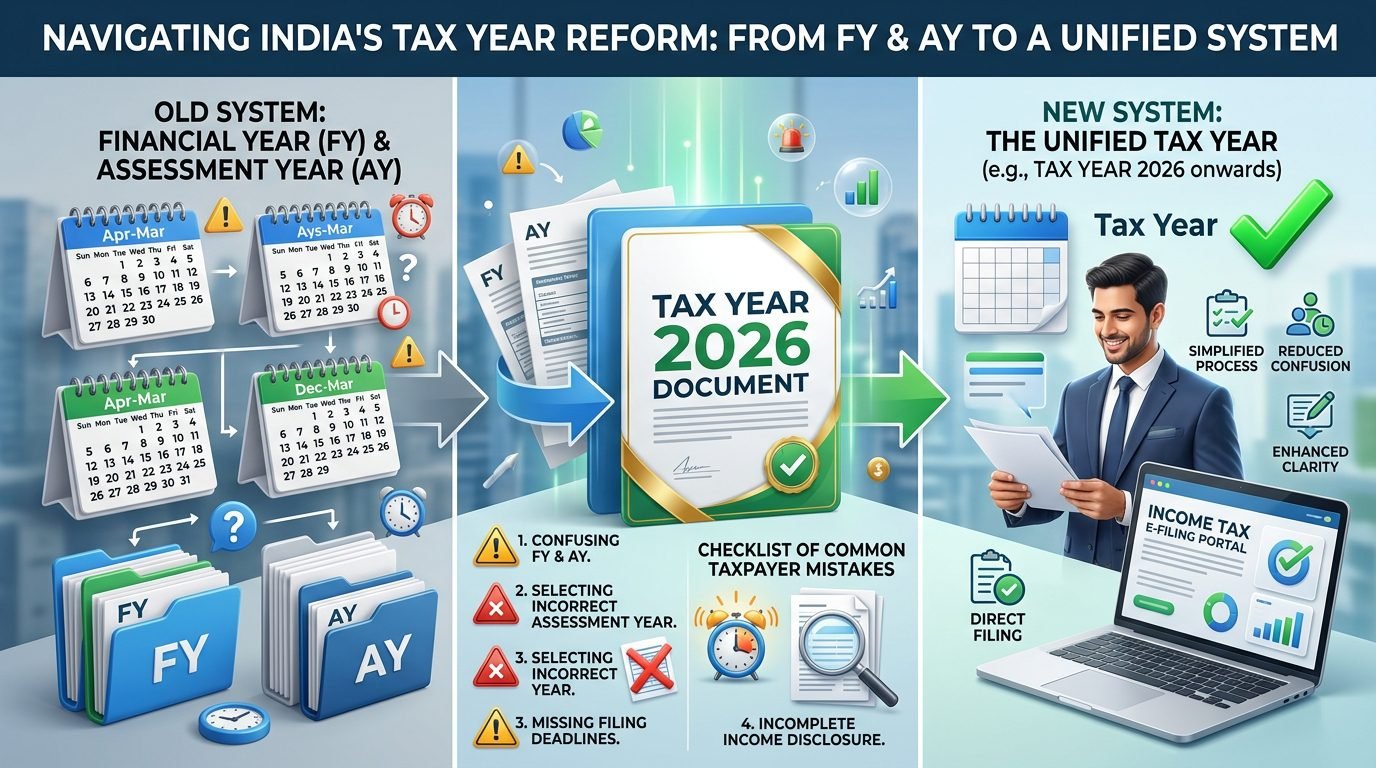
1. Assuming Tax Year completely replaces Financial Year everywhere. Some procedural references (audits, certain statutory filings) still use FY language even after the transition.
2. Filing income from FY 2025-26 under new Tax Year terminology. That year's return still follows the old AY 2026-27 system — the new terminology properly starts with income earned from April 1, 2026.
3. Miscalculating the Assessment Year conversion. Remember AY is always one year ahead of the income period it covers — subtract one from the AY's higher year to get the correct Tax Year.
4. Ignoring old spreadsheets and templates. Personal or business finance trackers built around FY/AY labels should be reviewed and updated to avoid confusion in year-over-year comparisons.
5. Assuming this changes your tax liability. It doesn't — this is purely terminology and legislative structure, not a change to slabs, deductions, or computation.
If you're also trying to keep track of other changes bundled into this same overhaul — updated HRA exemption city coverage, revised children's education allowance limits, and reorganized ITR deadlines — we're covering each of these individually as part of our full Income-tax Act 2025 series, alongside our existing pieces on ITR-4 investment disclosure, checking your ITR refund status, and the Section 244A refund interest calculator. For crypto holders specifically, our coverage of crypto tax notices in India and crypto bookkeeping for tax purposes remains relevant, since reporting periods will also shift to Tax Year language going forward. Our tax-loss harvesting India guide and 8th Pay Commission salary calculator are two more tools worth revisiting during this same annual review, alongside our direct vs regular mutual fund comparison for anyone rebalancing tax-advantaged investments this cycle.
Small business owners and freelancers navigating this alongside their broader GST 2.0 compliance requirements should treat this transition year as a good checkpoint to review their entire compliance calendar rather than updating labels piecemeal as each document comes up. Investors weighing how this interacts with their broader financial planning may also find our mutual fund complete guide and 50/30/20 budgeting rule useful reference points, since good record-keeping habits make any terminology transition far less painful regardless of what the tax authority calls the underlying year.
It's also worth remembering that this terminology shift is only one piece of a much larger overhaul. The Income-tax Act, 2025 also touches TDS reporting structures, ITR filing deadlines, and long-standing exemption limits that hadn't been revised in years — we'd encourage readers to treat 2026 as a genuine "read the fine print" year rather than assuming last year's filing habits carry over unchanged. If you're managing SIPs or long-term investment goals through this transition, our ₹1 crore SIP calculator and how SIP works explainer remain unaffected by any of this — the underlying investing math doesn't change just because the tax vocabulary around it does. Readers holding retirement-linked tax-saving instruments may also want to revisit our UPS pension calculator and EPF portability guide as part of the same annual compliance review.
Frequently Asked Questions
Does Tax Year replace Financial Year completely?
Not entirely. Tax Year replaces the dual Previous Year/Assessment Year system for income tax purposes from April 1, 2026. However, Financial Year continues to exist as a general accounting concept, and some procedural tax matters like audits and certain statutory filings may still reference Financial Year for legal continuity.
When does the Tax Year concept actually take effect?
The Tax Year concept is effective from April 1, 2026, under the Income-tax Act, 2025. Income earned during FY 2025-26 (the year ending just before this) still follows the old Financial Year/Assessment Year system for filing purposes.
How do I convert an old Assessment Year reference to the new Tax Year?
Subtract one from the higher year in the Assessment Year range. For example, Assessment Year 2026-27 (which covered income from FY 2025-26) converts to Tax Year 2025-26, since both refer to the same underlying income-earning period.
Does this change how much tax I owe or when I file?
No. This is purely a terminology and legislative structure simplification. Tax slab rates, deduction rules, and the fundamental April-to-March accounting period remain unchanged.
What happens to businesses set up partway through a year?
For a newly established business or a new income source, the Tax Year begins from the date the business or income source was set up and ends on the following March 31 — the same logic previously used under the "Previous Year" concept.
Why did India move away from the dual Financial Year/Assessment Year system?
The dual-year system was a recurring source of taxpayer confusion, since income earned in one year was taxed and filed under a different year's label. India was one of the few major economies still using this approach; the Income-tax Act, 2025 aligns India with the single unified year concept used by most developed countries.
For readers who want the primary legal text rather than a summary, the full Income-tax Act, 2025 is available via India Code, the government's official legislative repository, and the e-Gazette of India carries the official notification. Chartered Accountants tracking the transition in detail often also reference the Institute of Chartered Accountants of India (ICAI) for professional guidance notes as CBDT circulars are issued through the year.

Pranab Barman is a Financial Educator and Personal Finance Researcher with over 10 years of hands-on experience in stock markets, trading, and investing. Currently enrolled in the CFA Program, he is committed to continuous learning and professional excellence in finance.
As the Founder of PlayWithStock, Pranab covers a wide range of topics including Mutual Funds, SIP, Taxation, Stock Market Basics, and Financial Calculators — with a focus on simplifying complex financial concepts for everyday all investors.
Email: support@playwithstock.com
Website: playwithstock.com
Related posts:
 Trump Just Gave Indian Pharma a Two-Year Countdown Clock — Here’s What the US Generic Drug Tariff Actually Means
 Silver Price Surge 2026: Why Silver Is Beating Gold This Year
 PMJDY, PMJJBY and PMSBY 2026: ₹456 a Year for ₹4 Lakh in Combined Cover
 ITR Filing Last Date 2026: July 31 Deadline, New Tax Act & Penalties
 Jio Financial vs Bajaj Finance vs HDFC AMC: Which is the Better Investment in 2026?
 Jio Financial Services Q1 FY27 Results Preview: Date, Estimates & Stock Analysis
 Give the Same $10,000 to Charity in 2025 vs 2026, and Your Tax Break Could Shrink — Here’s Why: OBBBA Tax Changes 2026 Explained
 Nifty July Seasonality: Why July Is Nifty’s Strongest Month (27-Year Data)