
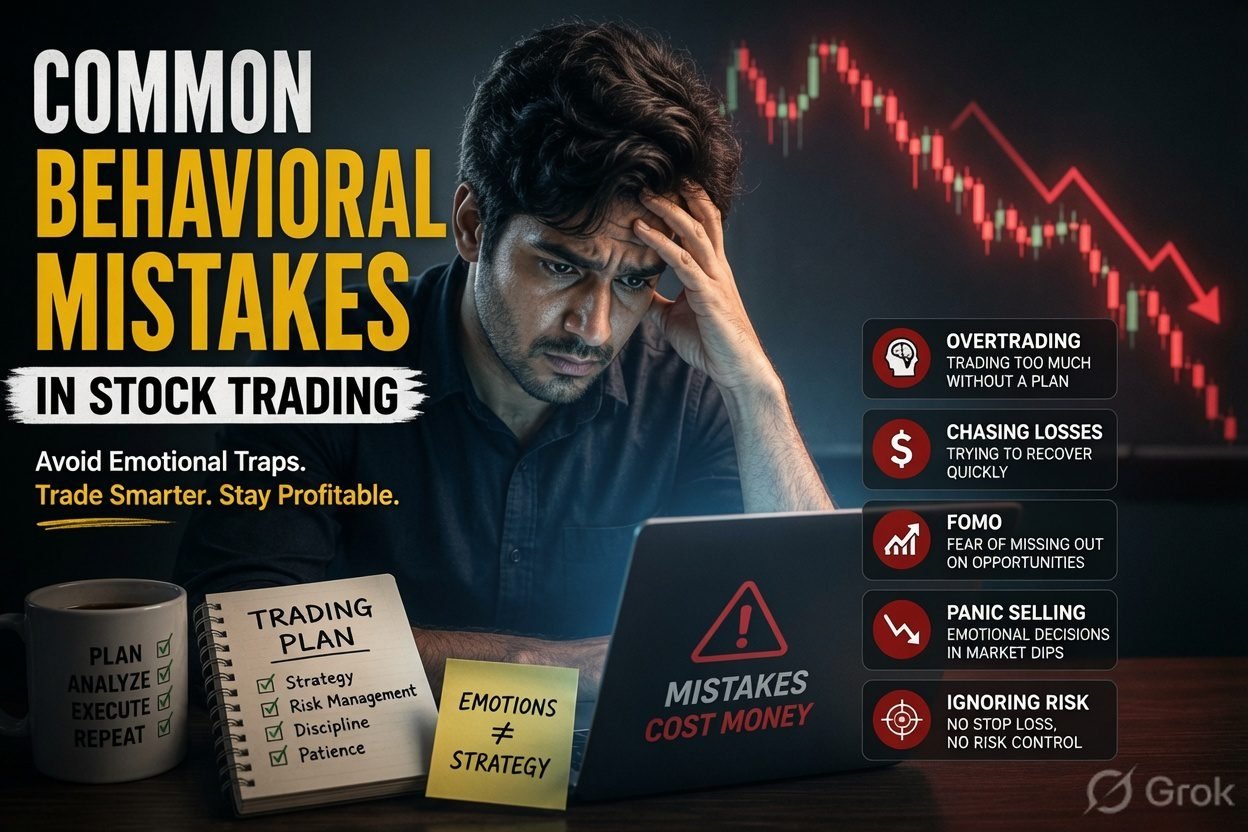

Common Behavioral Mistakes in Stock Trading
SEBI's own data shows 91% of individual traders lost money last year. The chart patterns weren't the problem — the decisions made after looking at them were, and understanding common behavioral mistakes in stock trading is the first real step toward not repeating them.
Table of Contents
- The Uncomfortable Truth: What SEBI's Data Shows
- Why Smart People Make Irrational Trading Decisions
- The Five Behavioral Biases Costing Traders Money
- The Persistence Problem: Why Losers Keep Trading
- Small Trader vs Large Trader: A Surprising Pattern
- How to Actually Break These Patterns
- SEBI's Own Regulatory Response
- Frequently Asked Questions
- Disclaimer
Before discussing behavioral mistakes in stock trading in the abstract, it's worth sitting with the actual numbers. A SEBI study on individual traders in the equity Futures & Options (F&O) segment found that 91% of individual traders incurred losses in FY25, averaging roughly ₹1.1 lakh per trader. Cumulative losses across individual traders reached approximately ₹2.88 trillion since 2021-22, according to CFA Institute's analysis of the same underlying data. This isn't a marginal edge going the wrong way — this is the overwhelming majority of participants losing money, year after year, in a market that keeps attracting more of them, as Business Standard's coverage of the original 2024 findings first documented.
The Numbers That Should Give Every Trader Pause
91%
of individual F&O traders lost money in FY25 (SEBI study)
16%
of active retail traders lost their entire capital in FY25 (per Zerodha CEO Nithin Kamath, citing SEBI data)
76%
of loss-making traders kept trading anyway, despite prior losses
Perhaps the most telling detail: SEBI's research found that only about 10% of these traders also invested through SIPs (Systematic Investment Plans) in mutual funds — suggesting most retail F&O participants treat the market as a short-term opportunity rather than a long-term wealth-building tool, which is precisely where behavioral mistakes in stock trading tend to concentrate, a pattern also explored in Outlook Business's breakdown of the SEBI findings.
None of this happens because retail traders are unintelligent. It happens because the human brain, which evolved to make fast survival decisions, is poorly suited to the specific demands of financial markets — where the "correct" emotional response (staying calm during a loss, waiting patiently through boredom, ignoring a hot tip) is often the exact opposite of our natural instinct. Research from Indian brokerage-side behavioral finance analysis consistently finds that even experienced investors remain vulnerable to these patterns — sophistication reduces but doesn't eliminate the underlying psychological pull.
The Market Isn't Actually "Fair" for Retail Traders
Many retail traders enter believing they're competing on a level playing field. In reality, they're often trading against institutional investors, hedge funds, and high-frequency trading firms with access to sophisticated algorithmic execution, faster data, and dramatically larger research resources, a structural imbalance discussed at length in independent market education research. This asymmetry compounds behavioral mistakes in stock trading rather than causing them outright — a retail trader making an emotional decision is competing against a counterparty that makes almost none. Understanding this dynamic is part of why building a foundation in beginner investing fundamentals and knowing the difference between the NSE and BSE matters before attempting to actively trade against far better-resourced counterparties.
Behavioral finance research identifies a recurring set of psychological patterns behind most trading losses. Naming these common behavioral mistakes in stock trading is often the first real step toward recognising them in the moment, rather than only in hindsight.
1Loss Aversion
Loss aversion means the pain of losing money feels psychologically much stronger than the pleasure of an equivalent gain. In practice, this shows up as holding a losing position far too long ("I'll sell once it recovers") while selling winning positions too early ("I don't want to give this gain back") — precisely the opposite of the discipline that actually builds wealth over time, a bias documented specifically for Indian investors in this behavioral finance research.
2Overconfidence Bias
A handful of successful trades can create a false sense of skill, leading to larger position sizes, more frequent trading, and less rigorous analysis on subsequent trades. Overconfidence is especially dangerous in a rising market, where broad gains — sometimes visible even in benchmark moves on the Nifty 50 or Sensex — can be mistaken for individual skill.
3Herd Mentality
Following the crowd into a hot stock or trending options trade — often amplified today by social media influencers and trading forums — feels emotionally safer than an independent decision, even when the underlying analysis doesn't support it. By the time a trade is genuinely "trending," much of the easy profit potential is often already gone. This herd dynamic is precisely what NISM's research on the retail derivatives rush identifies as a driver of the shift in F&O participant profile over the past few years.
4Recency Bias
Recency bias leads traders to assume that whatever the market has done recently will continue indefinitely — extrapolating a short winning or losing streak into a permanent trend. This is a major contributor to buying near local tops and panic-selling near local bottoms.
5Disposition Effect
Closely related to loss aversion, the disposition effect specifically describes the tendency to sell winning positions too quickly while clinging to losing ones for too long, driven by a desire to "lock in" the good feeling of a win and defer the bad feeling of an actual, realised loss. Academic behavioral finance literature has documented this pattern across nearly every major market globally, not just in India, suggesting it reflects something close to a universal feature of how humans process financial gains and losses rather than a culturally specific habit that better investor education alone would fully resolve.
Perhaps the single most striking finding in SEBI's research is behavioral rather than statistical: 76% of loss-making traders continued trading even after experiencing losses, a persistence pattern examined in detail by Ideas for India's re-examination of the SEBI evidence. This pattern — doubling down rather than stepping back — is a documented psychological response related to loss aversion: many traders feel an urge to "win back" a loss through continued trading rather than accepting it and reassessing.
This mirrors a pattern explored in our coverage of why investors lose money in the stock market more broadly — the mistake usually isn't a single bad trade, but a chain of decisions made specifically to avoid confronting an earlier loss. The same discipline that prevents someone from raiding a dedicated savings fund for an unrelated impulse applies directly here: recognising a sunk cost and moving on, rather than chasing it.
SEBI's data, further corroborated by ongoing market commentary on the F&O segment, reveals a counterintuitive detail worth understanding. Traders with options premium turnover exceeding ₹1 crore represented only about 17% of all options traders, yet accounted for more than 93% of total turnover and roughly 81% of total losses. By contrast, smaller traders — those with turnover under ₹1 lakh — contributed just 0.6% of aggregate losses, averaging only around ₹3,300 in losses per trader.
| Trader Category | Share of Traders | Share of Losses | Average Loss |
|---|---|---|---|
| High-turnover (>₹1 crore) | ~17% | ~81% | Substantially higher |
| Low-turnover (<₹1 lakh) | Majority | 0.6% | ~₹3,300 |
The takeaway isn't that small traders are somehow immune to behavioral mistakes in stock trading — it's that trading frequency and position size directly amplify the financial consequences of the same underlying biases. A trader making emotional decisions with small amounts loses small amounts; the same psychology, scaled up with leverage and frequency, produces genuinely life-altering losses, which is precisely why position sizing discipline matters as much as, if not more than, the underlying trade idea itself.
Write Rules Before You Trade, Not During
Decide your entry criteria, position size, and exit conditions (both profit target and stop-loss) before entering any trade — never in the emotional moment of watching a live price move. A rule written in a calm moment is far more reliable than a decision made mid-trade, precisely because the emotional pressures described earlier in this article haven't yet activated. Writing these rules down, in plain language, and reviewing them before every session — not just once at the start of a trading journey — helps counteract the natural tendency to quietly abandon discipline exactly when it matters most, which is usually in the middle of a losing streak or an unusually strong winning run.
Separate Investing Capital from Trading Capital
SEBI's finding that only 10% of F&O traders also run SIPs points to a structural fix: maintaining a separate, disciplined long-term investing plan — built around fundamentals-based investing and regular SIP contributions — creates a distinct, protected pool of wealth that isn't exposed to short-term trading decisions at all. Consider allocating this protected pool using a structured framework like the 50-30-20 budgeting rule, so trading capital is always clearly separated from money earmarked for genuine long-term goals.
Track Every Trade, Including the Losses
A written trading journal — recording the reasoning behind each trade, not just the outcome — makes patterns like recency bias and overconfidence visible in a way that memory alone never will. Reviewing this log periodically, especially after a losing streak, is often the fastest way to notice a specific bias repeating.
A Simple Cost Reality Check
Every trade carries brokerage, Securities Transaction Tax (STT), and exchange fees — costs that apply regardless of whether the trade wins or loses. Frequent trading multiplies these costs in a way that's easy to underestimate until reviewed in aggregate over a month or a year, quietly widening the gap between a trader's gross and net returns. The same principle applies when comparing mutual fund expense ratios or evaluating a buyback versus open-market sell decision — costs compound just as relentlessly as returns do, in the opposite direction.
Understand What You're Actually Trading
Complex instruments like weekly index options carry very different risk profiles from simple long-term equity positions. Before trading anything, understanding basics like how circuit breakers work, what the Nifty 50 and Sensex actually track, basic corporate actions, and even macro drivers like currency movements or interest rate decisions provides a foundation that pure chart-watching doesn't.
Recognising the scale of this problem, SEBI has introduced several measures specifically targeting retail F&O behaviour: raising minimum contract sizes, restricting weekly expiries, increasing margin requirements, and mandating that traders view and acknowledge risk-disclosure messages before executing trades on any platform, including on major exchanges like the NSE. The Union Budget for FY27 also proposed higher Securities Transaction Tax on derivatives trades, effective April 2026 — a further structural disincentive against excessive short-term trading, alongside broader awareness efforts run jointly with NISM, including national financial literacy initiatives aimed specifically at younger, first-time traders.
Early evidence suggests these measures haven't yet meaningfully changed outcomes — the share of traders reporting losses remained largely unchanged even after the October 2024 interventions, with aggregate losses actually increasing 41% year-over-year in the following period. This reinforces the core argument of this article: structural and regulatory changes alone don't fix behavioral mistakes in stock trading — the decision ultimately still rests with the individual trader in the moment.
What This Means for Tax Reporting Too
Frequent trading, especially in F&O, also carries tax implications that many retail traders underestimate until filing season. Gains and losses from derivatives trading need to be correctly classified and reported by the annual ITR filing deadline, and the same behavioral impulsiveness that drives excessive trading often extends to poor recordkeeping — another downstream cost of the same underlying psychological pattern, and one more reason disciplined documentation matters as much as disciplined trading itself. Salaried traders juggling both a full-time income and active trading, including those tracking changes via tools like the 8th Pay Commission salary calculator, should be especially careful to separate the two income streams clearly in their records, since mixing trading losses with regular salary reporting is a common and entirely avoidable source of filing errors come tax season.
Recognising behavioral mistakes in stock trading in real time — rather than only in hindsight after a losing streak — is a skill that improves with deliberate practice, much like any other. It starts with accepting that the biases described above aren't a personal failing unique to any one trader; they're a well-documented, universal feature of human psychology that the market consistently exploits at scale. This is precisely why even professional fund managers build systematic, rules-based processes rather than relying purely on in-the-moment judgment — the goal isn't to eliminate emotion entirely, which is likely impossible, but to build enough structure that emotion has fewer opportunities to override a sound plan. Building safer financial habits elsewhere — a dedicated sinking fund for predictable expenses, a diversified allocation across asset classes, or simply understanding how a demat account actually works before actively trading through it — tends to reduce the emotional intensity around any single trade, which is often the real first step toward avoiding behavioral mistakes in stock trading altogether. For more, explore our full Stock Market section or browse the complete Play With Stock article library.
SEBI's own study found that 91% of individual traders in the equity F&O segment incurred losses in FY25, with cumulative losses reaching approximately ₹2.88 trillion since 2021-22.
Loss aversion and the closely related disposition effect are among the most well-documented — holding losing positions too long while selling winning positions too early, driven by the psychological asymmetry between the pain of loss and the pleasure of gain.
SEBI's data found that 76% of loss-making traders continued trading despite prior losses — a pattern often driven by an urge to "win back" losses through continued activity rather than accepting them and stepping back to reassess.
No. SEBI data shows high-turnover traders (over ₹1 crore) account for roughly 81% of total losses despite being only about 17% of traders, while low-turnover traders contribute just 0.6% of aggregate losses. The same behavioral biases apply, but frequency and position size dramatically amplify the financial consequences.
They can't be eliminated entirely, since they stem from normal human psychology, but they can be meaningfully managed through pre-defined trading rules, disciplined position sizing, maintaining a trading journal, and separating short-term trading capital from long-term investing capital.



Pranab Barman is a Financial Educator and Personal Finance Researcher with over 10 years of hands-on experience in stock markets, trading, and investing. Currently enrolled in the CFA Program, he is committed to continuous learning and professional excellence in finance.
As the Founder of PlayWithStock, Pranab covers a wide range of topics including Mutual Funds, SIP, Taxation, Stock Market Basics, and Financial Calculators — with a focus on simplifying complex financial concepts for everyday all investors.
Email: support@playwithstock.com
Website: playwithstock.com
Related posts:
 Why Investors Lose Money: 7 Costly Mistakes to Avoid
 What is a Stock Split and Why Do Companies Do It
 What Is Circuit Breaker Stock Market: Meaning, Limits & 2026 Update
 Jio Financial Services Q1 FY27 Results Preview: Date, Estimates & Stock Analysis
 Beginner Investing: 7 Proven Steps to Start the Right Way
 What is a Demat Account? A Complete Beginner’s Guide
 Micro-Investing Apps for Beginners: A Complete Comparison
 Tax-Loss Harvesting: How It Works in India