

50-30-20 Rule: The Ultimate Budgeting Guide That Works in 2026
If you’ve ever finished a month wondering exactly where your salary disappeared, the 50-30-20 rule might be the simplest fix you’ll find. It’s not a complicated spreadsheet system or a restrictive diet-style budget. It’s just one number split three ways — and once you see it laid out, budgeting stops feeling confusing.
In this guide, we’ll break down exactly what the 50-30-20 rule is, how to calculate it for your own income, a real worked example in rupees, common mistakes people make with it, and how to adjust it if you live in an expensive city or have loan EMIs eating into your budget.
Table of Contents
- What Is the 50-30-20 Rule?
- Where the 50-30-20 Rule Came From
- Breaking Down the Three Categories
- How to Calculate Your 50-30-20 Budget
- A Worked Example: ₹50,000 Monthly Salary
- Common Mistakes People Make With the 50-30-20 Rule
- Is the 50-30-20 Rule Right for Everyone?
- Adjusting the Rule for Indian Households
- Tools to Track Your 50-30-20 Budget
- Frequently Asked Questions
What Is the 50-30-20 Rule?
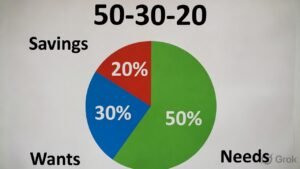
The 50-30-20 rule is a simple budgeting method that divides your take-home (after-tax) income into three buckets:
- 50% for Needs — rent, groceries, utilities, EMIs, insurance, transport
- 30% for Wants — dining out, entertainment, shopping, subscriptions, hobbies
- 20% for Savings and Debt Repayment — emergency fund, investments, extra loan payments
That’s the entire system. No complicated categories, no tracking every rupee down to the last tea stall purchase. Just three buckets, three percentages, and a monthly check-in.
The appeal of the 50-30-20 rule is that it works with percentages instead of fixed rupee amounts. Whether you earn ₹25,000 a month or ₹2,50,000 a month, the same ratio applies — only the numbers change.
Where the 50-30-20 Rule Came From
The 50-30-20 rule was popularized by Senator Elizabeth Warren and her daughter Amelia Warren Tyagi in their book All Your Worth: The Ultimate Lifetime Money Plan. The idea was to create a budgeting framework simple enough that anyone could apply it without needing a finance background — a rule you could explain in one sentence and still remember six months later.
That simplicity is exactly why the 50-30-20 rule has stayed relevant for over a decade, even as spending habits, apps, and payment methods have changed completely.
Breaking Down the Three Categories
The 50% Needs Category
Needs are the expenses you genuinely cannot avoid — the ones that keep a roof over your head and food on the table. This typically includes:
- Rent or home loan EMI
- Groceries and essential household items
- Electricity, water, gas, and basic utility bills
- Transportation to work (fuel, public transport, cab costs for commuting)
- Minimum insurance premiums (health and term insurance)
- Minimum payments on existing loans
A helpful test: if you’d face a real problem (losing your home, going hungry, missing work) by not paying for it, it’s a need. If life would just be a little less fun without it, it’s a want.
The 30% Wants Category
Wants are the expenses that make life enjoyable but aren’t strictly necessary for survival. This includes:
- Eating out and food delivery apps
- Movies, OTT subscriptions, and entertainment
- Shopping beyond basic necessities
- Vacations and weekend trips
- Gym memberships, hobbies, and lifestyle upgrades
There’s nothing wrong with spending on wants — the 50-30-20 rule isn’t about eliminating enjoyment, it’s about capping it so it doesn’t quietly consume your entire paycheck.
The 20% Savings and Debt Repayment Category
This is the category that actually builds your financial future. It includes:
- Emergency fund contributions
- SIPs and long-term investments
- Extra payments toward high-interest debt (beyond the minimum)
- Retirement savings
Many people flip this category to the bottom of their priority list, paying it only “if anything is left over.” The 50-30-20 rule flips that thinking — this 20% gets planned for first, the same way rent does.

How to Calculate Your 50-30-20 Budget
Calculating your own 50-30-20 split takes three simple steps.
Step 1: Find your monthly take-home income. Use your salary after tax deductions, PF contributions, and any other automatic deductions — this is the real amount that actually lands in your bank account.
Step 2: Multiply by each percentage.
- Needs = Take-home income × 0.50
- Wants = Take-home income × 0.30
- Savings/Debt = Take-home income × 0.20
Step 3: Compare to your actual spending. Look at your last 2-3 months of bank statements and sort your expenses into the three categories. Compare the totals to your target numbers from Step 2. The gaps you find are exactly where your budget needs attention.
A Worked Example: ₹50,000 Monthly Salary
Numbers are always easier to understand with a real example. Here’s how the 50-30-20 rule plays out for someone taking home ₹50,000 a month.
Category Percentage Amount Typical Expenses Needs 50% ₹25,000 Rent, groceries, utilities, commute, EMI Wants 30% ₹15,000 Eating out, shopping, entertainment, subscriptions Savings/Debt 20% ₹10,000 Emergency fund, SIP, extra loan payment If this person’s rent alone is ₹18,000 and groceries plus utilities add another ₹9,000, their needs category is already over budget at ₹27,000 — a signal that either their wants category needs to shrink to compensate, or their income needs to grow, or they need to look for a cheaper living situation.
This is exactly the value of the 50-30-20 rule: it doesn’t just tell you to “save more.” It shows you precisely which category is out of balance.
The Same Rule at Different Income Levels
The percentages stay identical no matter what you earn — only the rupee amounts change. Seeing this side by side makes the pattern easier to internalize.
Monthly Take-Home Needs (50%) Wants (30%) Savings/Debt (20%) ₹25,000 ₹12,500 ₹7,500 ₹5,000 ₹50,000 ₹25,000 ₹15,000 ₹10,000 ₹1,00,000 ₹50,000 ₹30,000 ₹20,000 ₹2,00,000 ₹1,00,000 ₹60,000 ₹40,000 Notice that at the ₹25,000 level, the Needs bucket of ₹12,500 is often unrealistic in a metro city, where rent alone can exceed that. This is exactly why the “Adjusting for Indian Households” section further down matters — the rule is a framework, not a rigid law that ignores your actual cost of living.
Why the 50-30-20 Rule Works Psychologically
Most budgeting systems fail not because the math is wrong, but because they’re mentally exhausting to maintain. Tracking every single transaction in a dozen micro-categories works for a few weeks before most people quietly give up.
The 50-30-20 rule succeeds where those systems fail for three behavioral reasons:
It requires only three decisions, not thirty. Every expense only needs to be sorted into one of three buckets, which takes seconds instead of minutes.
It builds in permission to spend. Because 30% is explicitly allowed for wants, there’s no guilt spiral around a weekend outing or a new pair of shoes — it’s already accounted for, as long as it fits inside the bucket.
It makes trade-offs visible immediately. If your wants spending creeps up mid-month, you can see the remaining balance in that bucket shrinking in real time, which triggers a natural course-correction — the same way watching a fuel gauge drop makes you plan your next petrol stop.
How the 50-30-20 Rule Compares to Other Budgeting Methods
It’s worth understanding how the 50-30-20 rule stacks up against other well-known approaches, so you can decide if it’s the right fit for you.
Zero-Based Budgeting assigns every single rupee of income a specific job before the month begins, down to the last amount. It’s more precise than the 50-30-20 rule but requires significantly more ongoing maintenance and planning.
The Envelope System allocates physical or digital “envelopes” of cash for each spending category (groceries, entertainment, transport) and stops spending once an envelope is empty. It offers tighter control than the 50-30-20 rule but can feel restrictive for people with irregular expenses.
The 50-30-20 Rule sits in the middle — simpler than zero-based budgeting, more flexible than the envelope system, and easier to sustain long-term precisely because it asks less of you day to day.
If you’ve tried more detailed systems in the past and abandoned them within a few weeks, the 50-30-20 rule is often the version that actually survives contact with real life.
Common Mistakes People Make With the 50-30-20 Rule
Mistake 1: Using Gross Income Instead of Take-Home Pay
Calculating your percentages on your gross salary before tax and deductions gives you numbers you can never actually hit, since that money was never available to spend in the first place.
Mistake 2: Miscategorizing Wants as Needs
It’s tempting to file food delivery under “groceries” or a premium OTT subscription under “essential.” Be honest with the categorization — the rule only works if the categories reflect reality.
Mistake 3: Treating the 20% as Optional
The savings and debt category is the one most often sacrificed when money feels tight in a given month. Treating it as a fixed, non-negotiable expense (the same way you’d treat rent) is what makes the rule actually build wealth over time instead of just organizing your spending.
Mistake 4: Giving Up After One Bad Month
Budgets are rarely perfect on the first try. If you go over in your wants category one month, the fix is adjusting the next month — not abandoning the system entirely.
Mistake 5: Not Accounting for Irregular or Annual Expenses
Costs like annual insurance premiums, festival spending, or car servicing don’t happen every month, so they’re easy to forget when calculating a monthly budget — until the month they hit, and blow the entire plan apart. Divide known annual expenses by 12 and build that monthly average into your Needs or Wants bucket in advance.
Mistake 6: Comparing Your Split to Someone Else’s
A colleague earning the same salary but living rent-free with family will have a completely different Needs percentage than someone paying full rent alone. The 50-30-20 rule is meant to be applied to your own numbers and your own circumstances, not benchmarked against someone else’s Instagram-worthy savings screenshot.
Using the 50-30-20 Rule With Irregular Income
If you run a business, freelance, or sell on platforms like Amazon or Meesho, your monthly income may swing significantly from month to month — which makes a fixed 50-30-20 split harder to apply directly.
The adjustment for irregular income earners is straightforward: calculate your percentages based on your average income over the last 6-12 months, not a single month’s figure. In a strong month, resist the urge to expand your Wants bucket proportionally — instead, route the surplus straight into your Savings/Debt bucket, since that’s exactly the kind of month that should accelerate loan repayment or build a buffer for the slower months ahead.
This approach also protects you from the most common irregular-income mistake: treating a single good month as the new normal, then struggling when the next month reverts to average.
Is the 50-30-20 Rule Right for Everyone?
The honest answer is: not perfectly, but it’s still useful as a starting framework for almost everyone.
The 50-30-20 rule assumes your needs can realistically fit into 50% of your income. For people living in high-cost cities, paying off multiple loans, or earning a lower income where rent alone consumes 40-50% of take-home pay, the ratio often needs adjustment.
This doesn’t mean the rule is broken — it means the ratio is a starting point, not a strict law. The real value is in the habit of categorizing spending into needs, wants, and savings, even if your personal split ends up being 60-25-15 instead of 50-30-20.
Adjusting the 50-30-20 Rule for Indian Households
Indian households often face two realities that the original 50-30-20 rule didn’t fully account for: high rent-to-income ratios in metro cities, and common multi-generational financial responsibilities (supporting parents, family EMIs, and festival or wedding expenses).
Here’s a more realistic adjusted split for many Indian earners, especially in metro cities:
Category Original Rule Adjusted for High-Cost Cities Needs 50% 55-60% Wants 30% 20-25% Savings/Debt 20% 20% Notice that the savings percentage stays protected at 20% even when needs go up — the adjustment comes out of the wants category, not the savings category. This is a deliberate choice: needs and savings are non-negotiable, wants are the flexible category that absorbs the pressure.
If you currently have high-interest debt (like the kind that comes from credit cards or personal loans), consider temporarily shifting a few extra percentage points from wants into the debt repayment portion of your 20% bucket until that debt is cleared — the interest saved is often a better return than what you’d earn parking that same money elsewhere.
Tools to Track Your 50-30-20 Budget
You don’t need expensive software to follow the 50-30-20 rule. A few practical options:
- A simple spreadsheet — three columns (Needs, Wants, Savings), one row per expense, updated weekly
- Budgeting apps — many free apps let you tag transactions by category automatically
- Your bank’s own app — several banking apps now show spending breakdowns by category out of the box
- A notebook — genuinely still works if you review it weekly instead of monthly
The tool matters far less than the consistency of reviewing it. A basic spreadsheet checked every week will outperform a sophisticated app that’s opened once a year.
Frequently Asked Questions
Is the 50-30-20 rule based on gross or net income? Always calculate the 50-30-20 rule based on net (take-home) income — the amount that actually reaches your bank account after tax and other deductions.
What if my rent alone is more than 50% of my income? This is common in expensive cities. Adjust the ratio to reflect your reality (for example, 60-20-20), while keeping the savings percentage protected rather than cutting it further.
Should loan EMIs go under Needs or Savings/Debt? Minimum required EMI payments go under Needs, since missing them has serious consequences. Any extra payment beyond the minimum, made specifically to clear debt faster, counts under the Savings/Debt category.
Can I use the 50-30-20 rule if my income changes every month? Yes — recalculate your target amounts each month based on that month’s actual take-home income, using the same percentages.
Is 20% enough for retirement savings? The 20% bucket in the 50-30-20 rule covers both emergency savings and investments, including retirement. Depending on your age and goals, you may want to allocate a specific portion within that 20% purely to long-term retirement investing.
Does the 50-30-20 rule work for freelancers or business owners? Yes, with one adjustment: calculate your percentages based on your average income over the past 6-12 months rather than a single month, and route surplus income from strong months directly into the Savings/Debt bucket instead of increasing everyday spending.
What should I do first if I’m currently over budget in every category? Start with Needs, since that’s where the biggest structural savings usually live (renegotiating rent, switching to a cheaper plan, reducing EMI burden through refinancing) — cutting Wants alone rarely closes a large enough gap on its own.
Your First 30 Days on the 50-30-20 Rule
Reading about a budgeting method and actually living by it are two different things. Here’s a simple week-by-week plan to move from theory to practice.
Week 1: Gather your real numbers. Pull up your last two months of bank and card statements. Don’t categorize anything yet — just get a clear, honest total of what actually left your account.
Week 2: Sort into the three buckets. Go through every transaction from Week 1 and label it Needs, Wants, or Savings/Debt. Resist the urge to reclassify things to make yourself look better — the accuracy here is what makes the rest of the plan work.
Week 3: Calculate your targets and find your gaps. Apply the 50-30-20 percentages to your actual take-home income, then compare your target numbers to what you found in Week 2. Identify the single biggest gap — usually it’s either an oversized Needs category or an under-funded Savings/Debt bucket.
Week 4: Make one structural change, not ten small ones. Rather than trying to fix everything at once, pick the single highest-impact change: renegotiating a bill, cancelling one unused subscription, or automating a fixed transfer into savings on salary day. One durable change tends to stick far longer than ten small resolutions made in the same week.
By the end of 30 days, you won’t have a perfect budget — but you’ll have real numbers, a clear picture of where the gaps are, and one concrete change already in motion. That’s a stronger position than most people ever reach with more complicated systems.
Conclusion
The 50-30-20 rule works because it’s simple enough to actually stick to. You don’t need to track every rupee obsessively — you just need to know your three numbers and check in on them regularly. Start by calculating your own 50-30-20 split this week, compare it to your last month’s actual spending, and adjust one category at a time rather than trying to overhaul your entire budget overnight.
If you’re just getting started with budgeting, explore more guides in our Personal Finance section — including practical strategies on saving money fast and understanding credit card traps that quietly drain your budget.

Pranab Barman is a Financial Educator and Personal Finance Researcher with over 10 years of hands-on experience in stock markets, trading, and investing. Currently enrolled in the CFA Program, he is committed to continuous learning and professional excellence in finance.
As the Founder of PlayWithStock, Pranab covers a wide range of topics including Mutual Funds, SIP, Taxation, Stock Market Basics, and Financial Calculators — with a focus on simplifying complex financial concepts for everyday all investors.
Email: support@playwithstock.com
Website: playwithstock.com
Related posts:
 Tax-Loss Harvesting: How It Works in India
 GST 2.0 for E-commerce Sellers (2026): Complete Guide
 ITR Refund Status Kaise Check Kare 2026: The Complete Step-by-Step Guide
 RBI Repo Rate Cut 2026: The Complete Home Loan EMI Guide
 Mutual Fund Guide India 2026: The Essential 7-Step Beginner Blueprint
 How to Invest in Gold ETF: The Complete Gold ETF vs Physical Gold Guide
 Record SIP Inflows June 2026: Indians Just Invested ₹31,781 Crore
 ITR-4 Investment Disclosure Calculator: New 2026 Rule for Presumptive Taxpayers