


Retirement Calculator India 2026: How Much You Actually Need to Save
Retirement Corpus Calculator
Retirement Calculator India 2026 questions almost always start the same way in our inbox: "Am I saving enough?" It's a genuinely hard question to answer with a gut feeling, because retirement is decades away for most people asking it, and inflation quietly erodes purchasing power in a way that's easy to underestimate. The calculator above gives you a real number based on your own inputs — the rest of this article explains exactly how it works, what assumptions it makes, and where those assumptions can go wrong.

Table of Contents
Complete Guide to Retirement Number Calculation
The core idea behind any retirement calculator is simple to state and genuinely easy to underestimate in practice: you need enough money invested by the time you stop working that it can pay you a monthly income, adjusted for inflation, for the rest of your life — without running out. Getting this number right requires three separate pieces of math working together: figuring out what your expenses will actually cost in future rupees (not today's rupees), figuring out how large a pool of money throws off that much income sustainably, and figuring out how much you need to save monthly, starting now, to build that pool.
Most people who feel behind on retirement savings aren't actually behind on effort — they're behind because they calculated using today's expense number instead of the inflated future number, which can understate the real target by a wide margin over a 25-30 year working career. This is the single most common reason retirement targets calculated casually turn out to be wrong. Broader retirement planning frameworks and inflation data are published by the RBI's Database on Indian Economy, useful if you want to build your own inflation assumptions from historical CPI data rather than relying on a single default rate.
How to Use This Calculator
Enter six inputs, and the calculator does the rest instantly:
Current age and planned retirement age — this sets how many years you have to save, which is the single biggest lever in the entire calculation. A 25-year-old and a 45-year-old with identical monthly expenses will get dramatically different required SIP amounts, purely because of the compounding years available.
Current monthly expenses — enter what you actually spend today, not an aspirational number. The calculator inflates this forward automatically, so you don't need to estimate future costs yourself.
Expected inflation rate — 6% is a reasonable long-term default for India based on historical averages, though you can adjust this if you want to stress-test a higher or lower scenario.
Expected return pre-retirement — this is the annual return you assume your invested SIP will earn before you retire. 11% is a commonly used moderate assumption for an equity-heavy portfolio over a long horizon; you can lower this if you plan a more conservative allocation.
Life expectancy — this determines how many years your retirement corpus needs to last after you stop working. 85 is a reasonable planning assumption, though you may want to use a higher number if longevity runs in your family.
The Formula Behind the Numbers
The Math, Step by Step
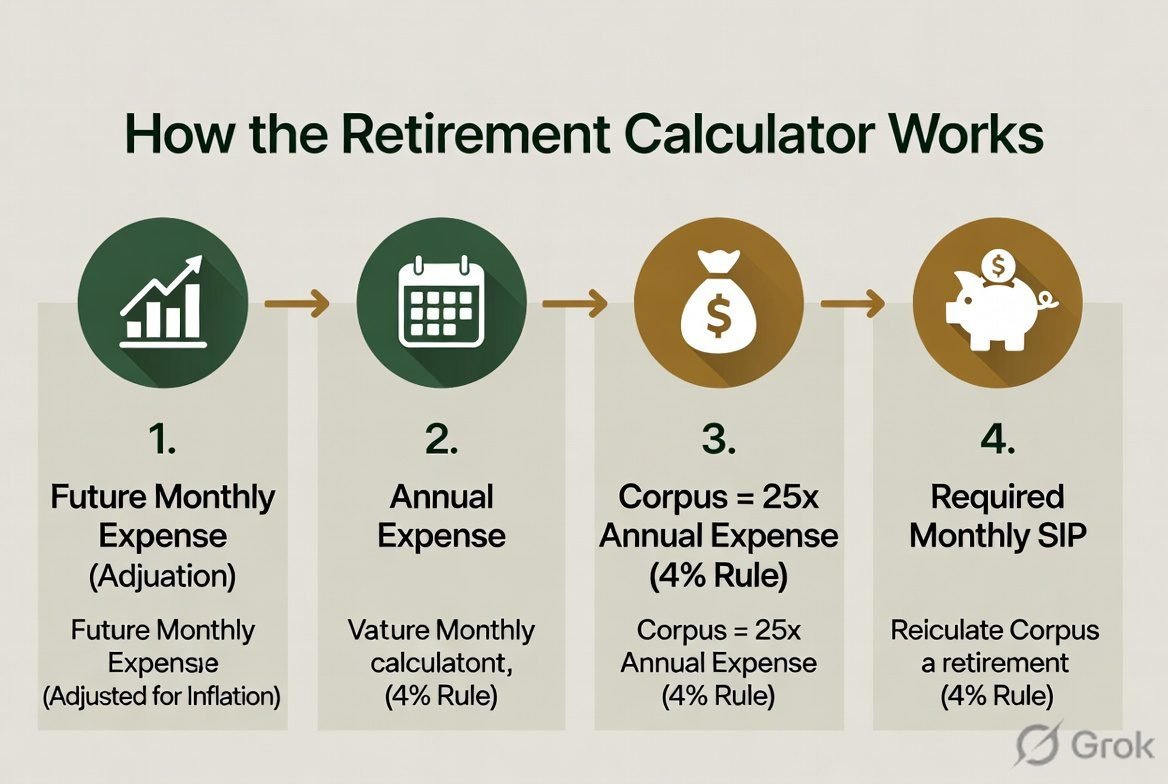
| Step 1 | Future Monthly Expense = Current Expense × (1 + inflation)^years to retirement |
| Step 2 | Annual Expense at Retirement = Future Monthly Expense × 12 |
| Step 3 | Retirement Corpus = Annual Expense × 25 (the 4% Rule) |
| Step 4 | Required Monthly SIP = Corpus ÷ Future Value Annuity Factor |
The "×25" step deserves its own explanation, since it's doing a lot of work in this calculation. It comes from what's widely known as the 4% Rule — the idea that withdrawing roughly 4% of a retirement portfolio annually, adjusted for inflation each year, has historically had a strong likelihood of lasting 30+ years without depleting the portfolio. Multiplying annual expenses by 25 is mathematically the same as saying you need a corpus 25 times your annual need, since 1/25 = 4%.
It's worth being upfront that the 4% Rule is a planning heuristic based on historical market behavior, not a mathematical guarantee — actual safe withdrawal rates can vary depending on market conditions during your specific retirement years, sequence-of-returns risk, and how flexible you're able to be with spending during a market downturn early in retirement. The original research behind the 4% Rule and its more recent academic refinements are discussed in depth by Investopedia's Four Percent Rule explainer and Morningstar's annual retirement income research, both useful if you want to understand the debate around this rule beyond the simplified version used in most calculators, including this one.
Common Mistakes People Make
Mistake 1: Using Today's Expenses as the Target
Calculating "I spend ₹40,000/month, so I need ₹40,000/month in retirement" ignores that inflation will have roughly tripled that number over a 25-30 year working career at 6% inflation. Always inflate forward.
Mistake 2: Ignoring Healthcare Cost Inflation
Medical costs in India have historically inflated faster than general consumer inflation — a gap tracked in detail by industry reports from CRISIL Research and health insurers' annual cost trend surveys. A single blended inflation rate for all expenses can understate the true target if healthcare will be a meaningfully larger share of spending in your later retirement years.
Mistake 3: Assuming a Static Return Throughout
Using the same optimistic return assumption right up until retirement — rather than gradually shifting to more conservative assumptions in the final 5-10 years — can overstate your projected corpus if markets have a rough patch right before you stop working.
Mistake 4: Not Starting Because the Number Feels Too Big
A large target corpus can feel discouraging enough that people delay starting entirely — which is exactly the wrong response, since delaying costs far more in required monthly SIP than starting small and increasing contributions gradually.
A Real Example Worked Through
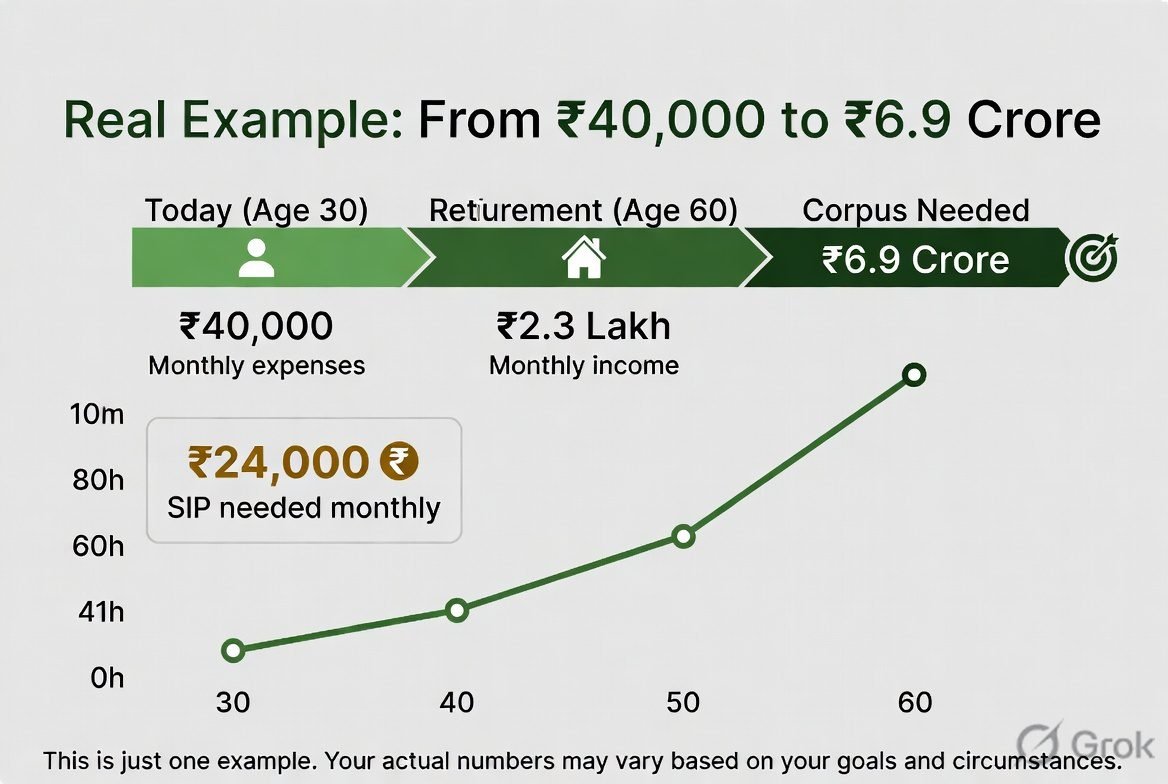
Take a 30-year-old planning to retire at 60, with current monthly expenses of ₹40,000, assuming 6% inflation and an 11% pre-retirement return. Over 30 years, that ₹40,000 monthly expense grows to roughly ₹2,29,800 per month in future value terms — nearly 5.75 times today's figure, purely from inflation compounding over three decades.
Annualized, that's about ₹27.6 lakh a year, and applying the 25x multiplier from the 4% Rule puts the required retirement corpus at approximately ₹6.9 crore. That number often surprises people the first time they see it — but working backward, funding it requires a monthly SIP of roughly ₹24,000-24,500 starting at age 30, growing at an assumed 11% annually over 30 years, which is a genuinely achievable number for many mid-career salaried professionals, especially when spread across NPS, EPF contributions, and equity mutual fund SIPs together rather than any single instrument alone.
Where This Monthly SIP Should Actually Go
The calculator tells you how much to save monthly — it doesn't tell you where. For most readers building a retirement corpus over a multi-decade horizon, a combination tends to work better than any single instrument: NPS for its extra ₹50,000 tax deduction and equity exposure, EPF if you're salaried (largely automatic), and equity mutual fund SIPs through our mutual fund complete guide for the remainder.
The specific split between these depends on your tax situation, employment type, and comfort with market volatility — our full EPF vs NPS vs PPF comparison walks through exactly how to think about that allocation decision in more depth than we can cover here.
Frequently Asked Questions
How much money do I need to retire in India?
It depends heavily on your current expenses, years to retirement, and expected inflation, but a common rule of thumb is 25 times your expected annual expenses at retirement, based on a 4% sustainable withdrawal rate.
What is the 4% rule in retirement planning?
The 4% rule suggests that withdrawing 4% of your retirement portfolio's value in the first year, and adjusting that amount for inflation each subsequent year, has historically had a strong likelihood of lasting 30+ years without depleting the portfolio.
What inflation rate should I use for retirement planning in India?
6% is a commonly used long-term average assumption for India, though actual inflation varies year to year and healthcare costs in particular have often inflated faster than general consumer prices.
Is it too late to start retirement planning at 40?
No, though the required monthly SIP will be meaningfully higher than if you'd started at 30, since there are fewer compounding years remaining. Starting at any age is better than continuing to delay, since delaying further only increases the required monthly contribution.
Should I use a single investment or multiple for retirement?
Most financial planners suggest combining instruments — such as NPS for its tax benefits, EPF if salaried, and equity mutual fund SIPs — rather than relying on a single investment vehicle for the entire retirement corpus.
Our Bottom Line
We built this calculator using the same future-value and 4% Rule methodology that professional retirement planning relies on, because we'd rather give you a number grounded in a real, checkable formula than a vague "save more" recommendation. The number that comes out might feel large — for most people starting in their late 20s or 30s, a multi-crore target is completely normal — but the required monthly SIP to get there is usually far more approachable than the headline corpus number suggests.
One last thing worth keeping in mind: this calculator, like any retirement projection, is a planning tool based on assumptions you provide, not a prediction of what will actually happen over the next 20-40 years. Markets, inflation, your own income growth, and your life circumstances will all shift in ways no calculator can fully anticipate. The genuine value of running this number isn't precision — it's having a concrete, trackable target instead of a vague sense that you should "probably be saving more," and revisiting the calculation every year or two as your actual income, expenses, and market conditions evolve.
If retirement planning is genuinely new territory for you, our beginner investing guide and NPS complete guide are useful next reads to understand where your monthly contribution should actually go.

Pranab Barman is a Financial Educator and Personal Finance Researcher with over 10 years of hands-on experience in stock markets, trading, and investing. Currently enrolled in the CFA Program, he is committed to continuous learning and professional excellence in finance.
As the Founder of PlayWithStock, Pranab covers a wide range of topics including Mutual Funds, SIP, Taxation, Stock Market Basics, and Financial Calculators — with a focus on simplifying complex financial concepts for everyday all investors.
Email: support@playwithstock.com
Website: playwithstock.com
Related posts:
 EPF vs NPS vs PPF 2026: Which Retirement Option Actually Suits You
 Best AI Stocks India 2026: 7 Picks That Are Actually Worth Watching
 How Does SIP Actually Work? 7-Point Breakdown for All Investors
 Section 244A Refund Interest Calculator
 Monthly SIP of ₹5,000 for 20 Years: Real Numbers, Real Story, and a Calculator
 Trump Just Gave Indian Pharma a Two-Year Countdown Clock — Here’s What the US Generic Drug Tariff Actually Means
 Free STT Hike Breakeven Calculator 2026 — see exactly how much extra STT the Budget 2026 hike adds to your F&O trades and how many points you now need to break even.
 SSY Maturity Calculator 2026: The Complete Guide