
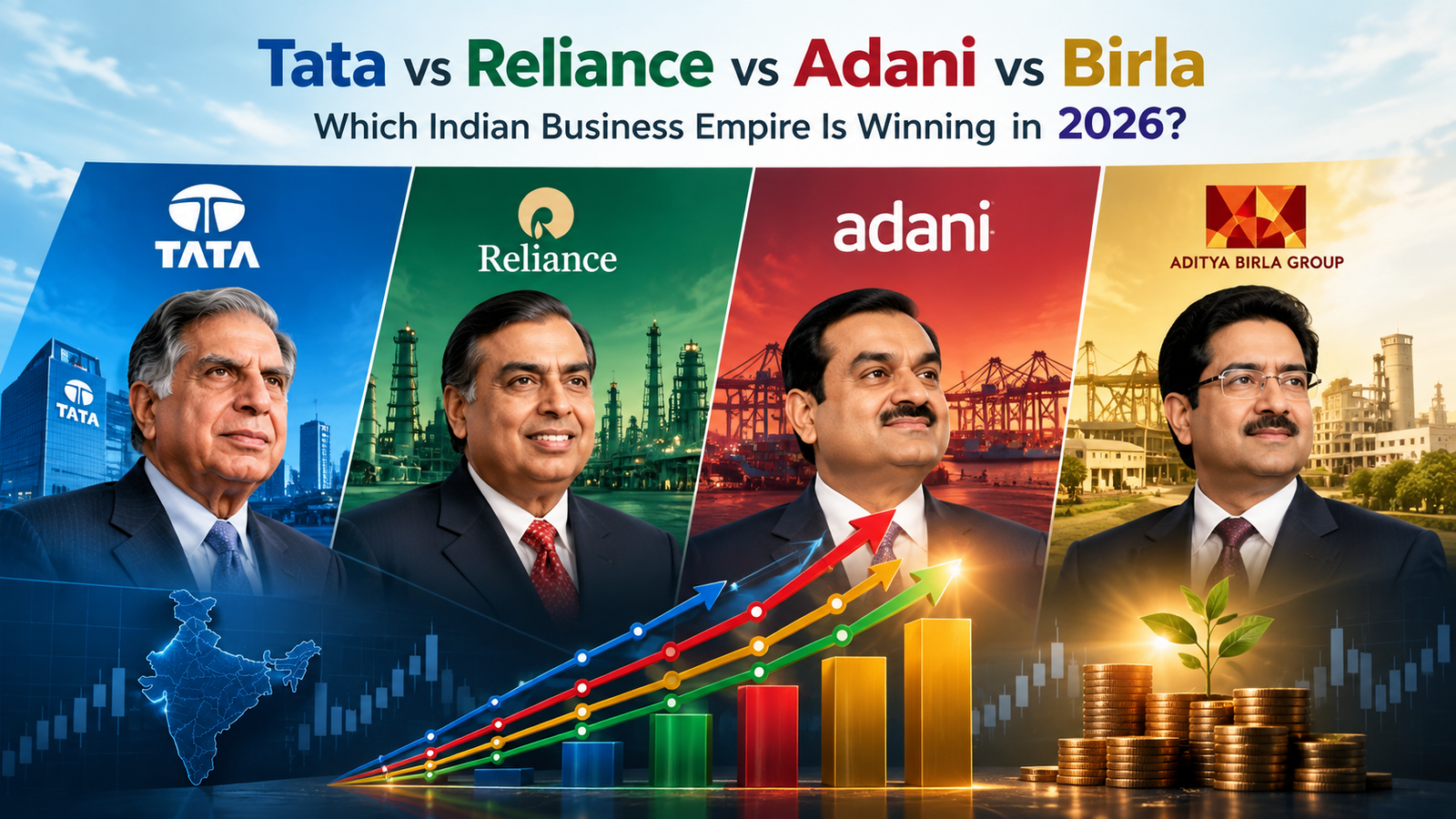

Tata vs Reliance vs Adani vs Birla: Which Indian Business Empire Is Winning in 2026?

Tata vs Reliance vs Adani vs Birla: Which Indian Business Empire Is Winning in 2026?
Published: Sep 23, 2026 | Updated: Sep 23, 2026 | Reading time: 18 min
Ask ten different investors who is winning the Tata vs Reliance vs Adani vs Birla race in 2026, and you will probably get ten different answers — and honestly, all ten could be right, depending on how you choose to measure "winning." If you go purely by combined market value, the Tata Group still sits at the very top of Indian industry, the way it has for most of the last decade. If you go by which single company is the most valuable in the country, Reliance Industries generally takes that crown. If you look purely at the speed of growth, the Adani Group has expanded faster than almost anyone else in Indian corporate history. And if you prefer steady, understated, decades-long compounding with almost no drama, the Aditya Birla Group quietly keeps doing exactly that, year after year.
This article puts all four business empires side by side — real market capitalisation figures, sector dominance, growth rates, debt levels, leadership structure, and 2025-2026 stock performance — so you can decide for yourself who is actually winning the Tata vs Reliance vs Adani vs Birla battle, rather than relying on headlines alone. If you're new to reading company valuations, our guide on what the stock market is and how it works is a useful starting point before diving into the numbers below.
Table of Contents
- Four Business Empires, One Big Question
- Tata Group — India's Most Diversified Conglomerate
- Reliance Industries — The Ambani Empire of Scale
- Adani Group — Infrastructure's Fastest-Growing Giant
- Aditya Birla Group — The Quiet Global Powerhouse
- Tata vs Reliance vs Adani vs Birla: Market Cap Comparison 2026
- Revenue and Profitability: Which Group Actually Earns More
- Growth Trajectory: Who Is Expanding the Fastest
- Sector-Wise Dominance: Who Leads Where
- Debt and Risk Profile Compared
- Leadership and Succession: Founders vs Professional Management
- Stock Market Performance: 2025-2026
- Tata vs Reliance vs Adani vs Birla: Employee Strength and Global Footprint
- Tata vs Reliance vs Adani vs Birla: CSR, Trusts, and Long-Term Vision
- How These Stocks Might Already Be in Your Portfolio
- Which Group Should Investors Watch in 2026
- Final Verdict
- Frequently Asked Questions
Four Business Empires, One Big Question
The Tata vs Reliance vs Adani vs Birla comparison isn't a new obsession for Indian business media — it has been a running storyline for at least fifteen years. But the shape of the competition keeps changing. A decade ago, this was largely a two-way race between Tata and Reliance. Then Adani arrived with an infrastructure-led growth story so aggressive that it briefly overtook Reliance in total group market capitalisation. Meanwhile, the Aditya Birla Group has spent the same period quietly building one of India's largest cement, metals, and financial services businesses, rarely making headlines but consistently showing up near the top of every valuation table.
According to the 2025 Hurun India 500 report, covered in detail by Business Today, Tata thrives on diversification, Reliance dominates through scale and consumer businesses, while Adani continues expanding through infrastructure and nation-building sectors. That single sentence, in many ways, captures the entire Tata vs Reliance vs Adani vs Birla debate — each group has picked a fundamentally different strategy for building wealth, and each strategy comes with its own strengths and vulnerabilities.
Tata Group — India's Most Diversified Conglomerate
By aggregate value, the Tata Group remains India's largest business house. As of the 2025 Hurun India 500 rankings, 14 Tata companies feature on the list, with a combined value of roughly ₹34 lakh crore. What makes the Tata Group unusual in the Tata vs Reliance vs Adani vs Birla comparison is just how spread out its empire is — spanning software services, automobiles, steel, hospitality, aviation, and consumer goods, with almost no single business accounting for a dominant share of total group value.
| Company | Sector | Listed On |
|---|---|---|
| Tata Consultancy Services (TCS) | IT Services | NSE, BSE |
| Tata Motors | Automobiles | NSE, BSE |
| Tata Steel | Metals | NSE, BSE |
| Tata Power | Energy & Utilities | NSE, BSE |
| Titan Company | Consumer & Retail | NSE, BSE |
The single biggest swing factor for Tata in the Tata vs Reliance vs Adani vs Birla story over the past year has been TCS. As the group's flagship IT services company, TCS alone has historically driven a huge share of total Tata Group valuation — and in 2025, that same reliance became a weakness, as slower earnings growth and structural shifts toward AI and automation eroded nearly ₹3 lakh crore from TCS's market capitalisation, making Tata the one major outlier among India's top conglomerates that year.
Reliance Industries — The Ambani Empire of Scale
If the Tata vs Reliance vs Adani vs Birla debate has one undisputed champion of "biggest single company," it's Reliance. Reliance Industries has consistently ranked as India's most valuable listed company, and 2025 was arguably its best year yet — the Reliance Group emerged as India's largest wealth creator, adding ₹4.6 lakh crore to investor wealth as its combined market capitalisation climbed to ₹23.44 lakh crore, driven largely by a near-30% rally in the flagship stock itself.
| Business Vertical | Segment | Key Brand |
|---|---|---|
| Oil-to-Chemicals | Refining & Petrochemicals | Reliance Refinery, Jamnagar |
| Digital Services | Telecom & Broadband | Reliance Jio |
| Retail | Consumer & E-commerce | Reliance Retail |
| New Energy | Green Hydrogen & Solar | Reliance New Energy |
What separates Reliance from the other three in the Tata vs Reliance vs Adani vs Birla comparison is its transition story — from a company once defined almost entirely by oil refining and petrochemicals into a business now equally powered by telecom subscribers and organized retail. That shift toward consumer-facing businesses is exactly why the Reliance Group alone accounted for close to half of all wealth created among India's top seven conglomerates in 2025.
Adani Group — Infrastructure's Fastest-Growing Giant
No group has moved faster in the Tata vs Reliance vs Adani vs Birla story over the past five years than Adani. The group's market capitalisation has approached ₹20 lakh crore in 2026, adding roughly ₹5 lakh crore in value within the year alone, with three Adani Group companies now ranking among India's top 20 firms by market cap.
| Company | Sector | Listed On |
|---|---|---|
| Adani Ports and SEZ | Ports & Logistics | NSE, BSE |
| Adani Enterprises | Incubator / New Ventures | NSE, BSE |
| Adani Power | Power Generation | NSE, BSE |
| Adani Green Energy | Renewable Energy | NSE, BSE |
Adani's growth strategy is built almost entirely around infrastructure and what the group itself calls "nation-building" sectors — ports, airports, power generation, renewable energy, and cement. In the Tata vs Reliance vs Adani vs Birla comparison, this makes Adani the most concentrated bet on India's physical infrastructure buildout, which is precisely why the group's fortunes tend to move more sharply with government policy, capital cycles, and interest rates than its more diversified rivals.
Aditya Birla Group — The Quiet Global Powerhouse
The least discussed name in most Tata vs Reliance vs Adani vs Birla headlines is often the Aditya Birla Group, yet by August 2026 its seven listed companies carried a combined market capitalisation exceeding $110 billion, on the back of a combined annual group revenue of roughly $70 billion generated across 42 countries — more than half of it from overseas operations.
| Company | Sector | Notes |
|---|---|---|
| UltraTech Cement | Cement | India's largest cement producer |
| Hindalco Industries | Metals (Aluminium, Copper) | Parent of Novelis (US) |
| Grasim Industries | Diversified Materials | Textiles, chemicals, financial services |
| Aditya Birla Capital | Financial Services | NBFC, insurance, asset management |
What makes Birla stand out in the Tata vs Reliance vs Adani vs Birla comparison is consistency without spectacle. The group rarely dominates headlines the way Reliance or Adani do, yet UltraTech Cement alone has historically been one of the single biggest value creators among all Birla companies through disciplined, steady mergers and acquisitions rather than dramatic expansion.
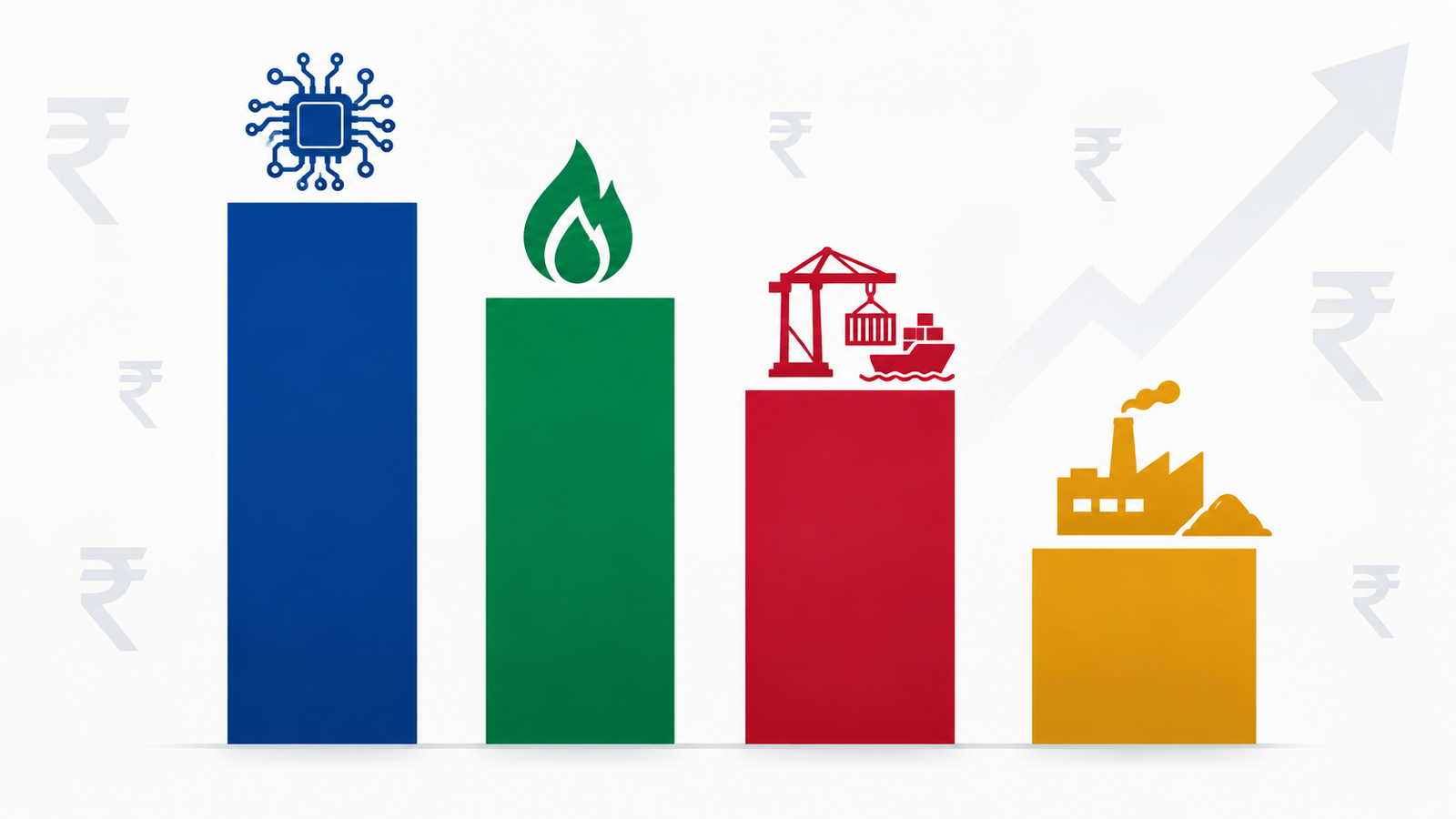
Tata vs Reliance vs Adani vs Birla: Market Cap Comparison 2026
Putting real numbers side by side is the clearest way to settle the Tata vs Reliance vs Adani vs Birla debate, at least on one dimension — total market value. Here is how the four groups stack up using the most recent figures available in 2025-2026.
Market Cap Snapshot (2025-2026)
| Group | Approx. Market Cap | Listed Companies | Primary Strength |
|---|---|---|---|
| Tata Group | ₹34 lakh crore | 14 (Hurun 500 list) | Diversification across sectors |
| Reliance Group | ₹23.4 lakh crore | 7 | Scale, retail and telecom |
| Adani Group | ~₹20 lakh crore | 10 | Infrastructure and energy |
| Aditya Birla Group | ~$110 billion (~₹9.6 lakh crore) | 7 | Global diversified materials & finance |
On pure aggregate value, Tata wins the Tata vs Reliance vs Adani vs Birla contest comfortably. But this single snapshot hides an important nuance: Reliance Industries alone is typically valued higher than any individual Tata company, meaning Tata's lead comes from sheer breadth — 14 companies contributing — rather than one dominant flagship business.
Revenue and Profitability: Which Group Actually Earns More
Market capitalisation reflects investor sentiment about the future, but revenue and profit tell you what each group is actually earning today. On this front, the Tata vs Reliance vs Adani vs Birla comparison shifts again. Reliance Industries alone generates one of the highest single-company revenues in India, driven by its oil-to-chemicals business combined with fast-growing retail and telecom arms. Tata Group's revenue is spread across its 14 companies, with TCS contributing outsized profitability relative to its revenue due to the high-margin nature of IT services.
Adani Group's revenue mix leans heavily toward capital-intensive infrastructure — ports, power, and airports — which typically carries thinner margins than software or consumer retail but benefits from long-term, contracted, annuity-like cash flows once assets are operational. Aditya Birla Group's $70 billion in combined annual revenue, more than half from overseas, reflects a genuinely globalized profile, with Hindalco's subsidiary Novelis contributing meaningfully from operations in the United States and beyond.
Where Each Group's Profit Actually Comes From
| Group | Primary Profit Driver | Margin Profile |
|---|---|---|
| Tata | TCS (IT Services) | High margin, services-driven |
| Reliance | Oil-to-Chemicals + Jio + Retail | Mixed — capital-intensive plus consumer |
| Adani | Ports, Power, Green Energy | Infrastructure, annuity-style cash flows |
| Birla | UltraTech Cement, Hindalco/Novelis | Industrial, globally diversified |
Growth Trajectory: Who Is Expanding the Fastest
If speed is your measure in the Tata vs Reliance vs Adani vs Birla debate, Adani is the clear standout. The group added roughly ₹5 lakh crore in market value during 2026 alone, a pace of expansion that outstrips every other major conglomerate on a percentage basis. Reliance, meanwhile, posted the largest absolute wealth creation among all Indian business groups in 2025, adding ₹4.6 lakh crore — nearly half of all wealth created among India's top seven conglomerates that year.
Tata's growth trajectory has been comparatively muted, largely because its largest constituent, TCS, faced real headwinds from slower enterprise IT spending and the broader industry shift toward AI-driven automation. Aditya Birla Group's growth has been steadier and less headline-grabbing, built on continuous small-to-mid-sized acquisitions and organic expansion in cement and metals rather than any single transformative bet.
2025-2026 Growth Highlights
- Adani: ~₹5 lakh crore added to market cap in 2026 alone — the fastest pace among the four groups.
- Reliance: India's #1 wealth creator in 2025, adding ₹4.6 lakh crore, powered by a ~30% rally in the flagship stock.
- Tata: Mixed year — group leadership intact by aggregate value, but TCS lost nearly ₹3 lakh crore in market cap.
- Birla: Steady, compounding growth via disciplined M&A rather than a single dramatic expansion.
Sector-Wise Dominance: Who Leads Where
Another useful lens for the Tata vs Reliance vs Adani vs Birla comparison is simply asking: who actually leads in which industry? No single group dominates every sector, and that is precisely what keeps this rivalry interesting.
| Sector | Market Leader | Key Company |
|---|---|---|
| IT Services | Tata | Tata Consultancy Services |
| Telecom | Reliance | Reliance Jio |
| Organized Retail | Reliance | Reliance Retail |
| Ports & Logistics | Adani | Adani Ports and SEZ |
| Renewable Energy | Adani | Adani Green Energy |
| Cement | Aditya Birla | UltraTech Cement |
| Aluminium & Metals | Aditya Birla | Hindalco Industries |
| Automobiles | Tata | Tata Motors |
This sector-by-sector breakdown is arguably the most honest way to answer the Tata vs Reliance vs Adani vs Birla question — because "winning" genuinely depends on which industry you care about most as an investor or consumer.
Debt and Risk Profile Compared
No Tata vs Reliance vs Adani vs Birla comparison is complete without looking at balance sheet risk, since aggressive growth is often funded by debt. Historically, Adani's rapid infrastructure buildout has relied more heavily on leverage than its peers, given how capital-intensive ports, power plants, and airports are to construct. Reliance funded much of its telecom and retail expansion through a combination of internal cash flows and large strategic capital raises, including stake sales in Jio and Reliance Retail to global investors, which helped keep leverage comparatively contained relative to the scale of expansion.
Tata Group companies generally maintain more conservative balance sheets on average, partly because TCS itself carries minimal debt and generates strong free cash flow, which supports the group's overall credit profile. Aditya Birla Group has also generally pursued a measured approach to leverage, funding acquisitions like the Novelis deal through a mix of debt and equity while maintaining investment-grade credit ratings across its major listed entities.
Key Risks in the Tata vs Reliance vs Adani vs Birla Race
- Tata: Heavy reliance on TCS means any slowdown in global IT spending disproportionately affects total group value, as seen clearly in 2025.
- Reliance: Continued success depends on sustaining growth in newer businesses like Jio and Retail as the older oil-to-chemicals business matures.
- Adani: Higher leverage tied to infrastructure buildout makes the group more sensitive to interest rate cycles and regulatory or policy shifts.
- Birla: Global exposure through Novelis and other overseas units means currency swings and global commodity cycles can meaningfully affect group earnings.
Leadership and Succession: Founders vs Professional Management
Leadership structure is one of the more overlooked angles in the Tata vs Reliance vs Adani vs Birla comparison, yet it shapes long-term strategy significantly. The Tata Group is unusual among Indian conglomerates in that operational control largely rests with professional CEOs at each company, overseen by Tata Sons and the Tata Trusts, rather than a single hands-on family patriarch running day-to-day operations. Reliance Industries, by contrast, remains firmly led by Mukesh Ambani, with his children increasingly taking on senior roles across the retail, telecom, and energy businesses in what looks like an active, ongoing succession process.
Gautam Adani continues to lead the Adani Group directly, maintaining a hands-on, founder-led approach across its infrastructure bets, while Kumar Mangalam Birla has led the Aditya Birla Group for decades with a notably low-key public style, favoring steady expansion and philanthropy over aggressive public positioning. Each leadership style has shaped how its group behaves under pressure — a factor worth remembering the next time a Tata vs Reliance vs Adani vs Birla headline focuses purely on numbers.
Stock Market Performance: 2025-2026
Zooming into recent stock performance adds one more layer to the Tata vs Reliance vs Adani vs Birla story. Reliance Industries shares rallied close to 30% during 2025, directly fueling the group's position as India's top wealth creator that year. Adani Group shares across its listed entities have shown some of the sharpest percentage gains of any major conglomerate in 2026, reflecting continued investor confidence in the group's infrastructure pipeline. Tata shares delivered a mixed picture, with TCS acting as a drag on overall group performance even as other Tata companies like Titan and Tata Motors posted more resilient returns. Aditya Birla Group shares, led by UltraTech Cement and Aditya Birla Capital, have generally moved in line with broader industrial and financial sector trends rather than showing the sharp swings seen in Adani or Reliance stock.
For readers who want to understand these swings in the context of broader market history, our article on the biggest stock market crashes in history explains how sector-wide sentiment shifts — not just company fundamentals — can move even the strongest blue-chip stocks in the short term.

Tata vs Reliance vs Adani vs Birla: Employee Strength and Global Footprint
Beyond market value and revenue, the Tata vs Reliance vs Adani vs Birla comparison also plays out in workforce size and global reach, which shapes how each group influences the broader economy. Tata Group is widely regarded as one of India's largest private-sector employers, with its companies collectively employing hundreds of thousands of people across IT services, manufacturing, and hospitality, and a footprint that spans well over 100 countries through TCS's global delivery network and Tata Motors' international operations, including Jaguar Land Rover in the UK.
Reliance Industries employs a large workforce concentrated heavily in India, with Reliance Retail alone counting among the largest private employers in the country given its sprawling network of stores. Adani Group's workforce is smaller in comparison but has grown rapidly alongside its infrastructure expansion, particularly in ports, logistics, and renewable energy project execution. Aditya Birla Group stands out for its international employee base, a natural consequence of generating more than half its revenue from the 42 countries it operates in, including a significant presence in North America through Hindalco's subsidiary Novelis.
Workforce and Global Presence Snapshot
| Group | Workforce Character | Global Footprint |
|---|---|---|
| Tata | Large, IT-services heavy | 100+ countries via TCS, JLR |
| Reliance | Large, retail-heavy in India | Primarily domestic, growing overseas energy ties |
| Adani | Growing, infrastructure-project driven | Expanding into ports and energy abroad |
| Birla | Globally distributed | 42 countries, strong US presence via Novelis |
Tata vs Reliance vs Adani vs Birla: CSR, Trusts, and Long-Term Vision
One dimension often missing from the Tata vs Reliance vs Adani vs Birla comparison is philanthropy and long-term capital structure, both of which shape how each group behaves over decades rather than quarters. The Tata Group is genuinely unusual on this front: roughly two-thirds of Tata Sons, the group's holding company, is owned by philanthropic Tata Trusts, meaning a substantial share of the group's long-term profits are structurally directed toward charitable causes rather than concentrated family wealth, a model that has shaped Tata's cautious, reputation-conscious approach to expansion for generations.
Reliance, Adani, and Aditya Birla all maintain active corporate social responsibility arms — Reliance Foundation, the Adani Foundation, and the Aditya Birla Foundation respectively — but ownership in each of these groups remains concentrated with the founding families rather than structured through a trust model like Tata's. This distinction matters for investors thinking long-term, since it subtly influences each group's appetite for risk, reinvestment, and how aggressively each pursues growth versus stability in the ongoing Tata vs Reliance vs Adani vs Birla competition.
Ownership and Philanthropic Structure
| Group | Ownership Structure | Philanthropic Arm |
|---|---|---|
| Tata | ~66% held by Tata Trusts | Tata Trusts (structural, large-scale) |
| Reliance | Ambani family-controlled | Reliance Foundation |
| Adani | Adani family-controlled | Adani Foundation |
| Birla | Birla family-controlled | Aditya Birla Foundation |
How These Stocks Might Already Be in Your Portfolio
Even investors who have never directly bought a share of Tata, Reliance, Adani, or Birla companies often hold exposure to all four through index funds and diversified mutual funds, since companies from every group typically feature among the largest constituents of the Nifty 50 and Sensex. Understanding the Tata vs Reliance vs Adani vs Birla dynamic is therefore relevant even for passive investors, since these four business houses collectively influence a meaningful share of overall index performance.
If you want to understand how index-based exposure works before deciding whether to add individual conglomerate stocks on top of it, our guide on Nifty 50 vs Sensex explained breaks down how these benchmark indices are constructed, while our piece on how to invest in index funds covers the basics of passive investing for readers who prefer simplicity over picking individual conglomerate stocks. For those specifically interested in steady, income-generating exposure, our article on dividend investing explains how some of these same large-cap names also fit into income-focused portfolios, and our guide on what market capitalization really means helps put all the numbers in this comparison into proper context.
Which Group Should Investors Watch in 2026
For investors trying to translate the Tata vs Reliance vs Adani vs Birla comparison into an actual decision, the answer depends heavily on what you're optimizing for. If you want diversification and relative stability, Tata's spread across sectors offers a natural cushion, though its heavy TCS weighting means IT sector trends deserve close attention. If you want exposure to India's consumption and digital growth story, Reliance's retail and telecom businesses remain a direct play on that theme. If you believe India's infrastructure buildout still has years of runway left, Adani offers the most concentrated exposure to that theme, alongside correspondingly higher volatility. If you prefer steady, globally diversified industrial exposure with less drama, Aditya Birla Group's cement and metals businesses are worth a closer look.
Before acting on any of this, it's worth revisiting the basics of how to diversify your stock portfolio, since concentrating too heavily in any single conglomerate — however dominant it looks today — carries risk regardless of which side of the Tata vs Reliance vs Adani vs Birla debate you favor.
Investors comparing these four business houses should also track them individually through official channels — NSE India's company pages and BSE India's disclosures offer real-time filings, while each group's investor relations pages — Tata, Reliance, Adani, and Aditya Birla — publish quarterly results and annual reports directly. For readers who want a refresher on interpreting these disclosures, our guide on how to read a company balance sheet and our article on common mistakes new investors make are both useful companions to this comparison.
Final Verdict: Who Is Really Winning?
There is no single, clean answer to the Tata vs Reliance vs Adani vs Birla question, and that's precisely the point. By total aggregate value, Tata leads. By single-company dominance and 2025 wealth creation, Reliance leads. By sheer speed of expansion, Adani leads. By quiet, globally diversified consistency, Aditya Birla leads. Each group has built a fundamentally different kind of empire, optimized for a different definition of success — and for investors, the smartest approach isn't picking a single winner, but understanding what each group actually represents before deciding where your own money belongs.
Frequently Asked Questions
1. Which is bigger, Tata or Reliance, in 2026?
By aggregate group market value, Tata is larger, with a combined valuation of around ₹34 lakh crore across 14 listed companies. However, Reliance Industries is typically the single most valuable individual company in India, and the Reliance Group as a whole was India's top wealth creator in 2025.
2. Is Adani Group bigger than Tata Group?
No, as of 2026 the Adani Group's market capitalisation, approaching ₹20 lakh crore, remains smaller than the Tata Group's aggregate value of roughly ₹34 lakh crore, though Adani has grown at a faster percentage pace in recent years.
3. How does Aditya Birla Group compare to Tata, Reliance, and Adani?
Aditya Birla Group, with a market capitalisation exceeding $110 billion as of August 2026, is generally smaller in total value than Tata, Reliance, and Adani, but stands out for its global revenue base, with over half its $70 billion annual revenue coming from overseas operations.
4. Which group had the best stock performance in 2025?
Reliance Industries had one of the strongest performances in 2025, with its flagship stock rallying close to 30% and the broader Reliance Group adding ₹4.6 lakh crore in investor wealth, the highest among all major Indian conglomerates that year.
5. Why did Tata Group underperform its rivals in 2025?
Tata Group's underperformance in 2025 was largely driven by Tata Consultancy Services, which lost nearly ₹3 lakh crore in market capitalisation amid slower earnings growth and structural shifts in the IT industry toward AI and automation.
6. Which group is the most diversified?
The Tata Group is widely considered the most diversified, with 14 listed companies spanning IT services, automobiles, steel, power, and consumer goods, meaning no single business dominates total group value the way TCS once did.
7. Is Adani Group riskier to invest in compared to Tata or Birla?
Adani Group's infrastructure-heavy business model generally involves higher leverage and greater sensitivity to interest rate cycles and regulatory shifts compared to the more diversified, lower-debt profiles typically seen across Tata and Aditya Birla Group companies.
8. Which conglomerate has the most global exposure?
Aditya Birla Group has the most globally diversified revenue base among the four, generating more than half of its $70 billion annual revenue from operations spread across 42 countries, including through subsidiaries like Novelis.
9. Who leads the Tata, Reliance, Adani, and Birla groups today?
Reliance Industries is led by Mukesh Ambani, the Adani Group by Gautam Adani, and the Aditya Birla Group by Kumar Mangalam Birla, while the Tata Group operates under a professional management structure across its companies, overseen by Tata Sons and the Tata Trusts.
10. Should I invest in just one of these groups, or diversify across all four?
Most financial experts generally recommend diversification rather than concentrating investments in a single business house, since each of these four groups carries a different risk and growth profile; spreading exposure can help balance stability, growth potential, and sector-specific risk.
For further reading on related topics covered on this site, see our guides on algorithmic trading regulations: SEBI vs SEC, AI-driven algorithmic trading and hedge funds, what market capitalization really means, blue chip stocks in India, best large-cap stocks to watch in 2026, Reliance Industries stock analysis, Tata Group stocks worth tracking, Adani Group stock analysis, Aditya Birla Group stock overview, and how to read a company balance sheet.

Pranab Barman is a Financial Educator and Personal Finance Researcher with over 10 years of hands-on experience in stock markets, trading, and investing. Currently enrolled in the CFA Program, he is committed to continuous learning and professional excellence in finance.
As the Founder of PlayWithStock, Pranab covers a wide range of topics including Mutual Funds, SIP, Taxation, Stock Market Basics, and Financial Calculators — with a focus on simplifying complex financial concepts for everyday all investors.
Email: support@playwithstock.com
Website: playwithstock.com
Related posts:
 Bank of Maharashtra Q1 FY27 Results: QIP Update, Business Growth & Preview
 Ethanol Stocks India: The Complete Guide to the Business, the E20 Controversy, and Every Listed Company
 Reliance Jio IPO 2026: India’s Biggest-Ever Listing, Explained
 Reliance Q1 FY27 Results: Revenue Hits Record ₹3.12 Lakh Crore, Profit Slips 22%
 GST Registration for Small Business 2026: When It’s Actually Mandatory
 Reliance Industries Q1 FY27 Results Preview: What to Expect on July 17
 H-1B $100K Visa Fee — Indian IT Stocks Pe Impact (2026 Update)
 FATF Anti-Fraud Rules 2026: What They Mean for Indian Investors