

H-1B $100K Visa Fee — Indian IT Stocks Pe Impact (2026 Update)
A policy that was declared dead in June is still, legally speaking, alive today — and somewhere between those two facts sits every Indian family with someone on an H-1B, and every investor holding TCS or Infosys in their portfolio.
Table of Contents
- Two Headlines, Nine Months Apart
- What the $100,000 Fee Actually Is
- The Day the Market First Reacted
- Company-Wise Exposure: Who's Most at Risk
- What Brokerages Are Actually Saying
- The Legal Rollercoaster: Where Things Stand
- The Bills Still Sitting in Congress
- Beyond the Stock Price: The Family Angle
- What Should an Investor Actually Do
- Frequently Asked Questions
In December 2025, a US federal judge upheld the Trump administration's $100,000 H-1B visa fee, ruling it lawful. Indian IT stocks fell on the news, and the Nifty IT index slipped as investors priced in a genuine, ongoing cost burden.
In June 2026, a different federal judge — this time District Judge Leo Sorokin — struck the same fee down, calling it an unlawful tax that only Congress, not the President, had the authority to impose. His written ruling was direct: "The President had no power or delegated authority to impose a tax on H-1B petitions."
Two courts. Two rulings. Nine months apart. This is not a story with a clean ending yet — and understanding why requires walking through the whole timeline, not just the most recent headline.
In September 2025, the Trump administration signed a proclamation imposing a flat $100,000 fee on new H-1B visa petitions — a dramatic jump from the previous filing cost, which typically ran into a few thousand dollars including base fees and premium processing.
Who Is and Isn't Affected
The fee's scope matters more than the headline number. It applies specifically to new petitions filed after September 21, 2025 — not to visa renewals, not to existing H-1B holders already working in the US, and not to re-entries. This distinction, clarified by the White House after the initial announcement, meaningfully softened the panic in some quarters, though it did little to calm Indian IT investors initially, since new hiring is exactly how these companies deploy fresh talent onsite for client projects.
Indian professionals are the primary group affected by design as much as by outcome — roughly 70-75% of all H-1B visas issued annually go to Indian nationals, making this the single largest immigration policy story for Indian tech talent in years.
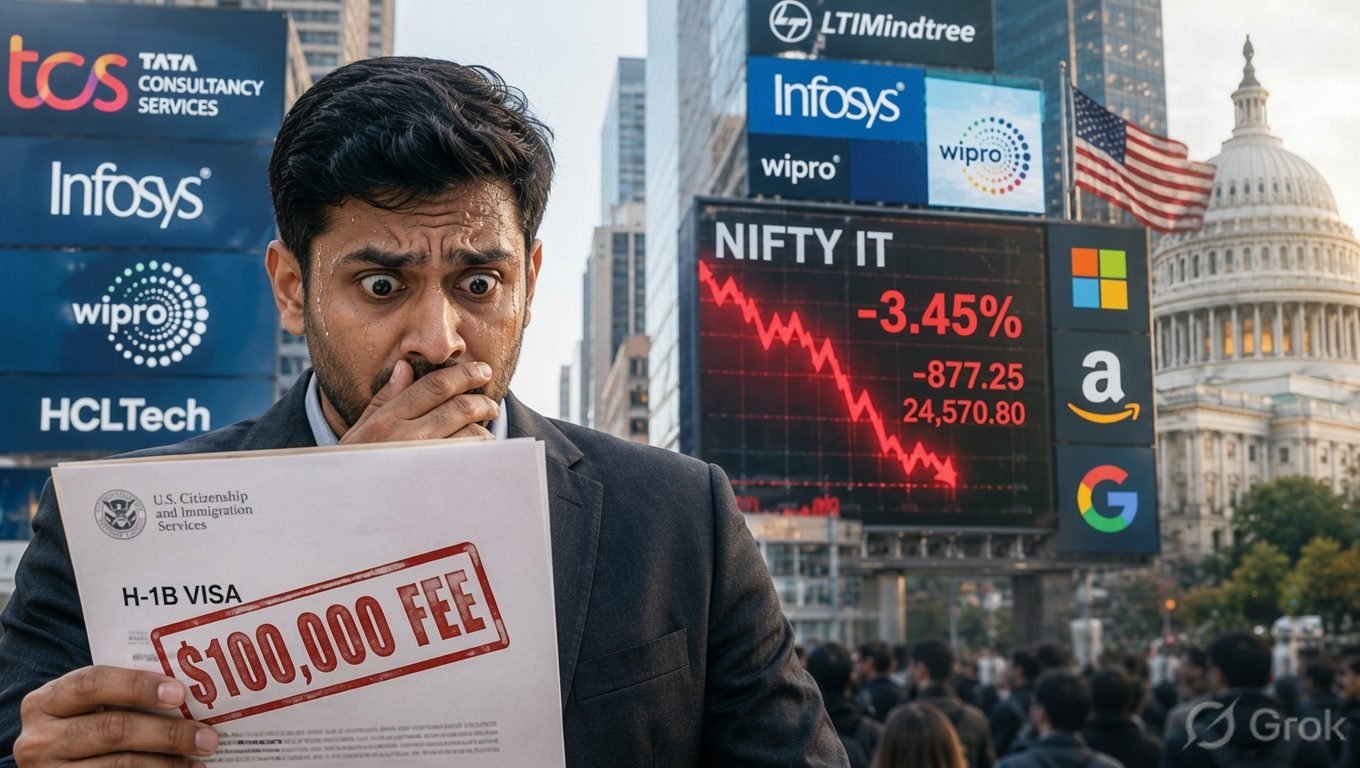
On September 22, 2025, the day after the fee took effect, Indian IT stocks fell sharply across the board. TCS dropped roughly 3% intraday, Infosys slipped between 1.9% and 2.6% depending on the exact reading, HCL Tech opened 1.5-2.5% lower, and Wipro declined over 2%. Tech Mahindra and LTIMindtree fell even harder, down 3.65% and 3.9% respectively.
Not every Indian IT company carries the same exposure to this fee. The numbers, compiled from US Citizenship and Immigration Services (USCIS) data, tell a fairly clear story about who has the most riding on the outcome.
| Company | H-1B Petitions | Share of New Hires Affected |
|---|---|---|
| TCS | 5,505 (highest of any Indian IT firm) | ~82% (~6,500 workers) |
| Infosys | 2,004 | ~93%+ (~10,400 workers) |
| LTIMindtree | 1,844 | Not separately disclosed |
| HCL America (HCLTech) | 1,728 | Not separately disclosed |
| Wipro | 1,523 | Not separately disclosed |
TCS holds the largest absolute number of H-1B petitions among Indian IT majors, but Infosys shows a notably higher percentage of its new hiring pipeline running through the H-1B route — meaning a sustained fee could disproportionately affect Infosys's onsite staffing model even though its total headcount is smaller than TCS's.
This is where the story gets genuinely nuanced, because different brokerage houses have arrived at meaningfully different conclusions about the actual financial damage.
The More Cautious Estimates
IIFL Securities modelled the impact on EBIT margins at roughly 20-60 basis points, translating to an EPS hit of 1.2% to 4.5%, depending on how aggressively companies continue H-1B-based hiring. Nuvama's scenario analysis estimated a potential 50-150 basis point margin impact if firms continue using H-1B workers at the higher fee level. One analysis focused on onsite wage inflation warned that a resulting "talent supply crunch" could drag profits by as much as 4-13% in a worst-case scenario.
The More Optimistic View
JM Financial took a notably different stance, calling the development a potential "net positive" — arguing that regulatory uncertainty being resolved (in either direction) is better for markets than prolonged ambiguity, and that the actual margin impact would likely be negligible, in the range of just 15-50 basis points.
The Structural Counter-Argument
Perhaps the most interesting take came from MOFSL, which pointed out a structural offset most headlines miss: if fewer new H-1B visas are issued, onsite revenue may decline — but so do onsite costs, since offshore delivery from India is structurally more profitable than onsite US delivery in the first place. Under this view, the net effect on EPS could be close to neutral over the medium term, even if headline revenue growth slows somewhat.
As of mid-2026, here's the honest, current status: the June 2026 ruling that struck down the fee as an unlawful tax has been stayed pending appeal. In plain terms, that means the fee technically remains in effect right now, even though a federal judge has already ruled against it, because the losing side (the government) has appealed, and the stay keeps the original policy operative while that appeal plays out.
This is genuinely unusual for investors to price correctly, because it means the "good news" of the June ruling hasn't actually translated into relief yet — the practical, dollar-and-cents situation for IT companies filing new H-1B petitions today is unchanged from before the ruling.
Even if the fee itself is eventually struck down permanently on appeal, two legislative proposals in the US Congress could achieve a similar effect through a different route: the American White-Collar Worker Jobs Act and the End H-1B Visa Abuse Act. Both propose moving toward a wage-based visa selection system, which would prioritise H-1B applicants offered higher salaries — a change that would likely force Indian IT companies to raise onsite pay significantly to remain competitive in the visa lottery, achieving a cost increase through a different mechanism than a flat fee.
Neither bill has passed as of this writing, and legislative timelines in the US Congress are notoriously unpredictable — but their existence means that even a favourable final court outcome on the $100,000 fee wouldn't necessarily close the chapter on rising US hiring costs for Indian IT firms.
It's worth pausing on something easy to lose in a discussion of basis points and EPS estimates: this policy touches real people, not just portfolios. For the thousands of Indian families with a son, daughter, or spouse on an H-1B in the US, this uncertainty isn't an abstract market variable — it's a direct question about career stability, ability to change jobs, and in some documented cases, a brutal 60-day window to find new sponsorship after a layoff before facing an unviable $100,000 re-entry cost.
Readers of this article may well be in both camps at once — holding IT stocks in a portfolio while also having a family member navigating this exact visa uncertainty in the US. Both concerns are legitimate, and neither cancels the other out.
Resist the Urge to Trade the Headline
The single biggest mistake in a story like this is reacting to each individual headline as if it were the final word. This situation has already flipped once — from "upheld" in December to "struck down" in June — and the appeal process means it could plausibly flip again. Selling in a panic on bad news, or buying aggressively on good news, both risk reacting to a chapter rather than the ending.
Focus on the Structural Picture, Not Just the Fee
The MOFSL observation is worth taking seriously: a genuine, sustained shift away from onsite H-1B hiring and toward offshore delivery isn't automatically bad for margins — it may even help them, given offshore work's structurally better profitability. Investors overly fixated on the fee alone risk missing this more important structural trend already underway across the sector.
Watch FY27 Hiring Data, Not Just Court Filings
Since H-1B lotteries and petitions typically run in Q4-Q1 of the fiscal year, the real, measurable financial impact — as opposed to speculative brokerage modelling — will first show up clearly in FY27 petition data and subsequent quarterly commentary from company managements. That's the number worth tracking closely, more than any single court hearing date.
Yes, technically. A June 2026 court ruling struck it down as an unlawful tax, but that ruling has been stayed pending the government's appeal, meaning the fee remains operative for new petitions in the meantime.
No. The fee applies only to new petitions filed after September 21, 2025. Renewals, re-entries, and existing visa holders are not subject to the new fee.
TCS holds the largest absolute number of H-1B petitions (5,505), while Infosys has the highest percentage of its new hiring pipeline affected (over 93% of new hires). Both face meaningful exposure, though through slightly different channels.
Under one structural argument (from MOFSL), yes — potentially. If reduced onsite hiring shifts more delivery to offshore India-based teams, which are typically more profitable, the net effect on EPS could be close to neutral or even mildly positive over the medium term, despite slower headline revenue growth.
This article does not provide individual investment advice. The situation remains genuinely unresolved and analyst opinions differ meaningfully — a decision to hold, buy, or sell should be based on your own research, risk tolerance, and time horizon, not a single news cycle.

Pranab Barman is a Financial Educator and Personal Finance Researcher with over 10 years of hands-on experience in stock markets, trading, and investing. Currently enrolled in the CFA Program, he is committed to continuous learning and professional excellence in finance.
As the Founder of PlayWithStock, Pranab covers a wide range of topics including Mutual Funds, SIP, Taxation, Stock Market Basics, and Financial Calculators — with a focus on simplifying complex financial concepts for everyday all investors.
Email: support@playwithstock.com
Website: playwithstock.com
Related posts:
 Gold Price Correction 2026: What It Means for Indian Investors
 FATF Anti-Fraud Rules 2026: What They Mean for Indian Investors
 What Is Circuit Breaker Stock Market: Meaning, Limits & 2026 Update
 Bank of Maharashtra Q1 FY27 Results: QIP Update, Business Growth & Preview
 Stocks to Buy After India-US Trade Deal 2026: A Sector-by-Sector Breakdown
 India UK Trade Deal 2026: What Gets Cheaper, and Which Stocks Just Won
 Best AI Stocks India 2026: 7 Picks That Are Actually Worth Watching
 Indian Bank Q1 FY27 Results: Preview, Estimates & What to Expect Today