
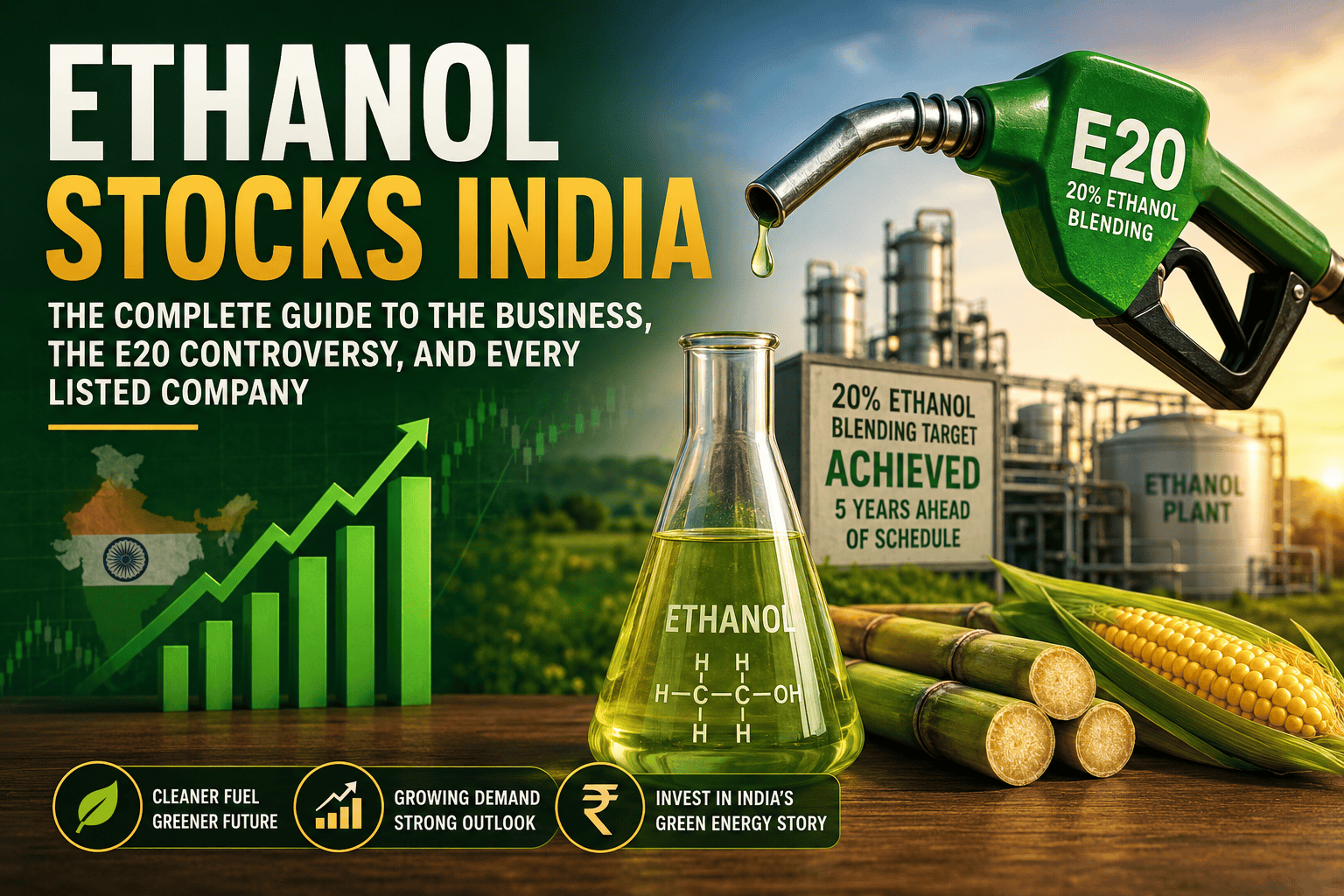

Ethanol Stocks India: The Complete Guide to the Business, the E20 Controversy, and Every Listed Company
India hit its 20% ethanol blending target five years early — and it's now sitting at the center of a Supreme Court battle, a consumer court ruling, and one of the fastest-growing stock themes on the market. Here's the full picture.
- 1. What Is Ethanol and Why Is It Trending in India
- 2. The E20 Story: How India Got Here
- 3. The Current Controversy: Mileage, Engine Damage, and the Supreme Court
- 4. What the Government Says
- 5. Real Problems the Ethanol Industry Is Facing Right Now
- 6. How the Ethanol Business Actually Works
- 7. Complete List of Ethanol Stocks on NSE and BSE
- 8. Which Ethanol Stocks Are Worth Watching
- 9. Risks Every Ethanol Investor Should Know
- 10. Recent Ethanol News Timeline
- 11. FAQs
Ethanol Stocks India have become one of the most talked-about themes in the market this year, and it's not hard to see why — the sector sits at the intersection of two massive stories happening at once. On one side, there's a genuine consumer controversy: millions of vehicle owners are asking whether E20 petrol is quietly damaging their engines and cutting their mileage, and the Supreme Court has been drawn into the debate. On the other side, there's a genuine investment story: the companies that produce ethanol have seen their distillery capacities, revenues, and stock prices reshaped by a government mandate that moved faster than almost anyone expected. This guide covers both sides properly — the controversy that's dominating headlines, and the complete list of stocks that are actually built around this business.
⚡ Ethanol in India — Quick Snapshot
| Current Blending Rate | 20% (E20), achieved 2025-26 |
| Original Target Year | 2030 (achieved 5 years early) |
| Blending in 2013-14 | Less than 1.5% |
| Forex Saved (cumulative) | ~₹1.36 lakh crore |
| Paid to Distilleries | ~₹1.96 lakh crore |
| Paid to Farmers | ~₹1.18 lakh crore |
| Ethanol Price (cane juice) | ₹65.61/litre |
1. What Is Ethanol and Why Is It Trending in India
Ethanol is a form of alcohol produced by fermenting sugars — in India, mainly from sugarcane juice, molasses (a sugar-refining byproduct), and surplus foodgrains like maize and rice. When blended into petrol, it reduces the country's dependence on imported crude oil, since ethanol is produced domestically from agricultural feedstock rather than imported. India currently blends ethanol into petrol at a 20% ratio — branded as E20 — and this single number is the reason the topic is everywhere right now, both in business news and in ordinary consumer conversations.
The reason it's trending isn't the policy itself — India has been building toward this for over a decade. It's trending because the rollout hit its target five years ahead of schedule, and the speed of that rollout has collided with millions of vehicle owners who feel they weren't given enough notice, information, or choice.
2. The E20 Story: How India Got Here
Under the National Policy on Biofuels, the government originally targeted 20% ethanol blending by 2030. That target was progressively pulled forward — first to 2025, and the country ultimately achieved it in the 2025-26 ethanol supply year, five years ahead of the original plan. Ethanol blending in petrol rose from under 1.5% in 2013-14 to a full 20% by 2025-26, a roughly 13-fold increase in just over a decade.
By the government's own figures, this rapid scale-up has delivered real, measurable results: approximately ₹1.36 lakh crore saved in foreign exchange from reduced crude oil imports, ₹1.96 lakh crore paid out to domestic distilleries, and ₹1.18 lakh crore disbursed to farmers — money that flows directly into rural incomes through sugarcane and grain procurement for ethanol production. India's total ethanol production capacity reached roughly 1,822 crore litres annually by mid-2025, built on a mix of molasses-based and grain-based feedstock.
The pace of this rollout is genuinely unusual by global standards — Brazil, often cited as the pioneer of ethanol-blended fuel, took decades to reach comparable blending levels. India compressed a similar journey into roughly ten years, and E20 became the default, and in most places the only, petrol available at the pump starting in 2025.
3. The Current Controversy: Mileage, Engine Damage, and the Supreme Court
This is the part of the ethanol story that's dominating headlines right now, and it's worth understanding in full because it directly affects sentiment around ethanol stocks too. In August 2025, advocate Akshay Malhotra filed a Public Interest Litigation in the Supreme Court challenging the nationwide E20 rollout, arguing that millions of vehicles — particularly those manufactured before 2023 — were not designed for such high ethanol content, and that owners were being left with no choice at the pump.
The petition raised several specific complaints: engine corrosion, declining fuel efficiency, mounting repair bills, and insurance companies allegedly rejecting damage claims tied to ethanol-related wear. It also pointed out that countries like the United States, Brazil, and those in the European Union still offer ethanol-free petrol as an option, with clear labelling of ethanol content — something India's rollout did not initially provide.
The Supreme Court, led by Chief Justice B R Gavai, declined to entertain the plea, effectively closing off judicial review of the policy itself — the bench considered the government's argument that E20 has materially benefited sugarcane farmers and declined to intervene, as reported by the Deccan Herald. But the controversy didn't end there. The matter resurfaced in a separate Supreme Court case in 2026, this one about ethanol procurement contracts, when the Attorney General's office reportedly described the 20% blending mandate as something the government was "experimenting" with — a comment that triggered fresh public backlash and questions on social media about whether citizens were unwitting participants in a large-scale fuel experiment.
Separately, in what's being described as India's first known consumer court ruling on this issue (as reported by Business Today), the Raipur District Consumer Disputes Redressal Commission ruled in favour of a vehicle owner who alleged that E20 petrol caused recurring engine problems — misfiring, declining performance, and mounting repair costs — despite the vehicle manufacturer and dealer disputing that the model was fully E20-compatible. This ruling is significant because it's the first time a formal legal body in India has sided with a consumer on this specific question, and it's likely to encourage similar claims going forward.
4. What the Government Says
Facing sustained public pressure, the Ministry of Petroleum and Natural Gas issued a detailed clarification in early July 2026 (covered in depth by Business Standard), addressing the most viral claims directly. On the specific claim that E20 cuts mileage by 30%, the ministry's response was that this figure reflects only ethanol's lower calorific value in isolation, not the real-world mileage impact — automakers' own industry body, the Society of Indian Automobile Manufacturers, has separately estimated the real mileage impact at closer to 2-4%, calling E20 safe but acknowledging a modest efficiency trade-off, particularly in older vehicles.
The government also pushed back on the "experiment" framing, clarifying that the Attorney General's remark was made in the specific context of an ethanol procurement contract dispute, not a comment on the merits or safety of the E20 policy itself. Separately, viral videos claiming to show raw sugarcane juice being mixed directly with petrol were dismissed by the ministry as misleading — it noted that ethanol is produced through fermentation and industrial processing that fundamentally changes its properties before blending, and that all ethanol must meet prescribed quality specifications before it reaches the fuel supply chain.
5. Real Problems the Ethanol Industry Is Facing Right Now
Beyond the consumer-facing controversy, the ethanol business itself is dealing with a set of structural challenges that matter directly to anyone evaluating ethanol stocks.
Rising Procurement Costs
Ethanol procurement costs have risen above refined petrol costs in recent periods — meaning oil marketing companies are, in effect, paying more for ethanol than they would for the petrol it's replacing. The mandate continues regardless, because the government weighs the energy security, environmental, and farm income benefits above the near-term cost differential, but this dynamic puts pressure on the economics for everyone in the supply chain.
Frozen Ethanol Prices
Government-fixed ethanol prices have remained largely unchanged since the 2022-23 season — currently ₹65.61 per litre for cane-juice-based ethanol, ₹60.73 for B-heavy molasses, and ₹56.28 for C-heavy molasses. With input costs for distilleries rising over that same period, a static price ceiling squeezes margins for producers who don't have scale or diversified feedstock flexibility.
Consumer Trust and Legal Exposure
The Raipur consumer court ruling is a genuine inflection point. If similar rulings follow — and legal experts expect they will, given the scale of E20's rollout — vehicle manufacturers, dealers, and by extension the broader ethanol ecosystem could face a wave of consumer disputes that shape public sentiment and potentially trigger further regulatory scrutiny.
Feedstock and Monsoon Dependency
Because most Indian ethanol still comes from sugarcane and grain, production volumes remain tied to monsoon performance and crop yields. A weak monsoon or a poor sugarcane season can tighten ethanol supply and squeeze the economics of diverting cane toward ethanol versus sugar production — a trade-off every integrated sugar-ethanol company has to actively manage each season.
6. How the Ethanol Business Actually Works
For investors, understanding the ethanol business model matters more than following the headlines. Indian ethanol producers generally fall into three categories, and the distinction matters for how each stock behaves.
Integrated sugar-ethanol producers — companies like Balrampur Chini Mills, Triveni Engineering, EID Parry, and Shree Renuka Sugars — run sugar mills with attached distilleries, giving them the flexibility to divert sugarcane juice or B-heavy molasses toward ethanol production instead of sugar, depending on which is more profitable in a given season. This flexibility is a genuine structural advantage, since it lets these companies hedge between two revenue streams rather than depending on either sugar prices or ethanol offtake alone.
Grain-based ethanol producers use maize and surplus rice as feedstock rather than sugarcane, which reduces dependency on the sugar cycle and monsoon-driven cane yields, though it introduces its own exposure to foodgrain price movements and government procurement policy for grain.
Technology and infrastructure providers — most notably Praj Industries — don't produce ethanol themselves at all. Instead, they design, build, and supply the bio-refinery technology and turnkey ethanol plants that producers use, making them a different kind of exposure to the same growth story: a pick on infrastructure build-out rather than on the ethanol commodity itself. This matters especially as India pushes into second-generation (2G) ethanol made from non-food biomass like rice straw and bagasse, an area where Praj has positioned itself as a technology leader.
Revenue for producers is largely locked in through long-term supply contracts with Oil Marketing Companies (OMCs) — Indian Oil, Bharat Petroleum, and Hindustan Petroleum — at government-fixed prices, which gives the sector a degree of revenue predictability that's unusual for an agri-linked business, but also caps upside if input costs rise faster than the fixed procurement price. This pricing dynamic is worth understanding alongside broader commodity trends — our coverage of gold's 2026 rally and silver's price surge both illustrate how commodity-linked businesses respond very differently to price cycles depending on whether their pricing is fixed by contract or floats with the market.
7. Complete List of Ethanol Stocks on NSE and BSE
Here is the full list of India's major listed ethanol and ethanol-linked companies. Most are integrated sugar-ethanol producers; a few are pure technology or diversified plays. All are listed on the NSE, BSE, or both — if you're new to trading these, our demat account explainer and NSE vs BSE guide cover the basics of how to actually buy shares in any of these companies.
| Company | Segment | Business Notes |
|---|---|---|
| Balrampur Chini Mills Ltd | Integrated sugar + ethanol | 10 sugar factories in UP; 1,050 KLPD distillery capacity; also building India's first industrial PLA bioplastic plant |
| Triveni Engineering & Industries Ltd | Integrated sugar + ethanol + engineering | Second-largest ethanol supplier in India; 860 KLPD capacity, expanding to 1,110 KLPD; highest ROE in the sector |
| E.I.D. Parry (India) Ltd | Integrated sugar + ethanol | One of India's oldest sugar manufacturers; large-cap leader by market cap in the sector |
| Shree Renuka Sugars Ltd | Sugar + green energy + ethanol | High-volume producer specialising in direct sugarcane juice fermentation |
| Praj Industries Ltd | Ethanol technology & engineering | Debt-free; designs and builds bio-refineries and ethanol plants; leader in 2G ethanol tech |
| Bajaj Hindusthan Sugar Ltd | Integrated sugar + ethanol | One of India's largest sugar producers by crushing capacity |
| Dalmia Bharat Sugar and Industries Ltd | Integrated sugar + ethanol | Part of the Dalmia Bharat group; expanding distillery footprint |
| Dwarikesh Sugar Industries Ltd | Integrated sugar + ethanol | UP-based; consistent focus on capacity expansion tied to E20 demand |
| Bannari Amman Sugars Ltd | Sugar + ethanol | South India-focused; diversified operations beyond sugar and ethanol |
| Uttam Sugar Mills Ltd | Sugar + ethanol | Mid-cap integrated producer |
| Davangere Sugar Company Ltd | Sugar + ethanol | Smaller-cap South India producer |
| Avadh Sugar & Energy Ltd | Sugar + ethanol + power | Integrated operations with cogeneration power assets |
| DCM Shriram Industries Ltd | Sugar + ethanol + chemicals | Diversified group with sugar-ethanol as one of several business lines |
| Dhampur Bio Organics Ltd | Ethanol-focused | Often cited as one of the purest-play ethanol stocks on the list |
| Dhampur Sugar Mills Ltd | Sugar + ethanol | Long-established UP-based sugar and distillery operator |
8. Which Ethanol Stocks Are Worth Watching
A few names stand out for different reasons, and it's worth understanding why rather than treating the sector as one uniform trade.
Balrampur Chini Mills is frequently cited as a frontrunner given its scale, its 1,050 KLPD distillery capacity, and its low debt-to-equity ratio, which gives it flexibility that more leveraged peers don't have. Its diversification into PLA bioplastics is also a signal that management is thinking beyond pure ethanol exposure.
Triveni Engineering stands out on capital efficiency — a Return on Equity above 67% is unusually high for the sector, reflecting an integrated business model across sugar, ethanol, and engineering that generates consistent earnings across multiple segments rather than depending on any single one.
Praj Industries is the technology play rather than a producer, which makes it a genuinely different kind of exposure — it benefits from every new distillery built in India, not just from ethanol prices or blending mandates. Its position in 2G ethanol technology (biomass-based, non-food feedstock) gives it a second growth vector as India's blending targets extend beyond E20 toward E25 and E30 in future years.
EID Parry is often positioned as the large-cap, lower-volatility option in the sector — a reasonable starting point for investors who want ethanol exposure without picking a smaller, more leveraged name.
For anyone building a broader view of how sector themes like this fit into a diversified portfolio, our sector rotation guide and beginner investing guide are useful companion reads before allocating capital to a single-theme trade like ethanol.
9. Risks Every Ethanol Investor Should Know
The ethanol theme is not a one-way bet, and treating it as one is a common mistake. Government-fixed pricing, while providing revenue predictability, also caps upside — if global sugar prices rise sharply, integrated producers may find sugar more profitable than ethanol in a given season, creating a natural ceiling on how much capacity actually gets diverted to ethanol regardless of blending targets.
The ongoing consumer and legal controversy is also a real, if indirect, risk. A wave of consumer court rulings similar to the Raipur case, sustained negative sentiment, or any future policy reversal or slowdown in blending targets would directly affect demand assumptions baked into current distillery expansion plans across the sector. Monsoon dependency remains structural for cane- and grain-based producers, and companies without diversified feedstock flexibility are more exposed to a single bad season than the sector's blue-chip integrated names — our monsoon 2026 India inflation analysis is a useful companion read for anyone weighing how weather risk flows through agri-linked sectors like this one.
Finally, valuations across several ethanol stocks have already re-rated meaningfully as the E20 story played out over the past two years — a lot of the "five years ahead of schedule" narrative may already be priced in, which is worth factoring in before assuming the next leg of growth will be as dramatic as the last. Our behavioral mistakes in stock trading guide and sector rotation piece are both relevant here — chasing a well-known theme after most of the re-rating has already happened is one of the more common ways retail investors underperform in thematic sectors. It's also worth understanding why investors lose money in popular themes generally, since the psychological pattern in a hyped sector like ethanol is often the same one that shows up in every other crowded trade.
10. Recent Ethanol News Timeline
For readers tracking this story as it develops, here's a quick timeline of the key events that have shaped the current ethanol narrative in India:
- August 2025: Advocate Akshay Malhotra files a PIL in the Supreme Court challenging the E20 rollout without a non-ethanol alternative.
- Mid-2026: The Supreme Court, led by CJI B R Gavai, declines to entertain the PIL, citing the government's argument around farmer benefits.
- June 30, 2026: The Attorney General's office clarifies that its earlier "experimenting" remark referred specifically to an ethanol procurement contract dispute, not the E20 policy's merits.
- July 6, 2026: The Ministry of Petroleum and Natural Gas issues a detailed public clarification addressing mileage, engine damage, and pricing claims around E20.
- Mid-July 2026: The Raipur District Consumer Disputes Redressal Commission rules in favour of a vehicle owner's E20-related damage claim — a first for Indian consumer courts on this issue.
This is very much a live story, and given how quickly it has moved over just the past twelve months, we'd expect further developments — whether new consumer court rulings, updated government data, or policy adjustments — in the months ahead. It sits alongside other 2026 developments worth tracking in our Global Economy and Business categories, and pairs naturally with our coverage of how oil price moves affect India, since ethanol blending is fundamentally a crude-import-substitution story.
10. Frequently Asked Questions
What is E20 petrol?
E20 is petrol blended with 20% ethanol and 80% petrol. India achieved 20% nationwide ethanol blending in the 2025-26 ethanol supply year, five years ahead of its original 2030 target.
Does E20 petrol damage car engines?
This is actively disputed. Government-referenced testing, including work cited from IIT Kanpur, has found no clear evidence of widespread engine damage, with mileage drops estimated under 5% for compatible vehicles. However, a Raipur consumer court has ruled in favour of one vehicle owner's damage claim, and a Supreme Court PIL on the issue was declined without a full merits review.
Did the Supreme Court ban E20 petrol?
No. The Supreme Court, led by Chief Justice B R Gavai, declined to entertain a PIL challenging the E20 rollout, effectively allowing the policy to continue. The court considered the government's argument that E20 benefits sugarcane farmers.
Which are the best ethanol stocks in India?
Commonly cited names include Balrampur Chini Mills, Triveni Engineering & Industries, EID Parry, Praj Industries, and Shree Renuka Sugars. Praj is a technology and infrastructure play rather than a producer, offering different exposure than integrated sugar-ethanol companies.
How is the price of ethanol decided in India?
Ethanol prices are fixed by the government and have remained largely unchanged since the 2022-23 season: ₹65.61 per litre for cane-juice-based ethanol, ₹60.73 for B-heavy molasses, and ₹56.28 for C-heavy molasses ethanol.
Is ethanol-free petrol still available in India?
E20 has become the standard, and in most cases the only, petrol available at fuel stations across India. Petitioners in the Supreme Court case sought continued availability of ethanol-free (E0) petrol as a choice, but the court declined to direct this.

Pranab Barman is a Financial Educator and Personal Finance Researcher with over 10 years of hands-on experience in stock markets, trading, and investing. Currently enrolled in the CFA Program, he is committed to continuous learning and professional excellence in finance.
As the Founder of PlayWithStock, Pranab covers a wide range of topics including Mutual Funds, SIP, Taxation, Stock Market Basics, and Financial Calculators — with a focus on simplifying complex financial concepts for everyday all investors.
Email: support@playwithstock.com
Website: playwithstock.com
Related posts:
 Bank of Maharashtra Q1 FY27 Results: QIP Update, Business Growth & Preview
 India UK Trade Deal 2026: What Gets Cheaper, and Which Stocks Just Won
 Stocks to Buy After India-US Trade Deal 2026: A Sector-by-Sector Breakdown
 Best AI Stocks India 2026: 7 Picks That Are Actually Worth Watching
 8th Pay Commission Salary Calculator: Complete 2026 Guide
 H-1B $100K Visa Fee — Indian IT Stocks Pe Impact (2026 Update)
 Crypto Bookkeeping for Tax in India: The Complete 2026 Guide
 AI Investing 2026: The Complete India-US Stock Guide