


What Is a Bonus Share? The Complete Beginner's Guide
A bonus share is a free extra share companies give existing shareholders from their reserves — but "free" doesn't automatically mean richer. Here's exactly how the math works.
Bonus share is a free additional share that a company gives to its existing shareholders, issued out of its accumulated reserves instead of cash. If you already own shares in a company, a bonus issue means more shares land in your demat account without you paying a single rupee — but as we'll explain below, "free" doesn't automatically mean your investment is worth more the day after.
We've tracked bonus issues on companies our readers hold — including the recent LIC bonus issue with a record date of 29 May 2026 — and the most common mistake beginners make is assuming a bonus announcement is pure upside. It isn't. This guide walks through exactly how the process works, why companies issue extra stock this way, what happens to your money on paper, and how it's taxed in India.
DefinitionWhat Is a Bonus Share, Exactly
A bonus share is an additional equity share issued to existing shareholders at no extra cost, funded by converting a company's free reserves or securities premium into share capital. Instead of paying that accumulated profit out as a cash dividend, the company "capitalises" it — turning retained earnings into new shares distributed to whoever already holds stock on the record date.
The key thing to understand upfront: this doesn't create new wealth out of thin air. The company's overall market value (market capitalisation) stays roughly the same immediately after the issue. What changes is the number of shares that value is divided across, and the price per share adjusts downward to match.
MechanicsHow a Bonus Share Issue Actually Works
The mechanics behind a bonus issue happen in a specific sequence, and understanding this order helps explain why the share price moves the way it does:
- Board approval — The company's Board of Directors proposes the issue, usually citing healthy free reserves and a desire to reward long-term shareholders.
- Shareholder approval — For most companies, this needs to be ratified at an AGM or through an EGM/postal ballot, depending on the company's structure.
- Regulatory filing — The ratio and intended record date are disclosed to the exchanges (NSE/BSE) under SEBI's Listing Obligations and Disclosure Requirements (LODR).
- Record date is fixed — This is the date the company's shareholder register is checked to determine who qualifies.
- Capitalisation of reserves — Free reserves or securities premium on the balance sheet are converted into paid-up equity capital.
- Allotment and credit — New shares are credited directly to eligible shareholders' demat accounts, typically within about 15 days of the record date, according to Bajaj Finserv's investor education material.
Because this whole process expands the number of outstanding shares without changing the underlying business value, the exchange automatically adjusts the stock's trading price downward on the ex-date to reflect the new share count.
RationaleWhy Do Companies Issue Bonus Shares
At first glance, giving away free shares sounds like the company is losing something. In accounting terms it isn't — reserves simply move from one part of the balance sheet to another. So why bother? A few real reasons come up again and again:
- Signalling confidence — Often read by the market as a signal that management is confident about future earnings, since you generally don't capitalise reserves if you expect a rough few years ahead.
- Improving liquidity — A high stock price with relatively few shares outstanding can feel "expensive" and trade thinly. More shares at a proportionally lower price can improve daily volumes.
- Rewarding shareholders without a cash outflow — Unlike a dividend, this doesn't require an actual cash payout, which matters for capital-intensive businesses preserving cash for expansion.
- Optically resetting the share price — Bringing the per-share price down can make a stock feel more accessible, even though fundamentals haven't changed.
We'd treat any such announcement as one data point, not a standalone reason to buy. One from a company with weak or declining free reserves is a very different story than one from a company with a genuinely strong balance sheet — the ratio and the underlying financial health matter far more than the announcement itself.
RatiosBonus Share Ratios Explained With Examples
Every issue is announced with a ratio, written as new shares : existing shares. This ratio tells you exactly how many additional shares you'll receive for every share you already hold.
| Ratio | Meaning | Example |
|---|---|---|
| 1:1 | 1 new share for every 1 share held | 100 shares become 200 shares |
| 1:2 | 1 new share for every 2 shares held | 100 shares become 150 shares |
| 2:1 | 2 new shares for every 1 share held | 100 shares become 300 shares |
| 3:1 | 3 new shares for every 1 share held | 100 shares become 400 shares |
| 1:10 | 1 new share for every 10 shares held | 100 shares become 110 shares |
Real ratios vary widely by company. According to reporting on India's 2026 corporate actions, Foce India approved a 7:5 bonus issue with a March 2026 record date — meaning shareholders received 7 new shares for every 5 they held, a less common but perfectly valid ratio structure.
TimelineRecord Date, Ex-Date, and Credit Date
Getting these three dates confused is the single most common reason beginners miss out on an issue they were expecting. Here's what each one means:
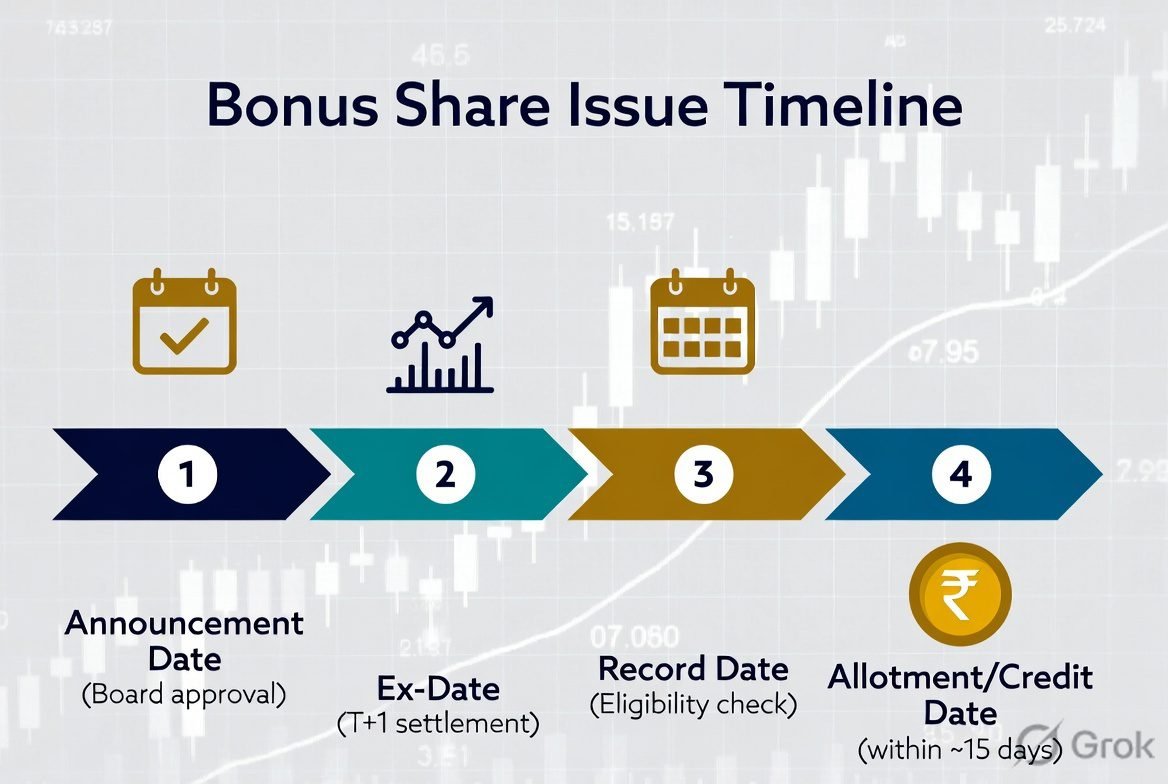
- Announcement date — When the company first informs the exchanges about the planned issue and ratio.
- Record date — The specific date the company checks its shareholder register. Only investors holding shares in their demat account on this date qualify.
- Ex-date — Under India's T+1 settlement cycle, this typically falls one trading day before the record date. Buy on or after the ex-date and you will not receive the extra shares, even though you technically own the stock.
- Credit date / allotment date — When the shares actually show up in your demat account, usually within roughly 15 days of the record date.
Worked ExampleReal Example: How Your Holding Changes
Let's walk through actual numbers using a hypothetical based on real market patterns.
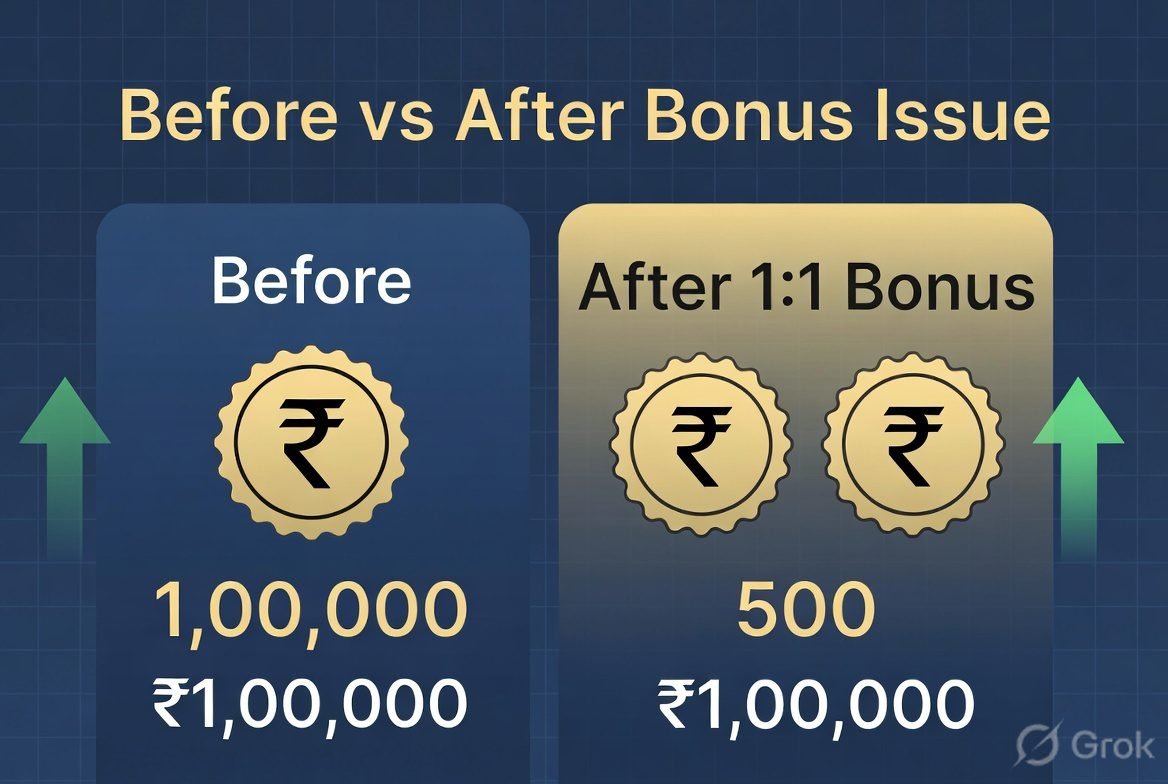
Suppose you own 100 shares of a company trading at ₹1,000 per share. Your total investment value: ₹1,00,000.
The company announces a 1:1 bonus issue. On the record date, you qualify. Within about 15 days, 100 new shares are credited to your demat account — you now hold 200 shares.
Your total investment value is, in theory, exactly the same as before. This is the part that surprises most first-time investors — a bonus issue by itself does not create additional wealth. What you're really getting is more shares at a proportionally lower price, which can help liquidity and psychologically make the stock feel "cheaper," but the arithmetic value of your holding stays flat on day one.
Where bonus shares can genuinely help you build wealth is if the improved liquidity, broader shareholder base, or the market's positive read on management's confidence leads to the stock re-rating upward over the following months — but that's a market outcome, not a guaranteed mechanical effect of the bonus itself.
We track bonus-adjusted holdings for our own model tracking sheet using exactly this 1:1 example, because it's the ratio most beginners encounter first and the easiest to sanity-check by hand before trusting any calculator.
ComparisonBonus Shares vs Stock Split vs Dividend
These three terms get mixed up constantly, and understanding the distinction is genuinely useful, not just trivia.
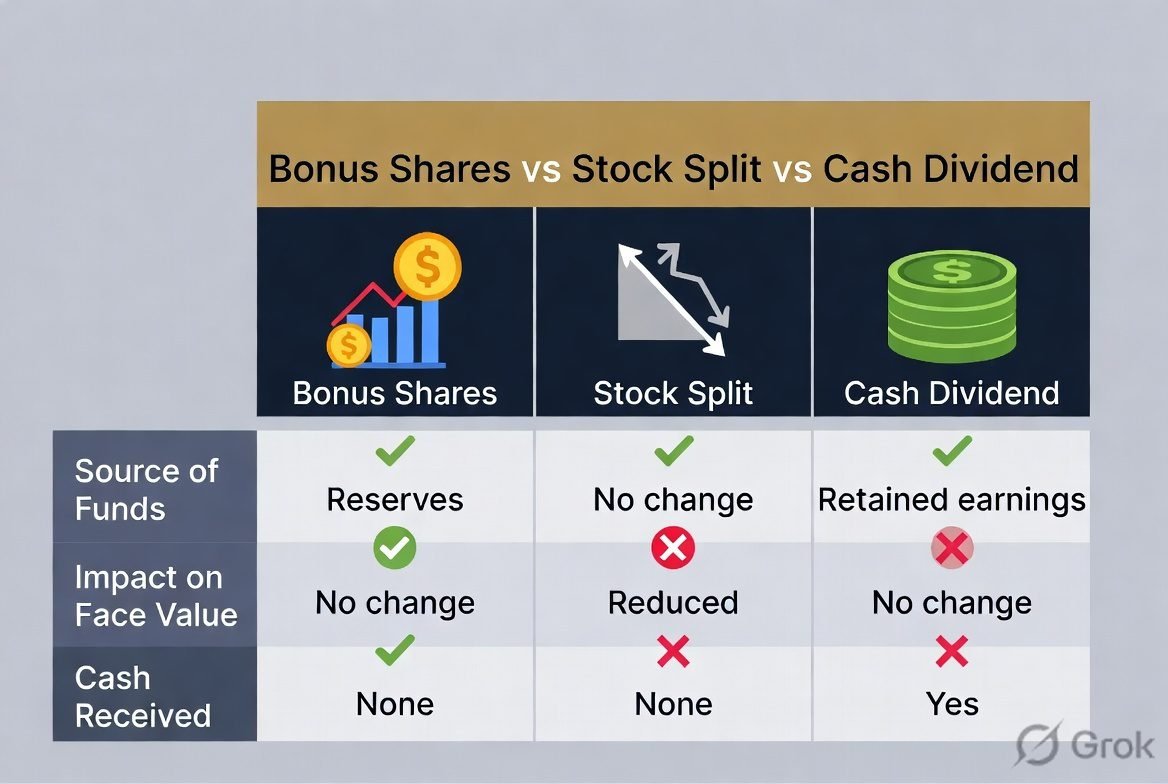
| Feature | Bonus Share | Stock Split | Cash Dividend |
|---|---|---|---|
| Source of funds | Capitalised free reserves | No new capital involved | Distributed profit |
| Face value | Stays the same | Reduced proportionally | Not applicable |
| Shares outstanding | Increases | Increases | Unchanged |
| Cash received | None | None | Yes |
| Tax at receipt (India) | None | None | Taxed as income in your slab |
A bonus issue capitalises reserves into new shares, while a stock split simply divides each existing share into smaller units by reducing the face value — no reserves are touched at all. A cash dividend, by contrast, actually puts money in your bank account and is taxed as income in the year you receive it.
If you're still building your foundational understanding of how the stock market works before layering on corporate actions like this, our beginner investing guide is a good place to start, and our explainer on NSE vs BSE covers where these shares actually get credited and traded.
TaxationTax Treatment of Bonus Shares in India
Bonus shares themselves are not taxed at the time of allotment — you don't owe anything simply for receiving them. Tax only becomes relevant when you eventually sell them, and the calculation has one important quirk:
- Cost of acquisition is treated as zero for these shares specifically, since you paid nothing for them.
- When you sell, the entire sale price becomes your capital gain, not just the appreciation over a purchase price.
- Holding period is calculated from the date of allotment, not from when you bought the original shares.
- If held for more than 12 months from allotment, gains qualify for long-term capital gains (LTCG) treatment; if sold within 12 months, they're taxed as short-term capital gains (STCG).
This zero-cost-basis rule genuinely surprises a lot of investors at tax filing time. If you're preparing your return around this, our ITR filing deadline guide covers the broader filing calendar, and understanding how circuit breakers affect trading is useful background if you're active around ex-dates when volatility can spike.
PitfallsCommon Mistakes Beginners Make
- ✕Assuming the announcement makes you instantly richer. As shown in the example above, your total holding value is essentially unchanged on day one — only the share count and price per share move.
- ✕Buying on the record date instead of before the ex-date. Because of settlement timing, you must own the stock before the ex-date, which typically falls a day earlier.
- ✕Confusing bonus shares with a stock split. They look similar on the surface (more shares, lower price) but work through entirely different accounting mechanisms.
- ✕Chasing stocks purely because free shares were announced. The ratio alone tells you nothing about whether the underlying business is fundamentally sound — always check the company's reserves, earnings trend, and overall financial health first.
- ✕Forgetting the zero-cost-basis rule at tax time, which can result in a much larger taxable gain than investors expect when they eventually sell.
FAQFrequently Asked Questions
Q.What is a bonus share in simple terms?
A bonus share is a free additional share a company gives to existing shareholders by converting part of its reserves into new share capital, instead of paying that money out as a cash dividend.
Q.Do I have to pay for bonus shares?
No. They are issued entirely free of cost to shareholders who qualify as of the record date.
Q.Does a bonus share increase the value of my investment?
Not immediately. The share price adjusts downward in proportion to the ratio, so your total investment value typically stays about the same right after the issue. Any future gain depends on how the market re-rates the stock afterward.
Q.What is the difference between record date and ex-date?
The record date is when the company checks its shareholder register to determine eligibility. The ex-date, usually one trading day earlier under India's T+1 settlement, is the actual cutoff — you must buy before the ex-date to be reflected as a shareholder on the record date.
Q.Are bonus shares taxable in India?
There's no tax at the time of receiving them. Tax applies only when you sell, and since your cost of acquisition is treated as zero, the entire sale proceeds count as your capital gain, taxed as short-term or long-term depending on your holding period from the allotment date.
Q.How is a bonus share different from a stock split?
A bonus issue capitalises company reserves into new shares, while a stock split simply divides the face value of existing shares into smaller units without touching reserves at all. Both increase share count and reduce price per share, but the underlying accounting is different.
Q.How long does it take to receive bonus shares after the record date?
Typically credited to your demat account within about 15 days of the record date, though exact timelines can vary by company and registrar processing speed.
Q.Can I sell bonus shares immediately after receiving them?
Yes, once credited to your demat account, they can be sold like any other holding — just be mindful of the short-term versus long-term capital gains tax treatment based on the allotment date.
References
- Choice India — LIC Bonus Share Record Date 2026
- HDFC Sky — Foce India Bonus Issue Record Date
- Anand Rathi — Bonus Shares 2026 Guide
- Bajaj Finserv — What Are Bonus Shares
- 5paisa — Bonus Shares vs Stock Split
- Kotak Neo — Upcoming Bonus Shares 2026
- Business Today — Upcoming Bonus Share Record Date Details
- SEBI — Listing Obligations and Disclosure Requirements
- NSE India — Corporate Actions

Pranab Barman is a Financial Educator and Personal Finance Researcher with over 10 years of hands-on experience in stock markets, trading, and investing. Currently enrolled in the CFA Program, he is committed to continuous learning and professional excellence in finance.
As the Founder of PlayWithStock, Pranab covers a wide range of topics including Mutual Funds, SIP, Taxation, Stock Market Basics, and Financial Calculators — with a focus on simplifying complex financial concepts for everyday all investors.
Email: support@playwithstock.com
Website: playwithstock.com
Related posts:
 Micro-Investing Apps for Beginners: A Complete Comparison
 Share Buyback Tender vs Sell Calculator: 2026 Tax Guide
 Trump Accounts Explained: The $1,000 Baby Bonus Already Reaching 6 Million Kids
 Term Insurance vs Endowment Plan: Which is Better for Beginners in 2026
 What is a Demat Account? A Complete Beginner’s Guide
 Vodafone Idea Stock 2026: The Complete ₹35,000 Crore Guide
 AI Investing 2026: The Complete India-US Stock Guide
 SSY Maturity Calculator 2026: The Complete Guide