


AI Investing 2026: The Complete India-US Stock Guide
Nvidia dropped 12% last month. Microsoft fell 17%. Broadcom gave back 20%. If your only exposure to "AI investing" content has been pure hype, here's the version that actually mentions the correction — and what it means for your money in India and the US.
The AI trade didn't die in July's pullback — but it did get tested, in ways most coverage conveniently skipped.
AI Investing 2026 content online falls into two camps, and neither is particularly useful. One camp is still writing "just buy Nvidia" posts as if it's 2023. The other is calling a bubble that hasn't actually burst. What almost nobody is doing is the boring, useful thing: looking at what actually happened to AI stocks over the past month, in both the US and India, and building a plan around that reality rather than a narrative.
So let's start with the part most guides bury or skip entirely.
What Actually Happened in June-July 2026
Understanding AI Investing 2026 properly means starting with the tension driving that pullback, and it's not really about AI at all — it's about interest rates. The US Federal Reserve, under new Chair Kevin Warsh, held the federal funds rate steady at 3.50-3.75% at its June 16-17 meeting, but the tone shifted noticeably hawkish. The updated dot plot showed nine of nineteen officials now expecting at least one more rate hike before the end of 2026 — a real reversal from the rate-cut expectations that had been supporting growth stock valuations earlier in the year. A softer-than-expected June jobs report (just 57,000 new jobs, against a forecast of 110,000) has since pulled the market back toward pricing in a hold at the next meeting on 28-29 July, but the hawkish scare itself was enough to knock the air out of richly-valued AI names.
That's the mechanism worth understanding: AI stocks, especially the mega-cap names trading on optimistic future-earnings assumptions, are unusually sensitive to interest rate expectations. When the market suddenly has to price in a plausible rate hike instead of a cut, the present value of those distant future earnings drops — and the stocks with the richest valuations get hit hardest, regardless of how good their actual quarterly numbers are.
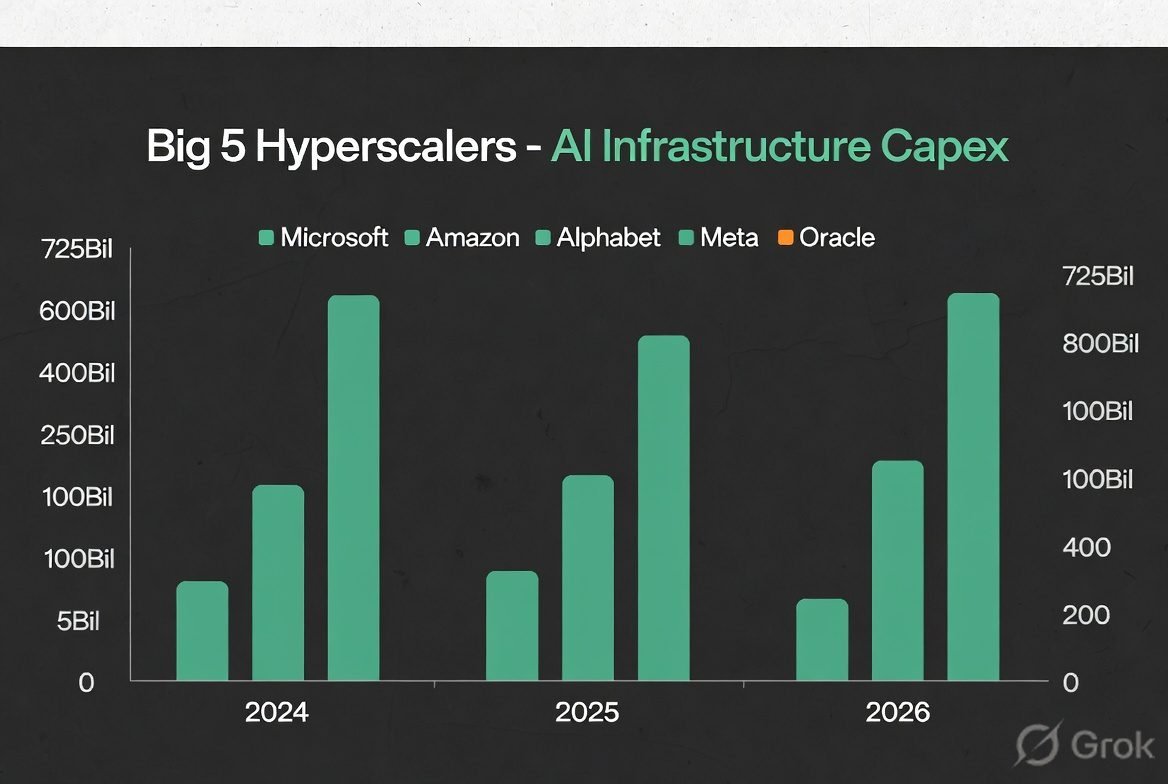
Meanwhile, the underlying business story kept getting stronger, not weaker, through the same period. The Big Five hyperscalers — Microsoft, Amazon, Alphabet, Meta, and Oracle — are now guiding toward combined 2026 capital expenditure of roughly $725 billion, according to Financial Times reporting cited by multiple outlets, a 77% jump from 2025 and well above the roughly $500 billion analysts had originally penciled in. Nvidia's share of that spending has actually been rising: the company now captures an estimated 57 cents of every dollar hyperscalers spend on AI infrastructure, up from 39 cents just four quarters earlier.
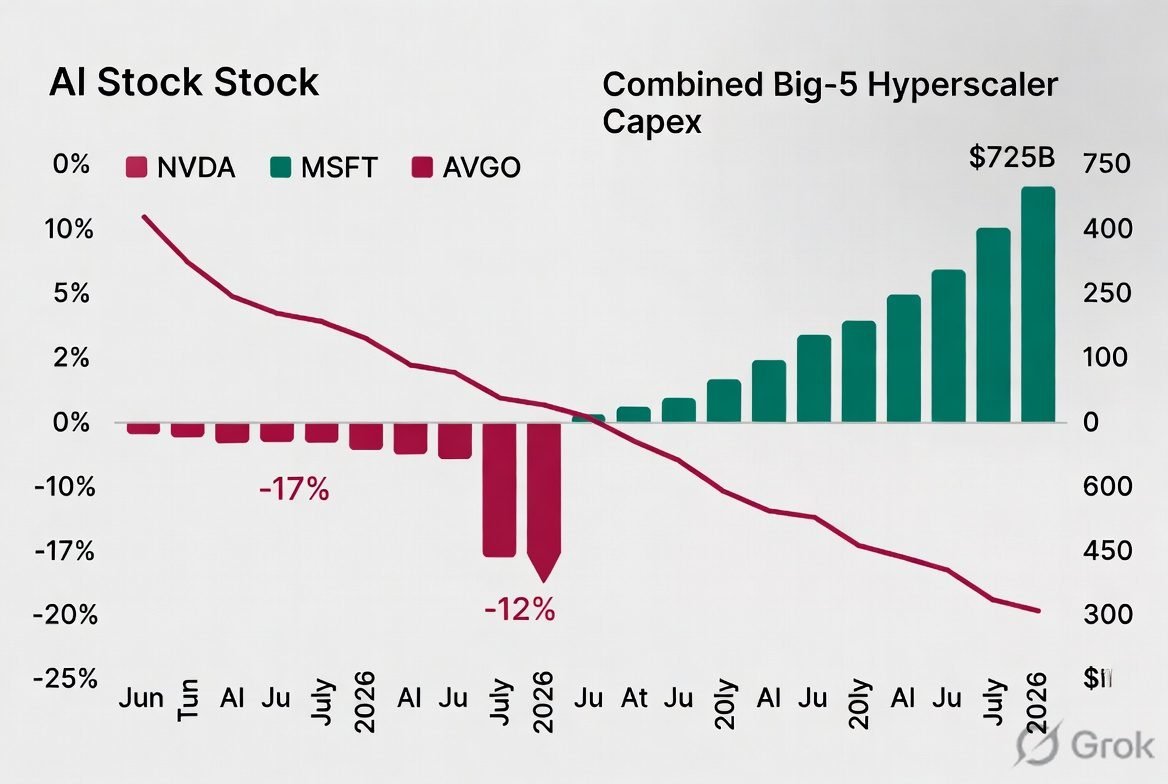
Capex guidance went up through the same weeks stock prices went down — a genuine disconnect worth sitting with, not explaining away.
US AI Stocks: What's Actually Holding Up in AI Investing 2026
Individual stock stories inside this pullback have looked quite different from each other, which is exactly why treating "AI stocks" as one homogenous basket is a mistake.
Held Up Relatively Well
Even after a roughly 20% pullback from highs, AVGO guided Q3 AI chip revenue to $16 billion — over 200% year-on-year growth — backed by confirmed hyperscaler design wins at Google, Meta, and OpenAI. Free cash flow hit $10.26 billion, about 46% of revenue, with eight consecutive quarters of EPS beats. Trading near $376 against an analyst consensus target above $520.
Hit Hardest
Down nearly 17% in a month heading into its late-July fiscal year-end print. The stock's size and valuation made it a natural target for rate-sensitive selling, even though Azure's AI-driven growth trajectory hasn't visibly cracked.
Nvidia (NVDA) sits in between — down about 12% over the same stretch, but still carrying, according to CEO Jensen Huang, $119 billion in supply commitments, and still controlling an estimated 80-90% of the AI accelerator market. Huang has publicly framed the current build-out as "the largest infrastructure expansion in human history," and whatever you think of the rhetoric, the order book behind it is real. Nvidia's next earnings report lands in late August, meaning July's price action is being driven almost entirely by macro rate speculation, not company-specific news.
Other names worth knowing about beyond the obvious mega-caps: Vertiv (VRT) and Equinix (EQIX) play the data-centre infrastructure and cooling side of the buildout rather than the chips themselves, while Constellation Energy (CEG) represents the power-generation angle — AI data centres consume enormous amounts of electricity, and that demand is feeding a genuine nuclear and natural gas revival conversation in US energy markets. Micron (MU) supplies the high-bandwidth memory that goes alongside AI chips, a less glamorous but structurally necessary part of the stack.
The ETF Route for US Investors
For anyone who doesn't want to bet on picking the right individual names, thematic AI ETFs remain the cleaner entry point — you own the buildout without needing to guess which specific chipmaker or hyperscaler wins the next product cycle.
| ETF | Ticker | Focus | Expense Ratio |
|---|---|---|---|
| Global X Artificial Intelligence & Technology | AIQ | Broad AI + software | 0.68% |
| VanEck Semiconductor | SMH | Chips & semiconductors | 0.35% |
| iShares Future AI & Tech | ARTY | Active/passive hybrid | ~0.47% |
| Global X Robotics & AI | BOTZ | Robotics + automation | 0.69% |
A reasonable starting split for a beginner: treat AIQ or ARTY as your core broad-AI holding, add SMH as a higher-conviction semiconductor satellite, and leave BOTZ as an optional tilt if you specifically want robotics exposure alongside pure AI software and chips. None of this needs to be complicated — the expense ratios across this category (0.35%-0.75%) are reasonable for thematic exposure, and there's little reason to pay more than that unless an actively managed fund has a genuinely differentiated, understood edge.
Every gigawatt of new AI data centre capacity translates almost directly into GPU procurement — the mechanical link investors are betting on.
India's AI Investing 2026 Story: The Uncomfortable Truth
This is where a lot of Indian-focused AI content gets sloppy, repeating the same two or three "AI-linked" stock names without checking whether the actual price action and analyst sentiment still support the story. It doesn't, for at least one of the usual suspects.
Tata Elxsi — The Story Has Cracked
Trading around ₹3,824 as of mid-July, down from a 52-week high of ₹6,439. Motilal Oswal Financial Services has a Sell rating with a ₹3,350 target — implying further downside — citing delayed deal closures, elongated decision cycles, and a guidance reset to high-single-digit FY27 growth. This is the exact opposite of the "clean AI story" framing that circulates in a lot of retail content.
Persistent Systems — Still the Stronger Story
Trading near ₹5,195, with quarterly revenue growth of over 7% sequentially and EBITDA growth above 17%. MOFSL maintains a Buy rating alongside HCL Technologies, in direct contrast to its Tata Elxsi call. Market cap of roughly ₹85,750 crore versus Tata Elxsi's ₹26,700 crore — a meaningfully larger, more liquid name.
Why does this matter beyond these two specific names? Because it's a useful lesson in how quickly a "story" stock can decouple from its narrative. Tata Elxsi's AI and design-engineering positioning was genuinely compelling in 2023-2024 — but positioning alone doesn't protect a stock price when actual deal closures slow down and growth guidance gets cut. Persistent Systems has continued delivering the revenue growth to back its own AI-and-cloud narrative; Tata Elxsi, for now, hasn't.
Beyond these two, the broader domestic basket worth knowing includes Bosch Ltd (automotive AI and Industry 4.0 automation), Happiest Minds (a digital-native services firm with high AI-project intensity), and the wider IT services pack — LTIMindtree, Coforge, and Cyient — all of which are seeing rising deal-value contribution from AI-linked digital transformation work, even if none of them are pure-play AI companies the way Nvidia is.
How Indians Can Actually Get AI Exposure
For most Indian investors, chasing individual "AI stocks" — domestic or American — is a riskier and more research-intensive route than it needs to be. Three practical paths, roughly in order of simplicity:
1. SIP Into International/Technology-Themed Funds
Several Indian mutual funds and Funds of Funds hold Nasdaq-100 or US technology-heavy portfolios, which gives automatic exposure to Microsoft, Nvidia, Amazon, Alphabet, and Meta without needing to open an LRS remittance every month. This is genuinely the lowest-friction route for most salaried investors, especially those running SIPs under roughly ₹50,000 a month, since it avoids repeated TCS, currency conversion, and paperwork. India's own SIP culture is worth noting here too — June 2026 inflows hit ₹31,781 crore, a three-month high and roughly 17% ahead of the same month last year, showing just how much disciplined domestic capital is now flowing into equity markets every single month.
2. Direct US Stocks/ETFs via the RBI's Liberalised Remittance Scheme
Every resident Indian can remit up to USD 250,000 per financial year for overseas investment, including US stocks and ETFs, without special RBI permission. In practice: pick a platform (Groww, Zerodha, Vested, INDmoney, or Interactive Brokers for more advanced users), complete KYC and a W-8BEN form for reduced dividend withholding, fund via LRS under purpose code S0001, and buy — fractional shares mean you can start with $10-50 in Nvidia or AIQ rather than needing a full share's worth of capital. Gains on US equities held over 24 months are taxed as long-term capital gains at 12.5% under current rules; dividends are taxed at your slab rate after foreign tax credit.
3. A Domestic AI-Linked Stock Basket
For investors who want direct India exposure to the theme, a small, deliberately diversified basket — rather than a single-name bet — reduces the risk of a Tata-Elxsi-style disappointment derailing the whole allocation. Treat this as a satellite position, not a core holding.
Three Sample Portfolios for 2026
These are illustrative structures, not personal recommendations — adjust based on your own age, risk tolerance, and existing holdings.
| Portfolio | Allocation |
|---|---|
| Conservative Indian Beginner (₹10,000-25,000/month SIP) | 50% Nifty/Sensex index or flexi-cap · 25% international/US-tech fund · 15% midcap/multicap · 10% direct satellite (Persistent Systems or small LRS buy of AIQ) |
| Balanced India + US (₹25,000+ SIP or SIP+LRS mix) | 40% Indian equity · 30% US AI ETFs via LRS (AIQ 20% + SMH 10%) · 15% domestic AI-linked basket · 15% gold ETF or debt |
| US Investor, Growth-Tilted ($500-2,000/month) | 40% Total US market (VTI/VOO) · 30% AI core (AIQ/ARTY) · 20% semiconductors (SMH) · 10% high-conviction individual names or BOTZ |
Whichever structure you pick, automate it. Set up auto-SIP on your salary-credit day, use direct mutual fund plans to avoid unnecessary commission drag, and review the actual holdings of any "international" or "technology" fund every six months to confirm its AI/tech weighting hasn't quietly drifted. The single biggest advantage of systematic investing through a volatile theme like this one is mechanical, not emotional: you automatically buy more units when prices fall and fewer when they're euphoric, which is the opposite of what most retail investors do when left to their own timing instincts.
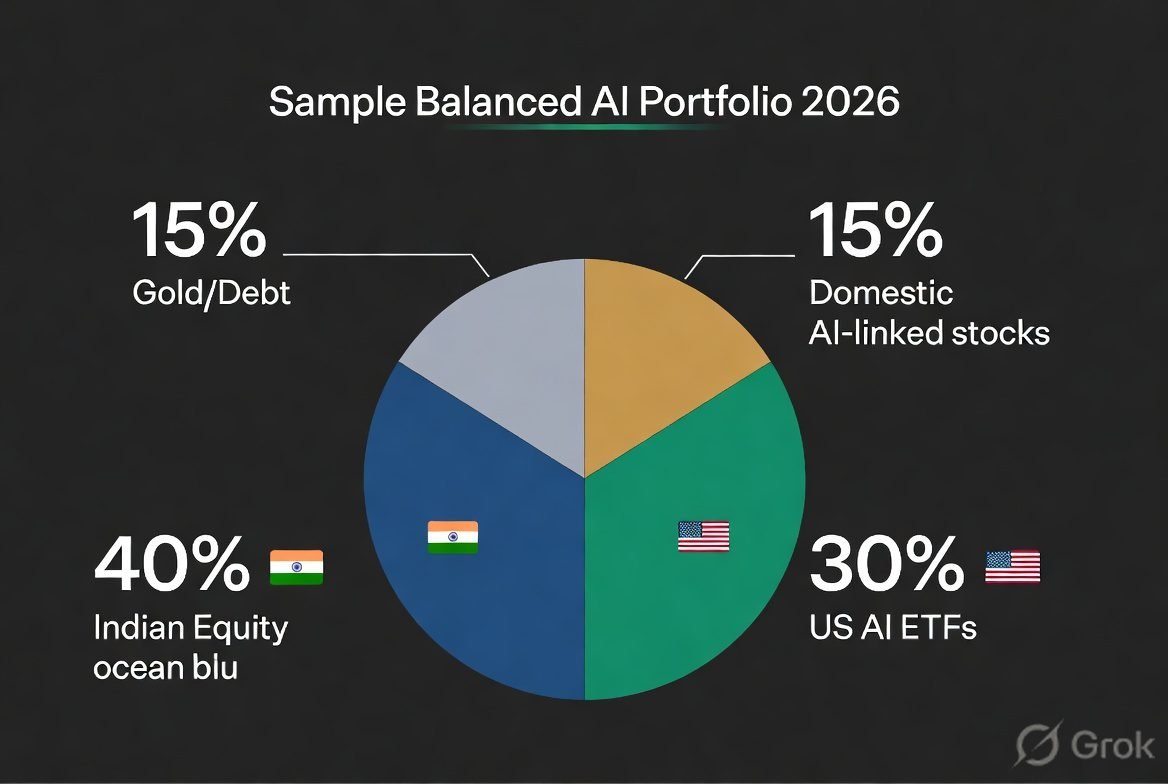
Diversified allocation beats stock-picking for the vast majority of people trying to participate in this theme.
The Risks the Hype Content Skips
Every one of these risks showed up in real form during the June-July 2026 pullback, which makes them easier to explain now than they would have been six months ago.
Valuation and Rate Sensitivity
Richly-valued growth names get hit hardest when rate expectations shift hawkish, exactly as MSFT and NVDA just demonstrated. This isn't theoretical anymore — it's the specific mechanism behind the past month's price action.
Concentration Risk
Nvidia alone dominates the weighting of many "broad" AI ETFs. If something goes wrong at one company — a supply disruption, a customer pulling back — a large share of your thematic exposure feels it. Prefer broader, more diversified ETFs over single-stock bets for the bulk of any AI allocation.
The "Story Stock" Trap (India-Specific)
Tata Elxsi's last two quarters are the clearest recent case study: a company can carry a compelling AI narrative for years and still see its stock cut in half from highs once actual deal execution slows. Verify current numbers before assuming any domestic "AI stock" reputation still holds.
Currency and Compliance Risk (Indians Investing Abroad)
INR-USD movement affects your rupee-denominated returns on any US holding, and foreign asset reporting requirements (Schedule FA/FSI) carry real compliance consequences if skipped. Treat US exposure as a genuinely long-term (5+ year) allocation to let currency effects average out.
Should You Buy Into AI Investing 2026 Right Now?
Honestly, nobody — including every analyst quoted in this piece — can tell you with certainty whether June-July's pullback is the buying opportunity or the first leg of something larger. What the data actually supports is more modest: the underlying business fundamentals (hyperscaler capex, order backlogs, AI chip demand) have not deteriorated alongside the stock prices, which is a meaningfully different situation than a correction driven by genuine demand destruction. The proximate cause here is interest rate repricing, not a crack in the AI buildout itself.
That distinction matters for how you act on it. If you already have a systematic SIP or dollar-cost-averaging plan running, the sensible response to this kind of pullback is usually to keep it running unchanged, not to either panic-sell or dramatically increase contributions on a single month's price move. If you've been sitting entirely in cash waiting for an entry point, a pullback caused by rate speculation rather than fundamental deterioration is at least a more defensible entry than buying at the prior highs — though "more defensible" is not the same as "guaranteed."
The Bottom Line
AI Investing 2026 is genuinely a different exercise than it was in 2023 — the opportunity has broadened well beyond "just buy Nvidia" into a real ecosystem spanning chips, power, data-centre infrastructure, and enterprise software, in both US and Indian markets. But the past month's pullback is a useful, concrete reminder that "the theme is real" and "the stock price is cheap right now" are two entirely different questions, and conflating them is how retail investors overpay for good stories. Build a diversified, systematic plan across both a broad core and a thematic satellite, check the actual current numbers on any specific stock before trusting its reputation, and let time and consistency — rather than perfect timing — do the heavy lifting.
FAQs: AI Investing 2026
No, though the entry point matters more after a pullback than it did during 2023's early run-up. The infrastructure build-out (hyperscaler capex, chip demand) remains in an early, expanding phase rather than a mature one.
The pullback was driven primarily by a hawkish shift in Fed rate expectations after the June FOMC meeting, which hit richly-valued growth stocks hardest, rather than by any deterioration in AI demand or hyperscaler spending plans.
Current analyst sentiment is notably cautious — Motilal Oswal has a Sell rating with a target implying further downside, citing delayed deal closures and reduced growth guidance. This has changed meaningfully from its earlier positioning as a "clean" AI story.
SIPs into international or technology-themed Indian mutual funds that hold Nasdaq-100 or US tech-heavy portfolios, since this avoids the paperwork, TCS, and repeated currency conversion involved in direct LRS remittances.
Common guidance ranges from 5-10% of equity for conservative or near-retirement investors up to 25-40% for younger, aggressive investors — but rarely 100%, given concentration and valuation risk.
For most beginners, broad AI ETFs (AIQ, ARTY) as a core holding with a semiconductor satellite (SMH) reduce single-company risk compared to concentrated individual stock bets, especially given how differently NVDA, MSFT, and AVGO have each behaved through the recent pullback.
USD 250,000 per financial year per resident individual under the RBI's Liberalised Remittance Scheme, with TCS applicable above ₹10 lakh in remittances (claimable as a credit later).
Unlike the 1999-2000 internet bubble, today's largest AI-linked companies are generating substantial real free cash flow alongside their spending, which is a materially different foundation. That doesn't eliminate valuation risk, but it does distinguish the current cycle from a pure narrative-driven bubble.
References: The Motley Fool: AI Stocks Crush the Market in 2026 · 24/7 Wall St: Top AI Stocks to Buy in July · A.L. Capital Advisory: AI Capex Cycle Analysis · Federal Reserve: June 2026 FOMC Statement · Wells Fargo: FOMC Meeting Summary · ICICI Direct: Tata Elxsi Share Price · Business Today: MOFSL Ratings on IT Stocks · BlinkX: Persistent Systems vs Tata Elxsi Comparison

Pranab Barman is a Financial Educator and Personal Finance Researcher with over 10 years of hands-on experience in stock markets, trading, and investing. Currently enrolled in the CFA Program, he is committed to continuous learning and professional excellence in finance.
As the Founder of PlayWithStock, Pranab covers a wide range of topics including Mutual Funds, SIP, Taxation, Stock Market Basics, and Financial Calculators — with a focus on simplifying complex financial concepts for everyday all investors.
Email: support@playwithstock.com
Website: playwithstock.com
Related posts:
 Micro-Investing Apps for Beginners: A Complete Comparison
 Vodafone Idea Stock 2026: The Complete ₹35,000 Crore Guide
 Beginner Investing: 7 Proven Steps to Start the Right Way
 Crypto Bookkeeping for Tax in India: The Complete 2026 Guide
 Stocks to Buy After India-US Trade Deal 2026: A Sector-by-Sector Breakdown
 What is a Demat Account? A Complete Beginner’s Guide
 What Is Circuit Breaker Stock Market: Meaning, Limits & 2026 Update
 ITR Refund Status Kaise Check Kare 2026: The Complete Step-by-Step Guide