


ITR filing last date 2026 is one of the most important dates on any Indian taxpayer’s calendar this year, and this filing season carries more weight than usual. Not only is the salaried taxpayer deadline just three weeks away, this is also the final assessment year filed entirely under the old Income Tax Act, 1961, before a new tax framework takes over. Here’s everything you need to know, verified against official sources.
Table of Contents
- ITR Filing Last Date 2026: Complete Deadline Calendar
- Why This Filing Season Is Different: The New Income Tax Act
- What Happens If You Miss the ITR Filing Last Date
- Belated Returns, Revised Returns and Updated Returns Explained
- Key Changes for AY 2026-27 You Should Know
- Which ITR Form Applies to You
- How to File Your ITR Before the Deadline
- FAQs
1. ITR Filing Last Date 2026: Complete Deadline Calendar
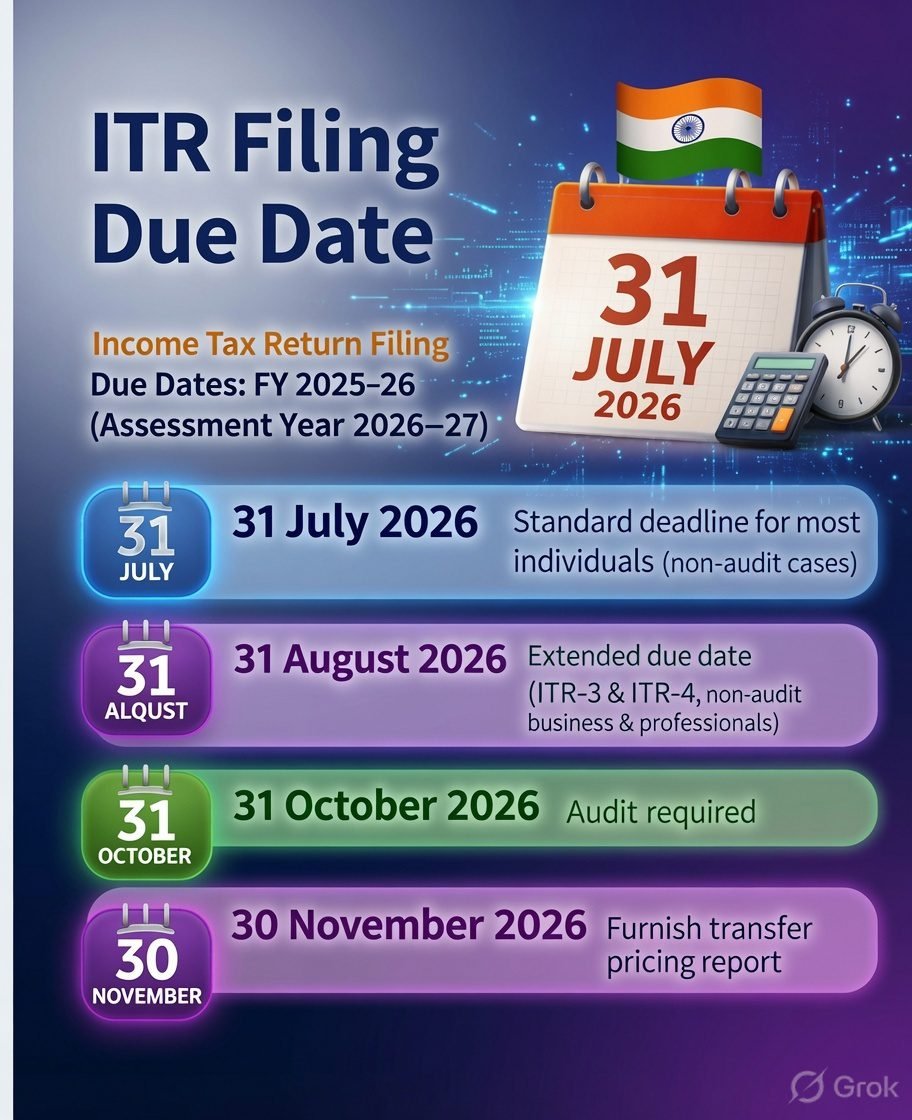
The ITR filing last date 2026 actually varies depending on your taxpayer category, not a single date for everyone. Here’s the complete breakdown, confirmed on the official Income Tax Department portal:
| Taxpayer Category | ITR Filing Last Date 2026 |
|---|---|
| Salaried individuals (ITR-1, ITR-2) | 31 July 2026 |
| Business/professionals without audit (ITR-3, ITR-4) | 31 August 2026 |
| Taxpayers requiring audit under Section 44AB | 31 October 2026 |
| Taxpayers with transfer pricing reports | 30 November 2026 |
| Tax audit report submission | 30 September 2026 |
This table applies to Assessment Year 2026-27, covering income earned in Financial Year 2025-26 (April 2025 to March 2026). If you’re a salaried employee, contractor income earner, or someone with two house properties or interest income, July 31 is your date to watch closely. You can also cross-check applicable due dates directly on the Income Tax India tax calendar.

2. Why This Filing Season Is Different: The New Income Tax Act
This year’s ITR filing last date 2026 marks a genuine turning point in Indian tax history. The Income Tax Act, 2025 comes into force from April 1, 2026, replacing the Income Tax Act, 1961, that has governed Indian taxation for over six decades.
However, since Assessment Year 2026-27 covers income earned in FY 2025-26, which falls entirely before the new Act took effect, this year’s returns are still governed completely by the old 1961 framework, according to the Income Tax Department’s official clarification. This makes AY 2026-27 the final filing season under the familiar old Act.
Going forward, filings for Tax Year 2026-27 (income earned from April 2026 onwards) won’t be due until July 2027, and they’ll fall under the new Act entirely. One notable change: the terms “Assessment Year” and “Previous Year” are being replaced by the simpler term “Tax Year” under the new framework, a structural simplification long requested by tax professionals.
3. What Happens If You Miss the ITR Filing Last Date
Missing the ITR filing last date 2026 doesn’t mean you’ve lost your only option, but it does carry real financial consequences. A late filing fee under Section 234F applies: ₹1,000 if your total income doesn’t exceed ₹5 lakh, and ₹5,000 in any other case.
Beyond the flat fee, interest under Section 234A accrues at 1% per month, or part of a month, on any unpaid tax amount, according to guidance from ClearTax. This interest compounds the longer you delay, making early filing meaningfully cheaper than late filing even before accounting for the flat penalty.
Perhaps the most overlooked consequence: filing late means losing the right to carry forward certain losses, including capital losses and business losses, to offset against future profits. If you’ve had a rough year in the stock market or elsewhere, missing this deadline can mean losing your ability to reduce future tax liability with this year’s losses entirely. This applies just as much to gains or losses booked on Nifty and Sensex-linked investments as it does to any other capital asset.
4. Belated Returns, Revised Returns and Updated Returns Explained
If you miss the original ITR filing last date 2026, Indian tax law offers a tiered set of fallback options, though each comes with trade-offs.
Belated Return: Filed after missing the original deadline, a belated return for FY 2025-26 can be submitted until December 31, 2026. Late fees and interest apply, and certain losses cannot be carried forward.
Revised Return: If you’ve already filed but discover an error, such as a missed deduction, Budget 2026 brought meaningful relief here. The revised return deadline has been extended from the earlier December 31 cutoff to March 31, 2027, giving taxpayers a full extra quarter to correct genuine mistakes.
Updated Return (ITR-U): This allows voluntary disclosure of previously omitted income, even years later, within four years from the end of the relevant assessment year. For AY 2026-27, that means updated returns can technically be filed until March 31, 2031, though additional tax of 25% to 50% on the incremental tax and interest applies as a penalty for this extended window.
5. Key Changes for AY 2026-27 You Should Know
Beyond the headline deadline, a few structural changes are worth understanding before you file:
ITR-1 now covers two house properties. Previously limited to a single house property, ITR-1 for AY 2026-27 has been expanded to cover income from up to two house properties, a change that lets more taxpayers use the simpler form rather than being pushed into ITR-2.
ITR-3/ITR-4 non-audit deadline extended. Business and professional taxpayers not requiring an audit now get until August 31, 2026, a full month more than salaried filers, and this is a permanent structural change under the Finance Act, 2026, not a one-time extension.
New tax regime remains default. Under Section 115BAC, the new tax regime continues as the default option for FY 2025-26, with no change to existing slabs announced in Budget 2026. Taxpayers who prefer the old regime, particularly those claiming deductions like those covered in our term insurance vs endowment plan comparison under Section 80C of the Income Tax Act, must actively opt in when filing.
Capital gains from gold and equity need careful reporting. With gold prices near record highs this year, many investors booked profits on physical gold, SGBs, or gold ETFs, all of which carry distinct capital gains treatment that must be reported accurately in the applicable ITR form.
6. Which ITR Form Applies to You
Choosing the correct ITR form determines your actual deadline and how complex your filing process will be. Getting this wrong can delay processing or trigger a notice from the department.
ITR-1 suits salaried individuals with income from salary, up to two house properties, or interest income within specified limits. Capital gains, foreign assets, or agricultural income exceeding ₹5,000 disqualify you from this simpler form.
ITR-2 applies if you have capital gains, more than two house properties, or are a company director, situations that push you beyond ITR-1’s scope, including investors actively trading through a demat account.
ITR-3 is for individuals with business or professional income requiring detailed accounting, while ITR-4 suits those opting for presumptive taxation with turnover within prescribed limits.
7. How to File Your ITR Before the Deadline
Filing itself happens directly through the Income Tax Department’s e-filing portal, where offline utilities and online filing tools for ITR-1 through ITR-4 are already active for AY 2026-27. Most salaried taxpayers can complete the process in under an hour with Form 16, bank interest certificates, and investment proofs on hand.
Before filing, it helps to have your full financial picture organized. If your investment records feel scattered across multiple accounts, a structured approach like our 50/30/20 budgeting framework or maintaining a dedicated sinking fund for annual tax payments can make each filing season considerably less stressful than a last-minute scramble. Beginners just starting to track their income and investments together can also benefit from our beginner investing guide, and our broader Personal Finance category covers related budgeting and tax topics in more depth.
Real-World Example
Consider two taxpayers with identical incomes. One files on July 25, 2026, comfortably ahead of the deadline, claims all eligible deductions carefully, and receives their refund within a few weeks. The other waits until August, misses the July 31 cutoff, and ends up filing a belated return in September.
The second taxpayer pays a ₹5,000 late fee plus accumulated interest under Section 234A, faces a delayed refund, and, if they had any capital losses from the year’s market volatility, permanently loses the ability to carry those losses forward to offset future gains. The gap between these two outcomes, purely due to timing, illustrates why the ITR filing last date 2026 deserves real attention well before the final week of July.
FAQs
What is the ITR filing last date 2026 for salaried employees? For salaried individuals filing ITR-1 or ITR-2, the ITR filing last date 2026 is 31 July 2026, covering income earned in FY 2025-26.
Is the ITR filing deadline different for business owners? Yes. Business and professional taxpayers filing ITR-3 or ITR-4 without an audit requirement have until 31 August 2026, a full month later than salaried filers, under changes introduced by the Finance Act, 2026.
What happens if I miss the ITR filing last date? You can still file a belated return until 31 December 2026, but you’ll face a late fee of ₹1,000 to ₹5,000 under Section 234F, interest under Section 234A, and the loss of your ability to carry forward certain losses like capital losses to future years.
Is this the last year under the old Income Tax Act? Yes. Assessment Year 2026-27 is the final filing season governed entirely by the Income Tax Act, 1961. The new Income Tax Act, 2025 applies from Tax Year 2026-27 onward, with those returns due in 2027.
Can I revise my ITR after filing if I make a mistake? Yes. Following Budget 2026 changes, the revised return deadline has been extended to 31 March 2027, giving taxpayers significantly more time to correct genuine errors compared to the earlier 31 December cutoff. This is general information, not personalized tax advice; consult a qualified chartered accountant for guidance specific to your situation.

References
- Income Tax Department — Official e-filing portal and ITR filing services
- Income Tax India — Official tax calendar, due dates, and Income Tax Act reference
- ClearTax — ITR filing due dates and penalty calculations
- TaxGuru — Budget 2026 ITR filing updates and revised return changes
- Jaro Education — ITR filing last date AY 2026-27 detailed breakdown
- Kissht — ITR filing last date and belated/updated return timelines
Disclaimer: This article is for informational and educational purposes only and does not constitute tax or legal advice. Tax rules and deadlines are subject to government notification and change. Please refer to our Disclaimer page and consult a qualified chartered accountant or the official Income Tax Department portal before filing.
Author: Pranab | Play With Stock Last Updated: July 10, 2026

Pranab Barman is a Financial Educator and Personal Finance Researcher with over 10 years of hands-on experience in stock markets, trading, and investing. Currently enrolled in the CFA Program, he is committed to continuous learning and professional excellence in finance.
As the Founder of PlayWithStock, Pranab covers a wide range of topics including Mutual Funds, SIP, Taxation, Stock Market Basics, and Financial Calculators — with a focus on simplifying complex financial concepts for everyday all investors.
Email: support@playwithstock.com
Website: playwithstock.com
Related posts:
 ITR Refund Status Kaise Check Kare 2026: The Complete Step-by-Step Guide
 Zepto IPO 2026: Complete Guide — Date, Valuation, Financials, and Should You Apply?
 ITR-4 Investment Disclosure Calculator: New 2026 Rule for Presumptive Taxpayers
 Jio Financial Services Q1 FY27 Results Preview: Date, Estimates & Stock Analysis
 Nifty July Seasonality: Why July Is Nifty’s Strongest Month (27-Year Data)
 Nominee vs Legal Heir India: The Difference That Can Break a Family
 Share Buyback Tender vs Sell Calculator: 2026 Tax Guide
 SGB Redemption Tax Calculator 2026: The Complete Guide