
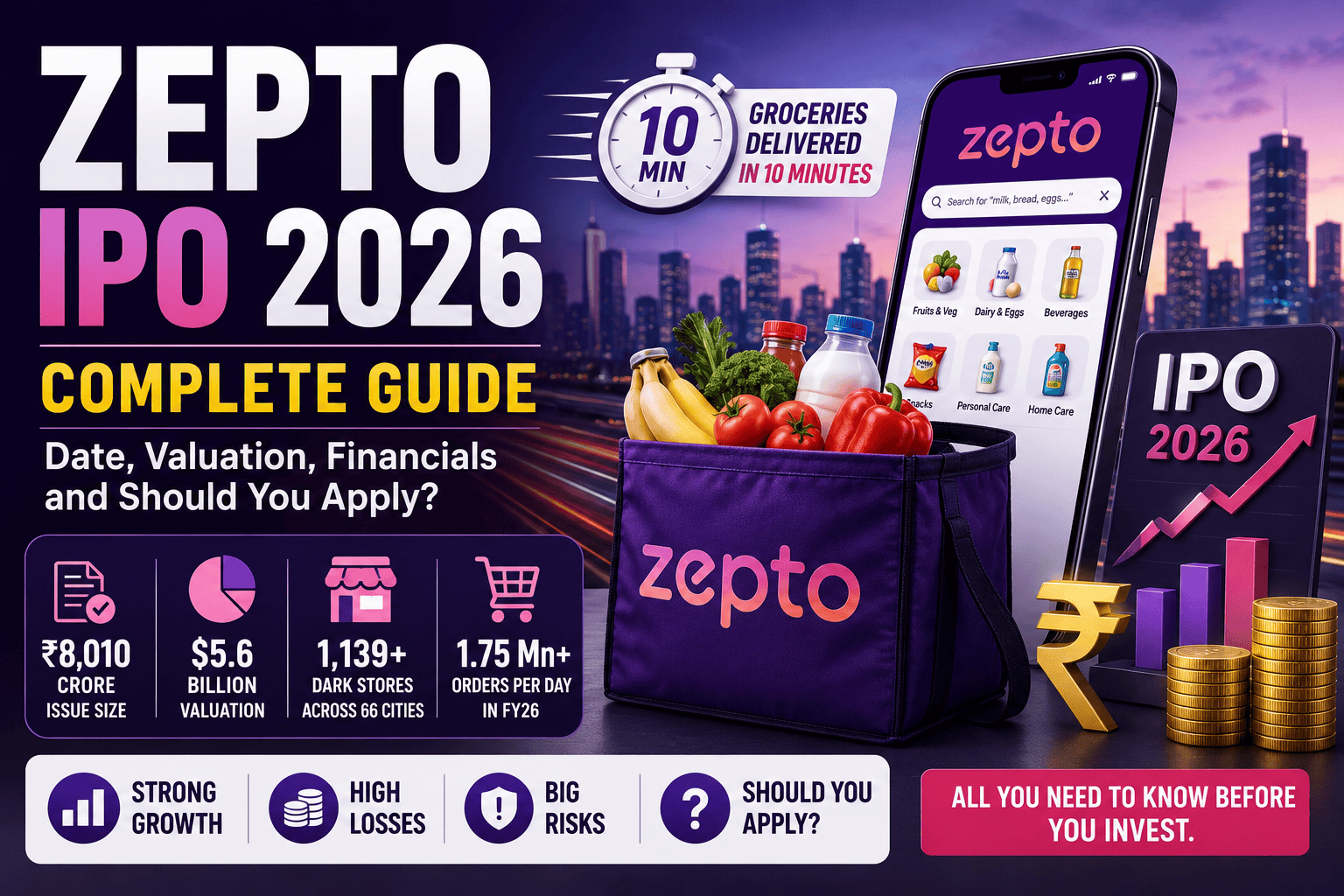

Zepto IPO 2026: Complete Guide — Date, Valuation, Financials, and Should You Apply?
Zepto IPO 2026 is probably the most talked-about upcoming listing in India's startup world right now. A company founded in 2021 by two 19-year-old Stanford dropouts, which promised to deliver groceries in 10 minutes, is now walking into Dalal Street with a ₹8,010 crore fresh issue, a $5.6 billion valuation, and a financial story that is equal parts impressive and sobering. Before you click "Apply" in your broker app, here is everything you actually need to know — the real numbers, the real risks, and an honest answer to whether this IPO makes sense for you.
What is Zepto — The Story Behind the 10-Minute Promise
In 2021, Aadit Palicha and Kaivalya Vohra were 19-year-old Stanford students stuck in India during the Covid-19 lockdown. They had a simple observation: getting groceries in Indian cities was genuinely painful. Traffic, queues, delivery apps that took 45 minutes to an hour — none of it was good enough. They dropped out of Stanford, moved to Mumbai, and started experimenting with what would become Zepto.
The core idea was simple but operationally hard to pull off. Instead of picking from a warehouse on the city's outskirts, Zepto set up "dark stores" — small, dense fulfillment centres packed with fast-moving grocery SKUs — right inside dense urban neighbourhoods. A customer places an order on the app; a picker in the dark store grabs the items; a delivery executive on a two-wheeler drops it within 10 minutes. No consumer-facing storefront, no wasted space, no long delivery routes.
What started as an experiment in one Mumbai neighbourhood in 2021 has become a company with 1,139 dark stores across 66 Indian cities, processing 1.75 million orders per day in FY26 and growing. In less than five years, Zepto went from zero to one of the top three quick commerce players in India — a category that barely existed when they started. That is genuinely remarkable.
The company has now domiciled in India (moved from Singapore to Bengaluru in January 2025), secured SEBI's formal approval in May 2026, and filed its Updated DRHP on June 8, 2026. The listing, expected in Q2 or Q3 FY27, would make Zepto India's first pure-play quick commerce company to list on domestic exchanges. Blinkit lists under Eternal (Zomato's parent), and Swiggy Instamart is part of Swiggy — neither is a pure-play. Zepto would be the first.
To understand the broader IPO market context before diving into Zepto's specifics, our SBI Mutual Fund IPO coverage and Reliance Jio IPO analysis show how different business models are valued differently at the time of listing.
Zepto IPO 2026 — Key Details at a Glance
| Parameter | Details |
|---|---|
| Company Name | Kiranakart Technologies Pvt Ltd (brand: Zepto) |
| IPO Type | Fresh Issue + Offer for Sale (OFS) |
| Fresh Issue Size | ₹8,010 crore |
| OFS | Up to 11.35 crore shares by existing investors |
| Total Expected Issue Size | ₹11,000–12,000 crore |
| Valuation (target) | $5.6–$5.95 billion (~₹47,000–50,000 crore) |
| DRHP Filed | December 26, 2025 (confidential) |
| Updated DRHP Filed | June 8, 2026 |
| SEBI Approval | May 8, 2026 |
| Expected Listing | Q2–Q3 FY27 (July–September 2026) |
| Listing Exchange | BSE + NSE |
| Lead Managers | Goldman Sachs, Morgan Stanley, Motilal Oswal, JM Financial, IIFL, HSBC, Axis Capital |
| Founders | Aadit Palicha (CEO) & Kaivalya Vohra (CTO) |
| Total Funding Raised | ~$1.8 billion (~₹16,000 crore) |
IPO Timeline: How We Got Here
| Date | Event |
|---|---|
| 2021 | Zepto founded by Aadit Palicha & Kaivalya Vohra in Mumbai |
| Aug 2023 | Achieved unicorn status at $1.4 billion valuation (Series E) |
| Jan 2025 | NCLT approves reverse merger — Zepto domiciled in India |
| Oct 2025 | Series H: raised $450 million from CalPERS at $7 billion valuation |
| Dec 26, 2025 | Confidential DRHP filed with SEBI |
| Jan 2026 | Formal IPO papers submitted to SEBI |
| Apr 8, 2026 | ED summons founders Palicha & Vohra under FEMA |
| May 8, 2026 | SEBI issues observation letter (formal IPO approval) |
| Jun 8, 2026 | Updated DRHP filed with FY26 financials and FEMA disclosure |
| Jul–Sep 2026 | Expected IPO opening and listing date |
The Financial Story — Revenue, Losses, and What the Numbers Really Say
This is where most IPO articles either get overly optimistic or unfairly harsh. Let us just look at the actual numbers from Zepto's own DRHP and talk through what they mean.
Zepto Revenue vs Net Loss (₹ crore)
Revenue went from ₹2,371 crore in FY24 to ₹22,623 crore in FY26. That is roughly a 10x jump in two years. The 103.6% year-on-year growth from FY25 to FY26 is not a rounding error — it genuinely nearly doubled in a single year.
But here is the other side: losses widened from ₹1,215 crore in FY24 to ₹5,905 crore in FY26. The company is losing more money in absolute terms even as revenue scales. The loss as a percentage of revenue has actually improved — from ~51% in FY24 to ~26% in FY26 — which is a positive signal. But in absolute rupee terms, Zepto burned ₹5,905 crore in FY26. That is roughly ₹16 crore every single day.
The honest read: Zepto's revenue growth is genuinely exceptional. Its path to profitability is improving on a per-order and per-store basis. But it remains deeply loss-making at the company level, and there is no firm timeline for when it crosses into net profit. Investors are being asked to bet on a future that is directionally improving but not yet visible in the P&L.
| Metric | FY24 | FY25 | FY26 |
|---|---|---|---|
| Revenue (₹ crore) | 2,371 | 11,110 | 22,623 |
| Net Loss (₹ crore) | 1,215 | 4,700 | 5,905 |
| Loss % of Revenue | ~51% | ~42% | ~26% |
| Dark Stores | ~400 | 1,029 | 1,139 |
| Daily Orders (avg) | ~7 lakh | ~13 lakh | 17.5 lakh |
| Orders/Store/Day | 1,325 | 1,565 | 1,677 |
| Annual Transacting Users | — | ~3.8 crore | 4.79 crore |
| Cities | ~20 | ~50 | 66 |
One number worth noting: orders per store per day jumped from 1,425 in Q1 FY26 to 2,140 in Q4 FY26 — a 50% improvement in a single year. This is called store-level productivity, and it directly impacts unit economics. More orders per store means fixed costs (rent, staff, electricity) are spread across more revenue. That improvement is real and meaningful.
How Zepto Actually Makes Money
Most people think Zepto just charges a delivery fee. The actual revenue model has multiple layers, which is important context for valuing the business correctly.
Product margins are the core. Zepto buys groceries and FMCG goods at wholesale prices and sells them at retail or near-retail prices. The gross margin on this is roughly 18–25%, which is actually decent for a grocery business. The challenge is that delivery, warehousing, and technology costs eat through most of this margin.
Platform fees and convenience charges are what customers pay on top of the product price. This is a relatively small but growing revenue line, especially as AOV (average order value) rises and more orders cross the fee-waiver threshold.
Advertising revenue through Zepto's "Atom" platform is the most interesting piece. Brands pay Zepto to feature their products prominently — think of it like in-app advertising but for groceries. The margins here are substantially higher than product sales, and Zepto is the only quick-commerce player to have productised this as a standalone B2B offering. As this revenue line grows, it meaningfully improves blended margins.
Zepto Café — fresh coffee, snacks, and hot meals delivered in 10 minutes alongside your groceries — adds a high-margin food category using the same dark-store infrastructure. This was already clocking ₹100 crore in monthly GMV run-rate by early 2025, with a target of ₹1,000 crore annual revenue in 2026.
Zepto Pharmacy — launched August 2025 — adds 10-minute medicine delivery, tapping into a completely new delivery occasion and increasing app open frequency for users.
The business model logic is this: if Zepto can increase how often you open the app (more order occasions through Café, Pharmacy, electronics), increase how much you spend per visit (higher AOV), and keep delivery costs flat or declining (better route density), the unit economics eventually flip positive. The data shows progress on all three fronts in FY26. Whether it moves fast enough to justify the IPO valuation is the central question.
Zepto vs Blinkit vs Swiggy Instamart — The Competitive Reality
| Metric | Zepto | Blinkit (Eternal) | Swiggy Instamart |
|---|---|---|---|
| Market Share (2026) | ~22–30% | ~46–50% | ~20–24% |
| Dark Stores | 1,139 | 2,200+ | 950+ |
| Cities | 66 | 35+ metros | 130+ |
| Profitability | Loss-making | Near profitable | Loss-making |
| IPO Status | Upcoming (FY27) | Listed (under Eternal) | Listed (under Swiggy) |
| Avg Order Value | ₹350–500 | ~₹709 | ~₹619 |
| Unique Strength | AI routing, Atom ad-tech | Zomato ecosystem, scale | Swiggy food cross-sell |
Blinkit is the clear market leader. It has more stores, a higher average order value, a profitable parent company (Eternal), and the widest geographic reach. Zepto's consolation is that it is the fastest-growing of the three, and its store-level productivity data is competitive with Blinkit's despite having fewer stores overall.
The more complicated picture is that Amazon Now and Flipkart Minutes have both crossed 500 dark stores each in 2026, bringing deep-pocketed competition that was not fully visible even 12 months ago. This is not a three-horse race anymore — it is closer to six. That changes the competitive calculus meaningfully for Zepto's long-term margin assumptions.
Key Risks Every Investor Must Know
1. Continued and widening losses. Zepto's own DRHP states that the company "may continue to incur losses" and that there is "no assurance that investment will enable higher revenue in the future." This is not boilerplate. Zepto is burning ₹16 crore a day and has no confirmed path to profitability on a company-wide basis yet.
2. The ED / FEMA matter. On April 8, 2026, the Enforcement Directorate summoned co-founders Aadit Palicha and Kaivalya Vohra under FEMA — the Foreign Exchange Management Act. The ED sought documents related to foreign investments, shareholding patterns, audited financials since FY21, and business model details. The founders appeared before the ED in April and May 2026 and submitted all requested documents. No penalty or enforcement action has been announced. But this is disclosed under "Risk Factors" in the DRHP, and investors should treat it as an active overhang until resolved formally.
3. Intensifying competition. Amazon and Flipkart entering quick commerce with genuine capital commitment changes the playing field. Both can afford to lose money longer than a standalone Zepto can. Customer acquisition costs may rise. Discount wars may return. This is the structural risk that no amount of operational efficiency fully protects against.
4. Valuation has already been cut. Zepto's last private round was at $7 billion. The IPO is targeting $5.6–$5.95 billion — a 15–20% haircut. This is actually a positive sign from a pricing discipline standpoint. But it also means early private investors are entering the IPO at lower returns than expected, and founders' paper wealth is lower than the headlines suggested a year ago.
5. New dark stores dilute margins temporarily. Every new dark store takes 12–14 months to reach breakeven. As Zepto continues expanding aggressively, new stores suppress near-term profitability even as older stores improve. This creates a structural tension between growth and margin improvement that will persist for several more years.
Is the Zepto IPO Valuation Fair?
At $5.6 billion (~₹47,000 crore), Zepto is being valued at roughly 2x its FY26 revenue of ₹22,623 crore. For a company growing 100%+ year-on-year, a 2x revenue multiple is actually quite modest by global tech standards. For context, loss-making high-growth companies in the US routinely list at 5–10x revenue.
The comparison point investors keep reaching for is Eternal (Zomato's parent), whose market cap includes Blinkit's valuation. Analysts estimate Blinkit alone contributes roughly ₹1.5–2 lakh crore to Eternal's total market cap. If Blinkit is worth that much while being the larger, more profitable player, Zepto at ₹47,000 crore looks relatively cheap.
But there is a catch. Blinkit is significantly closer to profitability, has a larger store network, and sits inside a profitable parent company that provides financial stability. Zepto has none of those buffers. It is a standalone loss-making entity asking public markets to fund its next phase of growth. That discount is probably justified.
The honest answer: the valuation is not obviously expensive given the growth rate. But it is not obviously cheap either given the losses and the competition. It sits in that uncomfortable middle zone where the outcome depends entirely on execution over the next 3–5 years.
Should You Apply for the Zepto IPO? Our Honest View
We ran a quick test using our own thinking on this. If Zepto manages to reach ₹50,000 crore in revenue by FY29 with 8% EBITDA margins (ambitious but not impossible), and trades at 2.5x revenue at that point, the market cap would be roughly ₹1.25 lakh crore — nearly 3x the IPO valuation. That is the bull case, and it requires flawless execution in a viciously competitive market while managing regulatory headwinds.
The bear case: competition intensifies, losses don't narrow fast enough, the ED matter escalates into something more serious, and the stock trades flat or lower for 2–3 years after listing. We have seen this movie before with Indian new-age companies — Paytm being the most cited example of what happens when unit economics don't improve fast enough post-listing.
Apply if: You understand this is a high-risk, high-reward bet on India's quick-commerce sector over 5+ years. You have a diversified portfolio where this would be a small allocation. You have read the DRHP risk factors and are comfortable with them.
Skip if: You are applying purely for listing-day gains — quick-commerce IPOs are not typically listing-day stories given high valuations. You are a conservative investor who needs predictable returns. This is not a substitute for index funds like a Nifty 50 index fund or stable mutual fund SIP.
One thing is certain: Zepto IPO 2026 will be one of the most closely watched listings of the year. Whether you apply or not, understanding this business matters because it tells you something important about where Indian retail and consumer behaviour are heading — and that has implications for everything from FMCG stocks to logistics companies in your existing portfolio. Our sector rotation guide explains how consumer sector shifts impact broader market allocations.
Disclaimer: This article is for educational and informational purposes only. It does not constitute investment advice or a recommendation to subscribe to the Zepto IPO. All financial data is sourced from Zepto's publicly available Updated DRHP (June 2026) and third-party analyst reports. IPO investments carry market risk. Please read the Red Herring Prospectus carefully and consult a SEBI-registered financial adviser before investing.
Frequently Asked Questions
1. What is the Zepto IPO date in 2026?
As of July 2026, Zepto has not announced a final IPO opening date. The company received SEBI's observation letter on May 8, 2026, and filed its Updated DRHP on June 8, 2026. The listing is expected in the July–September 2026 window (Q2 FY27), but the exact dates will be confirmed by the company and SEBI closer to the opening. Watch the NSE and BSE websites for the official announcement.
2. What is Zepto IPO price band?
Zepto has not announced its price band yet as of this writing. The price band will be declared in the Red Herring Prospectus (RHP), which is published approximately 3 days before the IPO opens for subscription. Based on the target valuation of $5.6–$5.95 billion and the number of shares, analyst estimates suggest a price range of ₹300–₹400 per share, but this will be confirmed only in the official RHP. Do not rely on Grey Market Premium (GMP) figures until the actual price band is announced.
3. What is Zepto's revenue and profit/loss for FY26?
According to the Updated DRHP filed with SEBI on June 8, 2026, Zepto's revenue from operations for FY26 (year ended March 31, 2026) was ₹22,623 crore — a 103.6% increase from ₹11,110 crore in FY25. The net loss for FY26 was ₹5,905 crore, widening from ₹4,700 crore in FY25. While revenue growth is exceptional, Zepto remains loss-making at the company level.
4. What is the ED / FEMA issue with Zepto founders?
On April 8, 2026, the Enforcement Directorate (ED) issued summons to Zepto co-founders Aadit Palicha and Kaivalya Vohra under the Foreign Exchange Management Act (FEMA). The ED sought documents related to foreign investments, shareholding patterns, audited financials since FY21, and details of the business model. Both founders appeared before the ED in April and May 2026 and submitted all requested documents. Zepto has disclosed this under the "Risk Factors" and "Litigation involving promoters" sections of its DRHP. No penalty or enforcement action has been announced as of this writing.
5. How many dark stores does Zepto have?
As of March 31, 2026, Zepto operated 1,139 dark stores across 66 Indian cities. This compares to 1,029 dark stores a year earlier (March 2025). For context, market leader Blinkit operates 2,200+ dark stores. Zepto's stores processed an average of 1,677 orders per day in FY26, up from 1,565 in FY25. In Q4 FY26, this jumped to 2,140 orders per store per day — a 50% improvement year-on-year, indicating significantly improved store-level productivity.
6. What is Zepto's market share in quick commerce?
Zepto holds approximately 22–30% market share in India's quick commerce segment based on various market research estimates as of 2026 (estimates vary depending on whether they measure GMV, order volume, or number of orders). Blinkit leads with approximately 46–50%, followed by Swiggy Instamart at 20–24%, and Zepto at 22–30%. Together, the top three control roughly 85% of the market. Amazon Now and Flipkart Minutes are newer entrants with growing presence.
7. Should I apply for the Zepto IPO for listing gains?
Zepto is a high-growth but loss-making company being listed at a significant valuation. Listing gains in such IPOs are not guaranteed and are highly dependent on market sentiment, final pricing, and broader market conditions at the time of listing. Unlike profitable IPOs with clear earnings visibility, high-burn startups often see more volatile listing-day performance. If you are applying purely for listing gains, the risk-reward may not justify it. Zepto is better suited as a long-term portfolio bet (5+ year horizon) for investors comfortable with the risk, rather than a short-term listing-day trade.
8. Who are the key investors in Zepto?
Zepto has raised approximately $1.8 billion from investors including CalPERS (led the $450 million Series H in October 2025 at $7 billion valuation), General Catalyst, Lightspeed Venture Partners, Avra, StepStone, Nexus Venture Partners, Y Combinator (early stage), and more recently domestic investors Motilal Oswal and Edelweiss through secondary share purchases. The company has actively worked to increase domestic Indian ownership before its IPO listing, in line with SEBI's preference for domestically anchored ownership structures.

Pranab Barman is a Financial Educator and Personal Finance Researcher with over 10 years of hands-on experience in stock markets, trading, and investing. Currently enrolled in the CFA Program, he is committed to continuous learning and professional excellence in finance.
As the Founder of PlayWithStock, Pranab covers a wide range of topics including Mutual Funds, SIP, Taxation, Stock Market Basics, and Financial Calculators — with a focus on simplifying complex financial concepts for everyday all investors.
Email: support@playwithstock.com
Website: playwithstock.com
Related posts:
 SBI Mutual Fund IPO 2026: Dates, Price Band, GMP & Should You Apply
 SBI Mutual Fund IPO Opens Tomorrow: Everything Before You Apply
 Jio Financial Services Q1 FY27 Results Preview: Date, Estimates & Stock Analysis
 ITR Filing Last Date 2026: July 31 Deadline, New Tax Act & Penalties
 Vodafone Idea Stock 2026: The Complete ₹35,000 Crore Guide
 Jio IPO 2026: 10 Crucial Facts Every Investor Must Know
 SK Hynix IPO: Massive $26.5B Debut Shocks Wall Street
 HDFC Bank, ICICI Bank, Axis Bank & Kotak Bank Q1 FY27 Results: The Complete Comparison