
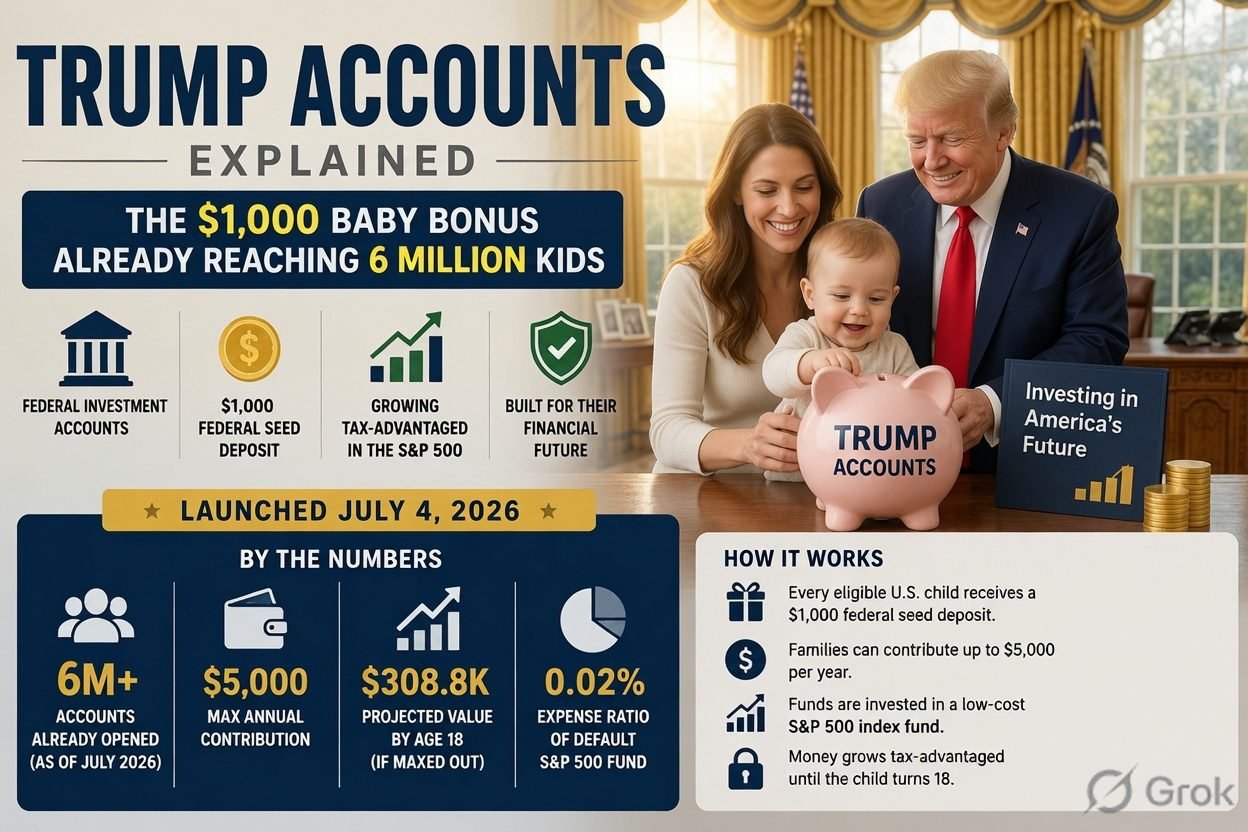

Trump Accounts Explained: The $1,000 Baby Bonus Already Reaching 6 Million Kids
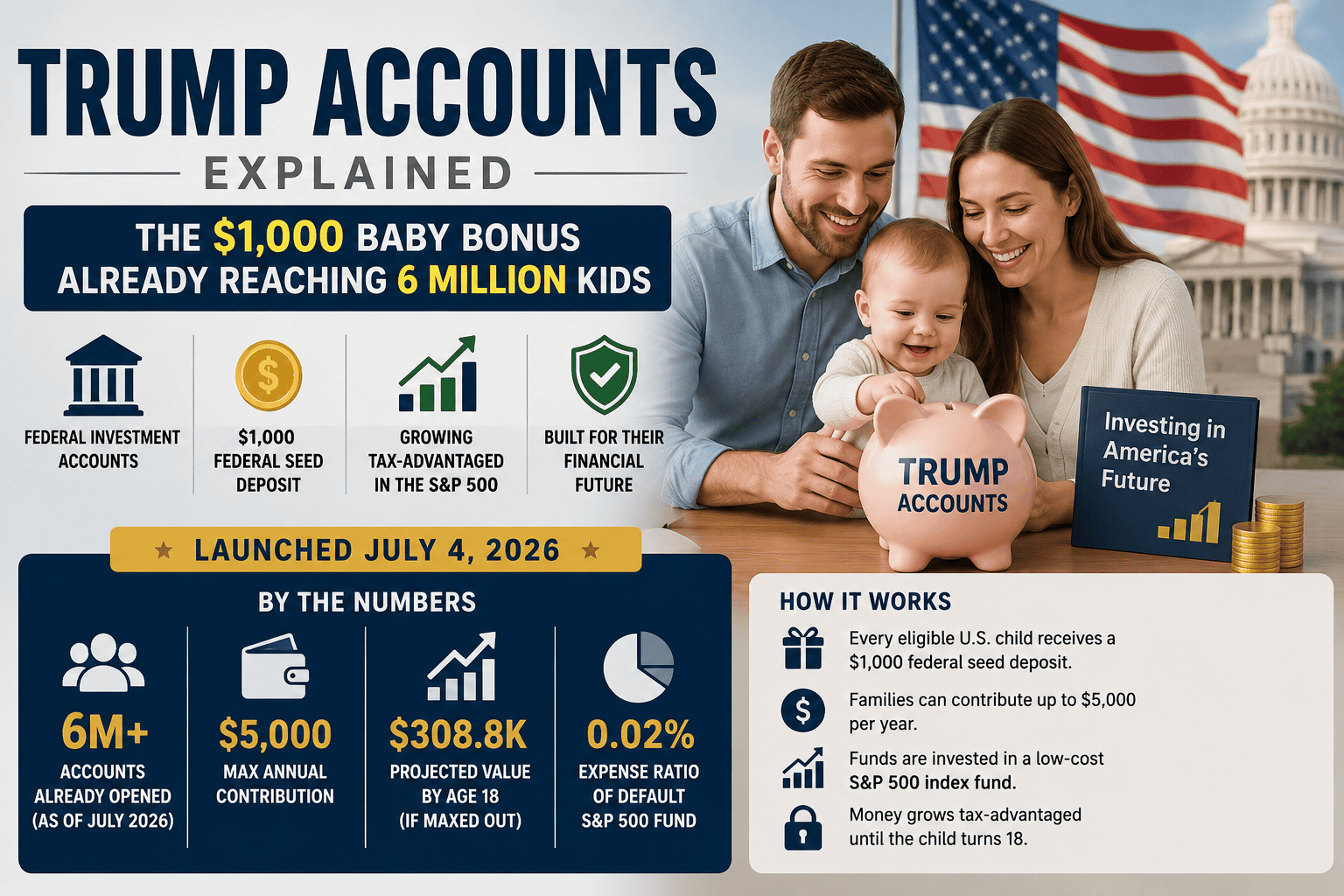
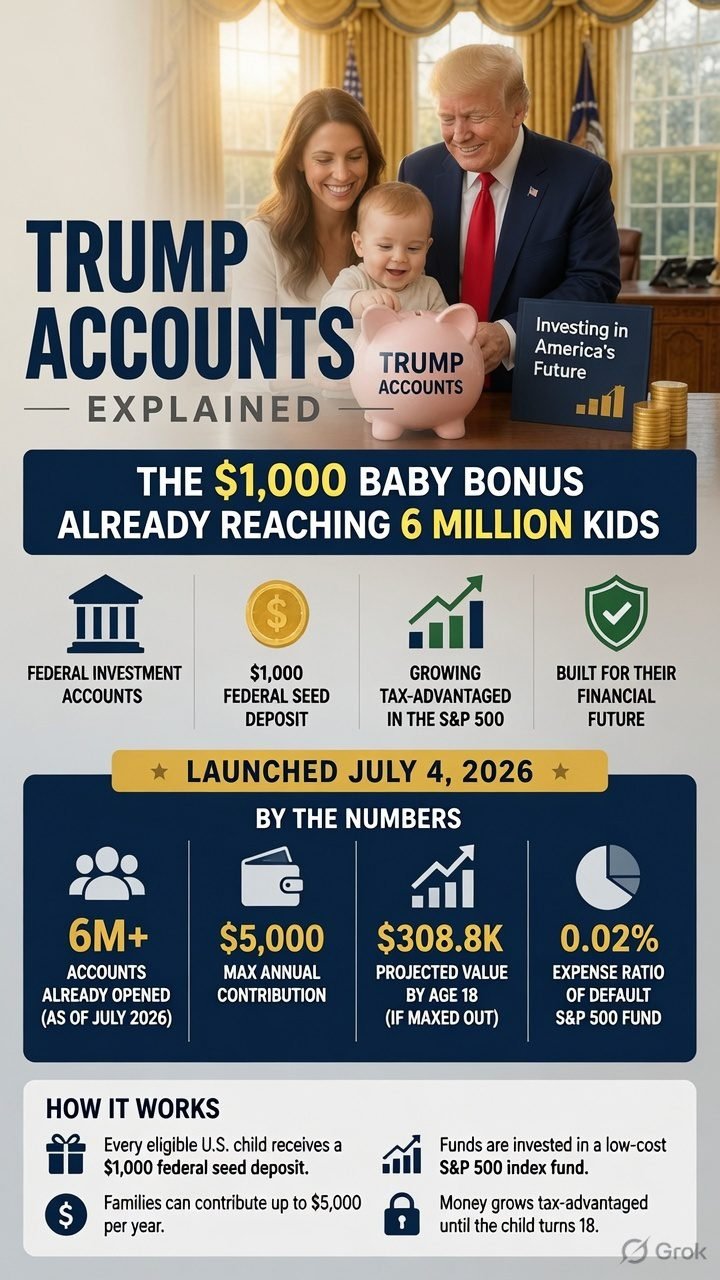
Trump Accounts went live on July 4, 2026 — federal investment accounts for American children, seeded with $1,000 and growing tax-advantaged in the S&P 500. Here's exactly how they work, who qualifies, and the math behind the headlines.
Trump Accounts explained simply: they're the newest federal experiment in getting American kids invested early, and the numbers are moving fast. Created under the 2025 One Big Beautiful Bill Act and launched July 4, 2026, more than 6 million accounts had already been opened as of this week, according to the U.S. Treasury Department. Here's the complete, verified breakdown of how they work.
The Program, In Five Charts
Swipe / scroll →Seed-Only vs Max-Funded
CEA estimates: $1,000 alone grows to ~$5,800 by 18; maxing $5,000/yr grows to ~$308,800.
Who Gets the $1,000
Of 6M+ accounts opened, 1.4 million children born 2025-2028 qualify for the $1,000 seed (~$1.4B total).
Default: S&P 500 Fund
Funds default into State Street's SPYM (S&P 500 ETF), just 0.02% expense ratio, managed by BNY Mellon.
Robinhood Chatter Spikes
StockTwits message volume around Robinhood (HOOD) roughly doubled in 24 hours around the July 4 app launch.
Not All Accounts Grow Equally
Connecticut's Treasurer estimates a 60x gap between a seed-only account and a fully maxed one by age 30.
1. Trump Accounts Explained: What They Actually Are
Trump Accounts are tax-advantaged investment accounts for American children under 18, created by the 2025 One Big Beautiful Bill Act and officially launched on July 4, 2026. Every eligible child born between 2025 and 2028 receives a one-time $1,000 seed deposit from the U.S. Treasury, and families can contribute up to $5,000 per year on top of that, according to CNN Business's launch-week coverage.
The account is managed by BNY Mellon, with the consumer-facing app built by Robinhood, and it automatically converts into a traditional IRA once the child turns 18. As of this week, more than 6 million Trump Accounts have already been opened, according to figures released by the U.S. Treasury Department.
2. Who Qualifies for the $1,000
Of the more than 6 million accounts opened so far, roughly 1.4 million belong to children who qualify for the federal $1,000 seed deposit, representing an estimated $1.4 billion in pilot contributions, per Treasury Department disclosures cited by CNN. The seed money specifically targets children born between 2025 and 2028, while older children can still open an account and contribute, just without the automatic federal deposit.
Families should note the account is opt-in, meaning eligible households need to actively open one rather than being automatically enrolled, which explains why the 6 million figure, while large, still represents a fraction of the roughly 73 million children under 18 in the United States.
3. The Compounding Math Behind the Headlines
The numbers driving most of the viral interest come from the White House Council of Economic Advisers. A seed-only account, just the $1,000 with no further family contributions, is projected to be worth approximately $5,800 by the time the child turns 18. An account that receives the maximum $5,000 per year every year, by contrast, is projected to be worth approximately $308,800 by age 18, according to figures reported by Spectrum News.
Treasury Secretary Scott Bessent has gone further, suggesting the initial $1,000 alone could compound to nearly $674,000 by traditional retirement age, assuming a 10.5% average annual S&P 500 return sustained over roughly five decades. That figure is an illustrative projection based on historical index averages, not a guarantee, and actual returns will vary significantly with market conditions over any given multi-decade stretch.
4. Trump Account vs 529 Plan vs Custodial Roth IRA
Families now face a genuine decision about which account, or combination of accounts, makes the most sense. Each vehicle serves a different purpose.
| Feature | Trump Account | 529 Plan | Custodial Roth IRA |
|---|---|---|---|
| Federal seed money | $1,000 (2025-2028 births) | None | None |
| Annual contribution limit | $5,000 | Varies by state, often high | Limited to child's earned income |
| Primary use | General wealth building, becomes IRA at 18 | Education expenses | Retirement, requires earned income |
| Default investment | S&P 500 index fund (SPYM) | Age-based portfolios | Investor's choice |
For families who can use multiple vehicles, financial planners generally suggest treating a 529 as the dedicated education fund, a custodial Roth IRA as an option once a teenager has earned income, and a Trump Account as a broader, more flexible long-term wealth-building tool that doesn't require the child to have income of their own.
5. The Corporate and Philanthropic Wave
The launch triggered a wave of private contributions that has arguably generated as much attention as the federal program itself. Michael and Susan Dell pledged $6.25 billion to fund accounts for an estimated 25 million children born between 2016 and 2024, extending eligibility well beyond the federal program's 2025-2028 window.
SpaceX President Gwynne Shotwell announced the company will gift SpaceX shares to more than 2 million children's accounts, and more than 50 major employers, including Uber, Intel, IBM, Nvidia, Steak 'n Shake, and Charter Communications, have committed to making contributions to employees' children's accounts as a new benefit category, according to reporting compiled by Forbes.
Why this matters for markets
This is a genuinely new, ongoing source of retail capital flowing into index funds over the coming years, a dynamic worth watching alongside other 2026 market stories like Bitcoin's steep drawdown and gold's record rally, both of which show how differently capital can behave across asset classes in the same year.
6. The Equity Debate: Who Really Benefits
The Brookings Institution and other policy researchers have flagged that the program's benefits skew heavily toward families who can afford to contribute the full $5,000 annually. Connecticut Treasurer Erick Russell estimated a fully maxed account could reach roughly $150,000 by age 30, compared to just around $2,500 for a low-income child receiving only the seed deposit with no further contributions, a gap of roughly 60 times.
This is the central tension in the program's design: the $1,000 seed is universal and genuinely meaningful for lower-income families with no other savings vehicle, but the $5,000 annual match opportunity primarily benefits households that already have disposable income to invest, a pattern common to many tax-advantaged savings programs and worth understanding rather than ignoring when evaluating the policy's real-world impact.

7. How to Open a Trump Account
Parents or guardians can open an account through the Robinhood-built application tied to the federal program, providing the child's Social Security number and basic eligibility documentation. Because the accounts default into a low-cost S&P 500 index fund, no active investment decisions are required to get started, though families can review or adjust allocations depending on the platform's available options.
For families weighing how a Trump Account fits into a broader financial plan, understanding basic index investing concepts first can help, a good starting point being our beginner investing guide, and structuring monthly contributions using a framework like the 50/30/20 budgeting rule can make consistent annual contributions easier to sustain.
Real-World Example
Consider two families with a child born in 2026. Family A opens the account, receives the $1,000 seed, and never contributes further; by age 18, the CEA projects that account near $5,800. Family B opens the account and contributes the full $5,000 annually every year; by age 18, that account is projected near $308,800. Neither outcome is guaranteed, since both depend on the S&P 500 delivering something close to its historical long-run average return, a pattern worth understanding the same way index concepts apply to other markets, including how the Nifty and Sensex indices function in India. The comparison illustrates why consistent contribution, not just the initial seed, drives the bulk of the outcome. Readers wanting to avoid common pitfalls in long-term investing can review our piece on why investors lose money, and those thinking about how similar tax-advantaged, long-horizon products compare can see our coverage of how insurance-linked savings products compound differently, or explore the ongoing SBI Mutual Fund IPO as an example of how large asset managers are positioned around similar long-term investing trends elsewhere. More coverage is available in our Personal Finance category and Global Economy category. Families should also factor any account activity into annual tax planning, a theme covered generally in our tax filing deadline guide, even though specific US tax treatment differs from India's framework.
8. FAQs
What are Trump Accounts?
Trump Accounts are federal, tax-advantaged investment accounts for American children under 18, created by the 2025 One Big Beautiful Bill Act, launched July 4, 2026, seeded with a one-time $1,000 government deposit for eligible children and allowing up to $5,000 in additional annual family contributions.
Who qualifies for the $1,000 seed deposit?
Children born between 2025 and 2028 qualify for the automatic $1,000 federal seed deposit. Older children can still open an account and contribute, but without the federal seed money.
How many Trump Accounts have been opened?
More than 6 million Trump Accounts had been opened as of early July 2026, according to the U.S. Treasury Department, with approximately 1.4 million qualifying for the $1,000 seed deposit.
What happens to a Trump Account when the child turns 18?
The account automatically converts into a traditional IRA once the child reaches age 18, continuing its tax-advantaged status into adulthood.
Is a Trump Account better than a 529 plan?
They serve different purposes. A 529 plan is specifically designed for education expenses, while a Trump Account is a more general-purpose, long-term investment account that doesn't require the funds to be used for education. Many financial planners suggest using both together rather than choosing one exclusively. This is not investment advice; consult a licensed financial advisor for guidance specific to your family's situation.
- CNN Business — Trump Accounts launch coverage and enrollment figures
- U.S. Department of the Treasury — Official Trump Account enrollment data
- Spectrum News — Council of Economic Advisers compounding projections
- Forbes — Corporate and philanthropic contribution coverage
- CNBC — Trump Accounts market and investor reaction
- Brookings Institution — Policy analysis on distributional impact
- Internal Revenue Service — Tax treatment of child investment accounts
- Robinhood — Trump Account app and enrollment platform
- State Street Global Advisors — SPYM S&P 500 fund details
- BNY Mellon — Trump Account program administration

Pranab Barman is a Financial Educator and Personal Finance Researcher with over 10 years of hands-on experience in stock markets, trading, and investing. Currently enrolled in the CFA Program, he is committed to continuous learning and professional excellence in finance.
As the Founder of PlayWithStock, Pranab covers a wide range of topics including Mutual Funds, SIP, Taxation, Stock Market Basics, and Financial Calculators — with a focus on simplifying complex financial concepts for everyday all investors.
Email: support@playwithstock.com
Website: playwithstock.com
Related posts:
 Why Is the Stock Market Falling Today? US-Iran Tensions, Crude Oil Spike & FII Selling Explained
 What Is a Bonus Share? The Complete Beginner’s Guide
 HDFC Bank Bonus Share: The Essential Guide for Investors 2026
 India Crypto Tax Notices: 44,000 Investors Just Got a Letter
 Vodafone Idea Stock 2026: The Complete ₹35,000 Crore Guide
 Monthly SIP of ₹5,000 for 20 Years: Real Numbers, Real Story, and a Calculator
 Reliance Jio IPO 2026: India’s Biggest-Ever Listing, Explained
 Fed Rate Hike 2026: Why the July 28-29 FOMC Meeting Could Change Everything