


ITR Refund Status Kaise Check Kare 2026: The Complete Step-by-Step Guide
Filed your return and now refreshing the portal every hour? Here's every official way to track your money, what each status message actually means, and a free calculator for the interest you're owed if the department is late.
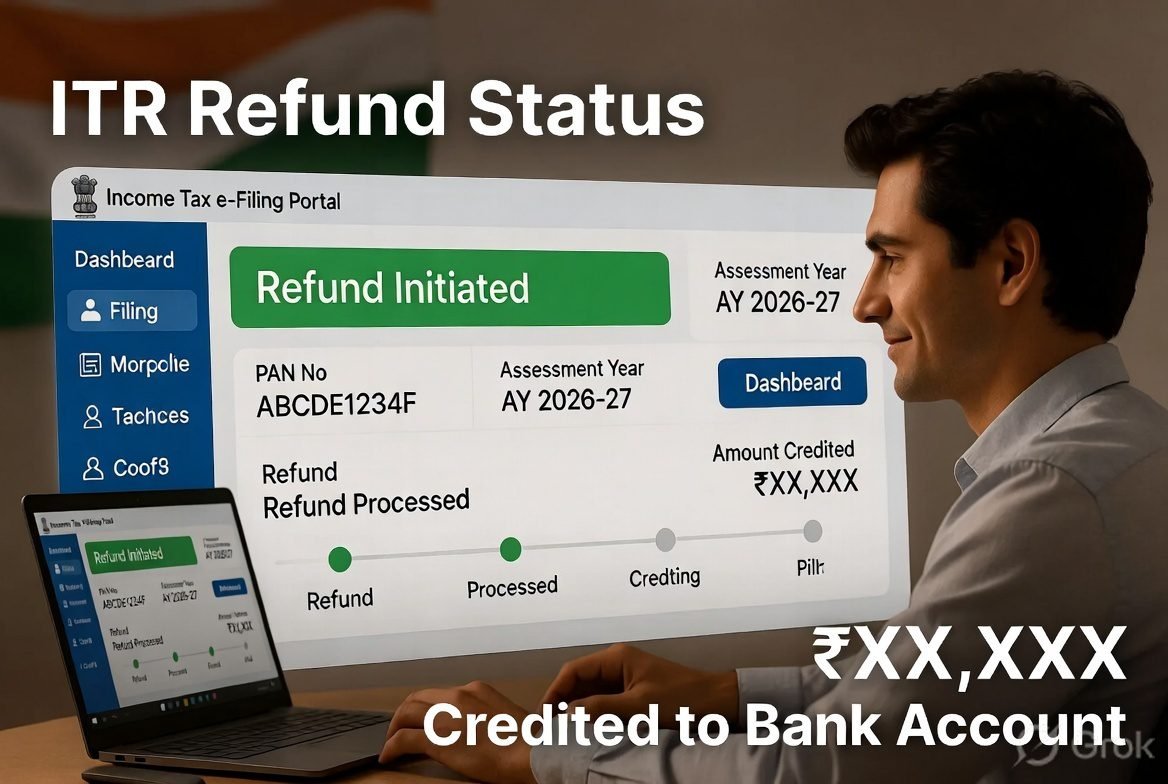
The refund status page on the Income Tax e-filing portal — the fastest of the two official routes.
- ITR Refund Status Kaise Check Kare — The Two Official Methods
- What Each Refund Status Message Actually Means
- How Long Does the Refund Actually Take?
- 7 Common Reasons Your Refund Is Stuck
- Section 244A: Interest on a Delayed Refund
- Free Calculator: Section 244A Refund Interest Estimator
- Refund Failed or Stuck? How to Raise a Grievance
- FAQs
ITR Refund Status Kaise Check Kare is probably the most-searched tax question every July and August, right after the filing deadline passes and the waiting begins. If you've filed your return for FY 2025-26 (Assessment Year 2026-27) and excess tax was deducted through TDS, TCS, or advance tax, the Income Tax Department owes that money back to you — and the good news is that the entire tracking process is now digital, taking under two minutes once you know where to look.
Every filing season, the same pattern repeats: taxpayers file within the first week of the window opening, verify immediately, and then spend the next month refreshing a portal tab, unsure whether "Processed" actually means the money is on its way or whether something quietly needs their attention. Part of the confusion comes from the fact that the refund process has genuinely changed over the last few cycles — cheques are now the exception rather than the rule, PAN-Aadhaar linking has become a hard gate rather than a soft recommendation, and the department's own Section 244A obligation to pay interest on delayed refunds is something very few taxpayers are ever told about directly.
This guide walks through both official ways to check your refund, decodes every status message you might see on screen, explains realistic timelines by ITR form type, and covers what to do — including the interest you're legally entitled to — if the refund is taking longer than it should. If you haven't filed yet, our ITR filing last date 2026 guide covers the July 31 deadline and late-filing consequences in detail.
ITR Refund Status Kaise Check Kare — The Two Official Methods
There are exactly two government-recognised portals for this. Both are free, and both only need your PAN and the relevant assessment year — never use a third-party app that asks for your net banking password or OTP to "check" your refund. The two portals pull from the same underlying CPC (Centralised Processing Centre) database in Bengaluru, so the status shown will always match between them; the difference is purely in interface speed and which one happens to be under lighter load on a given day.
Method 1: Income Tax e-Filing Portal (Recommended)
Mobile view of the e-filing portal's return timeline.
Method 2: Protean (formerly NSDL/TIN) Refund Status Portal
This second route is useful when the main portal is slow during peak filing season. Go to the Protean refund status page, enter your PAN, select the assessment year, complete the CAPTCHA, and click Proceed. It pulls data from the same CPC (Centralised Processing Centre) database, so the result matches the e-filing portal. Keep in mind that neither portal will show anything for a return that hasn't been e-verified yet — both are simply windows into CPC's processing pipeline, not a separate tracking system of their own.
How the Refund Money Actually Reaches You
Physical refund cheques have been almost entirely phased out. Today, virtually every refund is credited directly to your pre-validated bank account through NEFT or RTGS, which is faster, cheaper for the department, and eliminates the old problem of cheques getting lost or delayed in the post. This is precisely why bank account validation status matters so much — it isn't a bureaucratic formality, it's the actual payment rail your money travels on. If your account isn't pre-validated on the portal, the refund can be fully processed and "issued" on paper while the money itself has nowhere to go.
What Each Refund Status Message Actually Means
Once you've located your return, the status field will show one of several standard messages. Here's what each one means and what, if anything, you need to do next.
| Status Shown | What It Means | Your Next Action |
|---|---|---|
| Return Filed | Submitted but not yet e-verified | E-verify within 30 days or it's treated as not filed |
| Return Verified | E-verification accepted; processing not started | Wait — no action needed |
| Return Processed | CPC has finished checking your return | Refund (if any) is being computed |
| Refund Initiated / Issued | Payment order has been sent to the bank | Money should land within a few working days |
| Refund Failed | Bank couldn't accept the credit | Fix bank details, then submit a refund reissue request |
| No Demand No Refund | Tax paid matched tax due exactly | Nothing pending; return is closed |
| Defective Return (139(9)) | A discrepancy needs correction | Respond within the notice deadline to avoid the return being invalidated |
Two of these statuses trip people up more than the rest. "Return Processed" only confirms that CPC has finished its checks and issued an intimation under Section 143(1) — it does not by itself mean money has moved. "Refund Initiated" or "Refund Issued" is the actual trigger point where a payment instruction has left CPC for your bank; from here, credit typically follows within a few working days barring a bank-side hold. If your status has sat on "Processed" for several weeks without moving to "Refund Initiated," that gap itself is often the first sign of a data mismatch worth investigating rather than just waiting out.
How Long Does the Refund Actually Take?
There's no single fixed number — it depends heavily on which ITR form you filed and how clean the data matching was between your return, Form 26AS, and the AIS (Annual Information Statement).
| ITR Form | Typical Case | Usual Refund Window* |
|---|---|---|
| ITR-1 / ITR-4 | Salary, one house property, presumptive income | 15–30 days after e-verification |
| ITR-2 | Capital gains, multiple properties, foreign assets | 30–45 days after e-verification |
| ITR-3 | Business/professional income, audit cases | 45–60+ days, longer if scrutiny is triggered |
*Indicative ranges based on typical CPC processing patterns; individual cases vary with data mismatches or manual review.
(143(1))
Initiated
to Bank
Two things speed this up more than anything else: e-verifying immediately after filing instead of posting a physical ITR-V, and making sure your bank account is pre-validated on the portal before you file. If you're still deciding when to file, our piece on the ITR filing last date 2026 explains why filing early in the window (rather than on July 31 itself) often means a faster refund, simply because CPC's queue is shorter.
A few less obvious factors also matter. Returns claiming an unusually large refund relative to declared income are more likely to be flagged by the Risk Management System (RMS) for a closer look, which adds time regardless of the ITR form used. Salaried taxpayers whose employer has correctly deposited and reported TDS tend to see the fastest processing, since there's nothing to reconcile between the return and Form 26AS. Freelancers and business owners with multiple TDS deductors, on the other hand, are more likely to hit a mismatch simply because more moving parts are involved in the reconciliation.
7 Common Reasons Your Refund Is Stuck
Broadly, these seven causes fall into two buckets: things you control and things CPC controls. Bank validation, PAN-Aadhaar linking, and matching the name on your return with your bank records are entirely within your hands, and fixing them retroactively usually unblocks a stuck refund within days. Scrutiny selection and outstanding prior-year demands, on the other hand, sit with the department — the only real lever you have there is a well-documented grievance, which the later section of this guide covers.
Section 244A: Interest on a Delayed Refund
Here's what most taxpayers don't realise: the government doesn't get to sit on your money indefinitely for free. Under Section 244A of the Income Tax Act, 1961, you're entitled to simple interest at 0.5% per month (6% per annum) on a delayed refund, provided the delay isn't caused by an error on your part.
If you filed on or before the due date, interest accrues from 1 April of the assessment year until the refund is credited. If you filed a belated return, interest starts from the date of filing instead. One important caveat: if the delay is genuinely your fault — an incorrect bank account, an unanswered notice, incomplete disclosures — that period gets excluded from the interest calculation.
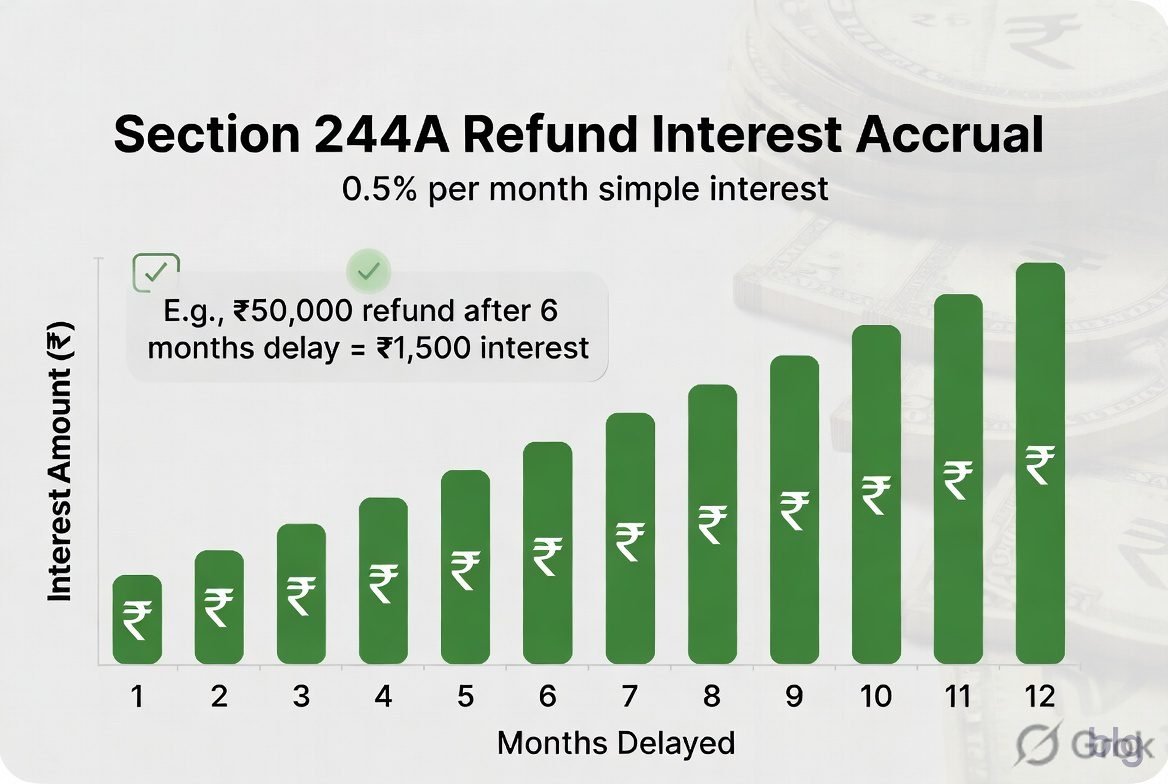
Interest under Section 244A compounds monthly in simple terms — it doesn't earn interest on interest.
This interest is not tax-free — it's added to your income under "Income from Other Sources" and taxed at your slab rate in the year you receive it, so remember to check your AIS for it before filing next year's return. According to recent industry data, refund volumes have run behind collections in parts of this filing season, largely traced back to TDS credit mismatches — all the more reason to know your rights here.
You don't need to calculate this interest yourself to receive it — CPC computes it automatically and includes it as a separate line item in your Section 143(1) intimation, alongside the refund principal. What's worth doing on your own is simply verifying that figure looks reasonable given how long the delay ran, since intimations occasionally carry the same TDS-mismatch errors that caused the delay in the first place. The calculator further down this page exists exactly for that cross-check.
Free Calculator: Section 244A Refund Interest Estimator
Use the tool below to estimate the interest owed on a delayed refund under Section 244A.
Section 244A Refund Interest Estimator
Refund Failed or Stuck? How to Raise a Grievance
If your status has shown "Refund Sent to Bank" for more than 10 working days with nothing credited, don't wait indefinitely. First, verify your bank details on the portal are current. Then file a Refund Reissue Request under Services on the e-filing dashboard if the failure reason is a bank-side issue. For anything unresolved beyond that, use e-File → Grievances → Submit Grievance, which is monitored separately from routine processing and typically gets a faster response. The CPC helpline (1800-103-0025) is also available for status queries. Some taxpayers have also used the RTI route for genuinely long-pending cases, though a grievance ticket resolves the vast majority of delays without needing to go that far.
Two things make a grievance more effective. First, attach documentation — a screenshot of your current status, the acknowledgement number, and your Form 26AS if a mismatch is suspected — rather than filing a bare-text complaint. Second, file promptly once a delay looks genuine rather than waiting several more months; a proactive complaint history is also what strengthens your case for Section 244A interest if the Assessing Officer ever tries to attribute the delay to you rather than to CPC.

FAQs: ITR Refund Status Kaise Check Kare
Just your PAN, the correct assessment year (AY 2026-27 for FY 2025-26 income), and your e-filing portal login. No separate app or additional document is required.
No. Processing only begins after e-verification or a physically signed ITR-V is received by CPC. Without it, the return is treated as not filed and no refund is issued.
Under Section 244A, whenever the department's own delay (not yours) pushes the refund beyond the normal processing window, at 0.5% per month, calculated from 1 April of the assessment year for on-time filers.
Simple ITR-1/ITR-4 returns are typically fastest, often within 15–30 days of e-verification. ITR-2 and ITR-3 with capital gains or business income can take 30–60 days or longer.
Check and correct your bank account validation and PAN-Aadhaar linking status on the portal, then submit a Refund Reissue Request from the Services menu.
Yes. NRIs use the same e-filing portal login and the same PAN-based process — there's no separate NRI-specific refund tracking system. The only extra step for NRIs is ensuring their Indian bank account (NRO/NRE, as applicable) is pre-validated on the portal.
Almost all refunds today are credited directly via NEFT/RTGS to your pre-validated bank account. Physical cheques are now rare and generally used only as a fallback in specific exception cases.
The Centralised Processing Centre in Bengaluru is where every e-filed return in India is processed — it verifies your figures against Form 26AS and the AIS, issues the Section 143(1) intimation, and triggers the refund payment instruction to your bank.
References: Income Tax e-Filing Portal · Refund Status User Manual · Salaried Individuals AY 2026-27 · Section 244A, Income Tax Act · Protean Refund Status Portal · ClearTax: Income Tax Refund Guide · Times Bull: ITR Refund 2026 · Bajaj Housing Finance: Refund Status · Bajaj Finserv: Section 244A · TaxBuddy: Refund Interest Explained · Angel One: Delayed Refund Interest · ITR Stats: Refund Status Guide · ITR Stats: 244A Interest Guide · All India ITR · SKM & Co: Refund Interest Analysis · RTI Wiki: Refund Delay Playbook

Pranab Barman is a Financial Educator and Personal Finance Researcher with over 10 years of hands-on experience in stock markets, trading, and investing. Currently enrolled in the CFA Program, he is committed to continuous learning and professional excellence in finance.
As the Founder of PlayWithStock, Pranab covers a wide range of topics including Mutual Funds, SIP, Taxation, Stock Market Basics, and Financial Calculators — with a focus on simplifying complex financial concepts for everyday all investors.
Email: support@playwithstock.com
Website: playwithstock.com
Related posts:
 Section 244A Refund Interest Calculator
 ITR-4 Investment Disclosure Calculator: New 2026 Rule for Presumptive Taxpayers
 Mutual Fund Guide India 2026: The Essential 7-Step Beginner Blueprint
 ITR Filing Last Date 2026: July 31 Deadline, New Tax Act & Penalties
 GST 2.0 for E-commerce Sellers (2026): Complete Guide
 RBI Repo Rate Cut 2026: The Complete Home Loan EMI Guide
 How to Invest in Gold ETF: The Complete Gold ETF vs Physical Gold Guide
 Nominee vs Legal Heir India: The Difference That Can Break a Family