

Silver Price Surge 2026: Why Silver Is Beating Gold This Year
Silver jewellery prices rose 133% in a single year — more than three times gold's inflation rate. Here's the genuine data behind the surge, and whether it's too late to get in.

Silver has quietly outrun gold's rally in 2026 — and most investors haven't caught on yet.
- The 2026 Rollercoaster: How Silver Actually Moved
- Why Silver Is Outpacing Gold: The Ratio Story
- The Real Engine Behind the Surge: Industrial Demand
- Six Years of Deficit: Why Supply Can't Keep Up
- India's Own Silver Price Surge 2026 Story
- What Retail Investors Are Actually Saying
- How to Actually Invest in the Silver Price Surge 2026
- Taxation on Silver Price Surge 2026 Investments
- The Risks Nobody's Highlighting Loud Enough
- Should You Buy Into the Surge?
- FAQs
Silver Price Surge 2026 isn't just a bullion-market talking point anymore — it's showing up directly in official Indian inflation data. When the Ministry of Statistics released June 2026 CPI numbers on 13 July, silver jewellery topped every single category tracked, up 133.21% year-on-year, more than triple the 36.82% rise recorded for gold, diamond, and platinum jewellery combined. That's not a typo, and it's not silver quietly following gold's lead — it's silver visibly outrunning it.
This piece pulls together what's actually driving that number: the genuine industrial demand story, the supply deficit now in its sixth consecutive year, India's own import restrictions and record purchases, what retail investors and traders have actually been saying online through 2026's volatility, and a clear-eyed look at how to invest in silver in India without getting caught in a correction. No hype, no "will 10x by Diwali" promises — just the data as it currently stands.
The 2026 Rollercoaster: How Silver Actually Moved
Understanding the Silver Price Surge 2026 story properly means accepting that silver didn't rise in a straight line this year, and pretending otherwise would misrepresent what actually happened. International spot silver started 2026 already elevated after a strong 2025, then spiked further in January — multiple market reports describe prices briefly touching the $115-120 per ounce range intraday before a sharp reversal, triggered partly by a dollar surge following Fed-chair nomination speculation. On the Indian side, MCX silver futures touched fresh record highs during the same window, with different trackers citing figures in the ₹3.2 lakh to ₹3.5 lakh per kilogram range — a roughly 74% jump within January alone according to one tracker.
What followed was a genuine correction, not just a pause. By mid-April, international silver had pulled back to roughly $73-74 per ounce, down close to 22% from the January peak. Indian prices moved in step. By mid-July, the domestic market was consolidating in a noticeably calmer — though still historically elevated and still volatile — range.
| Period (2026) | Approximate Level | What Happened |
|---|---|---|
| Early January | ~$80/oz international | Already elevated after a strong 2025 |
| Late January | ~$115-120/oz intraday (reported) | Sharp spike, then reversal on dollar strength |
| Mid-April | ~$73-74/oz | Correction of roughly 22% from peak |
| Mid-July | ₹210-271/gram in India (~$78-85/oz equivalent) | Consolidating after the correction, still volatile month-to-month |
Figures compiled from multiple bullion trackers and financial news sources as of mid-July 2026; exact numbers vary by source, city, and exact timestamp — treat as directional ranges, not precise quotes.
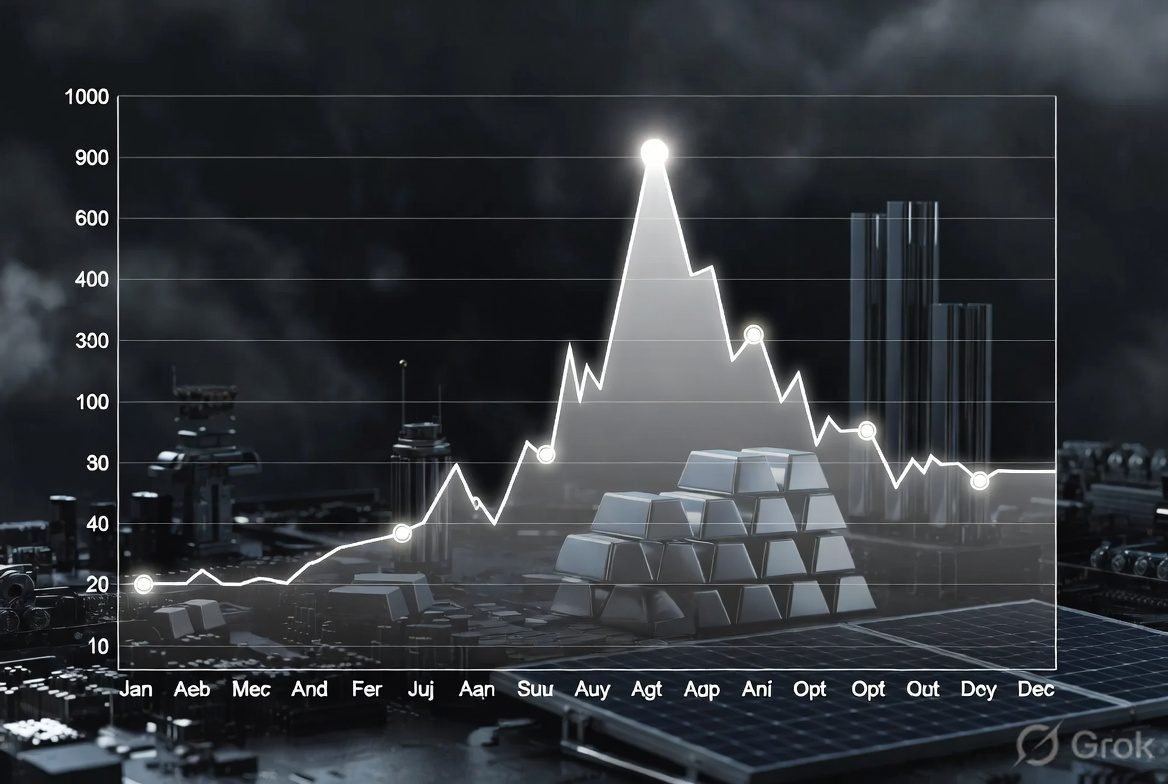
The shape of 2026 so far: a sharp January spike, a real correction, then a wide consolidation range through July.
Why Silver Is Outpacing Gold: The Ratio Story
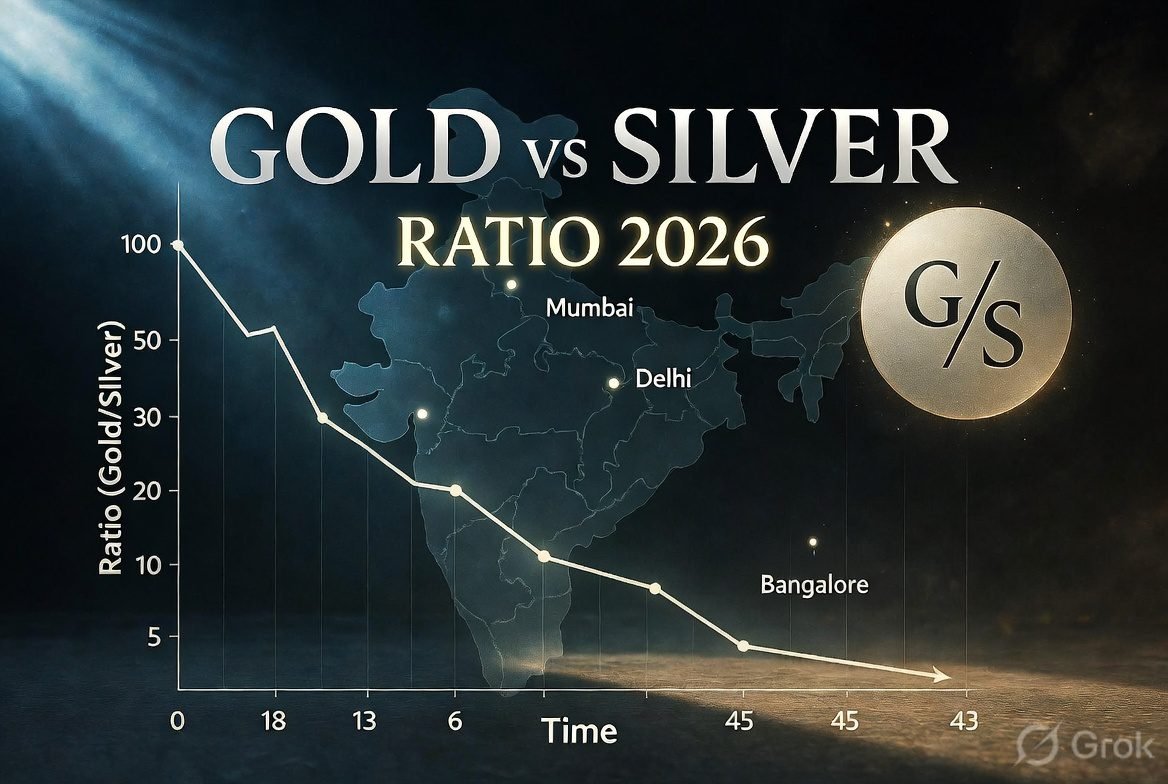
The gold-silver ratio — how many ounces of silver it takes to buy one ounce of gold — is the cleanest way to see the Silver Price Surge 2026 outperformance in one number. The ratio traded above 90-100 for stretches of 2025, a level many analysts considered historically stretched, implying silver was cheap relative to gold. Through 2026, that ratio has compressed meaningfully, with several market analyses placing it in the 55-65 range by mid-year, down sharply from its earlier peak. Some forecasts suggest it could drift toward its long-run median of 50-60 by year-end if silver's structural demand story continues to outpace gold's.
A compressing ratio means exactly what it sounds like: silver is closing the performance gap with gold, occasionally moving faster in both directions. That cuts two ways — it's part of why silver has delivered such outsized returns in 2025-2026, and it's also why silver's downside moves during corrections have been sharper than gold's on the same days.
The Real Engine Behind the Silver Price Surge 2026: Industrial Demand
Gold's price story is largely about central bank buying, safe-haven demand, and currency hedging. Silver's story is different, and this is the part most casual coverage skips: industrial applications now account for roughly 60% of total silver consumption, up from about 50% a decade ago. Silver isn't just a precious metal anymore — it behaves partly like an industrial commodity, with demand tied to real-world manufacturing rather than just investor sentiment.
Unlike jewellery demand, which is highly price-sensitive and pulls back when prices spike, industrial buyers have shown limited price sensitivity historically — silver typically represents a small fraction of a solar panel's or an EV's total cost, so manufacturers largely keep buying even at elevated prices. That's precisely what gives silver a demand floor gold's story doesn't have in the same way.
Six Years of Deficit: Why Supply Can't Keep Up With the Silver Price Surge 2026
The Silver Institute's data shows a persistent supply-demand imbalance running since 2021, with 2026 widely expected to mark a sixth consecutive annual deficit year. Global mine production has stayed roughly flat for a decade, constrained by a structural quirk: over 70% of silver is produced as a byproduct of mining for other metals like copper, lead, and zinc, meaning supply can't simply ramp up in response to higher prices the way a dedicated silver mine could.
The visible effect shows up in exchange inventories. Registered COMEX silver stocks and LBMA vault holdings have both declined meaningfully over the past several years as physical metal gets drawn down to meet the gap between what's mined and what's consumed. Recycling doesn't fully offset this either — silver recycling contributes a smaller share of total supply than gold recycling does, since so much silver ends up permanently embedded in solar panels, electronics, and medical devices that rarely return to the market.

Solar demand alone now consumes well over 100 million ounces of silver a year — and that number keeps climbing.
India's Own Silver Price Surge 2026 Story
India is the world's largest consumer of silver, importing over 80% of its domestic needs. That dependence has become a genuine policy issue in 2026: silver imports reportedly surged to a record range cited between roughly $9-12 billion for FY25-26, a substantial jump from the prior year, as jewellers, investors, and industrial buyers all competed for supply simultaneously.
That surge triggered a specific regulatory response. Authorities restricted imports of unstudded silver jewellery (as distinct from bullion) requiring DGFT licences, after officials found traders routing silver through a "finished jewellery" import classification — often via Thailand — to sidestep the higher duties applicable to bullion. Bullion imports themselves have remained permitted, though import duty levels on precious metals have been adjusted more than once during the year, so the exact current rate is worth checking directly before making a large purchase decision.
Back on the inflation side, that 133.21% year-on-year jump in silver jewellery prices recorded for June 2026 was actually a moderation — May 2026's reading had been even higher, at 155.25%. Read together, these numbers describe a market where retail jewellery demand is visibly straining under record prices even as investment and industrial demand keep pulling metal out of the system.
What Retail Investors Are Actually Saying
Beyond the official data, retail sentiment around the Silver Price Surge 2026 has been genuinely divided through the year — worth knowing before you assume either "everyone's buying" or "everyone's warning against it" is the full picture. A widely cited industry survey conducted around late 2025 found a majority of retail traders expecting silver to challenge or exceed $100 an ounce during 2026, reflecting real bullish conviction among individual investors heading into the year.
That optimism collided hard with reality during January's spike-and-reverse move. Online trading communities saw a wave of posts during the sharpest part of the correction — some investors reporting significant losses on leveraged silver positions, others noting gains on the reversal itself. The pattern is a familiar one in fast-moving commodity rallies: enthusiasm builds during the run-up, gets tested hard during the first serious correction, and then either fades or resets depending on how quickly prices stabilise. By several accounts, sentiment did stabilise into a more measured, still-constructive stance once the immediate volatility passed, rather than a wholesale retreat from the asset.
How to Actually Invest in the Silver Price Surge 2026
Once the "why" is clear, the practical question is which vehicle actually makes sense for a given goal. Each option carries a genuinely different cost and liquidity profile.
| Route | Best For | Key Consideration |
|---|---|---|
| Physical Silver (bars/coins) | Direct ownership, no counterparty risk | Storage, insurance, and resale premiums add real cost; insist on hallmarked purity |
| Silver ETFs | Liquid, exchange-traded exposure | Tracks domestic spot price; needs a demat account; low expense ratios versus physical |
| Digital Silver | Small, flexible purchases | Convenient for micro-investing via UPI, but check platform regulation and spreads |
| MCX Futures | Experienced traders seeking leverage | High risk; leverage amplifies both gains and losses significantly |
| Silver Mining Stocks | Equity-style upside exposure | Behaves more like a volatile stock than pure silver exposure; carries company-specific risk |
Silver ETF inflows in India have been genuinely strong through 2026, with one tracker citing a 139% month-on-month jump in January inflows alone and total silver ETF AUM rising sharply during the same period — evidence that a meaningful share of the demand story is now flowing through regulated, exchange-traded products rather than only physical bullion. A new SEBI valuation framework effective from 1 April 2026 also shifted how gold and silver ETFs are priced, basing Net Asset Value on domestic exchange spot prices rather than adjusted global benchmarks, which should reduce tracking mismatches going forward.
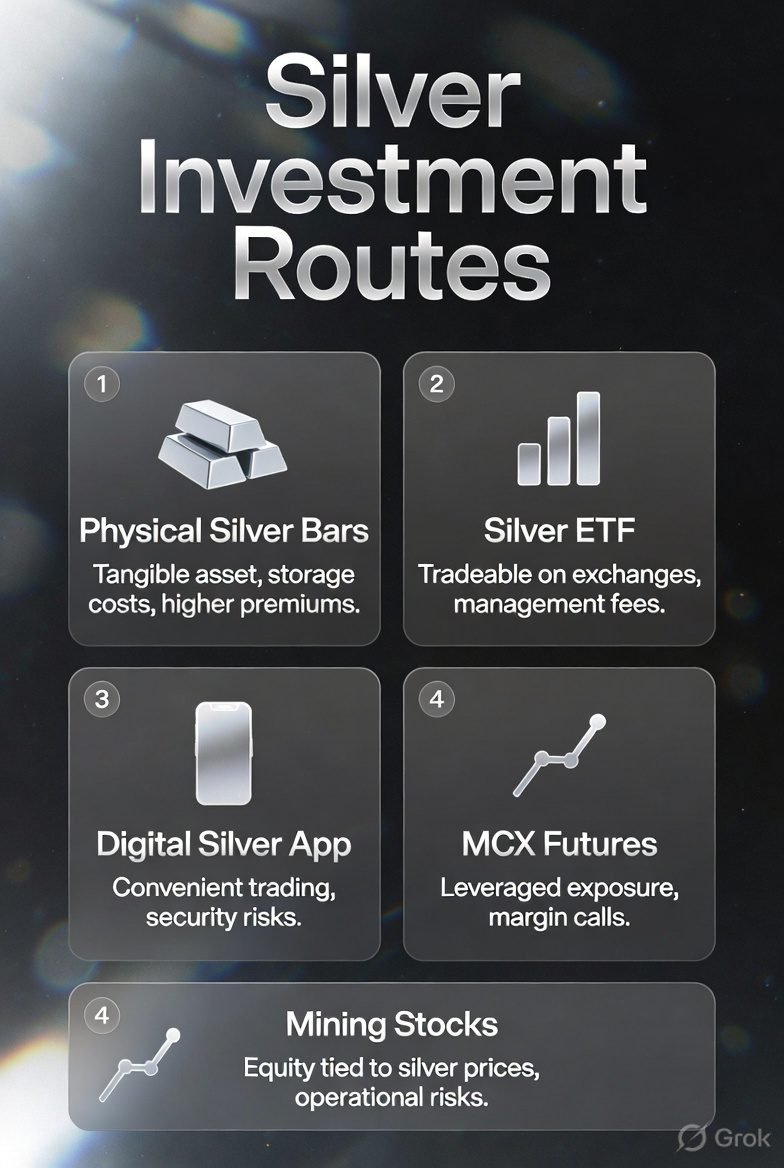
Each route to silver exposure trades off cost, liquidity, and risk differently — there's no single "best" answer.
Taxation on Silver Price Surge 2026 Investments
Silver investments in India are taxable, and the rules mirror gold's treatment in most respects. Physical silver and silver ETFs held for more than 12 months qualify for long-term capital gains treatment, taxed at 12.5% without indexation benefit under current rules. Holdings sold within 12 months are taxed as short-term capital gains at the investor's applicable income slab rate. Digital and physical silver purchases also attract 3% GST at the time of buying, similar to gold.
Unlike gold, there is no Sovereign Gold Bond equivalent for silver — no government-backed bond offering periodic interest alongside price-linked returns — so ETFs and digital silver remain the closest regulated, paper-based alternatives to owning the metal directly.
The Risks Nobody's Highlighting Loud Enough
Most coverage of the Silver Price Surge 2026 leans bullish by default, so it's worth being explicit about the counter-case. Several credible institutional forecasts for 2026 were notably more conservative than retail sentiment going into the year — some major banks projected silver averaging in the $55-60 range for the year as a whole, well below the levels briefly touched in January. That gap between institutional caution and retail enthusiasm is itself a signal worth taking seriously.
It's also worth noting that some of the loudest "silver supercycle" commentary comes from sources with a direct financial interest in silver sales — bullion dealers, mining companies, and their affiliated content. That doesn't make the underlying industrial-demand data wrong, but it's a reason to weight independent sources like the Silver Institute and major bank research more heavily than promotional content when forming a view.
Should You Buy Into the Silver Price Surge 2026?
The honest answer depends entirely on what role silver is meant to play in your portfolio. As a small, deliberate allocation — most guidance suggests limiting precious metals broadly to somewhere in the 5-10% range of a diversified portfolio — silver's structural demand story and persistent supply deficit make a reasonable case for inclusion, particularly through ETFs or digital silver rather than leveraged instruments. As a concentrated, timing-driven bet chasing the January highs, the risk profile looks very different, and 2026's own correction is the clearest evidence why.
For jewellery buyers specifically, the calculus is separate from the investment case entirely — cultural and occasion-driven purchases will likely continue regardless of price, as India's own inflation data on the Silver Price Surge 2026 has already shown, even as the weight of silver bought per rupee spent keeps shrinking.

FAQs: Silver Price Surge 2026
Silver's price is driven by both industrial demand (solar, EVs, electronics, data centres) and investment demand, unlike gold's largely monetary and safe-haven-driven story — the core reason behind the Silver Price Surge 2026. A persistent multi-year supply deficit and a previously stretched gold-silver ratio have both contributed to silver's sharper moves in both directions.
The structural demand and supply-deficit case remains intact, but institutional forecasts for 2026 vary widely, and silver has shown significantly higher volatility than gold. Treat any allocation as a small, deliberate part of a diversified portfolio rather than a concentrated bet.
Authorities found traders routing silver imports through a "finished jewellery" classification to avoid the higher duties applicable to bullion, prompting a licensing requirement on unstudded silver jewellery imports while bullion imports remained permitted.
For most investors, Silver ETFs offer the best balance of liquidity, low cost, and regulated exposure without storage concerns. Physical silver suits those prioritising direct ownership; MCX futures and leveraged instruments carry meaningfully higher risk.
Silver held over 12 months is taxed at 12.5% LTCG without indexation; holdings under 12 months are taxed as short-term gains at your income slab rate. Purchases also attract 3% GST.
No. There is currently no government-backed bond scheme for silver equivalent to Sovereign Gold Bonds. ETFs and digital silver remain the closest regulated paper-based alternatives.
References: IndexBox: India June 2026 CPI Inflation · Republic World: India Retail Inflation June 2026 · Silver Institute: Demand Forecast Report · JPMorgan: Silver Prices 2026 Outlook · Kitco News: Annual Silver Survey · Equiti: Industrial Demand Supports Silver · Motilal Oswal: Best Silver ETFs India · Tickertape: Silver ETFs Collection · Finowings: Silver Import Restrictions India · Business Today: Gold/Silver ETF Pricing Changes 2026 · OroPocket: Silver Taxation FY 2026-27

Pranab Barman is a Financial Educator and Personal Finance Researcher with over 10 years of hands-on experience in stock markets, trading, and investing. Currently enrolled in the CFA Program, he is committed to continuous learning and professional excellence in finance.
As the Founder of PlayWithStock, Pranab covers a wide range of topics including Mutual Funds, SIP, Taxation, Stock Market Basics, and Financial Calculators — with a focus on simplifying complex financial concepts for everyday all investors.
Email: support@playwithstock.com
Website: playwithstock.com
Related posts:
 Gold Price Prediction Diwali 2026: Will Gold Recover After the Correction?
 How to Invest in Gold ETF: The Complete Gold ETF vs Physical Gold Guide
 Gold Price All Time High India: Should You Buy Now or Wait in 2026
 Gold Price Correction 2026: What It Means for Indian Investors
 Silver Crash 2026: What Happened After Its All-Time High of $121
 SBI Mutual Fund IPO 2026: Dates, Price Band, GMP & Should You Apply
 RBI Repo Rate Cut 2026: The Complete Home Loan EMI Guide
 Fed Rate Hike 2026: Why the July 28-29 FOMC Meeting Could Change Everything