


Gold Price Prediction Diwali 2026: Will Gold Recover After the Correction?
Gold hit record highs earlier this year, then corrected sharply. With Dhanteras and Diwali just months away, here's what the data, the analysts, and the historical pattern actually say about where prices may head next.

Gold has always carried more than monetary weight during Diwali — but 2026's price swings have made timing the purchase harder than usual.
- Where Gold Stands Today
- Why Gold Corrected in 2026
- Factors That Will Drive Gold Into Diwali
- Diwali 2026 Dates and the Gold-Buying Tradition
- What History Says About Gold Around Diwali
- Expert Price Forecasts for Diwali 2026
- How to Buy Gold This Diwali: Comparing Your Options
- Risks to the Bullish Case
- FAQs
Gold Price Prediction Diwali 2026 has become one of the most searched questions among Indian buyers this year, and for good reason. After scripting a historic rally into early 2026, gold went through one of its sharpest corrections in years — leaving households who buy gold every Dhanteras and Diwali genuinely unsure whether to buy now, wait, or spread purchases across the festive season.
This isn't a small question. India's Dhanteras single-day gold sales routinely cross ₹12,000 crore, and the festive-and-wedding stretch from Dussehra through Diwali accounts for a meaningful share of the country's annual gold demand. Getting the timing even a little wrong, at current price levels, can mean a real difference in what a family pays for the same amount of gold. This guide walks through where prices stand today, why the correction happened, what's likely to move gold between now and 8 November 2026, and what analysts are actually forecasting — without pretending anyone can predict a commodity price with certainty.
Where Gold Stands Today
As of mid-July 2026, international spot gold has been trading in the $4,000–$4,080 per ounce range, holding on to gains of more than 20% over the past year even after pulling back close to 7% over the preceding month. In India, that translates to 24-karat gold trading around ₹1,44,500–₹1,45,000 per 10 grams, with 22-karat jewellery gold near ₹1,32,000–₹1,33,000 per 10 grams, according to daily rate trackers.
| Metric | Approximate Level (mid-July 2026) |
|---|---|
| International Gold (Spot) | $4,000–$4,080 / oz |
| 24K Gold (India, 10g) | ₹1,44,500–₹1,45,000 |
| 22K Gold (India, 10g) | ₹1,32,000–₹1,33,000 |
| Change vs 12 Months Ago | Roughly +20% (international) |
| Change vs Prior Month | Roughly −6% to −7% (correction) |
Figures compiled from multiple daily gold-rate trackers as of 13–15 July 2026; rates vary slightly by city, purity certification, and source. Always check a live rate before transacting.
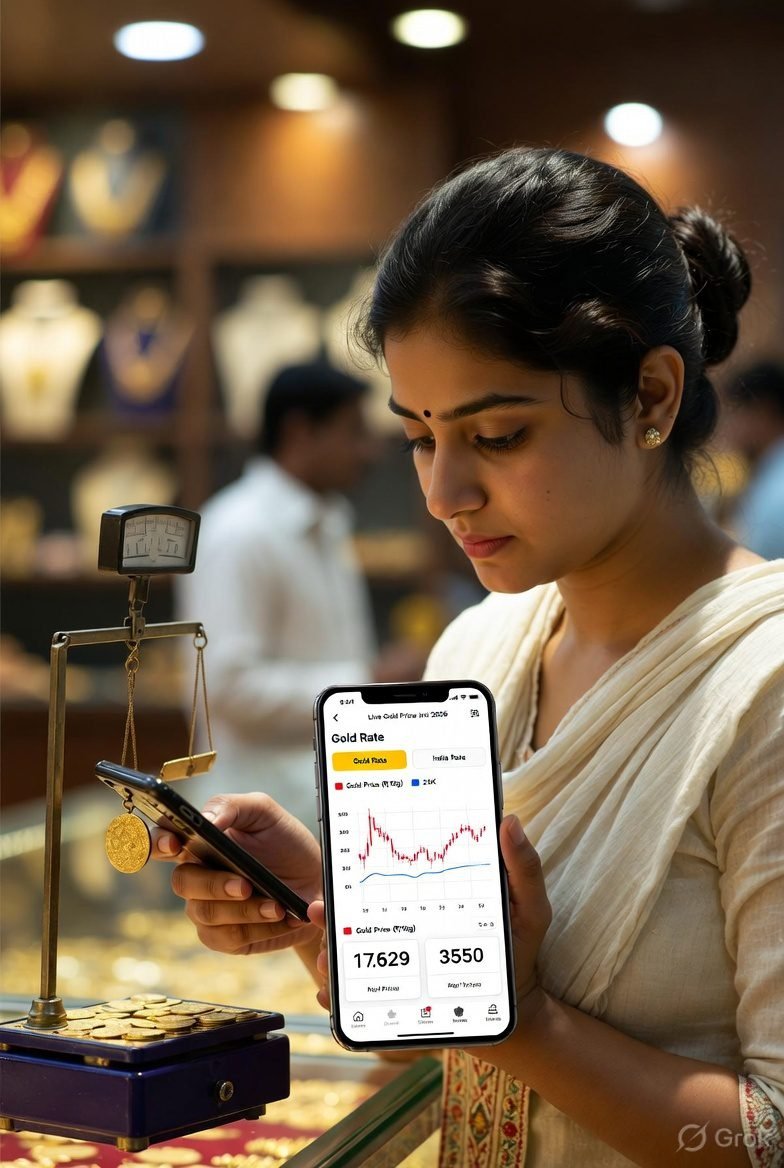
Checking the live rate before a purchase matters more than ever in a volatile year like 2026.
Why Gold Corrected in 2026
Reports of gold's exact all-time high vary by source and by which market (spot, MCX futures, retail) is being quoted — figures anywhere from roughly ₹1.69 lakh to ₹1.78 lakh per 10 grams have been cited for peaks reached in late January and early March 2026, driven by a combination of Middle East tensions, a pause in US rate hikes, and a rush into safe-haven assets. What followed was a corrective phase that has pulled prices down by somewhere in the region of 14–20% from those peaks, depending on the exact reference point used.
A few forces converged to trigger that pullback: a temporarily stronger US dollar reduced gold's appeal for dollar-based buyers, some profit-booking set in after an extraordinarily fast run-up, and improving US-India trade relations reduced one specific source of geopolitical anxiety that had been feeding safe-haven demand. None of this, on its own, reverses the structural drivers that pushed gold higher in the first place — it's better understood as a breather after a very steep climb than as evidence the bull run is over.
Factors That Will Drive Gold Into Diwali
Six forces will most likely determine where gold sits by the time Dhanteras and Diwali arrive in November. None of them move in isolation, and several can offset each other.
The India-US trade deal finalised earlier this year is a genuinely two-sided influence here: it reduces one geopolitical risk premium that had been supporting gold, but the broader improvement in investor sentiment it triggered for Indian equities could also mean less defensive rotation into gold specifically from domestic investors. Keep an eye on the Fed's rate decisions through August and September — those meetings sit close enough to Diwali to meaningfully shift sentiment either way.
Diwali 2026 Dates and the Gold-Buying Tradition
Diwali 2026 falls on Sunday, 8 November, with the full five-day festival running from Dhanteras on Friday, 6 November through Bhai Dooj on Tuesday, 10 November. Dhanteras — the day two before the main Lakshmi Puja — is traditionally considered the most auspicious day specifically for buying gold, silver, or new utensils, and it's the single day that typically sees the sharpest spike in jewellery footfall and sales volumes across the country.
| Date (2026) | Day | Occasion |
|---|---|---|
| 6 November | Friday | Dhanteras — traditional gold/silver buying day |
| 7 November | Saturday | Choti Diwali (Naraka Chaturdashi) |
| 8 November | Sunday | Diwali — Lakshmi Puja (main day) |
| 9 November | Monday | Govardhan Puja |
| 10 November | Tuesday | Bhai Dooj |
Because Diwali falls on a Sunday this year, several jewellers are already anticipating an extended shopping window across the preceding weekend, which could concentrate demand — and any price spike tied to that demand — into a shorter window than usual.
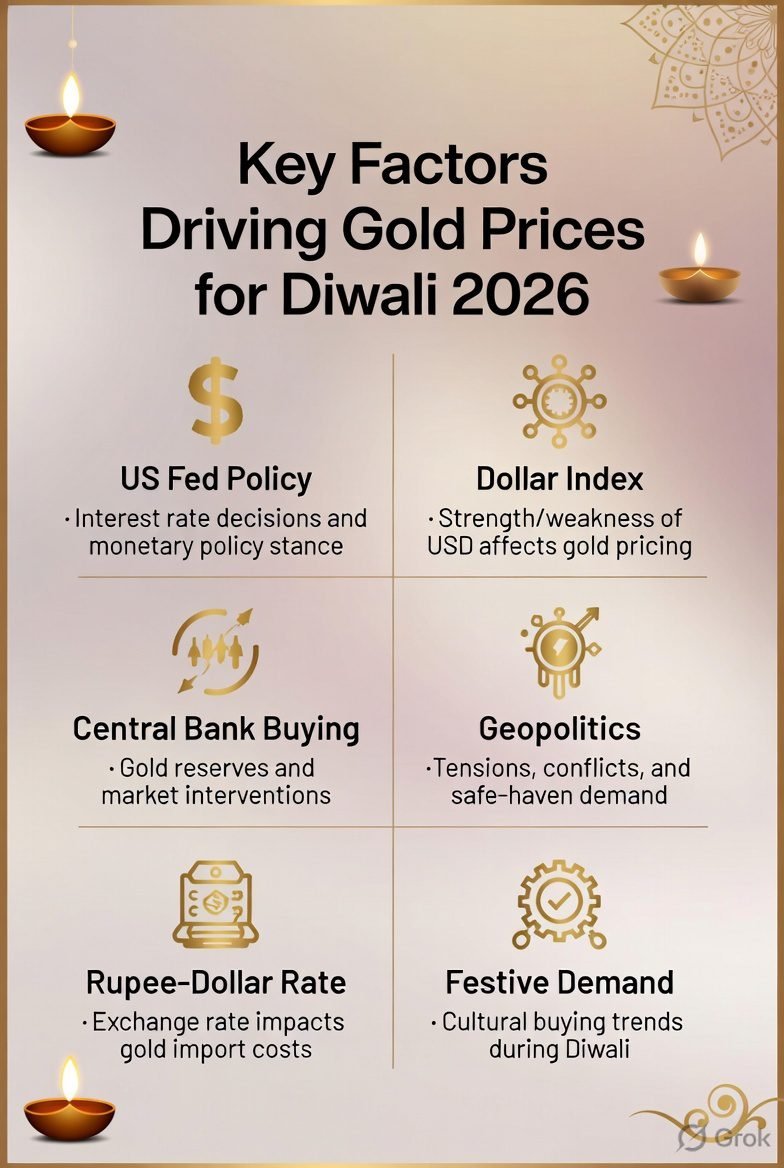
Six forces, working in different directions, will decide where gold lands by Diwali.
What History Says About Gold Around Diwali
Gold's price trajectory into and around Diwali doesn't follow a single reliable seasonal pattern the way, say, agricultural commodities sometimes do — but a few tendencies show up repeatedly across past years and are worth keeping in mind rather than treating as guarantees.
Buildup
Demand Spike
Lakshmi Puja
Cooling
Season Pickup
First, festive demand in India has historically proven remarkably resilient to high absolute prices — 2025 is a widely cited example, where record gold prices still didn't stop buyers, though the weight of gold purchased per household often dips even as rupee-value spending holds up or rises. Second, jewellers and bullion dealers typically report a genuine, if modest, uptick in international and domestic prices in the days immediately around Dhanteras itself, driven by the demand spike, though this effect is usually measured in single-digit percentage moves, not dramatic jumps. Third, any price weakness in the weeks before Diwali has often been treated by Indian buyers as a buying opportunity rather than a reason to wait further, which itself creates a support level as dip-buying kicks in.
Expert Price Forecasts for Diwali 2026
No forecast should be treated as a guarantee — commodity price predictions carry wide error margins, and 2026 has already shown how quickly sentiment can swing. That said, here's a summary of where major forecasters have been positioning their 2026 outlook as of mid-year.
| Source | Approximate 2026 Target | Basis |
|---|---|---|
| World Gold Council | Up to ~30% upside from early-2026 levels | Central bank demand, ETF inflows, rate-cut expectations |
| Goldman Sachs | ~$5,400/oz by end-2026 | Continued central bank buying, weaker dollar outlook |
| JPMorgan | ~$5,055/oz average by late 2026 | Structural central bank purchases |
| Domestic market commentary | ₹1.5–2 lakh per 10g range cited by various local analysts | Rupee weakness, import demand, global cues |
Forecasts compiled from public commentary by the listed institutions and market analysts as of mid-2026; ranges are wide and should be read as directional views, not price guarantees.
Reading across these, the common thread isn't a specific number — it's a broadly bullish medium-term bias built on the same handful of drivers: central bank accumulation, a US rate-cutting cycle, and persistent geopolitical uncertainty. Where forecasters diverge sharply is on how much of that is already priced in after 2026's rally, which is exactly why the correction happened in the first place and why further volatility into Diwali should be treated as the base case rather than a smooth, one-directional recovery.
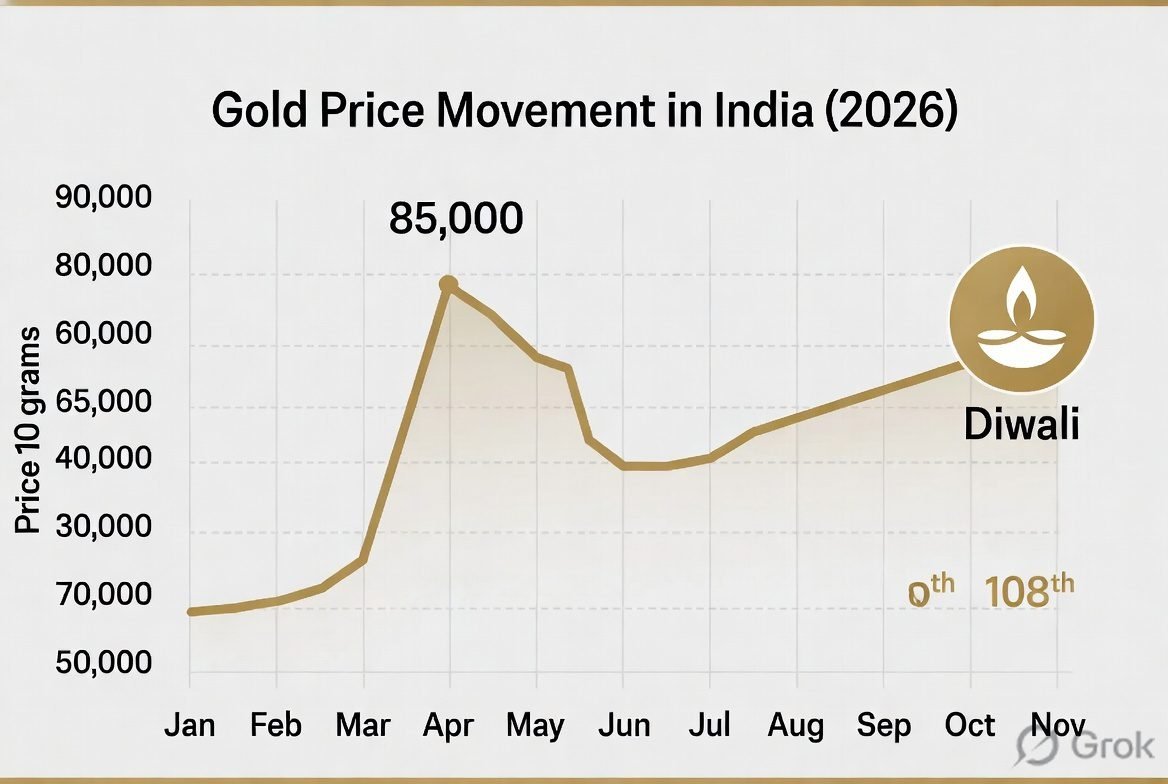
A visual of 2026's rally, correction, and the run-up to Diwali helps put the current price level in context.
How to Buy Gold This Diwali: Comparing Your Options
Beyond timing, how you buy gold this festive season matters almost as much as when. Each format carries a different cost structure, liquidity profile, and suitability depending on whether the goal is jewellery for personal use or gold as a portfolio asset.
| Format | Best For | Key Consideration |
|---|---|---|
| Physical Jewellery | Wearing, gifting, tradition | Making charges (often 8–25%) add meaningfully to cost; always insist on BIS hallmarking |
| Gold Coins/Bars | Simple physical holding with lower premiums | Lower making charges than jewellery, but still carries storage and resale considerations |
| Gold ETFs | Market-linked exposure without storage hassle | Tracks gold price closely; needs a demat account; see our Gold ETF vs Physical Gold guide |
| Digital Gold | Small, flexible purchases | Convenient for gifting small amounts; not yet fully SEBI-regulated the way ETFs are |
| Sovereign Gold Bonds | Long-term holders wanting an interest component | Government-backed; check current issuance availability before assuming a fresh tranche is open |
For festive, tradition-driven purchases, physical gold remains the default for most Indian households, and that isn't likely to change this Diwali. But for the portion of a purchase that's really an investment decision rather than a cultural one, comparing the effective cost — including making charges, GST, and storage — against ETFs or digital gold is worth the extra ten minutes it takes.
Risks to the Bullish Case
It's worth being explicit about what could derail the broadly positive forecasts summarised above, since most coverage of gold heading into a festive season tends to lean bullish by default.
None of these are predictions in themselves — they're simply the counter-scenarios that responsible forecasting has to account for. The realistic range for Diwali 2026 gold prices, given everything above, is probably better thought of as a band rather than a single number: continued volatility around current levels is at least as likely as either a sharp new rally or a deeper correction.
The Bottom Line
Gold's 2026 story so far has been a genuine boom followed by a genuine correction — both real, both explainable, and neither one cancelling out the other. Heading into Dhanteras and Diwali, the structural case for higher gold prices over the medium term (central bank buying, rate-cut expectations, persistent geopolitical risk) remains largely intact, even as short-term price action stays choppy. For festive buyers, the most defensible approach is the one Indian households have quietly used for generations regardless of what forecasters say: buy what tradition calls for on Dhanteras, and treat any additional gold purchase as a considered investment decision rather than a bet on catching the exact bottom.
FAQs: Gold Price Prediction Diwali 2026
No source can state this with certainty. Current levels are around ₹1.44–1.45 lakh per 10g (24K) as of mid-July 2026, with most large forecasters expecting a broadly bullish medium-term bias, but a wide range of outcomes remains realistic by November.
Yes. Gold has corrected roughly 14–20% from the highs reached in January-March 2026, though exact figures vary by source and market reference point.
This depends on your purpose. For traditional Dhanteras/Diwali purchases, most households buy regardless of price level. For investment-purpose gold, staggered buying (spreading purchases over weeks or months) reduces the risk of timing a single purchase badly.
Diwali (Lakshmi Puja) falls on Sunday, 8 November 2026. Dhanteras, the main gold-buying day, falls two days earlier on Friday, 6 November 2026.
A combination of dollar strength, profit-booking after a very sharp rally, and reduced geopolitical risk premium following improved US-India trade relations contributed to the correction.
For traditional or gifting purposes, physical gold remains the norm. For pure investment allocation, Gold ETFs typically carry lower effective costs than jewellery once making charges are factored in.
Recommended size: 1000 × 400 px (landscape)
Placeholder reserved — image will be added later
References: Trading Economics: Gold Price Data · Bajaj Broking: Gold Price Today · ClearTax: Gold Rate India · ClearTax: Gold Price History · Motilal Oswal: Gold Rate Forecast 2026 · Grip Invest: Gold Price Prediction 2026 · Aditya Birla Capital: Gold Price Prediction · IIFL: Gold Rate Forecast India · Poonawalla Fincorp: Gold Price Outlook · Airtel Finance: Gold Price Prediction 2026 · Diwali 2026 Date & Calendar · Diwali 2026: Full Festival Guide · ICICI Direct: US-India Trade Agreement · CNBC: India-US and EU Trade Deals

Pranab Barman is a Financial Educator and Personal Finance Researcher with over 10 years of hands-on experience in stock markets, trading, and investing. Currently enrolled in the CFA Program, he is committed to continuous learning and professional excellence in finance.
As the Founder of PlayWithStock, Pranab covers a wide range of topics including Mutual Funds, SIP, Taxation, Stock Market Basics, and Financial Calculators — with a focus on simplifying complex financial concepts for everyday all investors.
Email: support@playwithstock.com
Website: playwithstock.com
Related posts:
 Gold Price Correction 2026: What It Means for Indian Investors
 How to Invest in Gold ETF: The Complete Gold ETF vs Physical Gold Guide
 Gold Price All Time High India: Should You Buy Now or Wait in 2026
 SBI Mutual Fund IPO 2026: Dates, Price Band, GMP & Should You Apply
 Jio IPO 2026: 10 Crucial Facts Every Investor Must Know
 What Is Circuit Breaker Stock Market: Meaning, Limits & 2026 Update
 F&O STT Hike Breakeven Calculator: 2026 New Rates
 Jio Financial Services Q1 FY27 Results Preview: Date, Estimates & Stock Analysis