


Gold Price Correction 2026: What It Means for Indian Investors
Gold went from an unthinkable ₹1.93 lakh per 10 grams to today's ₹1.44 lakh in five months — and somehow, both the record high and the "crash" happened in the very same year.
Table of Contents
- From Record High to "Correction" in Five Months
- Where Gold Actually Stands Today
- Why Is Gold Falling: The Four Real Drivers
- Gold's 2026 Rollercoaster: Key Milestones
- Why This Isn't the Same as a Stock Market Crash
- The Central Bank Buying Nobody's Talking About
- How Indians Actually Invest in Gold
- Tax Rules on Gold You Should Know
- What Should You Actually Do Now
- Frequently Asked Questions
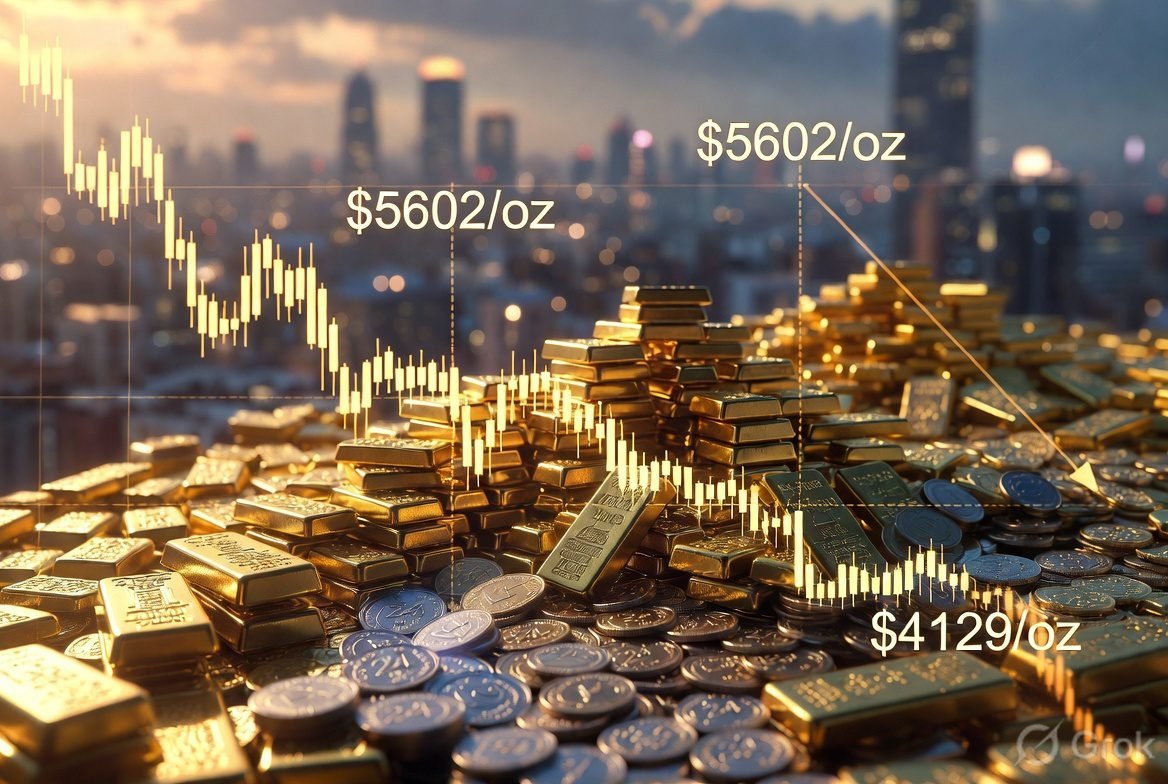
The gold price all-time high in India arrived on January 28, 2026, when international spot gold touched $5,602 an ounce — domestically, MCX gold crossed an unprecedented ₹1.93 lakh per 10 grams. It was a 60% gain in roughly twelve months, an extraordinary move for an asset that typically moves 10-15% in a good year.
Five months later, gold sits near $4,129 an ounce and ₹1.44 lakh per 10 grams — a correction of roughly 26% from the peak. For anyone who bought at the top, that stings. But zoom out even slightly, and a different picture appears: gold is still up 37.6% over the past year, comfortably outperforming most other asset classes despite the pullback. If you're new here, this piece pairs well with our broader Global Economy coverage and our full article library on Play With Stock.
As of July 12, 2026, 24-karat gold trades at approximately ₹14,433 per gram (₹1,44,330 per 10 grams) across major Indian cities including Delhi, Mumbai, and Chennai, per daily rate tracking from GoodReturns. 22-karat gold sits near ₹13,230 per gram. MCX August gold futures have traded in a range of roughly ₹1.44-1.48 lakh per 10 grams over the past two weeks, while international spot prices can be tracked live via Trading Economics.
Silver has fallen even harder in percentage terms — down close to 10% for the month of July alone, trading around ₹2,35,000 per kilogram, as tracked in our silver crash 2026 coverage.
1. A Stronger Dollar
Gold and the US dollar have historically moved in opposite directions, since gold is priced globally in dollars. When the Dollar Index (DXY) strengthens, gold typically becomes relatively more expensive for holders of other currencies, dampening demand. Recent dollar strength has been a direct headwind on gold prices through mid-2026.
2. Fed Rate Hike Expectations
Gold pays no interest, which makes it structurally less attractive whenever US interest rates are expected to rise — holding gold means giving up the yield available on interest-bearing dollar assets. Market pricing for a US Federal Reserve rate hike has fluctuated through 2026, and every uptick in Fed rate hike expectations has coincided with fresh pressure on bullion.
3. Cooling Geopolitical Panic (Even Amid Real Conflict)
Gold's January spike was driven substantially by fear — escalating Middle East tensions, uncertainty over Iran, and broader geopolitical risk. Periods of diplomatic progress, even partial or temporary, tend to drain some of that "fear premium" out of gold prices, even as underlying tensions (including disruptions affecting the Strait of Hormuz, tracked closely via Brent crude oil pricing, and broader India-US trade relations) remain far from fully resolved.
4. ETF Outflows and a Rotation Back to Risk Assets
Gold-backed ETFs saw outflows in the tens of tonnes through May and June 2026, as some investors rotated capital back toward equities and technology stocks, a trend tracked in detail by State Street's Monthly Gold Monitor. This is a classic pattern: when fear recedes, "safe haven" allocations shrink and risk appetite returns — a dynamic closely related to the psychology explored in why investors lose money in the stock market.
Gold's 2026 Rollercoaster: Key Milestones
It's tempting to read a 26% pullback the same way one might read a sharp fall in the Nifty 50 or Sensex — as a warning sign. But gold's correction sits on top of a genuinely record-breaking run, not a bubble bursting from nothing. Even at today's "corrected" price, gold remains roughly 90% above its 2022 levels and 75% above pre-pandemic levels — a very different picture from equity investors who bought near a genuine top and watched a permanent capital loss.
One structural force has remained remarkably steady through all of this volatility: central bank buying. The World Gold Council's June 2026 Mid-Year Outlook found that 89% of surveyed central banks expect global gold reserves to rise over the next twelve months, continuing a streak of net purchases exceeding 1,000 tonnes annually for three straight years. Reserve diversification away from the US dollar — a theme closely connected to dollar index dynamics — is a big part of this story, with a growing share of respondents expecting lower dollar holdings in global reserves over the next five years.
Indian households collectively hold an estimated 25,000 tonnes of gold — the largest private stockpile in the world — but the way that gold is held is changing. Beyond physical jewellery, three routes have become mainstream (see official NSE Sovereign Gold Bond market data, RBI-authorised SGB information, and current SGB listings and yields for further reading):
| Route | What It Is | Best Suited For |
|---|---|---|
| Sovereign Gold Bonds (SGB) | Government-issued bonds tracking gold price, plus 2.5% annual interest | Long-term holders comfortable locking in for 5-8 years |
| Gold ETFs | Exchange-traded funds backed by physical gold, bought via a demat account | Investors wanting liquidity and no storage hassle |
| Digital Gold | Fractional gold purchased through apps, redeemable for physical delivery | Very small, flexible, frequent purchases |
Many financial planners recommend a staggered, SIP-style approach to gold buying rather than a single lump sum — a philosophy that mirrors the logic behind record equity SIP inflows in India: regular, disciplined buying smooths out entry price risk far better than trying to time a single "perfect" purchase. If you're entirely new to markets, our beginner investing guide and demat account explainer are good starting points before buying any gold ETF, since ETFs trade on exchanges just like stocks — through either the NSE or BSE.
For those specifically holding older Sovereign Gold Bond tranches, understanding early exit mechanics matters — our SGB premature redemption calculator helps estimate what an early exit is actually worth at today's prices.
One useful contrast: unlike individual stocks, which can hit a circuit breaker and halt trading during extreme volatility, gold and gold ETFs don't carry the same exchange-level trading halts — a structural difference worth understanding if you're used to equity market mechanics.
Following changes announced in the Union Budget, long-term capital gains on gold (held over 24 months) are taxed at 12.5% without indexation — a meaningfully simpler and, for many investors, more favourable regime than the older 20%-with-indexation structure. Gains on gold held under 24 months are taxed as short-term capital gains at your regular income tax slab rate. As with any capital gain, this needs to be correctly reported by the ITR filing deadline each year — SGB capital gains at maturity, notably, are fully tax-exempt for individual investors, one of the format's most underrated advantages. This is notably simpler than the tax treatment around cryptocurrency in India, where reporting requirements have become considerably stricter.
Don't Treat a Correction Like a Crash
As covered above, the structural demand picture — central banks buying over 1,000 tonnes a year, a weakening long-term case for the dollar — hasn't changed just because the price pulled back from an extreme high. Panic-selling gold purely because it's down from its peak repeats the exact same behavioural mistake explored in our piece on why investors lose money in the stock market.
Gold Is a Portfolio Diversifier, Not a Standalone Bet
Gold works best as one piece of a diversified portfolio alongside equities, debt, and other assets — not as a replacement for any of them. This is the same core principle behind diversified products like life cycle funds, which automatically rebalance exposure across asset classes as an investor's goals and time horizon evolve. If you're still working out your overall monthly allocation, the 50-30-20 budgeting rule is a reasonable starting framework for deciding how much of your savings bucket should even go toward an asset like gold in the first place — and if you're a government employee mapping this against upcoming salary changes, our 8th Pay Commission salary calculator can help project your future investible surplus.
Compare Before You Buy — Fees Matter Here Too
Whether you're picking a gold ETF, a mutual fund with gold exposure, or comparing fund houses generally, expense ratios quietly eat into long-term returns exactly the same way they do in equity funds — our Mutual Fund TER vs BER calculator is a useful starting point for that comparison.
Keep an Eye on the Broader Macro Picture
Gold doesn't move in isolation. Inflation trends (including domestic pressures explored in our monsoon 2026 India inflation coverage), currency moves, and even sentiment in adjacent alternative assets like Bitcoin's 2026 correction all feed into the same broad risk-appetite cycle that gold responds to. Investors who track the wider picture — rather than gold in a vacuum — tend to make better-timed decisions.
Gold didn't crash so much as correct from an extreme, fear-driven record high. A stronger US dollar, shifting Fed rate hike expectations, cooling geopolitical panic, and ETF outflows all combined to pull prices down roughly 26% from January's peak.
This article does not provide individual investment advice. Structural demand from central banks remains strong, and gold is still up significantly over the past year, but any allocation decision should reflect your own goals, time horizon, and overall portfolio diversification.
As of July 12, 2026, 24-karat gold trades around ₹14,433 per gram (approximately ₹1.44 lakh per 10 grams) in major Indian cities, though prices vary slightly by city and change daily.
SGBs suit long-term holders comfortable with a multi-year lock-in and offer tax-free capital gains at maturity plus 2.5% annual interest. Gold ETFs offer more liquidity and flexibility for investors who may need to exit sooner. The right choice depends on your time horizon.
Gold held over 24 months qualifies for long-term capital gains tax at 12.5% without indexation. Gold held under 24 months is taxed as short-term capital gains at your regular income tax slab rate. SGB gains at maturity are fully tax-exempt for individual investors.
For live international gold and silver futures pricing beyond what's covered here, Investing.com's commodities data is a useful reference for cross-checking prices before making any purchase decision.

Pranab Barman is a Financial Educator and Personal Finance Researcher with over 10 years of hands-on experience in stock markets, trading, and investing. Currently enrolled in the CFA Program, he is committed to continuous learning and professional excellence in finance.
As the Founder of PlayWithStock, Pranab covers a wide range of topics including Mutual Funds, SIP, Taxation, Stock Market Basics, and Financial Calculators — with a focus on simplifying complex financial concepts for everyday all investors.
Email: support@playwithstock.com
Website: playwithstock.com
Related posts:
 How to Invest in Gold ETF: The Complete Gold ETF vs Physical Gold Guide
 FATF Anti-Fraud Rules 2026: What They Mean for Indian Investors
 Gold Price All Time High India: Should You Buy Now or Wait in 2026
 Circle National Trust Bank: What the OCC Approval Means for USDC and CRCL
 H-1B $100K Visa Fee — Indian IT Stocks Pe Impact (2026 Update)
 SBI Mutual Fund IPO 2026: Dates, Price Band, GMP & Should You Apply
 Vedanta Demerger 2026: What It Means for Shareholders
 India US Trade Deal 2026: Inside the Tariff Rollercoaster Before July 22