


Systematic Withdrawal Plan (SWP): The Complete 2026 Guide to Turning Your Mutual Fund Corpus Into a Monthly Income
SWP Calculator — See How Long Your Corpus Lasts
Enter your invested amount, the monthly withdrawal you want, and an expected annual return. We'll show you the monthly capital gains-taxable portion and how many years your money realistically holds up.
How to Use This SWP Calculator
- Enter your total invested corpus — the lump sum you already have (or plan to have) sitting in a mutual fund scheme before you start withdrawing.
- Enter your desired monthly withdrawal — the fixed amount you want credited to your bank account every month.
- Enter your expected annual return — a conservative estimate for the fund category you're using. Equity hybrid funds are commonly modelled around 8-11%, pure equity funds higher but with more volatility, debt funds lower and steadier.
- Set the withdrawal period you want to check — for most retirement planning, 20-25 years is a reasonable horizon to test.
- Click Calculate. The tool projects your corpus month by month, applying the return first and then deducting the withdrawal — this is the actual order in which an AMC processes an SWP, not a simplified average.
We built this calculator to warn you directly if your chosen withdrawal rate isn't sustainable at your assumed return, rather than just showing a clean-looking number and letting you assume it's fine. If you see the red warning line, it means the math doesn't hold up over your full period — either lower the monthly withdrawal or revisit the return assumption.
- 1. What Is a Systematic Withdrawal Plan
- 2. Complete Guide: How SWP Actually Works
- 3. The SWP Formula Explained
- 4. SWP Taxation in India (2026 Rules)
- 5. SWP vs Fixed Deposit vs Dividend Plans
- 6. Common SWP Mistakes to Avoid
- 7. Real Example: A 25-Year SWP Walkthrough
- 8. Who Should Actually Use an SWP
- 9. Conclusion
- 10. FAQs
1. What Is a Systematic Withdrawal Plan (SWP)
A Systematic Withdrawal Plan (SWP) is the exact mirror image of a SIP. With a SIP, you're feeding money into the market every month, buying units and building a corpus over years. A Systematic Withdrawal Plan flips that direction — you've already built the corpus, and now you're pulling a fixed amount out every month while the rest of it stays invested and, ideally, keeps growing quietly in the background.
It's an instruction you set up once with your mutual fund house: redeem units worth ₹X on a chosen date every month, and credit that amount to my registered bank account. The AMC handles the mechanics — selling just enough units at that day's NAV, and leaving the remainder invested exactly as before.
This has become one of the more searched retirement and passive-income topics in Indian personal finance for a simple reason: a lot of people who built a solid mutual fund portfolio over 15-20 years through SIPs eventually reach the stage where they need the corpus to pay them back, monthly, the way a salary once did — and SWP is the structured, tax-aware way to do that.
2. Complete Guide: How SWP Actually Works
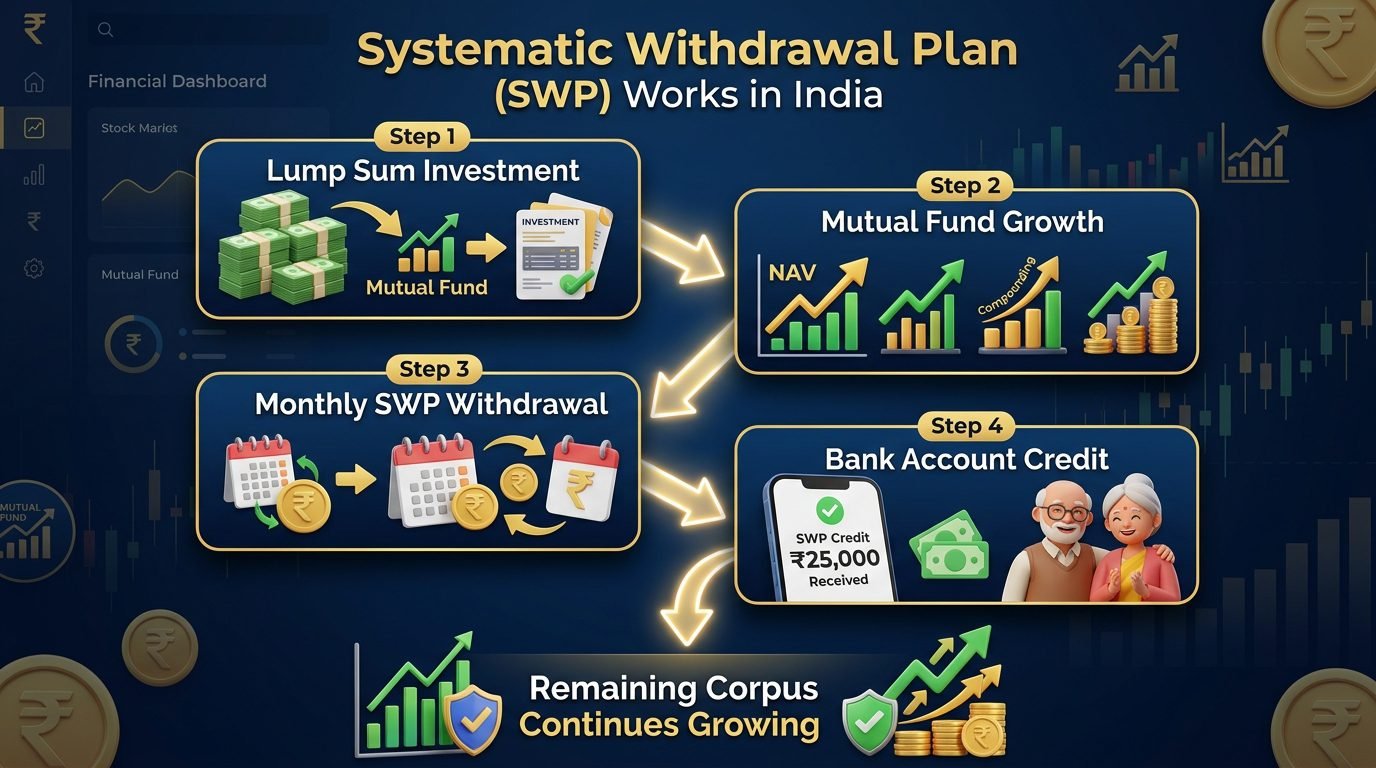
Here's the mechanical sequence, step by step, since most explainers skip the actual back-end process:
- You invest a lump sum into a mutual fund scheme — usually in the Growth option, not the IDCW (dividend) option, for reasons we'll get to in the taxation section.
- You register an SWP mandate specifying the withdrawal amount, frequency (monthly is most common, though quarterly is also available), and the date.
- On the scheduled date, the AMC calculates how many units need to be sold to generate your requested withdrawal amount, based on that day's declared NAV.
- Those units are redeemed and the resulting amount hits your registered bank account, typically within 1-3 working days.
- The remaining units stay invested, continuing to earn (or lose) value based on the fund's performance until the next withdrawal cycle.
The part that trips up a lot of first-time users: your corpus doesn't grow or shrink in a straight line. In a month where the fund's NAV rises sharply, your remaining corpus can actually be higher than the previous month, even after the withdrawal. In a falling market, the opposite happens — more units get sold to generate the same rupee amount, which quietly accelerates how fast the corpus depletes. This is exactly what our calculator above is modelling when it shows the corpus running out earlier than expected at higher withdrawal rates.

3. The SWP Formula Explained
The underlying math combines a monthly withdrawal against a compounding balance. In plain terms, for each month:
Balance (next month) = [Balance (this month) × (1 + monthly return)] − Withdrawal amount
Where monthly return = annual expected return ÷ 12, applied before the withdrawal is deducted — because the fund's returns accrue continuously through the month, and the redemption happens on your specific SWP date.
Run this month over month, and you get the trajectory our calculator plots. It's a subtly different formula from a plain annuity calculation because the "interest" here isn't fixed or guaranteed — it's a market-linked assumption, which is exactly why we recommend testing your numbers at more than one return assumption (try running the calculator once at 10% and again at 7%, to see how sensitive your corpus life is to a market that underperforms your expectation).
4. SWP Taxation in India (2026 Rules)
This is genuinely the strongest argument in favour of SWP over alternatives like FD interest or IDCW payouts, and it's worth understanding properly rather than taking on faith.
Every SWP withdrawal is legally treated as a partial redemption of your mutual fund units — not as "income" in the way FD interest is. That means only the gain portion of what you withdraw is taxable; the portion that represents your own original capital coming back to you isn't taxed again. Redemptions follow the FIFO (First In, First Out) rule, meaning your oldest units are sold first — which usually works in your favour, since older units are more likely to already qualify for the long-term capital gains rate.
| Fund Type | Holding Period | Tax Treatment |
|---|---|---|
| Equity Mutual Fund | Under 12 months (STCG) | 20% flat on the gain portion |
| Equity Mutual Fund | Over 12 months (LTCG) | 12.5% on gains above ₹1.25 lakh/year exemption |
| Debt Mutual Fund (post-April 2023 purchase) | Any period | Taxed at your income tax slab rate |
| Bank Fixed Deposit (comparison) | N/A | Entire interest taxed at slab rate, up to 30%+ |
A quick worked example to make this concrete: if you redeem units worth ₹15,000 in a month, and ₹9,000 of that is your original invested capital while ₹6,000 is the gain, only that ₹6,000 gain portion enters the capital gains calculation — and if those units were held over a year, it's taxed at 12.5% only after your cumulative annual long-term gains cross ₹1.25 lakh. Compare that to a fixed deposit paying the same ₹15,000/month in pure interest, all of which gets added to your taxable income at your slab rate — for anyone in the 30% bracket, the difference in what actually reaches your pocket is substantial.
One detail we'd flag clearly: choose the Growth option, not IDCW, when setting this up. With IDCW, the entire payout is taxed at your slab rate as "income from other sources" — you lose the capital-gains tax advantage entirely, which defeats much of the point of using SWP in the first place.
If you're also managing other tax planning around the same time, it's worth reading this alongside our ITR filing deadline guide and our piece on tax-loss harvesting in India, since SWP gains need to be reported correctly under capital gains, not clubbed with your salary income.
5. SWP vs Fixed Deposit vs Dividend Plans
| Parameter | Bank FD | Equity SWP (Growth) | IDCW/Dividend Plan |
|---|---|---|---|
| Tax on full amount received? | Yes, all interest taxed | No, only gain portion | Yes, full amount at slab rate |
| Payout consistency | Fixed and guaranteed | Fixed amount, market-linked corpus | Variable, depends on fund's payout |
| Inflation-beating potential | Low | Higher (equity exposure continues) | Higher, but tax-inefficient |
| Control over payout amount | Fixed at opening | Fully investor-controlled | Not investor-controlled |
| Capital erosion risk in a downturn | None | Real — more units sold when NAV falls | Real |
We'd rather be direct here: SWP isn't a risk-free alternative to an FD, and treating it that way is the most common misunderstanding we come across. What it is, though, is a meaningfully more tax-efficient way to generate income from money you're comfortable keeping exposed to some market movement — which is a different trade-off, not a strictly better one, and worth weighing against your own risk tolerance. For a side-by-side on where gold fits into this comparison too, see our guide on Gold ETF vs physical gold, since a diversified income strategy in retirement often blends more than one of these tools.
6. Common SWP Mistakes to Avoid
Mistake 1: Setting the withdrawal rate too high
A withdrawal rate above roughly 7-8% annually (withdrawal × 12 ÷ corpus) starts eating into principal faster than most equity-oriented funds can realistically replace it over the long run, especially across a sequence of a few weak market years early in the SWP. Run your own numbers through the calculator above before committing to a monthly figure.
Mistake 2: Starting SWP in a lump sum right before a market downturn
This is known as "sequence of returns risk" — the exact same average annual return can produce very different outcomes depending on whether the bad years happen early or late in your withdrawal period. If early years are weak, you're selling more units at depressed prices, which permanently damages the corpus's ability to recover.
Mistake 3: Choosing IDCW instead of Growth option
As covered above, this quietly gives up the entire tax advantage that makes SWP attractive in the first place.
Mistake 4: Ignoring the difference between equity and debt fund taxation
Running an SWP from a debt fund purchased after April 2023 means every gain is taxed at your slab rate regardless of holding period — a materially different (and often costlier) outcome than an equity SWP held long-term. Confirm your fund category before assuming the equity tax treatment applies.
Mistake 5: Never revisiting the withdrawal amount
A ₹20,000/month withdrawal set in 2020 buys meaningfully less in 2026 due to inflation, but many investors never revisit or increase it — nor do they check whether the corpus is depleting faster than planned. An annual review, similar to the discipline in our inflation and portfolio guide, keeps the plan realistic.
7. Real Example: A 25-Year SWP Walkthrough
Consider an investor with a ₹50 lakh corpus in an equity-oriented hybrid fund, withdrawing ₹25,000/month (a 6% annual withdrawal rate) and assuming a conservative 9% expected annual return. Using the same balance formula our calculator applies, this withdrawal rate comfortably sustains the corpus well past 25 years, with the balance continuing to grow in most years because the assumed return outpaces the withdrawal rate. Push that same corpus to a ₹40,000/month withdrawal instead (a 9.6% annual rate) at the same 9% return assumption, and the corpus visibly starts depleting within 15-18 years, since the withdrawal rate now exceeds what the return can replace. We'd trust this kind of side-by-side comparison over a single static number precisely because it's the withdrawal-to-return gap, not the withdrawal amount alone, that determines how long the money actually lasts — run both scenarios yourself using the calculator at the top of this page with your own corpus figures.
8. Who Should Actually Use an SWP
SWP tends to suit three kinds of investors particularly well: retirees who've built a corpus over decades of SIP investing and now need it to function like a monthly pension, professionals wanting a modest secondary income stream from investments they've already held for years without disturbing their primary career income, and anyone with a defined 5-10 year goal — funding a parent's care, a child's education instalments — who wants structured, tax-aware withdrawals rather than one large redemption.
It's probably not the right tool if your investment horizon before needing the money is under 3 years, or if your corpus is still small enough that a market downturn early on could meaningfully derail the goal — in that case, our guide on beginner investing fundamentals and building toward an emergency fund first is a more appropriate starting point.
9. Conclusion
A Systematic Withdrawal Plan (SWP) is best understood as a controlled, tax-aware faucet on a corpus you've already built — not a guaranteed income product, and not something to set and forget without checking in periodically. Used with a realistic withdrawal rate against a conservative return assumption, it's one of the more tax-efficient ways available to Indian investors to convert accumulated wealth into a monthly income. Used carelessly, with too high a withdrawal rate or the wrong fund option, it can deplete a lifetime's savings faster than a comparable fixed-income alternative would have. Run your own numbers through the calculator at the top of this page before setting one up, and revisit those numbers at least once a year.
10. Frequently Asked Questions
SWP is generally more tax-efficient than an FD, since only the gain portion of each withdrawal is taxed, versus the entire interest amount in an FD. However, SWP carries market risk and no guaranteed return, while an FD's payout is fixed and guaranteed — the better choice depends on your risk tolerance, not tax efficiency alone.
Many financial planners treat an annual withdrawal rate of 6-8% of the corpus as a reasonable starting range for equity-oriented funds, though the safe rate depends heavily on your fund's expected return and market conditions. Use the calculator above to test your specific numbers rather than relying on a generic rule.
No. Only the capital gains portion of each withdrawal is taxable; the portion that represents your original invested capital is not taxed again, since it's simply your own money being returned to you.
Growth option is strongly preferred. With IDCW, the entire payout is taxed at your income slab rate, which removes the capital-gains tax advantage that makes SWP attractive in the first place.
Yes. If your monthly withdrawal rate exceeds what your fund's actual returns can sustain — particularly if poor market years occur early in the withdrawal period — the corpus can deplete faster than initially projected. This is why testing your numbers with a calculator before committing is important.
SIP is a method of investing a fixed amount regularly to build a corpus over time. SWP is the reverse — withdrawing a fixed amount regularly from an already-built corpus, while the remainder stays invested.
Yes. Most AMCs allow you to modify, pause, or stop an SWP mandate at any time through their portal or app, typically with a few days' processing lead time before the next scheduled withdrawal.
Yes, SWP works with debt funds as well, but the taxation differs — gains on debt fund units purchased after April 1, 2023 are taxed at your income slab rate regardless of holding period, unlike the more favourable long-term equity capital gains treatment.
Related Reading on Play With Stock
- How SIP Works: Complete Guide
- Mutual Fund Complete Guide India
- Direct vs Regular Mutual Fund
- Index Funds vs Active Funds India
- ITR Filing Last Date 2026
- Tax-Loss Harvesting in India
- How Inflation Affects Your Stock Portfolio
- SIP Compounding Calculator
Official & External Sources

Pranab Barman is a Financial Educator and Personal Finance Researcher with over 10 years of hands-on experience in stock markets, trading, and investing. Currently enrolled in the CFA Program, he is committed to continuous learning and professional excellence in finance.
As the Founder of PlayWithStock, Pranab covers a wide range of topics including Mutual Funds, SIP, Taxation, Stock Market Basics, and Financial Calculators — with a focus on simplifying complex financial concepts for everyday all investors.
Email: support@playwithstock.com
Website: playwithstock.com
Related posts:
 STP (Systematic Transfer Plan) 2026: Lumpsum Investing Without Timing Risk
 NPS National Pension System 2026: Complete Guide to Rules, Tax Benefits and Withdrawal
 Same Fund, Same Manager, Different NAV: Direct vs Regular Mutual Fund Explained With Real Numbers
 Monthly SIP of ₹5,000 for 20 Years: Real Numbers, Real Story, and a Calculator
 Mutual Fund Guide India 2026: The Essential 7-Step Beginner Blueprint
 Term Insurance vs Endowment Plan: Which is Better for Beginners in 2026
 ₹1 Crore in SIP: How Much to Invest Monthly
 What Are Life Cycle Funds? SEBI’s Quiet New Mutual Fund Category