
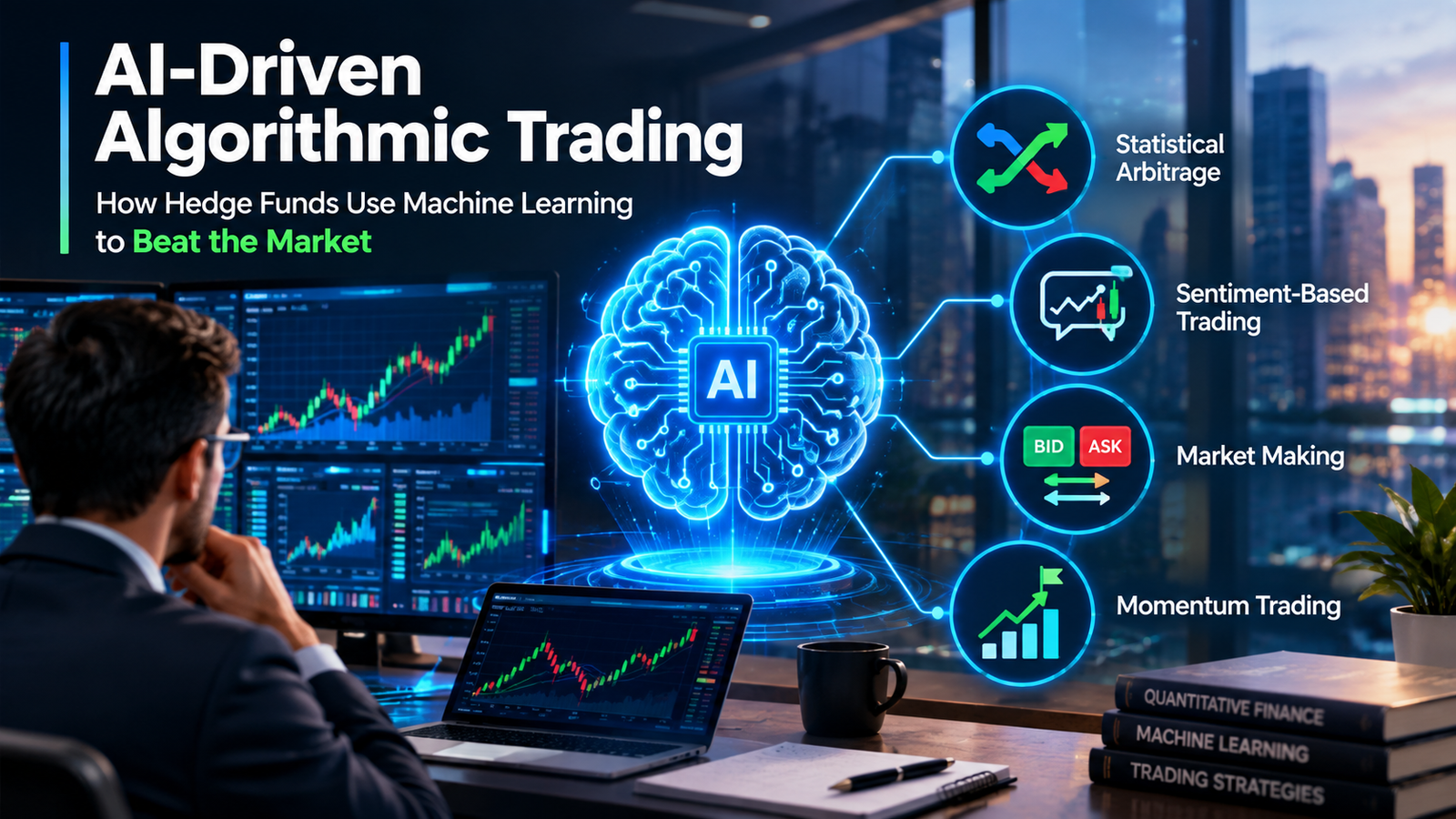

AI-Driven Algorithmic Trading: How Hedge Funds Use Machine Learning to Beat the Market
Over the past decade, AI-driven algorithmic trading has quietly become the single biggest force reshaping how money moves through global financial markets. What once required a floor full of human traders shouting orders is now executed in microseconds by machine learning models that read data, predict outcomes, and place trades faster than any human ever could. Today, the majority of daily trading volume on major exchanges like the NYSE and NASDAQ is executed not by people, but by algorithms — many of them powered by artificial intelligence.
In this in-depth guide, we will explore exactly how AI-driven algorithmic trading works, why hedge funds have invested billions of dollars into machine learning infrastructure, and how these firms consistently attempt to beat the market using data that ordinary retail investors rarely get to see. If you're new to investing, you may first want to read our beginner-friendly guide on what the stock market is and how it works, since this article assumes a working understanding of how markets function.
What Is AI-Driven Algorithmic Trading?
AI-driven algorithmic trading refers to the use of artificial intelligence and machine learning models to automatically make trading decisions — deciding what to buy, what to sell, how much to trade, and precisely when to execute the order — without direct human intervention at the moment of the trade. Traditional algorithmic trading follows fixed, pre-programmed rules written by a human programmer. AI-driven algorithmic trading goes a step further: the system itself learns from historical and live market data, continuously adjusting its own decision-making process as new patterns emerge.
This distinction matters enormously. A traditional algorithm might say, "buy this stock if its price crosses above its 50-day moving average." An AI-driven algorithmic trading system, on the other hand, might analyze thousands of variables simultaneously — price action, order book depth, news sentiment, social media chatter, satellite imagery of retailer parking lots, and even weather patterns — and independently decide which combination of signals is most likely to predict a profitable trade, updating that decision model automatically as market conditions shift.
Why Hedge Funds Have Embraced AI-Driven Algorithmic Trading
Hedge funds exist for one core purpose: to generate returns that outperform the broader market, often called "alpha." In a world where information spreads instantly and millions of professional investors are competing for the same edge, finding alpha has become extraordinarily difficult using traditional research methods alone. This is precisely why the largest and most sophisticated funds in the world have poured enormous resources into AI-driven algorithmic trading over the last fifteen years.
Firms such as Renaissance Technologies, Two Sigma, Citadel, and D.E. Shaw are widely known in the financial industry for their heavy reliance on quantitative and AI-based strategies. According to reporting from Investopedia's overview of algorithmic trading, algorithm-based strategies now account for a substantial majority of trading volume in U.S. equity markets, a dramatic shift from the manual, human-driven trading floors of the 1990s.
The appeal is simple: machine learning models can process far more data, far faster, and far more consistently than any human analyst. They do not get tired, they do not panic during volatile sessions, and they do not let emotion cloud a decision. For a hedge fund managing billions of dollars, even a tiny statistical edge — repeated across millions of trades — can translate into massive profits over time.
The Core Technologies Behind AI-Driven Algorithmic Trading
To understand how hedge funds actually use machine learning to beat the market, it helps to break down the key technologies that make modern AI-driven algorithmic trading possible.
Machine Learning Models
Most AI-driven algorithmic trading systems rely on a combination of supervised learning, unsupervised learning, and reinforcement learning. Supervised learning models are trained on historical labeled data to predict future price movement, while unsupervised learning is often used to detect hidden patterns or clusters in massive, unlabeled datasets, such as identifying previously unknown relationships between different asset classes.
Natural Language Processing (NLP)
Modern AI-driven algorithmic trading systems increasingly use natural language processing to scan earnings call transcripts, news headlines, regulatory filings, and social media posts in real time, converting unstructured text into structured sentiment scores that feed directly into trading decisions within milliseconds of a headline being published.
Reinforcement Learning
Reinforcement learning is one of the most advanced techniques used in AI-driven algorithmic trading. Instead of being told exactly what to do, the model is given a reward function — typically profit — and learns through millions of simulated trades which actions lead to the best long-term outcomes, similar to how a chess-playing AI learns winning strategies purely through repeated self-play.
High-Frequency Data Infrastructure
None of this works without enormous computing power. Hedge funds running AI-driven algorithmic trading systems invest heavily in low-latency infrastructure, sometimes placing servers physically inside stock exchange data centers to shave microseconds off execution time, a practice known as co-location.
Common AI-Driven Algorithmic Trading Strategies
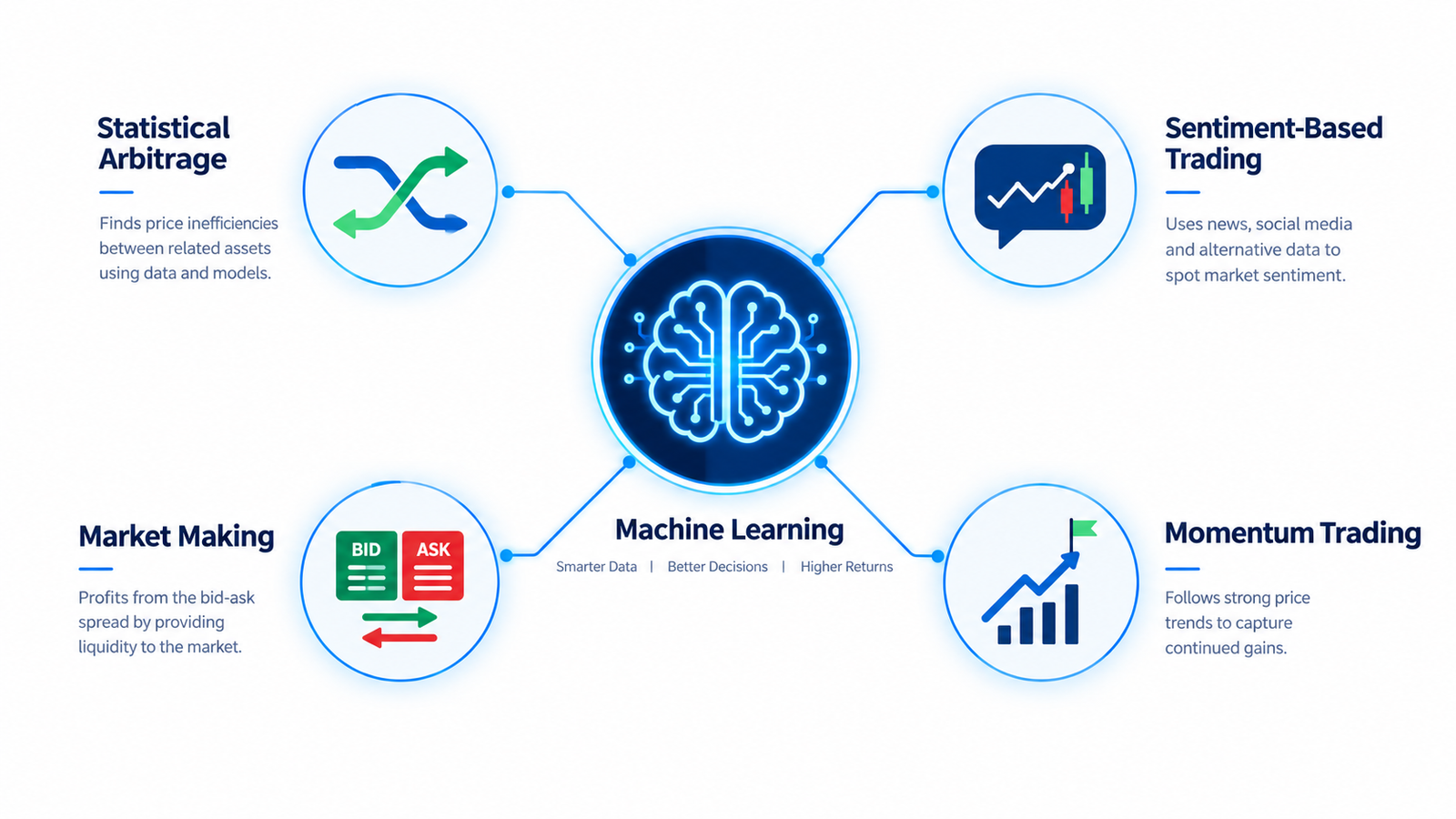
Hedge funds do not rely on a single approach. Instead, most funds running AI-driven algorithmic trading systems combine multiple strategies, often running dozens or even hundreds of individual models simultaneously across different asset classes.
Statistical Arbitrage
Statistical arbitrage strategies use machine learning to identify pairs or groups of assets whose prices historically move together. When the relationship temporarily breaks down, the algorithm automatically buys the undervalued asset and sells the overvalued one, betting that the relationship will eventually revert to its historical pattern.
Sentiment-Based Trading
By combining natural language processing with market data, AI-driven algorithmic trading systems can trade on breaking news within milliseconds, often reacting to an earnings announcement or a central bank statement before a human trader has even finished reading the headline.
Market Making Algorithms
Many AI-driven algorithmic trading systems act as automated market makers, continuously posting both buy and sell orders to profit from the small difference between the bid and ask price, while using machine learning to dynamically adjust pricing based on real-time volatility and order flow.
Momentum and Trend-Following Models
These systems use machine learning to detect the early stages of a price trend across thousands of instruments simultaneously, entering positions as momentum builds and exiting automatically once the model detects signs of reversal or exhaustion in the trend.
Traditional Algorithmic Trading vs AI-Driven Algorithmic Trading
To fully appreciate why hedge funds have shifted so heavily toward machine learning, it helps to compare traditional rule-based algorithmic trading with modern AI-driven algorithmic trading side by side.
- Decision logic: Traditional algorithmic trading follows fixed if-then rules written by humans. AI-driven algorithmic trading learns its own decision rules directly from data and continuously refines them.
- Adaptability: Traditional systems require manual reprogramming when market conditions change. AI-driven algorithmic trading systems can automatically retrain and adapt as new data becomes available.
- Data usage: Traditional algorithms typically rely on price and volume data alone. AI-driven algorithmic trading incorporates alternative data such as news sentiment, satellite imagery, and social media signals.
- Complexity: Traditional strategies are relatively simple and explainable. AI-driven algorithmic trading models, especially deep learning systems, can be extremely complex and harder to interpret.
- Performance in new conditions: Traditional algorithms may fail silently when markets behave differently than expected. AI-driven algorithmic trading models are designed to recognize and adjust to genuinely new patterns, though they are not immune to failure either.
This evolution from static rules to adaptive, self-learning systems is exactly why AI-driven algorithmic trading has become the dominant approach among the world's most successful hedge funds over the past decade.
How a Hedge Fund Builds an AI-Driven Algorithmic Trading Model
Building a functioning AI-driven algorithmic trading system is a long, resource-intensive process that typically involves several distinct stages, each requiring specialized expertise.
Step 1: Data Collection and Cleaning
Every AI-driven algorithmic trading project begins with gathering vast amounts of historical and real-time data, including price feeds, order book data, news archives, and alternative datasets. This raw data must then be carefully cleaned, since even small errors or missing values can seriously distort a machine learning model's predictions.
Step 2: Feature Engineering
Quantitative researchers identify and construct "features," or measurable signals, that the AI-driven algorithmic trading model will use to make predictions, such as price momentum, volatility measures, or sentiment scores extracted from news articles.
Step 3: Model Training and Backtesting
The machine learning model is trained on historical data and then rigorously backtested against past market conditions to evaluate how the AI-driven algorithmic trading strategy would have performed, though hedge funds are careful to test on data the model has never seen to avoid misleading results.
Step 4: Risk Management Layer
Before any AI-driven algorithmic trading model goes live, firms build strict risk management rules around it, including maximum position sizes, stop-loss triggers, and circuit breakers that automatically halt trading if the model behaves unexpectedly.
Step 5: Live Deployment and Continuous Monitoring
Once deployed, AI-driven algorithmic trading systems are continuously monitored by human quant teams, who track performance, watch for signs of model decay, and retrain the system periodically as market conditions evolve.
AI-Driven Algorithmic Trading in Indian Markets
India has seen rapid growth in algorithmic and AI-driven algorithmic trading activity over the past several years, particularly following SEBI's introduction of clearer regulatory frameworks for algorithmic trading on the NSE and BSE. Proprietary trading firms and increasingly sophisticated retail platforms have started offering AI-based tools that allow Indian traders to backtest strategies and automate order execution.
However, AI-driven algorithmic trading in India still lags behind the scale seen in U.S. and European markets, largely due to infrastructure costs, data availability, and the relatively recent introduction of comprehensive regulatory guidelines. As data access improves and computing costs continue to fall, AI-driven algorithmic trading is expected to play an increasingly significant role in Indian markets over the coming years.
The Cost of Building AI-Driven Algorithmic Trading Infrastructure
One of the biggest barriers to entry in AI-driven algorithmic trading is cost. Large hedge funds often spend tens of millions of dollars annually on data subscriptions, cloud computing power, low-latency network infrastructure, and highly specialized talent, including PhD-level machine learning researchers and quantitative developers.
This is precisely why AI-driven algorithmic trading has historically remained concentrated among a relatively small number of well-capitalized institutional players, even though the core machine learning techniques themselves are increasingly well documented and publicly available through academic research and open-source tools.
Ethical Considerations Around AI-Driven Algorithmic Trading
As AI-driven algorithmic trading systems have grown more powerful, they have also raised important ethical questions. Critics argue that ultra-fast algorithmic trading can create an uneven playing field, where institutional players with faster infrastructure gain an advantage over ordinary retail investors who cannot compete on speed.
There are also broader concerns about market stability, since a poorly designed AI-driven algorithmic trading model, if deployed at scale, has the potential to trigger unintended chain reactions across interconnected markets, a risk regulators continue to study closely as adoption of these systems increases worldwide.
How Hedge Funds Actually Beat the Market Using AI
It's important to understand that AI-driven algorithmic trading does not guarantee profits, and no machine learning model can predict the market with certainty. What separates successful hedge funds from unsuccessful ones is not access to AI itself — since the underlying technology is now widely available — but rather the quality of their proprietary data, the sophistication of their models, and the discipline of their risk management systems.
Top-performing funds typically maintain an "edge" through several combined advantages: access to alternative datasets that competitors don't have, faster execution infrastructure that shaves critical milliseconds off every trade, teams of PhD-level researchers constantly retraining and improving their models, and strict risk controls that prevent any single losing strategy from causing catastrophic losses to the overall portfolio.
This is a crucial distinction for retail investors to understand. The same volatility and panic-driven selling that caused historic crashes we covered in our article on the biggest stock market crashes in history — including the 1987 Black Monday crash and the 2010 Flash Crash — were both directly worsened by algorithmic trading systems reacting to market conditions faster than regulators or human traders could respond.
Real-World Examples of AI-Driven Algorithmic Trading Success
Renaissance Technologies' Medallion Fund is perhaps the most famous example of AI-driven algorithmic trading success in financial history, reportedly generating average annual returns exceeding 60% before fees over several decades by relying almost entirely on quantitative and machine learning models rather than traditional fundamental analysis.
Similarly, Two Sigma has built its entire investment philosophy around AI-driven algorithmic trading, employing thousands of engineers, data scientists, and researchers who treat markets as a massive, ever-changing dataset to be modeled and predicted using cutting-edge machine learning techniques borrowed from fields as varied as genomics, physics, and computer vision.
The Risks and Limitations of AI-Driven Algorithmic Trading
Despite its power, AI-driven algorithmic trading is not without serious risks, both for the hedge funds using it and for the broader financial system as a whole.
Overfitting to Historical Data
One of the biggest dangers in AI-driven algorithmic trading is overfitting, where a model becomes so finely tuned to historical patterns that it fails to generalize to new, unseen market conditions, often performing beautifully in backtests but poorly in live trading.
Flash Crashes and Systemic Risk
When many AI-driven algorithmic trading systems react to the same signal simultaneously, they can create dangerous feedback loops, as seen during the 2010 Flash Crash, where automated selling triggered further automated selling within minutes, temporarily wiping out nearly a trillion dollars in market value.
Black Box Decision-Making
Many advanced machine learning models, particularly deep neural networks, function as "black boxes," meaning even the engineers who built the AI-driven algorithmic trading system cannot always fully explain why the model made a particular decision, raising serious concerns for regulators and risk managers alike.
Data Quality and Bias
AI-driven algorithmic trading models are only as good as the data they are trained on. Poor quality, incomplete, or biased historical data can lead machine learning models to learn false patterns that do not hold up in real market conditions, resulting in significant losses.
Regulatory Oversight of AI-Driven Algorithmic Trading
As AI-driven algorithmic trading has grown to dominate market volume, regulators around the world have introduced stricter oversight to protect market stability. In the United States, the U.S. Securities and Exchange Commission (SEC) closely monitors high-frequency and algorithmic trading firms, requiring detailed reporting and risk controls to prevent another event similar to the 2010 Flash Crash.
In India, the Securities and Exchange Board of India (SEBI) has introduced specific frameworks for algorithmic and high-frequency trading, requiring brokers to implement risk management systems, order-to-trade ratios, and mandatory approval processes before deploying new AI-driven algorithmic trading strategies on Indian exchanges.
Can Retail Investors Use AI-Driven Algorithmic Trading?
While hedge funds have access to institutional-grade infrastructure, retail investors today have more access to AI-driven algorithmic trading tools than ever before. Several brokerage platforms now offer algorithmic trading features, pre-built trading bots, and even basic machine learning tools that allow individual traders to automate parts of their strategy.
However, retail investors should approach this space with caution. Hedge funds running AI-driven algorithmic trading systems typically have access to proprietary data, faster execution speeds, and teams of specialized researchers that individual traders simply cannot replicate. For most retail investors, understanding how these systems work — and how they can affect market volatility — is far more valuable than attempting to compete directly with institutional-grade AI-driven algorithmic trading desks.
The Future of AI-Driven Algorithmic Trading
Looking ahead, AI-driven algorithmic trading is only expected to grow in sophistication and market influence. Large language models, similar to the technology behind modern generative AI tools, are increasingly being integrated into trading systems to analyze complex, unstructured information such as earnings calls, regulatory filings, and geopolitical news in ways that were simply impossible just a few years ago.
At the same time, quantum computing research is beginning to explore how vastly more powerful processing capabilities could eventually be applied to portfolio optimization and risk modeling within AI-driven algorithmic trading systems, potentially unlocking a level of predictive power that today's classical computers cannot achieve. Regulators, meanwhile, will likely continue tightening oversight to ensure that the speed and scale of AI-driven algorithmic trading does not come at the cost of overall market stability.
Common Myths About AI-Driven Algorithmic Trading
As interest in AI-driven algorithmic trading has grown among retail investors, several persistent myths have emerged that are worth addressing directly.
Myth 1: AI-Driven Algorithmic Trading Always Wins
Many retail investors assume that because a strategy uses artificial intelligence, it must be inherently profitable. In reality, most AI-driven algorithmic trading models experience losing periods, and even top hedge funds regularly report months or quarters of underperformance despite sophisticated machine learning infrastructure.
Myth 2: You Need to Be a Programmer to Understand AI-Driven Algorithmic Trading
While building an AI-driven algorithmic trading system does require technical expertise, understanding the basic concepts — how these systems use data, why hedge funds rely on them, and what risks they introduce — is accessible to any investor willing to learn, without needing to write a single line of code.
Myth 3: AI-Driven Algorithmic Trading Will Make Human Analysts Obsolete
Although AI-driven algorithmic trading has automated many routine trading tasks, human oversight remains critical for setting overall strategy, managing risk during unprecedented events, and ensuring models are operating within appropriate ethical and regulatory boundaries.
Myth 4: Retail-Level AI Trading Bots Match Hedge Fund Performance
Many consumer-facing platforms market simple trading bots as "AI-powered," but these tools rarely match the sophistication, data access, or execution speed of true institutional AI-driven algorithmic trading systems, and investors should evaluate such products with realistic expectations.
Comparing Popular Machine Learning Approaches in AI-Driven Algorithmic Trading
Not all machine learning techniques used in AI-driven algorithmic trading are the same, and hedge funds often combine several approaches depending on the specific strategy and asset class involved.
- Random Forests and Gradient Boosting: Widely used in AI-driven algorithmic trading for predicting short-term price direction, these models combine many simple decision trees to produce a more accurate and stable overall prediction.
- Recurrent Neural Networks (RNNs) and LSTMs: These deep learning architectures are particularly well suited to AI-driven algorithmic trading because they are designed to recognize patterns in sequential, time-series data such as historical price movements.
- Reinforcement Learning Agents: As discussed earlier, these models learn optimal trading behavior through simulated trial and error, making them especially useful for AI-driven algorithmic trading strategies involving complex, multi-step decision-making, such as optimal trade execution.
- Transformer Models: Originally developed for language processing, transformer-based architectures are increasingly being adapted for AI-driven algorithmic trading, particularly for analyzing large volumes of text-based financial data such as news and earnings reports.
Each of these techniques comes with its own strengths and trade-offs, and successful AI-driven algorithmic trading desks typically employ specialized teams dedicated to researching and refining the specific model architecture best suited to each individual strategy.
Key Takeaways on AI-Driven Algorithmic Trading
- AI-driven algorithmic trading uses machine learning models that learn and adapt from data, rather than following fixed, pre-programmed rules.
- Leading hedge funds like Renaissance Technologies and Two Sigma have built entire investment philosophies around AI-driven algorithmic trading.
- Common strategies include statistical arbitrage, sentiment-based trading, automated market making, and momentum-based models.
- Risks include overfitting, flash-crash-style feedback loops, black-box decision-making, and data quality issues.
- Regulators like the SEC and SEBI have introduced specific rules to monitor and control the risks of algorithmic trading systems.
- Retail investors have growing access to algorithmic tools, but institutional-grade AI-driven algorithmic trading remains difficult to fully replicate.
To understand how algorithm-driven panic has historically triggered major downturns, revisit our detailed breakdown of the biggest stock market crashes in history, which covers both the 1987 and 2010 crashes directly linked to automated trading systems.
Frequently Asked Questions About AI-Driven Algorithmic Trading
1. What is AI-driven algorithmic trading in simple terms?
AI-driven algorithmic trading is the use of artificial intelligence and machine learning models to automatically analyze market data and execute trades without direct human decision-making at the moment of the trade, allowing the system to learn and adapt over time rather than follow fixed rules.
2. How is AI-driven algorithmic trading different from regular algorithmic trading?
Traditional algorithmic trading follows fixed, pre-programmed rules created by a human. AI-driven algorithmic trading uses machine learning models that continuously learn from new data and adjust their own decision-making process, rather than relying on static, unchanging instructions.
3. Which hedge funds are most famous for AI-driven algorithmic trading?
Renaissance Technologies, Two Sigma, Citadel, and D.E. Shaw are among the most well-known hedge funds that rely heavily on AI-driven algorithmic trading and quantitative research to generate returns for their investors.
4. Can AI-driven algorithmic trading guarantee profits?
No. While AI-driven algorithmic trading can identify patterns and execute trades with speed and precision beyond human capability, it cannot guarantee profits, and poorly designed models can lose significant amounts of money, especially during unusual or unprecedented market conditions.
5. Is AI-driven algorithmic trading legal?
Yes, AI-driven algorithmic trading is legal and widely used by regulated financial institutions, though it is subject to oversight by regulators such as the SEC in the United States and SEBI in India, which require risk controls and reporting to prevent market instability.
6. Did AI-driven algorithmic trading cause the 2010 Flash Crash?
Automated and algorithmic trading systems were directly linked to the severity and speed of the 2010 Flash Crash, as rapid, automated selling by multiple systems reacting to the same signals created a feedback loop that briefly wiped out nearly a trillion dollars in market value within minutes.
7. Can retail investors access AI-driven algorithmic trading tools?
Yes, many brokerage platforms now offer basic algorithmic trading tools and pre-built trading bots for retail investors, although these tools typically lack the proprietary data, execution speed, and research infrastructure available to institutional hedge funds.
8. What skills are needed to work in AI-driven algorithmic trading?
Careers in AI-driven algorithmic trading typically require strong skills in mathematics, statistics, computer programming, and machine learning, along with a solid understanding of financial markets, making it a highly competitive field dominated by candidates with advanced technical degrees.
9. What data do AI-driven algorithmic trading systems use?
These systems use a wide range of data, including historical price data, order book information, news sentiment, earnings reports, social media activity, and increasingly, alternative datasets such as satellite imagery, credit card transaction data, and shipping records.
10. Will AI-driven algorithmic trading eventually replace human traders completely?
While AI-driven algorithmic trading has already replaced many traditional trading floor roles, human oversight remains essential for setting strategy, managing risk, interpreting unusual market events, and ensuring regulatory compliance, meaning a complete replacement of human involvement remains unlikely in the near future.
Final Thoughts on AI-Driven Algorithmic Trading
AI-driven algorithmic trading has fundamentally transformed how hedge funds and institutional investors approach the market. What was once a purely human-driven process, based on intuition, fundamental research, and manual execution, has evolved into a highly sophisticated, data-driven discipline where machine learning models process enormous amounts of information to identify opportunities invisible to the human eye.
For everyday investors, understanding how AI-driven algorithmic trading works is increasingly essential, not necessarily to compete directly with institutional players, but to better understand the forces shaping daily price movements, volatility spikes, and even historic crashes. As machine learning technology continues to advance, AI-driven algorithmic trading will only become a more dominant force in global financial markets, making it one of the most important concepts for any serious investor to understand in the years ahead.

Pranab Barman is a Financial Educator and Personal Finance Researcher with over 10 years of hands-on experience in stock markets, trading, and investing. Currently enrolled in the CFA Program, he is committed to continuous learning and professional excellence in finance.
As the Founder of PlayWithStock, Pranab covers a wide range of topics including Mutual Funds, SIP, Taxation, Stock Market Basics, and Financial Calculators — with a focus on simplifying complex financial concepts for everyday all investors.
Email: support@playwithstock.com
Website: playwithstock.com
Related posts:
 Passive Investing in India Just Crossed ₹14 Lakh Crore — Here’s the Index Funds vs Active Funds Math Behind It
 Bull Market vs Bear Market: Meaning, Examples & How to Identify Them
 Common Behavioral Mistakes in Stock Trading
 Trading vs Investing: What’s the Real Difference (And Which Suits You)
 Nifty July 2026: Will It Hit 24,800? Complete Market Outlook and Stock Guide
 Today Nifty India Market Outlook: Oil, Rupee, VIX and FII Selling Explained
 Nifty, Sensex Today: Market Outlook for July 24, 2026 — Global Cues, Crude Oil, Rupee & Key Levels
 10 Biggest Stock Market Crashes in History and What We Learned