
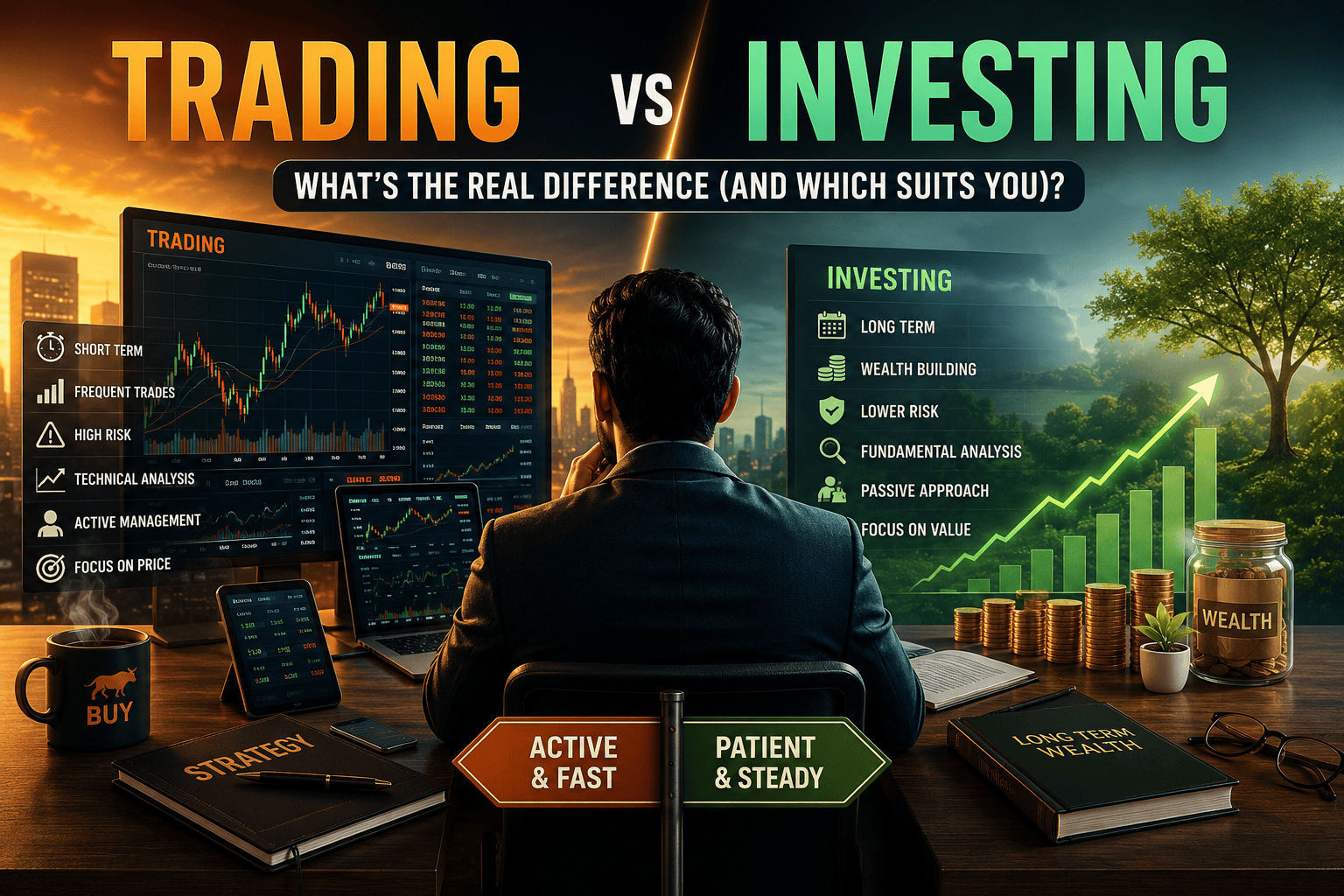

Trading vs Investing: What's the Real Difference (And Which Suits You)
Trading vs investing is the first genuinely important fork in the road for anyone opening a demat account, and honestly, most beginners don't realize they've picked a side until they're already a few months in and wondering why their approach feels stressful or their returns feel underwhelming. The two aren't different speeds of the same activity — they're built on different logic entirely, and mixing them up without realizing it is one of the quieter ways new investors lose money.
We see this confusion constantly on this site — someone opens a demat account intending to "invest for the long term," then finds themselves checking prices five times a day and selling the moment a stock dips 3%. That's not investing anymore, even if that's what they set out to do. This article draws the actual line, with real numbers, so you know which side of it you're standing on.

Table of Contents
- The Core Difference in One Sentence
- Side-by-Side Comparison
- Time Horizon: Minutes vs Decades
- What Each One Actually Requires
- Tax Treatment: A Genuinely Big Difference
- Real Example: Same Stock, Two Different Outcomes
- Which One Suits You
- Can You Do Both at Once?
- Common Mistakes Beginners Make
- Frequently Asked Questions
The Core Difference in One Sentence
Investing means buying ownership in a company because you believe the business itself will grow over years, while trading means buying and selling a stock because you expect its price to move in a certain direction over a much shorter window — often days, sometimes minutes. An investor cares whether the company will still be relevant and profitable in a decade. A trader mostly doesn't care about the decade — they care whether the price moves the way they expect in the next few sessions.
Side-by-Side Comparison
Trading
- Holding period: minutes to a few weeks
- Relies on technical analysis, charts, volume
- Requires active, near-daily monitoring
- Higher stress, faster feedback loop
- Profits taxed as business income or STCG
- Can use leverage (margin, F&O)
Investing
- Holding period: years to decades
- Relies on fundamental analysis, company financials
- Requires occasional review, not daily attention
- Lower stress, benefits from compounding
- Profits taxed as LTCG after 1 year (lower rate)
- Generally avoids leverage
Neither column is "better" in an absolute sense — they're built for different goals, and pretending one is a strictly upgraded version of the other is where a lot of beginner confusion actually starts.
Time Horizon: Minutes vs Decades
This is the single clearest dividing line, even though it's not the only one. A trader might buy Reliance shares in the morning and sell them by evening for a 2% gain — that's intraday trading, the most extreme end of the trading spectrum. Swing traders hold positions for days to weeks, still chasing price movement rather than business growth. An investor, by contrast, might buy shares in a company like TCS or Infosys specifically because they believe it'll be a meaningfully bigger business in 10 years, and they're willing to sit through short-term volatility to find out.
Typical Holding Periods by Approach
| Style | Typical Holding Period | Category |
|---|---|---|
| Intraday Trading | Minutes to hours (closed same day) | Trading |
| Swing Trading | Days to a few weeks | Trading |
| Positional Trading | Weeks to a few months | Trading (borderline) |
| Long-Term Investing | Years to decades | Investing |
What Each One Actually Requires
Traders lean heavily on technical analysis — reading charts, tracking volume, watching moving averages and candlestick patterns to guess where price goes next. This genuinely requires screen time; day traders may be actively watching and executing for hours during market sessions, reacting to every meaningful tick. Investors lean on fundamental analysis instead — reading company financials, checking whether revenue and margins are actually growing, and generally spending far less daily time on it, since the whole point is that short-term price noise shouldn't change a decision made on a multi-year thesis.
A Realistic Time Commitment Comparison
We'd put it this way: an active trader might spend 3+ hours a day hunting for setups and managing open positions during market hours. A long-term investor doing this properly might spend 10-20 minutes a month reviewing their holdings' quarterly results and checking whether their original investment thesis still holds. That gap in daily time commitment is often the most underestimated difference for beginners who assume both approaches take roughly the same effort.
Tax Treatment: A Genuinely Big Difference
This part rarely gets enough attention in beginner content, but it materially affects your actual take-home returns. Delivery-based equity investments held over one year qualify for Long-Term Capital Gains (LTCG) tax at a flat 12.5% on gains above ₹1.25 lakh in a financial year — a meaningfully lower rate. Short-term equity trades (held under a year) attract Short-Term Capital Gains (STCG) tax at a flat 20%. Intraday trading and Futures & Options activity, however, are typically treated as business income and taxed according to your income tax slab, which can run considerably higher for active traders in higher brackets.
Tax Treatment by Activity Type
| Activity | Tax Treatment | Rate |
|---|---|---|
| Delivery-based, held > 1 year | Long-Term Capital Gains | 12.5% above ₹1.25 lakh/year |
| Delivery-based, held < 1 year | Short-Term Capital Gains | 20% flat |
| Intraday trading | Speculative business income | As per income tax slab |
| Futures & Options (F&O) | Non-speculative business income | As per income tax slab |
Frequent trading also means paying brokerage, transaction charges, and STT (Securities Transaction Tax) on every single trade, which quietly compounds against you over dozens or hundreds of trades in a way that a buy-and-hold investor simply doesn't experience. This is one of several structural reasons why our coverage of why investors lose money in the stock market points to overtrading as a recurring theme, not a one-off mistake.
Real Example: Same Stock, Two Different Outcomes
Two Approaches to the Same Company
Imagine two people both buy shares in a solid, well-established company on the same day. The trader is watching for a 3-5% price swing and plans to exit within a week regardless of what happens to the underlying business — if the stock drops 4% on a bad news day, they're likely out, loss booked, moving to the next setup. The investor bought because they believe this company will meaningfully grow its earnings over the next 5-10 years — that same 4% dip barely registers, because it doesn't change the underlying thesis, and history shows short-term dips are a normal, recurring part of holding through a market cycle, not a sign the original decision was wrong.
Neither person is "right" in isolation — but if the trader had accidentally convinced themselves they were "investing" when they bought, that panic-driven exit on a routine 4% dip would represent exactly the kind of mismatch between intention and actual behavior that causes real damage to a portfolio.
Which One Suits You
For most first-time market participants, investing tends to be the more forgiving starting point — it requires less daily monitoring, benefits from compounding over time, and gives patient mistakes more room to correct themselves. A slightly high entry price on a genuinely good company often gets bailed out by years of growth; a similar mistiming mistake in active trading rarely has that same cushion. This is broadly why most experienced voices in Indian markets suggest beginners start with investing and only move toward trading later, if at all, once they've built real market comfort.
Quick Self-Check: Which Fits You Better
| If This Describes You | Lean Toward |
|---|---|
| Limited time to watch markets daily | Investing |
| Comfortable with charts, enjoys active monitoring | Trading |
| Building wealth for a distant goal (retirement, home) | Investing |
| Seeking supplemental short-term income with capital at risk | Trading |
| New to markets entirely | Investing first, trading later if at all |
Can You Do Both at Once?
Plenty of experienced market participants do both, but deliberately — keeping the two pools of money and mindset genuinely separate rather than letting one bleed into the other. A common structure: the bulk of savings goes into long-term investing (index funds, blue-chip stocks, mutual funds) as the core wealth-building engine, while a small, clearly-defined slice — money you're genuinely prepared to lose — goes toward active trading as a separate, bounded experiment.
This separation matters because it protects your long-term compounding from short-term trading losses, and it protects your trading discipline from the temptation to "just hold a little longer" on a losing trade because you've mentally reclassified it as an investment after the fact. Readers exploring this dual approach should also review our piece on behavioral mistakes in stock trading, since blurring this line is one of the most common patterns we cover there.
Common Mistakes Beginners Make
Watch Out For These
1. Starting a "long-term investment" and panic-selling on the first dip. If you're exiting on short-term price noise, you were trading, not investing, whether or not that was the original plan.
2. Turning a losing trade into an "investment" after the fact. Holding a bad trade indefinitely because you don't want to book the loss isn't investing — it's avoidance, and it ties up capital that could be working elsewhere.
3. Underestimating the tax and cost drag of frequent trading. STT, brokerage, and short-term tax rates quietly erode returns across dozens of trades in ways a single trade's P&L doesn't reveal.
4. Jumping into trading before understanding basic market mechanics. Trading without understanding how orders, indices, and volatility actually work is closer to gambling than strategy.
5. Assuming trading is inherently more profitable. Skilled traders can genuinely outperform, but most retail traders underperform a simple long-term index approach once fees, taxes, and behavioral mistakes are accounted for.

If you're leaning toward investing as your starting point, our beginner investing guide and ₹1 crore SIP calculator are natural next reads. If trading genuinely interests you down the line, understanding circuit breakers and how the major indices move is a more responsible starting point than jumping straight into intraday positions with real capital.
It's also worth being honest about a pattern we see constantly among beginners who lean toward trading purely because it sounds exciting: the loudest success stories on social media are almost never representative of the average outcome. For every trader who genuinely turned a small account into something significant, there are far more who quietly gave up after a string of losses that never made it into anyone's highlight reel. This survivorship bias is worth keeping in mind before assuming trading is the faster path to wealth — our coverage of why most investors and traders actually lose money digs into this pattern in more detail, backed by real retail investor data rather than anecdote.
For readers who've already decided investing is their starting point, the next practical questions are usually about structure — how much to invest, which index or fund to start with, and how to build the habit without needing to constantly watch the market. Our how SIP works explainer and index funds vs active funds comparison are good next steps, and our stock split and bonus share explainers cover two common corporate actions that long-term investors specifically need to understand, since they don't matter much to a short-term trader passing through a stock for a few days.
One last practical note before you decide: whichever path you choose, start small. Paper trading (practicing without real money) or a small trial investment lets you experience the actual emotional and time demands of each approach before committing meaningful capital — a stage far too many beginners skip entirely, jumping in with their full savings before they've actually tested whether the daily rhythm of trading suits them, or whether the patience required for investing genuinely matches their temperament.
Frequently Asked Questions
Is trading or investing better for beginners?
Investing is generally considered the safer, more forgiving starting point for beginners, since it requires less daily monitoring and benefits from long-term compounding. Trading requires more time, skill, and discipline, and carries higher risk for those without experience.
Can I do both trading and investing at the same time?
Yes, many experienced market participants do both, but deliberately keep the two separate — the bulk of capital in long-term investments, with a small, clearly defined portion set aside for active trading.
What is the tax difference between trading and investing in India?
Delivery-based investments held over a year qualify for LTCG tax at 12.5% above ₹1.25 lakh. Short-term equity trades attract 20% STCG. Intraday and F&O trading are typically taxed as business income at your applicable income tax slab.
Does trading require more time than investing?
Yes, significantly. Active traders often spend hours daily monitoring positions and markets, while investors following a long-term approach typically review holdings only periodically, such as monthly or quarterly.
Is trading more profitable than investing?
Not necessarily. While skilled traders can achieve high returns, most retail traders underperform a simple long-term investing approach once fees, taxes, and behavioral mistakes like overtrading are factored in.
How do I know if I'm actually trading instead of investing?
If you're exiting a position based on short-term price movement rather than a change in the underlying business fundamentals, you're trading, regardless of your original intention when you bought the stock.

Pranab Barman is a Financial Educator and Personal Finance Researcher with over 10 years of hands-on experience in stock markets, trading, and investing. Currently enrolled in the CFA Program, he is committed to continuous learning and professional excellence in finance.
As the Founder of PlayWithStock, Pranab covers a wide range of topics including Mutual Funds, SIP, Taxation, Stock Market Basics, and Financial Calculators — with a focus on simplifying complex financial concepts for everyday all investors.
Email: support@playwithstock.com
Website: playwithstock.com
Related posts:
 Monthly SIP of ₹5,000 for 20 Years: Real Numbers, Real Story, and a Calculator
 Common Behavioral Mistakes in Stock Trading
 EPF vs NPS vs PPF 2026: Which Retirement Option Actually Suits You
 Nominee vs Legal Heir India: The Difference That Can Break a Family
 Sensex Nifty Crash July 2026: 3 Real Reasons Behind the Fall
 Beginner Investing: 7 Proven Steps to Start the Right Way
 Same Fund, Same Manager, Different NAV: Direct vs Regular Mutual Fund Explained With Real Numbers
 Micro-Investing Apps for Beginners: A Complete Comparison