


If you are wondering why is stock market falling today, this detailed analysis explains the impact of US-Iran tensions, rising crude oil prices, FII selling and global market trends on the Indian stock market.
Here’s exactly what happened, why it happened, and what it means for you as an investor.
Table of Contents
- What Happened in the Market Today
- The Real Trigger: US-Iran Tensions Escalate
- Why Crude Oil Prices Spiked
- Why Rising Crude Oil Hurts India More Than Other Countries
- FII Selling: The Second Big Factor
- How US and Global Markets Reacted
- India vs US Market: What’s the Real Difference
- Sectors and Stocks Hit Hardest
- What Should Investors Do Now
- FAQs
1. What Happened in the Market Today
Indian benchmark indices fell sharply, with the sell-off broad-based across sectors:
- Sensex closed at 76,503.60, down 1,677 points (−2.15%) — one of the steepest single-day falls in months
- Nifty 50 settled at 23,882.05, down roughly 517 points (−2.12%)
- Bank Nifty dropped over 1,350 points, falling more than 2.3%
- India VIX (the market’s “fear gauge”) rose to around 14.5, signalling elevated but not panic-level anxiety
- All 30 Sensex constituents ended in the red — a genuinely broad-based decline, not a sector-specific correction
- The rupee weakened against the US dollar, adding another layer of pressure on foreign investor sentiment
This wasn’t a random dip. It was the direct result of a specific chain of global events that started thousands of kilometres away, in the Middle East.
2. The Real Trigger: US-Iran Tensions Escalate
Markets had been cautiously optimistic after a ceasefire agreement between the US and Iran earlier this year. That fragile peace broke down again this week.
Here’s the sequence:
- The US Treasury Department revoked a waiver that had allowed limited purchases of Iranian oil, with the new restriction taking effect from mid-July
- The US carried out fresh strikes on Iranian targets in and around the Strait of Hormuz, in response to attacks on commercial vessels transiting the region
- President Trump publicly stated that the earlier ceasefire arrangement was “effectively null,” reviving fears of a prolonged conflict
Why does this matter for stock markets thousands of miles away? Because the Strait of Hormuz is one of the most strategically important waterways on Earth — roughly a fifth of the world’s seaborne oil and LNG trade passes through it. Any threat to shipping in that corridor immediately shows up in oil prices, and oil prices immediately show up in stock markets.

3. Why Crude Oil Prices Spiked
Oil prices jumped sharply over just two trading sessions:
- Brent crude rose to around $78 per barrel, up roughly 6-8% in two days
- WTI crude climbed to nearly $75 per barrel
- Natural gas benchmarks in Europe also rose, adding to the broader energy-price anxiety
The logic is straightforward: traders price in a geopolitical risk premium whenever a major oil-producing region faces instability. Even before a single barrel is actually disrupted, the possibility of disrupted supply is enough to push prices higher, because oil markets are forward-looking and supply chains can’t react instantly to a crisis.
4. Why Rising Crude Oil Hurts India More Than Other Countries
This is the part most beginner investors miss, and it’s worth understanding properly.
India imports over 80% of its crude oil requirement. That single fact explains almost everything about why oil-price shocks hit Indian markets harder than markets in oil-producing or oil-self-sufficient economies.
When crude oil rises:
- India’s import bill rises, which widens the current account deficit
- A wider current account deficit puts pressure on the rupee, since more dollars are needed to pay for the same amount of oil
- A weaker rupee makes India less attractive to foreign investors, since their eventual dollar-denominated returns shrink
- Higher fuel costs feed into transportation, logistics, and manufacturing costs across the economy, pressuring corporate margins and adding to inflation
- The RBI’s inflation and interest rate calculations get complicated, since imported inflation via fuel prices isn’t something domestic monetary policy can directly control
This is why aviation, paint, tyre, and logistics stocks — all heavy consumers of crude-linked inputs — tend to fall the hardest whenever oil spikes, while upstream oil and gas producers can sometimes benefit.
This pattern — FIIs selling, DIIs buying — is extremely common during global risk-off events, and it’s worth understanding why it happens:
- FIIs manage global portfolios and tend to reduce exposure to emerging markets first when global uncertainty rises, since emerging market currencies (like the rupee) are typically more volatile than the dollar
- A depreciating rupee directly reduces FII returns when measured in dollar terms, creating an incentive to exit before further currency weakness
- DIIs — mutual funds, insurance companies, pension funds — are largely investing domestic household savings (SIPs, for example) that flow in regardless of daily headlines, which is exactly why consistent SIP investors tend to be far less rattled by these swings than short-term traders
Real-World Example
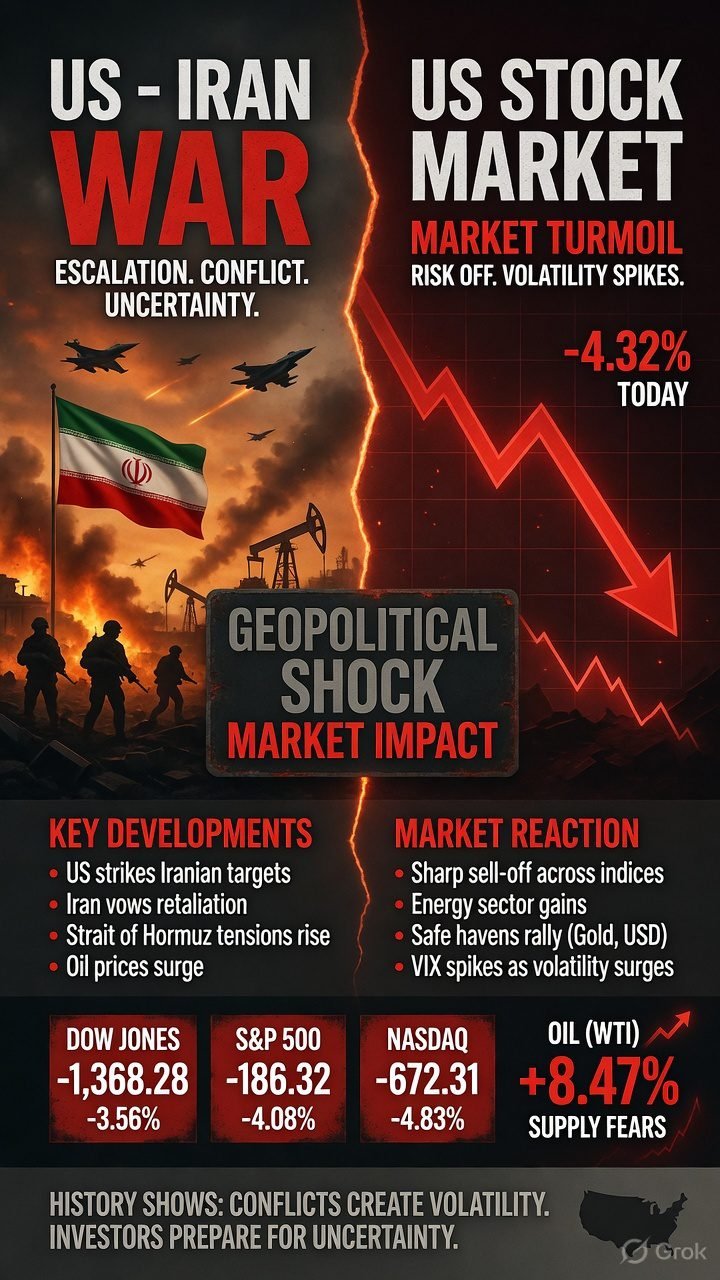
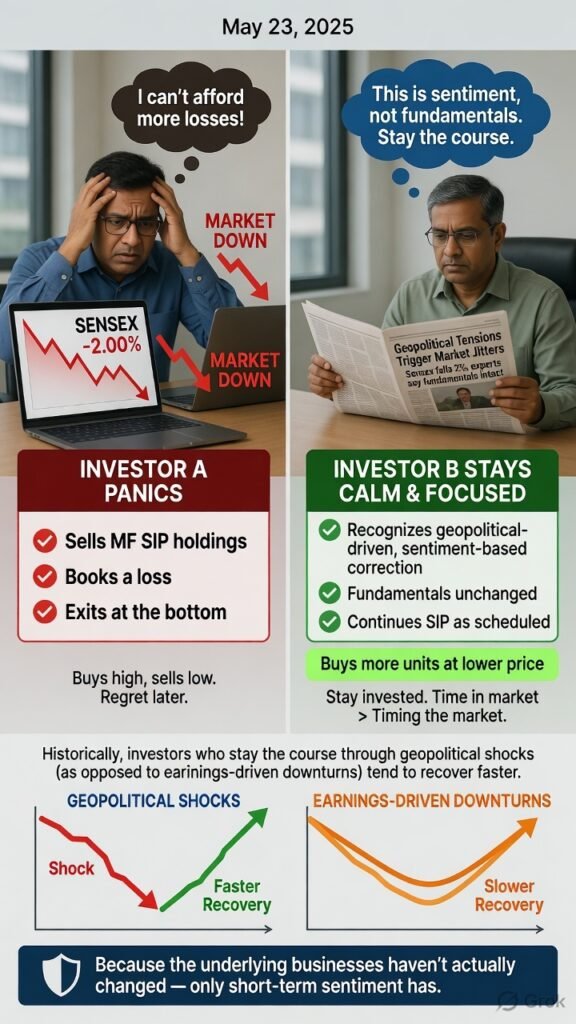
Consider two investors on this exact day. Investor A panics after seeing Sensex down 2% and sells his mutual fund SIP holdings at a loss. Investor B, who has read this article, recognizes this as a geopolitical-driven, sentiment-based correction rather than a change in company fundamentals, and instead continues his SIP as scheduled — effectively buying more units at a lower price. Historically, investors who stay the course through geopolitical shocks (as opposed to earnings-driven downturns) tend to recover faster, because the underlying businesses haven’t actually changed — only short-term sentiment has.

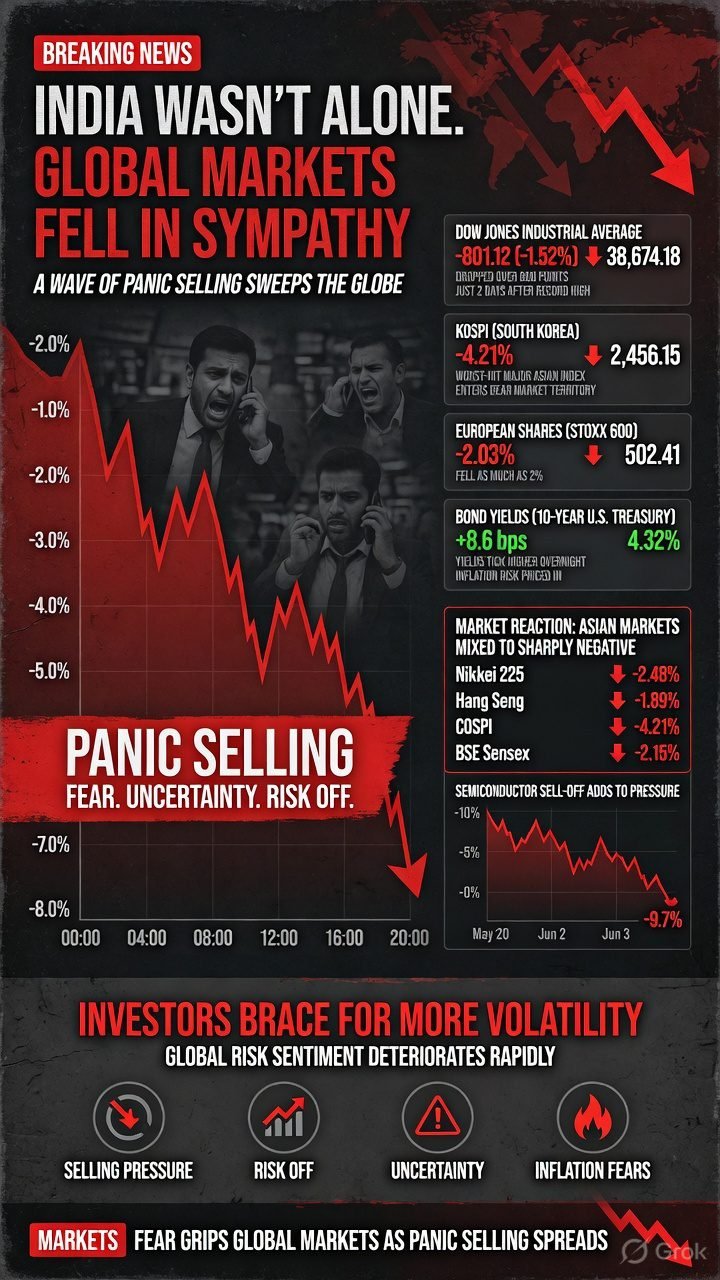
India wasn’t alone. Global markets fell in sympathy:
- The Dow Jones Industrial Average dropped over 800 points (around 1.5%), just two days after hitting a record high
- Asian markets were mixed to sharply negative — South Korea’s Kospi was the worst-hit major Asian index, entering bear market territory amid a separate but overlapping semiconductor sell-off
- European shares fell as much as 2%
- Bond yields ticked higher overnight, signalling that investors were pricing in renewed uncertainty and inflation risk
7. India vs US Market: What's the Real Difference
This is the question everyone should be asking: if it’s a global event, why did Indian markets fall more (around 2.1-2.2%) than the US market (around 1.5%)?
The difference comes down to a few structural factors:
| Factor | United States | India |
|---|---|---|
| Oil import dependency | Net exporter in recent years; less directly exposed | Imports 80%+ of crude needs — directly exposed |
| Currency | US dollar is the global reserve currency and tends to strengthen during risk-off events | Rupee tends to weaken during risk-off events, compounding the pain |
| Investor base | Deep domestic investor base, less sensitive to single-day FII-style flows | Still meaningfully influenced by FII flows, especially during global uncertainty |
| Inflation transmission | Oil price shocks affect but don’t dominate the inflation picture | Oil price shocks feed quickly into transportation and input costs economy-wide |
| Market reaction pattern | Tends to fall on the fear of disruption | Tends to fall on both the fear of disruption and the actual economic cost of oil imports |
In short: the US largely reacts to global oil shocks as a sentiment and inflation-expectations story. India reacts to the same shock as both a sentiment story and a real economic cost story, because higher oil prices genuinely make the country’s import bill more expensive in a way they don’t for a net oil-neutral economy like the US. This is a structural difference, not a one-day anomaly — it shows up almost every time global crude prices spike sharply.
8. Sectors and Stocks Hit Hardest
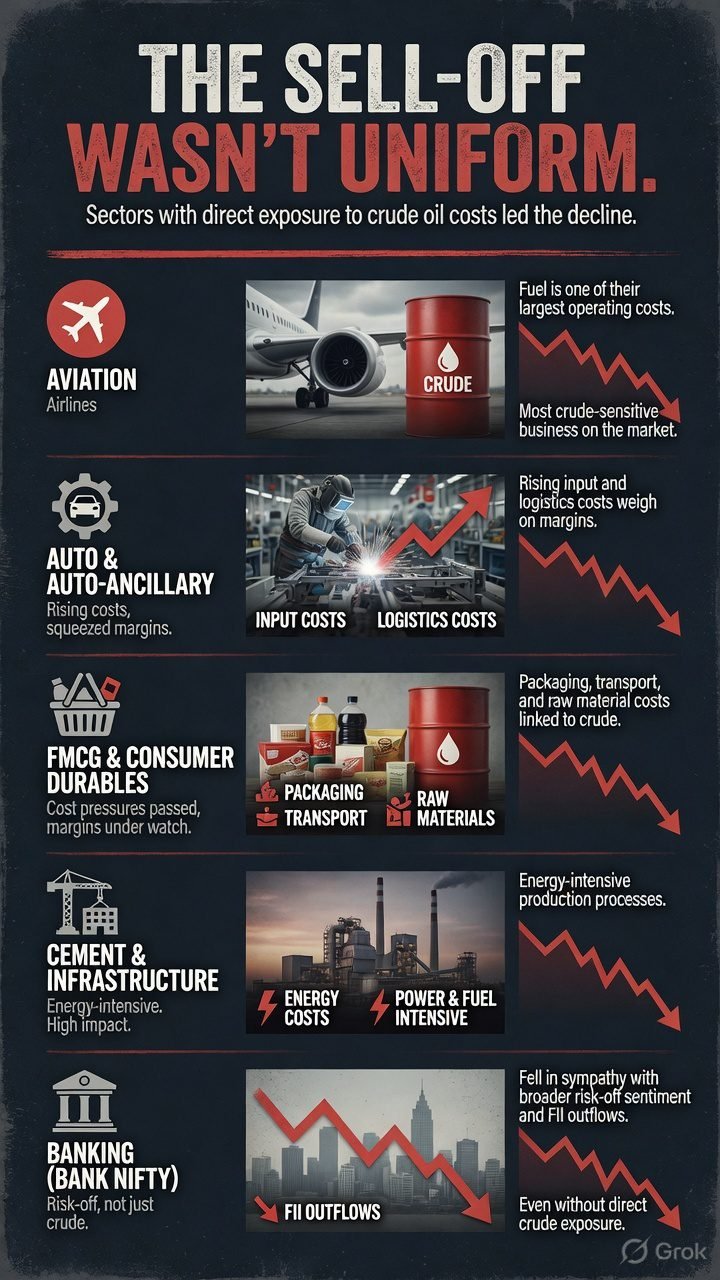
The sell-off wasn’t uniform. Sectors with direct exposure to crude oil costs led the decline:
- Aviation — airlines are among the most crude-sensitive businesses on the market, since fuel is one of their largest operating costs
- Auto and auto-ancillary — rising input and logistics costs weigh on margins
- FMCG and consumer durables — packaging, transport, and raw material costs linked to crude
- Cement and infrastructure — energy-intensive production processes
- Banking (Bank Nifty) — fell in sympathy with broader risk-off sentiment and FII outflows, even without direct crude exposure
On the flip side, upstream oil exploration and production companies, along with some energy-linked plays, are the segments that typically hold up better — or even gain — during a crude price spike, since higher prices can mean higher realizations for producers.
9. What Should Investors Do Now
A single-day fall driven by geopolitical headlines is a very different situation from a fall driven by weak company earnings or a genuine economic slowdown. A few grounded principles apply here:
- Avoid panic-selling quality holdings based on a headline-driven, sentiment-based decline — the underlying businesses haven’t changed overnight
- Continue SIPs as scheduled — this is precisely the kind of volatility that dollar-cost averaging is designed to smooth out
- Watch crude oil and the rupee, not just the Sensex — these two data points will tell you whether the pressure is easing or intensifying over the coming days
- Review sector exposure — if a portfolio is heavily concentrated in crude-sensitive sectors (aviation, paints, tyres), understand that near-term volatility in those names may continue until the geopolitical picture stabilizes
- Don’t try to time a geopolitical event — these situations can resolve quickly (as the earlier ceasefire showed) or escalate further, and neither outcome is reliably predictable
FAQs
Q1. Why did the Sensex fall today? The Sensex fell primarily due to renewed US-Iran military tensions, a resulting spike in global crude oil prices, rupee depreciation, and consequent FII selling in Indian equities.
Q2. How does crude oil price affect the Indian stock market? India imports the vast majority of its crude oil needs, so rising oil prices widen the import bill, pressure the rupee, add to inflation, and squeeze margins for crude-sensitive sectors like aviation, autos, and FMCG — all of which weigh on stock prices.
Q3. What is the Strait of Hormuz and why does it matter for markets? The Strait of Hormuz is a narrow shipping corridor between the Persian Gulf and the Arabian Sea through which a large share of the world’s oil and LNG trade passes. Any threat to shipping safety there raises fears of a global oil supply disruption, which immediately affects oil prices and, in turn, equity markets worldwide.
Q4. Should I sell my stocks when the market falls due to geopolitical news? Not necessarily. Geopolitical-driven corrections are typically sentiment-based rather than a reflection of deteriorating company fundamentals. Many investors choose to stay invested or continue systematic investments (SIPs) through this kind of volatility rather than reacting to single-day headlines. This is not financial advice — consider your own risk tolerance and time horizon, or consult a qualified financial advisor.
Q5. Why did the Indian market fall more than the US market on the same news? India’s higher dependence on oil imports, its more currency-sensitive investor base, and the rupee’s tendency to weaken during global risk-off events all mean that global oil shocks tend to hit Indian markets harder than markets in less oil-import-dependent economies like the US.
References
- Business Today Markets — “Why market is falling today: Sensex drops 1,500 pts, Nifty tests 24,000”
- Al Jazeera — “Oil surges as US strikes Iran, reversing return to pre-war prices”
- NPR — “Tensions with Iran add fresh uncertainty to an already shaky global economy”
- Trendlyne Markets Today — FII/DII activity data, July 8, 2026
- Option Chain India — Technical Analysis for Nifty, Bank Nifty & Sensex, 9 July 2026
Disclaimer: This article is for informational and educational purposes only and does not constitute investment advice. Market data is accurate as of the time of publishing and is subject to change. Please consult a SEBI-registered financial advisor before making investment decisions.
Author: Pranab | Play With Stock Last Updated: July 9, 2026

Pranab Barman is a Financial Educator and Personal Finance Researcher with over 10 years of hands-on experience in stock markets, trading, and investing. Currently enrolled in the CFA Program, he is committed to continuous learning and professional excellence in finance.
As the Founder of PlayWithStock, Pranab covers a wide range of topics including Mutual Funds, SIP, Taxation, Stock Market Basics, and Financial Calculators — with a focus on simplifying complex financial concepts for everyday all investors.
Email: support@playwithstock.com
Website: playwithstock.com
Related posts:
 Rupee vs Dollar July 2026: 5 Shocking Reasons the Rupee Is Falling
 Oil Price Crash 2026: How the End of a War Is Reshaping India’s Economy
 What Is Circuit Breaker Stock Market: Meaning, Limits & 2026 Update
 Nifty July 2026: Will It Hit 24,800? Complete Market Outlook and Stock Guide
 Trump Accounts Explained: The $1,000 Baby Bonus Already Reaching 6 Million Kids
 Reliance Jio IPO 2026: India’s Biggest-Ever Listing, Explained
 What is a Stock Split and Why Do Companies Do It
 What is the Dollar Index (DXY) and Why It Matters for India