
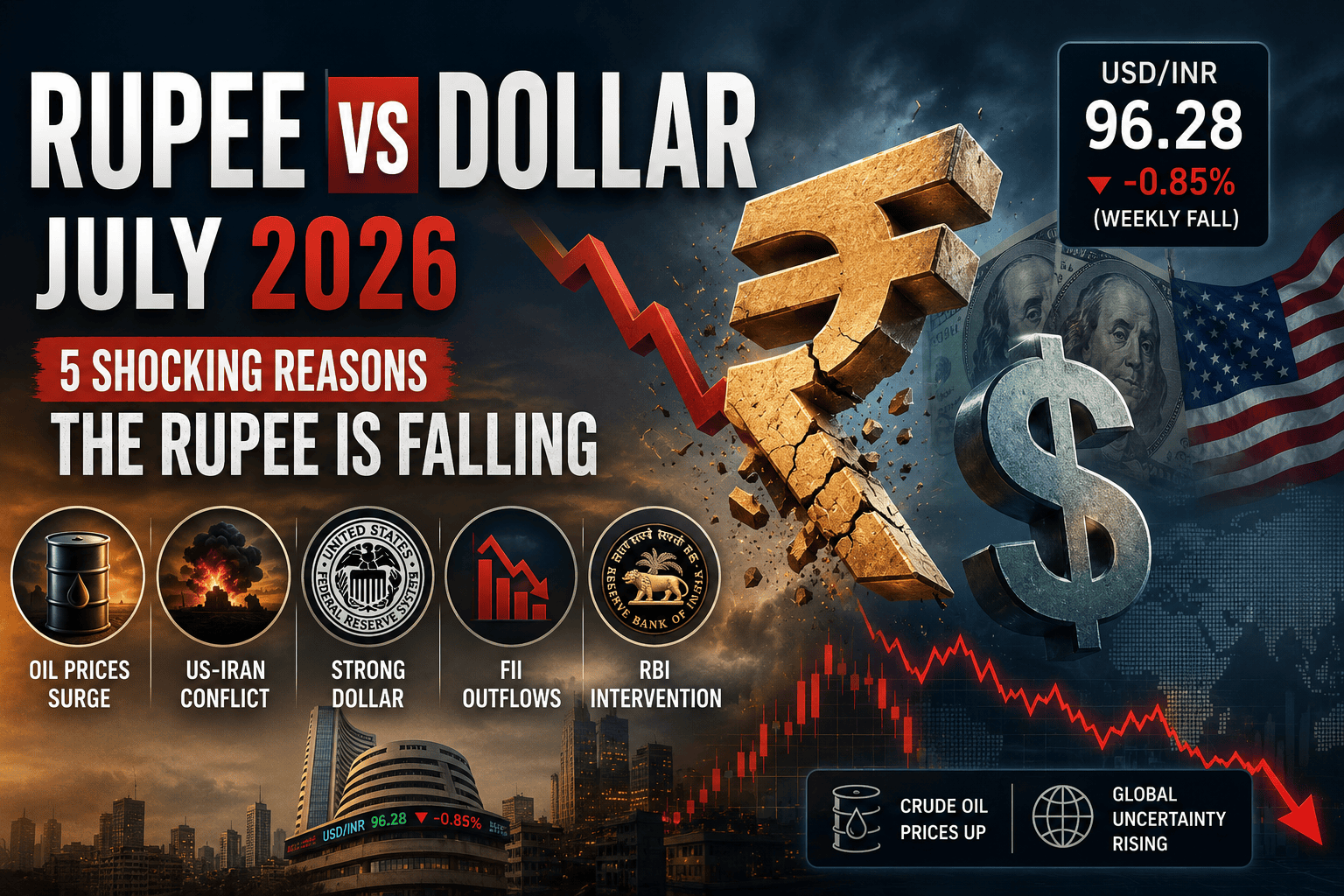

Rupee vs Dollar July 2026:
5 Shocking Reasons the Rupee Is Falling
The Indian rupee just had its worst week since May. One currency, five compounding pressures — and a central bank caught between defending the exchange rate and not burning through reserves.
The rupee vs dollar rate closed at 96.28 on Friday, July 18, 2026 — down nearly 1% for the week, its sharpest single-week fall since May. During the week it touched 96.58 intraday, less than half a percent from the all-time record low of 96.96 hit in May. This is not random noise. It's five pressures hitting simultaneously.
This article explains exactly what's driving the rupee vs dollar July 2026 move — the real forces behind the numbers — with real numbers, not vague macro language. We'll also cover what it means for your portfolio, your EMIs, and whether the RBI can actually stop this.
The SetupRupee vs Dollar July 2026: Where Things Stand
To understand the rupee vs dollar July 2026 situation, you need the full year's context. The rupee started 2026 at around 89.86 per dollar — that was a relative high point.
By May 20, it had hit an all-time record low of 96.96. There was a partial recovery after RBI intervention and some stabilisation in oil prices. Then this week happened.
| Date / Period | USD/INR Rate | Key Driver |
|---|---|---|
| January 2026 (start) | 89.86 | Relative stability, RBI intervention supporting |
| March 2026 | ~94.82 | West Asia conflict escalation, oil surge, FII outflows |
| May 20, 2026 | 96.96 (ATL) | All-time record low — peak oil + peak US-Iran tension |
| Early July 2026 | ~95.33 | Partial recovery after crude pullback |
| July 13, 2026 | 95.95 | US-Iran ceasefire MoU collapsed, crude surged |
| July 16, 2026 | 96.32 | Three consecutive sessions of losses, crude near monthly high |
| July 18, 2026 (today) | 96.28 | Sharpest weekly fall since May — week close |
The rupee vs dollar rate has fallen 11.61% over the past twelve months — one of the worst performances among Asian currencies. Over the past four weeks alone, USD/INR has gained 1.53%. Every time it recovers, a new external shock appears. That pattern tells you something important: the pressure is structural and external, not a simple India-specific problem that the RBI can fully solve.
Reason 01Oil +13%: The Biggest Driver of Rupee vs Dollar This Week
India imports approximately 70% of its crude oil requirement — which is the core reason the rupee vs dollar is so sensitive to oil prices and pays for it in US dollars. When Brent crude rises 13% in a week — as it did this week due to the US-Iran conflict — India's import bill for that week jumps proportionally. Oil importers (primarily state-run refiners like Indian Oil, BPCL, HPCL) rush to buy dollars to meet these payments. That demand directly pushes USD/INR higher.
The MCX Crude Oil contract expiring July 20 rose over 7% on a single day (July 9) when the US-Iran MoU collapsed. It then rose another 4.6% on July 13. That's a two-week crude surge that no currency management can fully absorb without burning forex reserves. This is precisely why oil prices are the single most important variable for the rupee vs dollar exchange rate — more important than FII flows, more important than domestic GDP data.
Reason 02US-Iran Conflict and the Hormuz Risk
The US-Iran conflict that began escalating in mid-2025 entered a new phase in July 2026. The memorandum of understanding (MoU) between the US and Iran — which had briefly stabilised oil markets in early July — collapsed on July 9. Iran then announced the Strait of Hormuz would be closed "until further notice" as retaliation.
The rupee vs dollar sensitivity to the Strait of Hormuz is acute — it's the world's most important oil chokepoint — approximately 20% of global oil supply transits through it daily. When Iran threatened its closure (or actually restricted it), global crude markets reacted immediately. For India, which relies on Persian Gulf oil as its primary energy source, this is a direct supply chain risk on top of a price risk.
Iran's top negotiator stated publicly that the country "has never welcomed war, nor do we now" — but also that it must "stand firm to protect national security." That's not de-escalation language. Markets are pricing in continued uncertainty, and currencies of oil-importing nations like India are bearing the cost. This geopolitical dimension connects directly to the oil price impact on India that we covered separately — except in this case we're seeing the opposite: an oil price surge, not a crash.
Reason 03Dollar Strength and US Interest Rate Expectations
The US Federal Reserve held rates at 3.50–3.75% after the April 2026 FOMC meeting. India's RBI has been cutting — repo rate is now 5.25%, down from 6.5% in early 2025. The narrowing spread between safe US Treasury yields and Indian Government Bond yields reduces the incentive for foreign portfolio investors to hold Indian debt.
This week, US CPI data came in softer than expected for June 2026 — providing some temporary relief. Markets scaled back expectations for a Fed rate hike, weakening the dollar slightly. The US Dollar Index (DXY) traded near 100.52, near a four-week low.
But even a softening dollar wasn't enough to reverse the oil-driven rupee vs dollar pressure — which tells you how dominant the oil factor is right now. Our coverage of the Fed rate watch and the Dollar Index explained give more background.
Reason 04Importer Demand and Cautious FPI Flows
A forex market trader described this week's rupee vs dollar dynamic precisely: "Exporters have once again withdrawn from the market anticipating further weakness. Importers are not inclined to let any dip on USD/INR go." That asymmetry — importers buying aggressively, exporters holding — is itself a feedback loop. The more the rupee falls, the more exporters expect it to fall further, so they hold dollars longer, which makes the rupee fall more.
Foreign portfolio investors (FPIs) have actually been net buyers in July — approximately $1.5 billion in equities and $500 million in debt were purchased by overseas investors this month. In theory, that should support the rupee. In practice, it wasn't enough to offset the importer dollar demand and oil-related pressures. The rupee weakened despite positive FPI flows — which is a notable signal about how dominant the oil narrative has become this week.
| Factor | Direction for INR | Strength This Week | Offsetting? |
|---|---|---|---|
| Oil price surge (+13%) | Negative (↓ INR) | Very Strong | No |
| US-Iran conflict / Hormuz risk | Negative (↓ INR) | Strong | No |
| Importer dollar demand | Negative (↓ INR) | Strong | No |
| FPI equity + debt inflows | Positive (↑ INR) | Moderate | Partially |
| Softer US CPI (lower Fed rate expectation) | Positive (↑ INR) | Weak this week | Marginally |
| RBI intervention (state bank dollar sales) | Positive (↑ INR) | Measured, not aggressive | Partially |
Reason 05The RBI's Measured Stance — Not a Hard Defense
The Reserve Bank of India has been present in both the spot and non-deliverable forward (NDF) markets this week. State-run banks — acting on behalf of the RBI — sold dollars to limit the rupee's fall. This intervention is what prevented the rupee from crashing through its May record low of 96.96. But multiple traders and analysts characterised the intervention as "measured" rather than an aggressive defense of a specific level.
Why measured? The RBI's net forward dollar liabilities stood at $106.6 billion as of May 2026. Every dollar sold to defend the rupee vs dollar rate reduces reserves and adds to forward liabilities.
The central bank is conscious of not burning reserves defending a level it can't hold if oil keeps rising. As one APAC economist at State Street noted: "Should rupee depreciation pressures persist, the RBI may find itself caught between a rock and a hard place."
This constraint on RBI action is important for investors to understand. It means the rupee's trajectory over the next few weeks depends far more on whether oil prices stabilise and whether the US-Iran conflict de-escalates than on anything the RBI does. The central bank can slow the fall; it cannot reverse it against a sustained external shock. Our RBI repo rate and home loan EMI article covers how RBI's domestic rate decisions interact with these currency pressures.
For InvestorsRupee vs Dollar Fall — What It Means for Your Money
The rupee vs dollar rate isn't just a macro number — it touches your portfolio, your EMIs, and your purchasing power in specific, calculable ways.
| Category | Impact | Why |
|---|---|---|
| IT sector stocks (TCS, Infosys, Wipro) | Positive | Earn in USD, report in INR — every rupee fall boosts INR revenue |
| Pharma exporters | Positive | USD export earnings worth more in INR terms |
| Gold investors (India) | Positive | Gold priced in USD — weaker rupee raises INR gold price |
| US stock investors (via LRS) | Positive | USD-denominated returns worth more in INR at repatriation |
| Oil & gas companies (importers) | Negative | Higher cost of crude in INR terms — margin pressure |
| Home loan borrowers | Mixed | RBI may delay rate cuts if inflation rises — EMIs stay higher longer |
| Importers (electronics, edible oil) | Negative | Higher USD purchase cost passed on as consumer price rises |
| Students/travel abroad | Negative | Every dollar of fees/expenses costs more rupees |
OutlookRupee vs Dollar: What Happens Next
The honest answer on rupee vs dollar near-term direction: it depends almost entirely on two variables outside India's control — oil prices and the US-Iran conflict. If the conflict escalates further and oil stays elevated, the rupee could test its May all-time low of 96.96 and potentially push past it. If there's even a partial de-escalation, oil retreats, and the currency recovers to the 94–95 range seen earlier this month.
| Scenario | Oil Price Direction | USD/INR Target | Probability |
|---|---|---|---|
| Conflict escalates, Hormuz restricted | Brent above $120 | 97–100 | Low-moderate |
| Status quo — no resolution, no escalation | Brent $100–115 | 95–97 | Most likely |
| Partial de-escalation, ceasefire signals | Brent below $100 | 93–95 | Moderate |
| Full ceasefire, Hormuz reopens | Brent below $90 | 90–93 | Low near-term |
The RBI's foreign exchange reserves stood at approximately $640 billion as of mid-July 2026 — a level that gives the central bank significant capacity to intervene if it chooses to do so more aggressively. The question is whether it will, and at what exchange rate level it decides to draw a harder line. Traders put that level near 97 — the previous record. If 96.96 is tested again, expect the RBI to respond with larger dollar sales.
For broader context on India's macroeconomic situation — the inflation side, the monsoon's role, and the trade balance — our articles on monsoon 2026 and inflation, the India-US trade deal, and the India-UK FTA stocks impact give useful surrounding context. And if you're thinking about whether to hedge your portfolio with gold given the currency pressure, our gold price correction guide and gold all-time high article are directly relevant.
Frequently Asked Questions
- HDFC Sky — Rupee logs sharpest weekly drop since May, plunges 1% to 96.28 — 18 July 2026
- Business Recorder — Indian rupee logs sharpest weekly drop in nine as oil price jump stings
- FXStreet — Indian Rupee plummets as US-Iran ceasefire collapse lifts oil prices
- FXStreet — Indian Rupee extends decline amid elevated oil prices — July 16, 2026
- TradingPedia — Rupee slides as oil, tensions lift USD/INR — July 13, 2026
- InvestingLive — Rupee nears record low as RBI intervenes but oil, risk aversion weigh
- Bajaj Broking — Why the Rupee is Falling in 2026 and What Lies Ahead
- NAGA — USD to INR Forecast H2 2026
- Upstox — Why Indian Rupee Is Falling Against US Dollar
- Anand Rathi — Why Is INR Falling Against USD in 2026?
- Trading Economics — Indian Rupee — Historical Data and News
- Reserve Bank of India — rbi.org.in — Foreign exchange reserves and intervention data
- NSE India — nseindia.com — Currency derivatives market data
- Times Darpan — Why Is Indian Rupee Falling Against Dollar in 2026?
- Zerodha Pulse — pulse.zerodha.com — Live market news aggregator
Pranab Jyoti Barman
Pranab covers Indian markets, global economy, and currency movements at Play With Stock. Every data point in this rupee vs dollar July 2026 article — exchange rate levels, crude price moves, RBI intervention details — is sourced from confirmed financial news reports published on or before 18 July 2026.
About Play With Stock →
Pranab Barman is a Financial Educator and Personal Finance Researcher with over 10 years of hands-on experience in stock markets, trading, and investing. Currently enrolled in the CFA Program, he is committed to continuous learning and professional excellence in finance.
As the Founder of PlayWithStock, Pranab covers a wide range of topics including Mutual Funds, SIP, Taxation, Stock Market Basics, and Financial Calculators — with a focus on simplifying complex financial concepts for everyday all investors.
Email: support@playwithstock.com
Website: playwithstock.com
Related posts:
 Why Is the Stock Market Falling Today? US-Iran Tensions, Crude Oil Spike & FII Selling Explained
 What is the Dollar Index (DXY) and Why It Matters for India
 Nifty July Seasonality: Why July Is Nifty’s Strongest Month (27-Year Data)
 Fed Rate Hike 2026: Why the July 28-29 FOMC Meeting Could Change Everything
 India US Trade Deal 2026: Inside the Tariff Rollercoaster Before July 22
 ITR Filing Last Date 2026: July 31 Deadline, New Tax Act & Penalties
 Reliance Industries Q1 FY27 Results Preview: What to Expect on July 17
 Infosys Q1 FY27 Results Preview: What to Watch on 23 July