


Atal Pension Yojana 2026: Complete Guide to Rules, Contribution and Eligibility
Atal Pension Yojana 2026 is genuinely one of the most under-discussed retirement schemes we cover on this blog, largely because it isn't aimed at the salaried, tax-planning audience that most retirement content targets. It's built for people without an employer-run EPF account, without the income to comfortably lock money into NPS or PPF, and without any formal retirement safety net at all — daily wage earners, drivers, domestic workers, small shop owners, and farmers. That doesn't make it less relevant to the rest of our readers though; if you have parents, domestic staff, or extended family in the unorganised sector, this is genuinely useful information to pass along.
We've covered the more market-linked and salaried-employee-focused retirement options in our NPS National Pension System 2026 guide and EPF vs NPS vs PPF comparison. APY fills a genuinely different gap in that picture. Our broader beginner investing guide covers the foundational concepts if retirement planning is new territory for you, regardless of which specific scheme ends up being the right fit. Official scheme statistics and enrollment data are published on the NPS-CRA APY scheme details page.

Table of Contents
- What Is Atal Pension Yojana
- Eligibility: Who Can and Can't Join
- The Contribution Chart: What You'd Actually Pay
- The 2022 Tax Payer Exclusion Rule
- The 2026 Extension to FY 2030-31
- What Happens If the Subscriber Dies Before 60
- Missed Payments and Penalties
- APY vs NPS: Which One Actually Applies to You
- How to Apply
- Frequently Asked Questions
What Is Atal Pension Yojana
Atal Pension Yojana is a government-backed pension scheme designed to provide a guaranteed monthly pension to individuals working in the unorganised sector, managed by the Pension Fund Regulatory and Development Authority (PFRDA). It's mainly designed for workers such as daily wage labourers, shop workers, drivers, farmers, domestic workers, homemakers, and self-employed individuals.
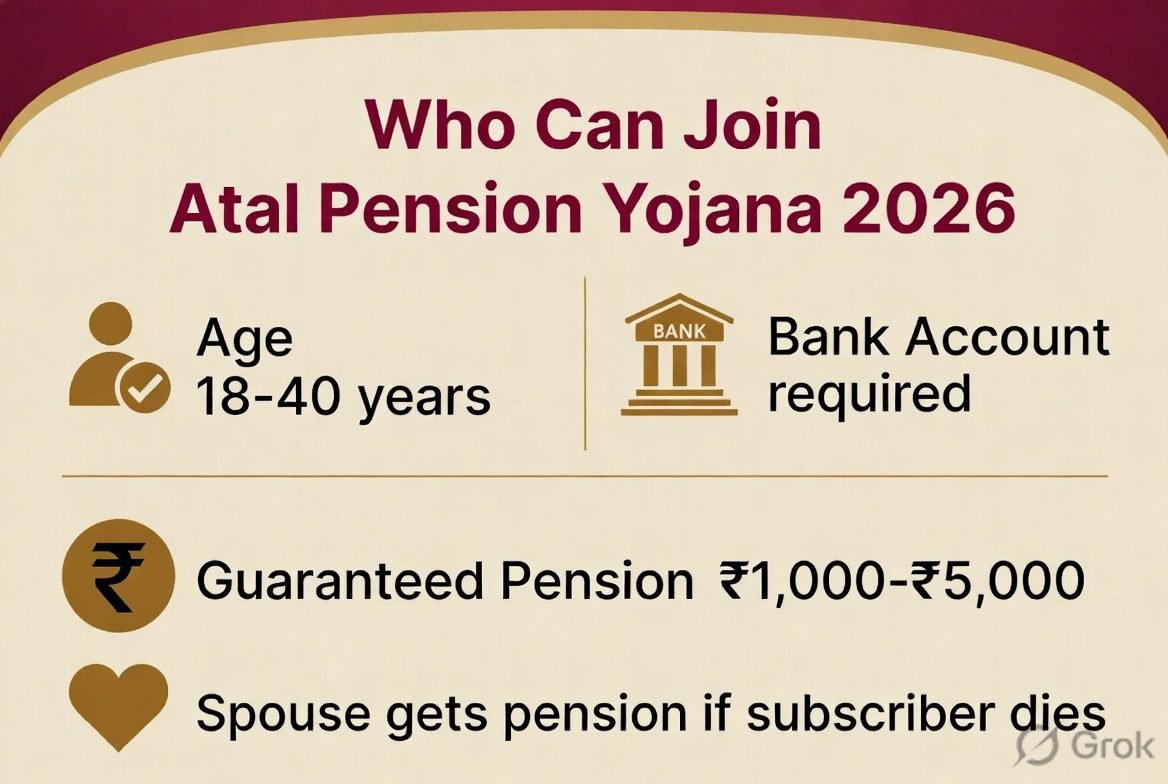
Launched by the Government of India in 2015, APY guarantees a fixed pension after age 60, ranging from ₹1,000 to ₹5,000 per month, and is one of the most popular retirement schemes in India in 2026 thanks to its low contribution requirements, automatic bank deductions, and lifelong pension benefit.
What makes APY structurally different from every other scheme we've covered on this blog is the nature of the guarantee itself. NPS returns fluctuate with markets; EPF and PPF offer fixed but periodically revised rates. APY instead guarantees a fixed rupee pension amount decided at enrollment, backed by the Government of India under the Finance Act, 2016 — the closest thing to a true sovereign pension guarantee available to India's unorganised sector workforce.
Atal Pension Yojana — 2026 Snapshot
| Regulator | PFRDA |
| Eligible Age | 18–40 years |
| Pension Range (Monthly) | ₹1,000 – ₹5,000 |
| Contribution Range (Monthly) | ₹42 – ₹1,454 |
| Scheme Extended Till | FY 2030-31 |
| Tax Benefit | Section 80C |
Eligibility: Who Can and Can't Join
The age limit for Atal Pension Yojana is a minimum of 18 years and a maximum of 40 years. To open an APY account, you need an active savings bank account or a post office savings account, since contributions are automatically debited. Aadhaar authentication is mandatory under the Aadhaar Act, and a registered mobile number is required for SMS alerts from PFRDA's Central Recordkeeping Agency.
Two categories of people are specifically excluded, and both are worth knowing about clearly:
Already in EPF/PPF/Similar Schemes
Individuals already enrolled under other similar schemes like EPF or PPF fall outside APY eligibility and are not entitled to enrol.
Income Tax Payers
Any person who is or has been an income tax payer from October 1, 2022 onwards is not eligible for fresh application under the APY scheme.
This second rule genuinely reshaped who APY is meant for — it's now explicitly reserved for people without formal, taxable income streams, reinforcing its role as a social security net for the unorganised sector rather than a general-purpose retirement product anyone can opt into for the government-backed guarantee alone. This distinction is worth internalizing clearly: unlike NPS or PPF, where eligibility is broad and inclusive by design, APY deliberately narrows its audience over time as India's tax base widens, which is a genuinely unusual design choice among Indian retirement schemes.
The Contribution Chart: What You'd Actually Pay
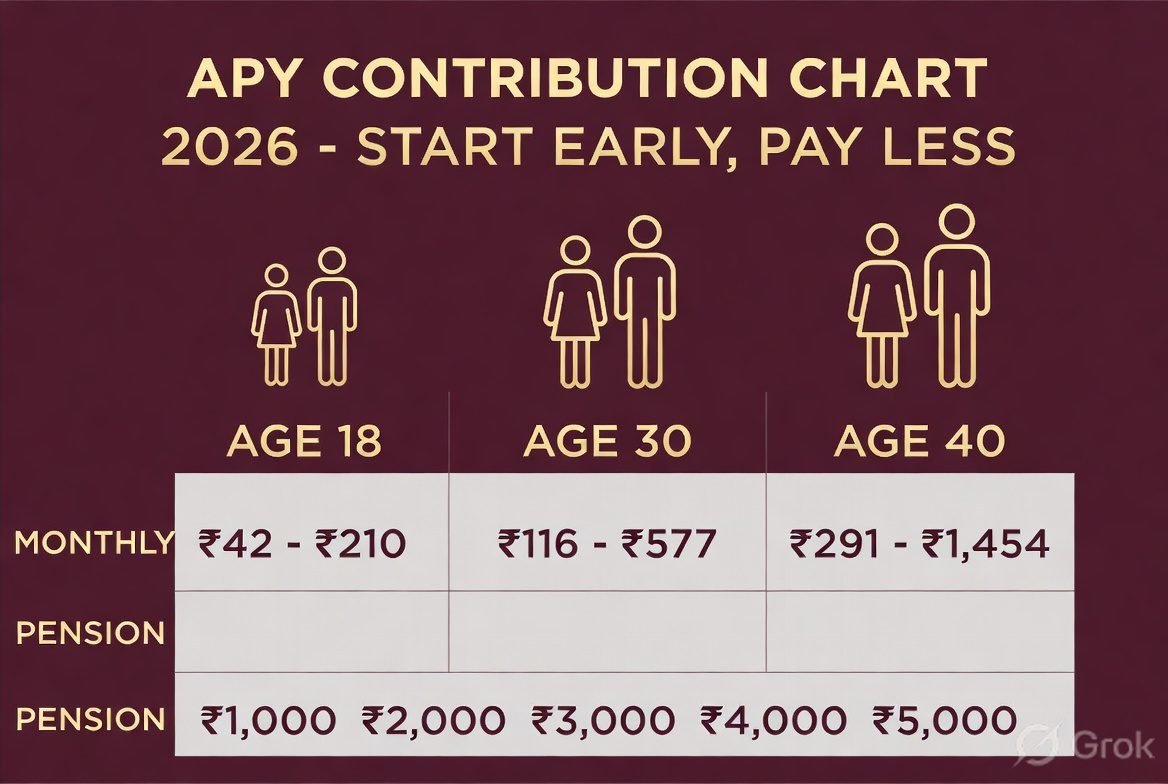
The contribution amount depends on the pension amount chosen — ₹1,000, ₹2,000, ₹3,000, ₹4,000, or ₹5,000 per month — and subscribers contribute until they turn 60 to receive that guaranteed pension.
| Entry Age | For ₹1,000/mo Pension | For ₹5,000/mo Pension |
|---|---|---|
| 18 years | ₹42/month | ₹210/month |
| 30 years | ~₹116/month | ~₹577/month |
| 40 years | ₹291/month | ₹1,454/month |
To receive a monthly fixed pension between ₹1,000 and ₹5,000 after retirement, a subscriber joining at age 18 needs to contribute only ₹42 to ₹210 per month. A subscriber starting at age 40 for the same pension amount needs a far higher contribution — between ₹291 and ₹1,454 per month. That gap is the entire logic of the scheme in one sentence: the earlier you join, the dramatically less you pay for the same guaranteed outcome, since your money has decades longer to be invested before the pension payouts begin.
Once enrolled, changing the pension amount isn't allowed — only the frequency of contribution payments (monthly, quarterly, or half-yearly) can be changed. This makes the initial choice of pension slab genuinely important to think through carefully rather than adjust later, unlike more flexible instruments like SIP contributions where you can typically increase or decrease the amount over time.
The 2022 Tax Payer Exclusion Rule
This rule trips up a genuine number of people who assume APY is a general tax-saving instrument like PPF or ELSS. Since October 1, 2022, any individual who is or has been an income tax payer is no longer eligible to join APY — a rule designed to keep the scheme focused on lower-income groups who lack formal social security.
If you're a salaried professional reading this and wondering whether APY fits into your own retirement plan, the honest answer is usually no — you're better served by NPS, EPF, or PPF, all of which we've covered in depth and which don't carry this taxpayer restriction. Where APY genuinely matters for most of our readers is as information worth sharing with parents, household staff, or extended family members who are in the unorganised sector and don't have access to these other options.
The 2026 Extension to FY 2030-31
The Union Cabinet approved the extension of Atal Pension Yojana on January 21, 2026, continuing retirement-focused financial inclusion efforts. The scheme remains active in 2026, with government funding support continuing through FY 2030-31.
This extension matters because it confirms the government's continued commitment to funding the scheme's guarantee — a genuinely important detail for a product whose entire value proposition rests on that guarantee holding for decades into the future. Official confirmation and updates on scheme continuity are published through the PFRDA's official website and Press Information Bureau releases.
What Happens If the Subscriber Dies Before 60
In case of the subscriber's death, the spouse can continue receiving the pension. If the subscriber dies before age 60, the accumulated corpus is given to the spouse, who can choose to continue the scheme or exit it. After the death of both the subscriber and spouse, the nominee receives the corpus.
This spouse-continuation feature is genuinely more generous than many people assume when they first hear about APY — it means the family protection built into the scheme extends meaningfully beyond just the original subscriber, which is particularly relevant for the single-income households APY is often designed to serve.
Missed Payments and Penalties
If you miss APY contributions, a small penalty ranging from ₹1 to ₹10 per month, depending on the contribution amount, is charged until the dues are paid. This penalty structure is deliberately modest compared to penalties on many private financial products, reflecting the scheme's design for genuinely low and irregular income earners who may occasionally miss a payment cycle.
APY vs NPS: Which One Actually Applies to You
| Feature | Atal Pension Yojana | NPS |
|---|---|---|
| Pension Type | Guaranteed, fixed amount | Market-linked, no guarantee |
| Target Audience | Unorganised sector, low income | All citizens, including salaried |
| Income Tax Payers | Not eligible since Oct 2022 | Eligible |
| Age Limit to Join | 18–40 years | 18–70 years |
| Extra Tax Deduction | 80C only | 80C + extra ₹50,000 under 80CCD(1B) |
The core distinction is straightforward: Atal Pension Yojana offers a guaranteed pension based on your contribution and age, while the National Pension System provides market-linked returns with no guaranteed pension amount. If you're eligible for both based on income and haven't crossed the tax-payer threshold, the guaranteed nature of APY's payout is a genuinely different risk profile than NPS's equity-linked growth potential — worth reading our full NPS guide to understand that trade-off in more depth.
Compare: EPF vs NPS vs PPF →How to Apply
Applying for APY is genuinely simple and typically doesn't require a visit beyond your existing bank branch. You'll need an active savings account, Aadhaar linkage, and a registered mobile number. The bank performs Aadhaar authentication through UIDAI e-KYC, and physical verification is generally waived if e-KYC succeeds. Most major banks also offer APY enrollment through net banking, and the official eNPS portal provides digital enrollment options as well.
Frequently Asked Questions
Who is eligible for Atal Pension Yojana?
Indian citizens aged 18-40 with an active savings bank account can join, provided they aren't already enrolled in similar schemes like EPF or PPF, and haven't been an income tax payer since October 1, 2022.
How much does Atal Pension Yojana cost per month?
Contributions range from ₹42 to ₹1,454 per month depending on your entry age and the pension amount chosen (₹1,000 to ₹5,000), with earlier enrollment resulting in significantly lower monthly contributions.
Can income tax payers join Atal Pension Yojana?
No. Since October 1, 2022, any individual who is or has been an income tax payer is not eligible for fresh APY applications.
What happens to Atal Pension Yojana if the subscriber dies before 60?
The spouse can continue receiving the pension or exit and receive the accumulated corpus. After the death of both the subscriber and spouse, the nominee receives the corpus.
Is Atal Pension Yojana still active in 2026?
Yes. The Union Cabinet approved the extension of APY on January 21, 2026, with government funding support continuing through FY 2030-31.
What is the difference between Atal Pension Yojana and NPS?
APY offers a guaranteed, fixed pension amount and is restricted to non-taxpayers aged 18-40, primarily targeting the unorganised sector. NPS offers market-linked returns with no fixed guarantee and is open to all citizens aged 18-70, including salaried taxpayers.
Our Bottom Line
APY genuinely fills a role that no other scheme on this blog quite covers — a guaranteed, government-backed pension specifically built for people without access to employer retirement benefits or the income headroom for market-linked options. If you're a salaried reader, it's likely not the right fit for your own portfolio given the tax-payer restriction, but it's worth understanding well enough to explain to family members or household staff who genuinely could benefit from it.
For your own retirement planning as a taxpaying individual, our NPS complete guide, EPF vs NPS vs PPF comparison, and retirement calculator are the more directly relevant next reads.

Pranab Barman is a Financial Educator and Personal Finance Researcher with over 10 years of hands-on experience in stock markets, trading, and investing. Currently enrolled in the CFA Program, he is committed to continuous learning and professional excellence in finance.
As the Founder of PlayWithStock, Pranab covers a wide range of topics including Mutual Funds, SIP, Taxation, Stock Market Basics, and Financial Calculators — with a focus on simplifying complex financial concepts for everyday all investors.
Email: support@playwithstock.com
Website: playwithstock.com
Related posts:
 NPS National Pension System 2026: Complete Guide to Rules, Tax Benefits and Withdrawal
 UPS Pension Calculator 2026: The Complete Guide
 ITR Refund Status Kaise Check Kare 2026: The Complete Step-by-Step Guide
 SGB Premature Redemption Calculator 2026: Tax Rules, RBI Dates & Exit Guide
 GST 2.0 for E-commerce Sellers (2026): Complete Guide
 RBI Repo Rate Cut 2026: The Complete Home Loan EMI Guide
 FATF Anti-Fraud Rules 2026: What They Mean for Indian Investors
 SEBI 2026 F&O Rules: 8 Crucial Position Limit Changes Every Trader Must Know