


What Is Sector Rotation? A Simple Guide for Indian Investors
Why do metal and auto stocks suddenly start running while FMCG names sit quietly for months, and then the other way around a year later? There's a name for that pattern, and once you see it, you can't really unsee it in the market.
Sector rotation is simply the tendency of money to move from one part of the stock market to another as the economy moves through its natural ups and downs. It sounds abstract until you watch it happen with your own portfolio — you own a metals stock that quietly triples over eight months while your FMCG holding barely moves, and then a year later the roles reverse completely. That's not random. It's the market doing what it almost always does.
I want to walk through this properly, not just define the term and move on, because understanding sector rotation changes how you read market news. The next time you hear "IT stocks are leading the rally" or "metals are the worst performers this quarter," you'll actually know what that means for where we are in the cycle, and roughly what tends to come next.
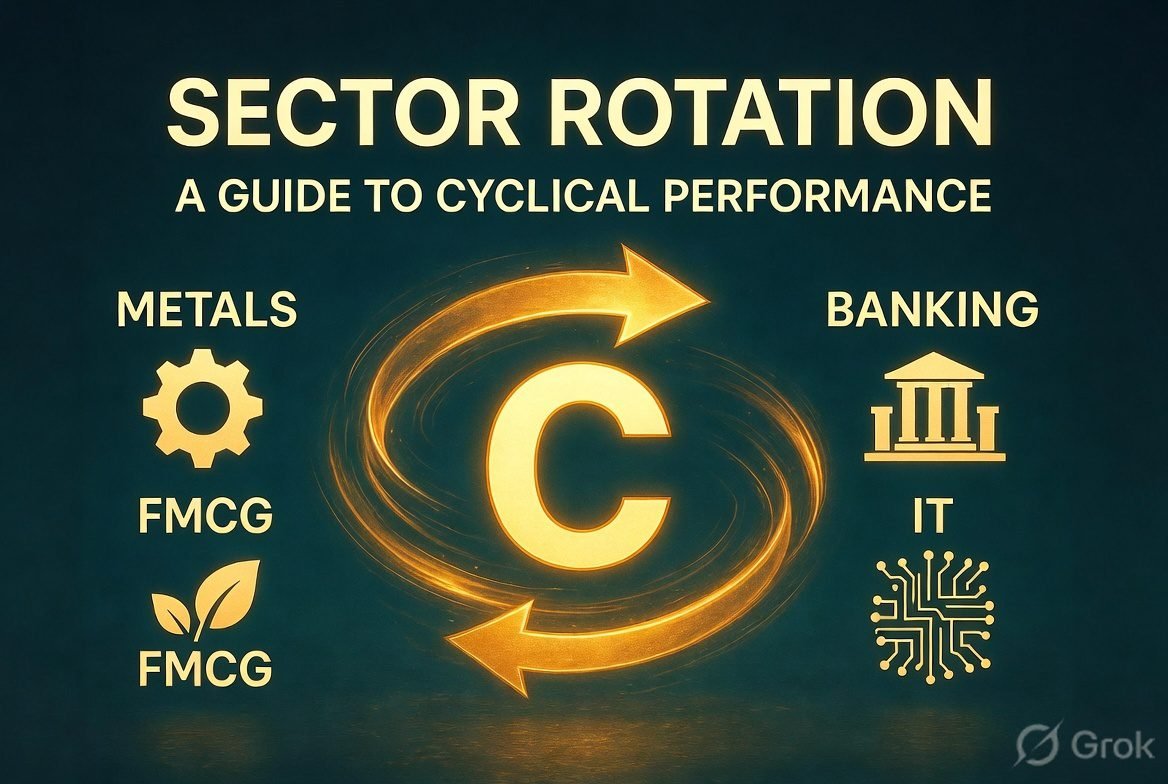
The Basic Idea, Without the Jargon
Think about a party that moves through a house over the course of an evening. Early on, everyone's in the kitchen. A couple hours later the crowd has drifted to the living room. By midnight, half the guests are outside on the porch. Nobody sent a memo telling people to move — it just happens naturally as the mood of the evening shifts.
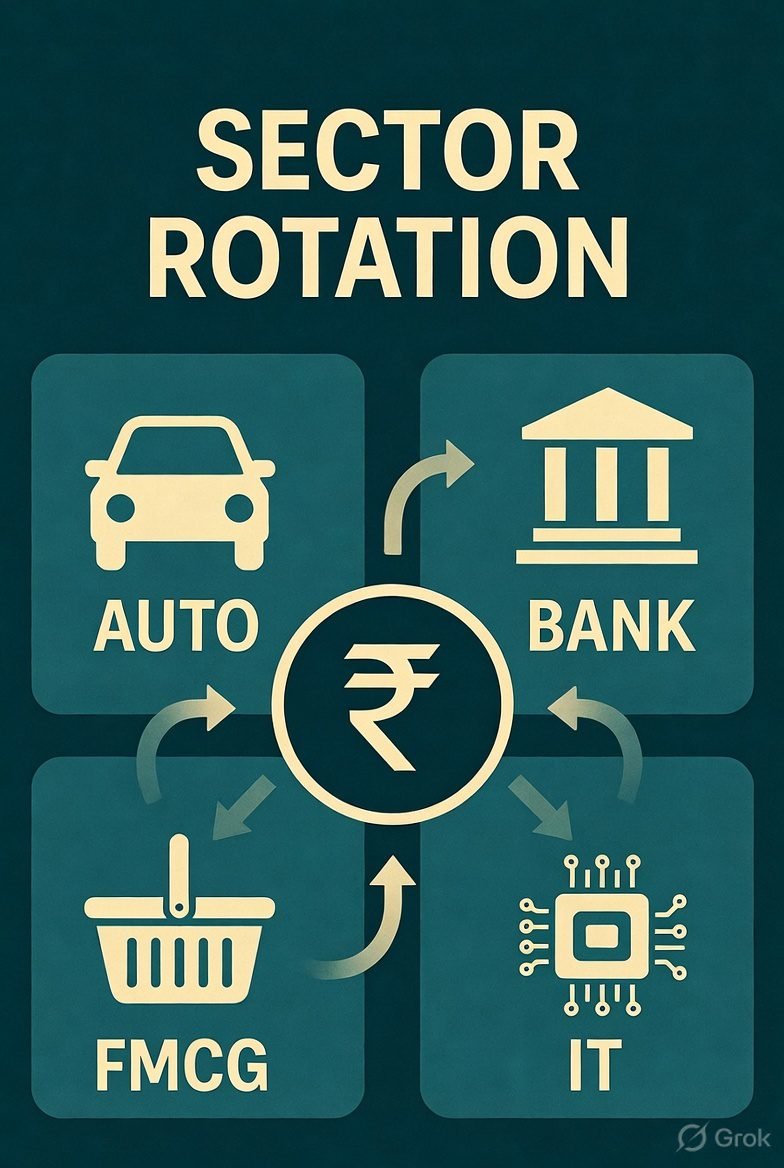
The stock market works a lot like that party. Different sectors — banking, IT, metals, FMCG, pharma, and so on — tend to do well at different points in the economic cycle, and investors, sensing this, gradually move their money from the sectors that have already had their moment toward the ones that are about to have theirs. Sector rotation is just the name for that ongoing drift of money.
It matters because the same broad market can be flat overall while completely different things are happening underneath the surface. Nifty might be up 2% for the quarter, and that number alone tells you almost nothing — it could be that IT rallied 15% while metals fell 10%, or the reverse. Sector rotation is the lens that shows you what's actually going on beneath a single index number.
The Four Phases, and Who Tends to Win Each One
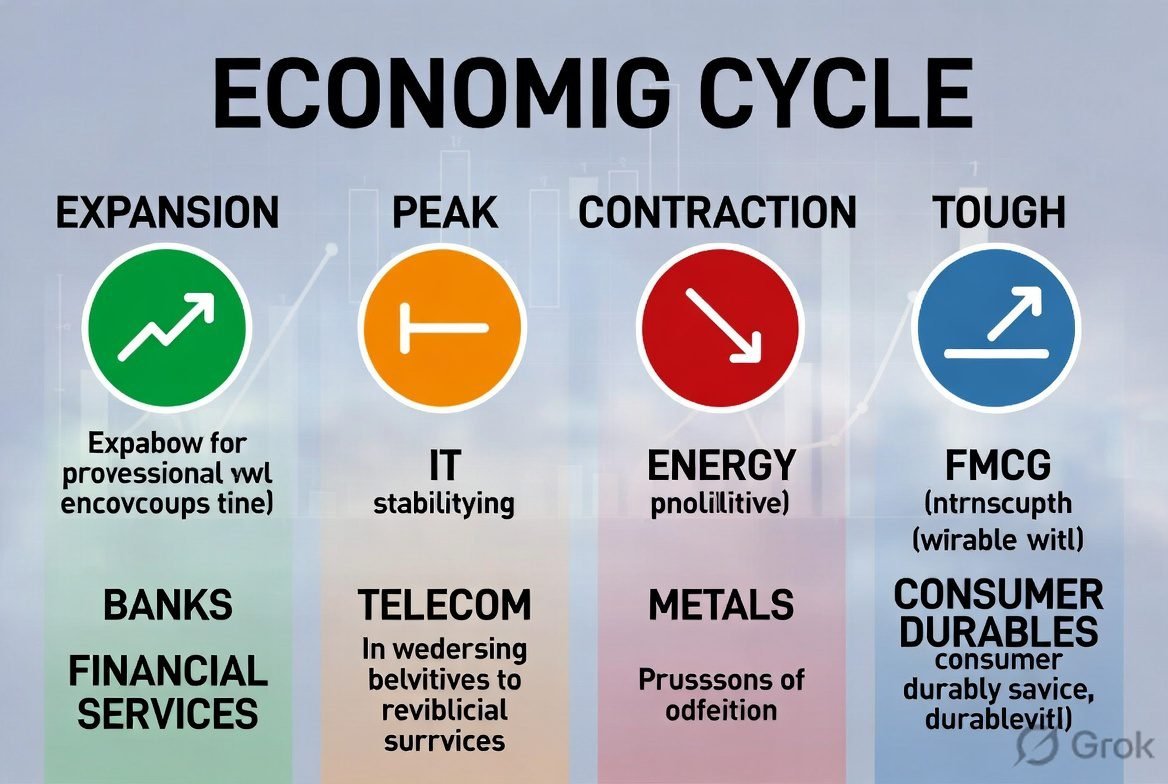
Economists generally describe the business cycle in four stages, and each one tends to have its own favourite sectors. This isn't a rigid law — real markets are messier than any textbook diagram — but it's a genuinely useful map more often than not.
| Phase | What's happening economically | Sectors that tend to lead |
|---|---|---|
| Expansion | GDP growth accelerating, credit flowing, confidence rising | Banks, industrials, real estate |
| Peak | Growth still strong but starting to plateau, inflation creeping up | Technology, healthcare |
| Contraction | Demand slowing, rates possibly rising, sentiment turning cautious | Energy, commodities (early), then defensives take over |
| Trough | Growth at its weakest, but the ground is being laid for the next expansion | FMCG, utilities, pharma — sectors people need regardless of the economy |
I'd add a caveat here that most explainers skip: these four phases don't arrive on a neat schedule, and a sector "leading" doesn't mean every stock in it goes up. Within banking during an expansion, the well-run lenders with strong loan books outperform, and the weaker ones can still struggle. The framework tells you where to look, not what to buy blindly.
What's Actually Happening in Indian Markets Right Now
This isn't just theory — it's visible in the 2026 data if you know where to look. Over the trailing nine months, metals have been the standout performer in Indian markets, driven by a mix of global tailwinds in copper, nickel, and zinc prices, along with domestic anti-dumping duties on Chinese steel that have kept margins healthy for Indian producers. Auto has run almost as hard, helped along by GST rate cuts on several vehicle categories and a genuine surge in EV adoption following government incentive schemes.
Sector performance, roughly year-to-date (2026)
Approximate figures drawn from sector-level commentary through mid-2026. Individual stock performance within each sector varies considerably — this reflects broad sector trends, not a guarantee for any single company.
Meanwhile FMCG has genuinely lagged this year. There's a "rural revival" story that keeps getting mentioned in market commentary, tied to a good monsoon season, but the sector's biggest names are still adjusting to a real shift in how people shop — quick-commerce apps and private-label products have eaten into the market share that traditional FMCG giants used to take for granted. That's not a temporary blip investors should just wait out; it looks more like a structural change in the sector's growth story.
The playbook that's worked for a lot of Indian fund managers this year has been simple to describe and hard to execute well: stay overweight metals as long as global industrial demand holds, and focus on quality names within banking and IT rather than the sector broadly.

Bank Nifty and infrastructure have both outperformed the broader index this year too, though more modestly than metals or auto, since the market has already priced in a good chunk of the cumulative repo rate cuts seen through 2025. When a good outcome is widely expected, the stock price often reflects that expectation well before the actual news arrives — which is itself a useful thing to understand about how markets work generally, not just about sector rotation specifically.
Why This Actually Happens
It's worth spending a moment on the mechanics, because "the economy changes and sectors change with it" is true but doesn't fully explain why it works this way.
Interest rates are probably the single biggest lever. When rates are low and expected to stay low, borrowing is cheap, which helps sectors that depend heavily on credit — real estate, banking, and capital-intensive industrials all benefit. When rates start rising, or the market expects them to, that credit-sensitive advantage fades, and money tends to drift toward sectors that don't need cheap financing to grow, like technology and healthcare, where the value comes more from intellectual property and services than from large capital outlays.
Consumer behaviour plays a role too, and India's demographic story matters specifically here. A young, growing middle class with rising disposable income makes consumption-linked sectors — FMCG, retail, autos — genuinely cyclical and demand-driven in a way that's a bit more pronounced than in some slower-growing, older economies.
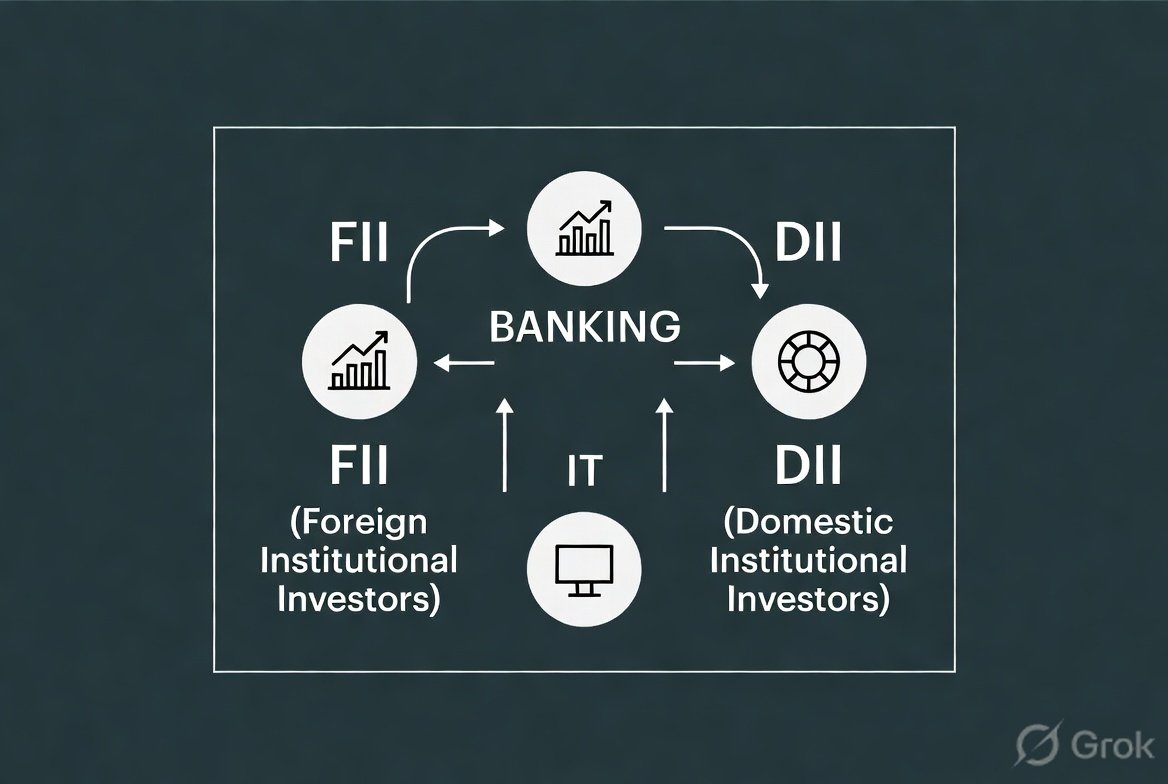
And then there's simple capital flow. Foreign Institutional Investors and Domestic Institutional Investors between them move enormous sums of money, and when either group decides to shift allocation away from one sector and into another, that flow itself becomes a force that pushes prices, sometimes well beyond what the underlying fundamentals alone would justify in the short term.
A Short History Lesson, Because Patterns Repeat
India's market history actually makes this easier to see than most theoretical explanations do. In the late 1990s and early 2000s, capital rotated hard out of traditional industries like steel and cement and into technology, riding the early internet boom and Y2K-related IT spending — it's the period that turned Infosys, Wipro, and TCS from domestic companies into genuine global players.
A few years later, between roughly 2003 and 2008, the story flipped. Strong GDP growth, easy credit, and a government push on infrastructure spending sent money rotating into construction, real estate, and power — sectors that had been quiet during the IT-led years suddenly became the market's favourites.
More recently, between 2021 and 2024, PSU stocks, defence, and capex-linked names led the market, a rotation tied to renewed government focus on domestic manufacturing and defence self-reliance. None of these rotations were obvious in advance to most retail investors — they're much easier to spot looking backward than they were to predict looking forward, which is a genuinely important honesty to keep in mind before assuming you can time the next one perfectly.
How to Actually Use This as an Investor
I don't think sector rotation is something most retail investors should try to trade aggressively — jumping in and out of sectors based on short-term momentum is a strategy that looks great in hindsight and is genuinely difficult to execute in real time, even for professionals. But understanding it changes a few things about how you might approach your own portfolio.
- Diversify across the cycle, not just across companies. Owning five great stocks that are all in the same sector isn't real diversification if that sector is about to enter its weak phase.
- Read sector-level news with the cycle in mind. When you hear metals or energy are running hot, ask where that fits in the broader cycle rather than just chasing the momentum.
- Use rotation to understand your existing holdings, not just to pick new ones. If your portfolio is heavy in one sector that's clearly late in its run, that's useful information even if you decide to do nothing about it.
- Favour quality within a leading sector over the sector broadly. As the 2026 example shows, "metals are up" doesn't mean every metals stock deserves your money — the companies with genuinely strong balance sheets tend to hold their gains better when the rotation eventually turns.
- Don't try to catch the exact top or bottom of a rotation. Sectors rarely announce their peak in advance, and by the time it's obvious a rotation has happened, a meaningful part of the move has usually already occurred.
If you're still building your foundation before layering on a sector-level view, our beginner investing guide and our explainer on the stock market's basic mechanics are worth reading first — sector rotation is more useful once the fundamentals of how the market itself works are solid.
Where People Go Wrong With This
The most common mistake I see is treating sector rotation like a precise timing tool rather than a general map. It tells you the terrain, not the exact moment to move. People who try to rotate their entire portfolio the instant a sector shows the first sign of strength often end up chasing a move that's already substantially played out.
The second mistake is assuming every economic cycle looks like the last one. The specific sectors that lead an expansion can differ meaningfully between cycles depending on what's actually driving growth — this cycle's expansion has been shaped by GST reforms and global commodity tailwinds in a way that's genuinely different from the credit-driven infrastructure boom of the mid-2000s.
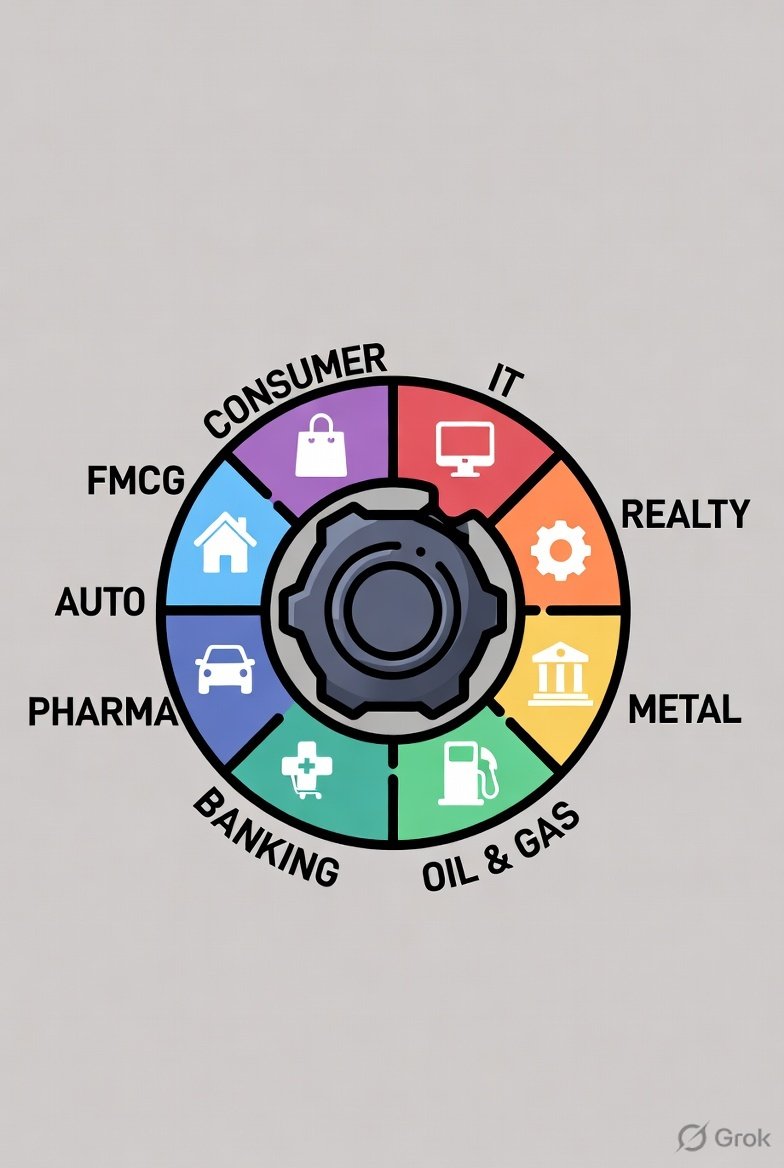
And the third, probably the most costly mistake, is ignoring rotation entirely and treating every stock purely on its individual merits with no regard for what sector it sits in or where that sector is in its cycle. A genuinely good company can still underperform for a couple of years simply because it's sitting in a sector that's out of favour — that's not the company's fault, but it's your money either way, and it's worth knowing the difference between a bad company and a good company in a bad moment for its sector.
Questions People Ask
What is sector rotation in simple terms?
Sector rotation is the tendency of investment capital to move from one industry sector to another as the economy moves through its natural cycle of growth, slowdown, and recovery, with different sectors performing best at different points in that cycle.
Which sectors are leading the Indian market in 2026?
Metals and auto have been the strongest performers through much of 2026, helped by global commodity tailwinds, anti-dumping duties on steel, GST rate cuts on vehicles, and rising EV adoption. FMCG has lagged, partly due to a structural shift toward quick-commerce and private-label products.
Can a beginner actually use sector rotation to invest?
Yes, though mainly as a framework for understanding diversification and reading market news, rather than a precise timing tool. Beginners generally get more value from using it to avoid over-concentration in a single sector than from trying to actively trade rotations.
How long does a typical sector rotation cycle last?
There's no fixed timeline — cycles have historically lasted anywhere from a couple of years to the better part of a decade, depending on what's driving the underlying economic cycle. India's IT-led rotation in the early 2000s and the infrastructure-led rotation of 2003-2008 both played out over multi-year periods.
Is sector rotation the same as sector rotation strategy in trading?
Sector rotation describes the underlying market phenomenon, while a sector rotation strategy refers to a more active investing approach that deliberately shifts portfolio allocation between sectors to try to capture that pattern. The strategy version requires more active management and carries higher transaction and timing risk than simply being aware of the phenomenon.
What causes a sector to fall out of favour?
A combination of factors typically drives this: rising interest rates making the sector's business model less attractive, slowing demand in its underlying market, a structural shift in consumer or industry behaviour, or simply capital flowing toward sectors perceived to offer better near-term growth.
Sources
- Lemonn — How to Do Sector Rotation in Indian Stock Market
- CMT Association — Sector Rotation Within the Indian Market
- Goodwill's Blog — What Is Sector Rotation in Indian Markets
- Monarch Networth Capital — Sectoral Momentum in India
- Bajaj Finserv Markets — Sector Rotation in Stock Market
- Investing.com India — Sector Rotation Intensifies, 2026
- NSE India — Sectoral Indices

Pranab Barman is a Financial Educator and Personal Finance Researcher with over 10 years of hands-on experience in stock markets, trading, and investing. Currently enrolled in the CFA Program, he is committed to continuous learning and professional excellence in finance.
As the Founder of PlayWithStock, Pranab covers a wide range of topics including Mutual Funds, SIP, Taxation, Stock Market Basics, and Financial Calculators — with a focus on simplifying complex financial concepts for everyday all investors.
Email: support@playwithstock.com
Website: playwithstock.com
Related posts:
 Stocks to Buy After India-US Trade Deal 2026: A Sector-by-Sector Breakdown
 Gold Price Correction 2026: What It Means for Indian Investors
 FATF Anti-Fraud Rules 2026: What They Mean for Indian Investors
 Why Investors Lose Money: 7 Costly Mistakes to Avoid
 What Is a Bonus Share? The Complete Beginner’s Guide
 India Crypto Tax Notices: 44,000 Investors Just Got a Letter
 Indian Bank Q1 FY27 Results: Preview, Estimates & What to Expect Today
 H-1B $100K Visa Fee — Indian IT Stocks Pe Impact (2026 Update)